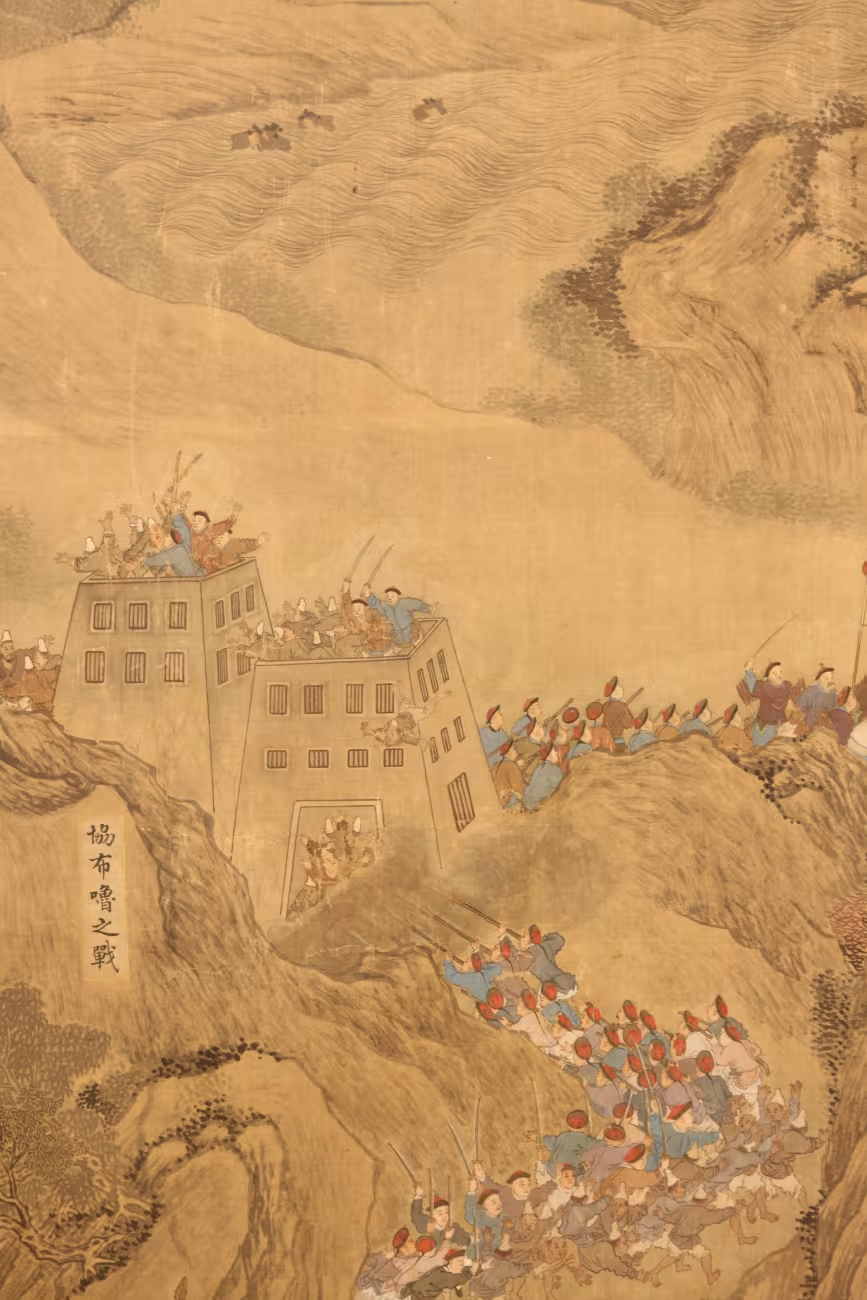
‘A Yam between Two Rocks’: Transcultural Histories of Nepal’s Relations with India, China, and Tibet
Conference
In his political testament, Divyopadeśa (c. 1774), King Pṛthvīnārāyaṇa Śāha poignantly likened Nepal's geopolitical position, wedged between China and India, to that of a “Yam between two rocks” (duī ḍhuṅgāko tarula). This metaphor underscores the intrinsic link between Nepal's political destiny and its neighbors—a sentiment echoed by political analysts and decision-makers to this day. However, within the same text occurs another famous phrase — that of Nepal as the “true Hindustan” (asala hindustāna). In demarcation to colonized India, this self-representation upholds Hinduism’s central role for the polity, observes the Brahmanical caste order, and zealously restricts foreign influence.
It is this notion of Nepal as the “true Hindustan” that has shaped the country's image as a “fossil” (Mary Des Chene), offering tourists an authentic glimpse into Indian culture and researchers an opportunity to study an India in the making (“Le Népal, c'est l'Inde qui se fait”, Sylvain Lévi). The conference takes these tensions as a point of departure to delve into the historical, political, cultural, and intellectual connections between Nepal and the world, especially India, China, and Tibet. Moreover, it seeks to explore moments of conflict, seclusion, and the restriction of exchange resulting from complex entanglements. By investigating the potential of transculturality in understanding specific aspects of Nepal’s non-colonized history, the conference simultaneously honors Professor Axel Michaels on the occasion of his 75th birthday. It critically engages with a key term in his scholarly oeuvre, inviting reflection on Nepal’s dynamic relationships with neighboring regions in the past and present.
Date : 27-28 mai 2024
Conférence de l'Académie des sciences et des lettres de Heidelberg, Unité de recherche « Documents sur l’histoire de la religion et du droit au Népal prémoderne » et « Projet de documentation du patrimoine népalais »
Lieu : Académie des sciences et des lettres de Heidelberg / Centre d’études asiatiques et transculturelles, Université de Heidelberg / Musée d’anthropologie, Fondation J.u. E. von Portheim
Contact : Lara Basile (lara.basile@hcts.uni-heidelberg.de), Simon Cubelic (simon.cubelic@hadw-bw.de)
Programme (lien interne)