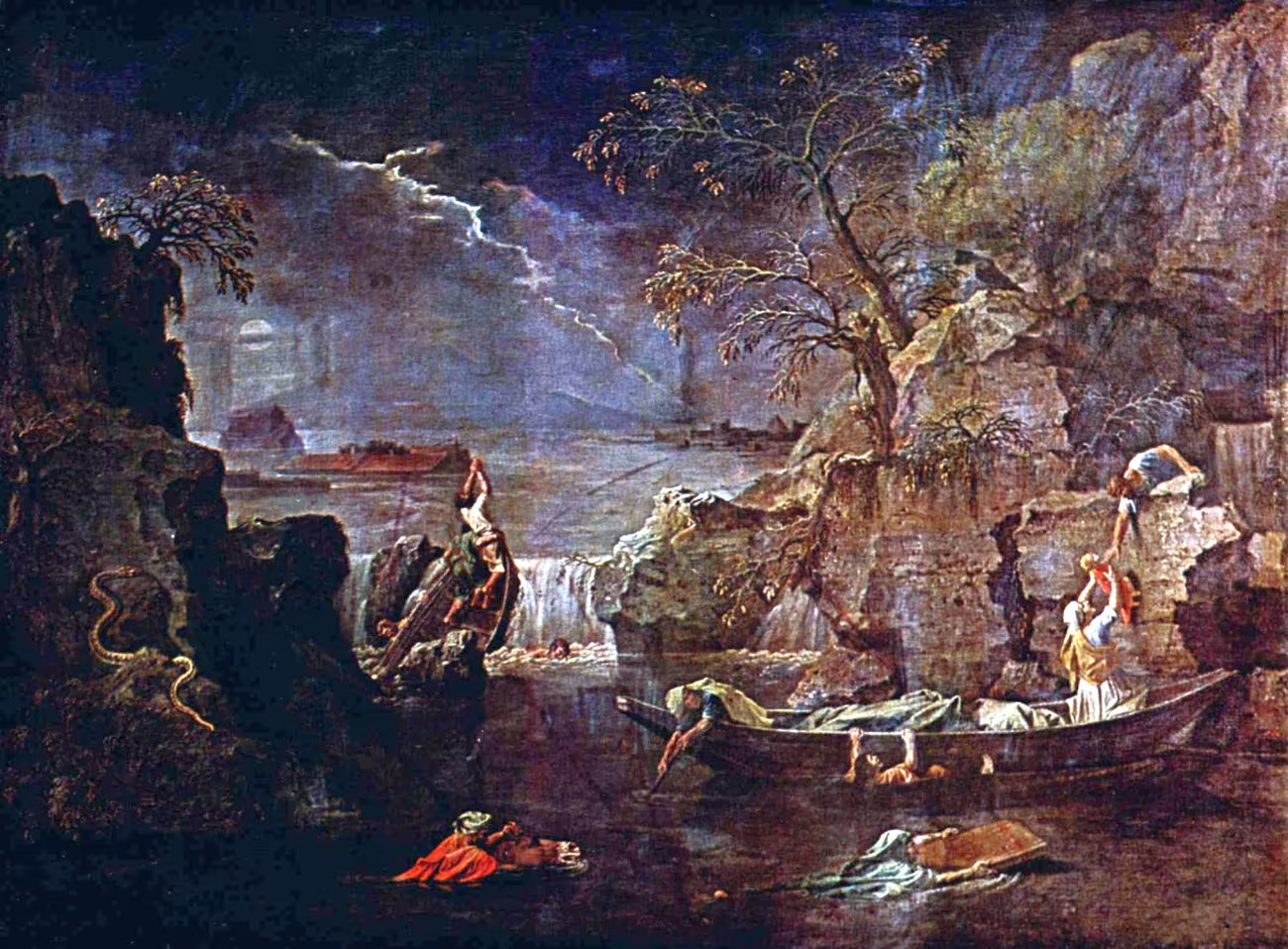
Ruperto Carola Lecture Series - Henry Keazor: Nicolas Poussin’s “Four Seasons” and Their Modern Interpretations
External Event Organized by an Academy Member The current Ruperto Carola lecture series stems from the “Academy for Future” climate crisis working group at HAdW and the “Worldmaking Kolleg” (CREATIO Workshop) and is organized by Academy member Barbara Mittler.
Lecture as part of the Ruperto Carola Lecture Series by Academy Member Prof. Dr. Henry Keazor (Institute for European Art History, University of Heidelberg)
Against the backdrop of the climate crisis, war, a pandemic, and a radically changing world order, the question of the tension between endings and beginnings seems highly relevant. To what extent do catastrophes and crises not only pose a potential threat but can also mark the beginning of radical metamorphoses and new world models? How can we understand catastrophe as an opportunity—as a chance for a new beginning, for the reemergence of a different creation story? The questions posed by the Ruperto Carola lecture series touch upon our shared experiences across generations and cultures and serve as a starting point for bringing together—in various event formats (lectures, panel discussions, concerts, readings, and film screenings)— to bring scholars, public figures, and artists into dialogue with one another and with a broad audience.
About the lecture: From the End to the Beginning? Nicolas Poussin’s “Four Seasons” and its modern interpretations
Contrary to what the title of the four paintings—commonly used today—might suggest, Nicolas Poussin’s “Four Seasons,” painted between 1660 and 1664, are by no means simple depictions of a natural cycle. Rather, the artist combines various cycles—such as times of day and seasons, but also historical eras—and illustrates them through episodes from the Old Testament. Since these episodes were not selected according to the narrative chronology of the Bible, the cyclical elements of the passage of time overlapped with the leaps and breaks dictated by the biblical stories. The result is a highly complex temporal structure in which beginning and end repeat themselves in a linear progression of human history. This paper traces this process, suggests possible interpretations, and then discusses selected modern interpretations of Poussin’s “Seasons” in art and music.
Further information and program: www.uni-heidelberg.de/de/transfer/kommunikation/ruperto-carola-ringvorlesung
PLEASE NOTE: THE TIME LISTED IN THE iCAL DOWNLOAD IS CURRENTLY INCORRECT. PLEASE CHECK THE RESPECTIVE EVENT PAGES FOR THE EVENT TIMES.
Date: January 30, 2023
Location: Auditorium of the New University, Universitätsplatz 1, 69117 Heidelberg
Start time: 7:30 p.m.