January 14, 2026
Digital collection of basic vocabularies for approximately 1,500 languages of the world
New Academy Project "Global Basic Lexicon"
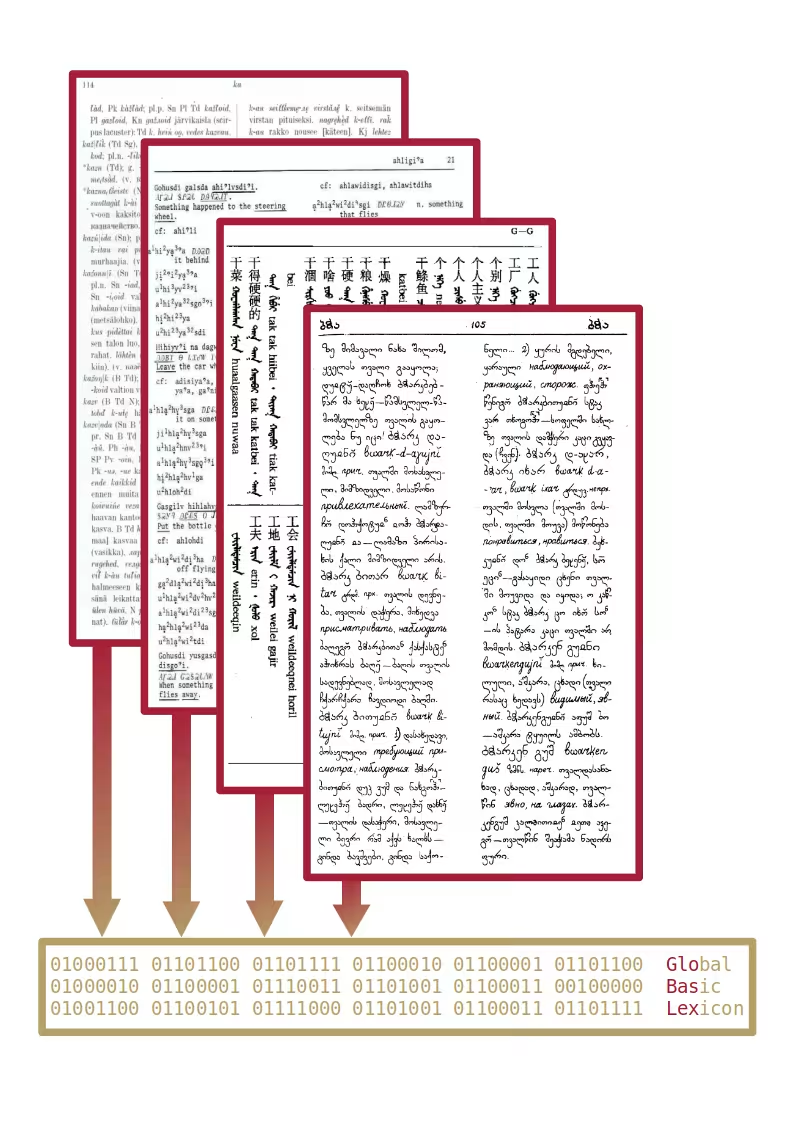
The Academy project “Global Basic Lexicon (GloBasLex)” is creating a freely accessible digital database that provides a uniformly compiled basic vocabulary for approximately 1,500 languages*. The project, scheduled to run for 15 years and funded with 520,000 euros annually, was approved by the Joint Science Conference (GWK) of the federal and state governments and included in the Academies Program for funding.
The project has a clear goal: to create a freely accessible, digital collection of basic vocabularies for approximately 1,500 languages of the world. For each of these languages, 1,000 basic terms will be recorded. In addition to a standardized phonetic transcription, the database will also contain information on how the words are structured. This will make it easier to look up words and analyze them statistically.
The data is intended not only to provide a more reliable foundation for linguistic typology research but also to create an important basis for data-driven historical linguistics. This will enable new insights to be gained into many previously under-researched language families and regions.
Furthermore, the GloBasLex database is also valuable for other academic disciplines, such as cognitive science, archaeology, or genetics, which compare their own research findings with linguistic patterns.
For the general public, GloBasLex will be available as an online language atlas. It is intended to spark fascination with the world’s linguistic diversity—a diversity that is increasingly under threat—and to raise awareness of smaller languages, thereby preserving an important part of our cultural heritage.
The project of the Heidelberg Academy of Sciences and Humanities will begin in 2026, run for 15 years, and be led by Prof. Dr. Gerhard Jäger in Tübingen.
The joint research program of the German academies of sciences—the Academies Program—aims to explore, preserve, and bring to life our cultural heritage. It is currently the largest research program in the humanities and social sciences in Germany and is unique on an international scale. Since 1979/80, it has been jointly funded by the federal and state governments. Through the editions, dictionaries, and text corpora produced at research projects, the Academies are creating central repositories of knowledge for the future that are available to scholars and the public—increasingly in digital form as well.
* An error had crept into the number of world languages, which has been corrected above.