
2026
2025
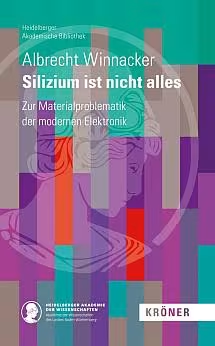
Silizium ist nicht alles. Zur Materialproblematik der modernen Elektronik
Albrecht Winnacker
Heidelberger Akademische Bibliothek
Stuttgart, Alfred Kröner Verlag, 2025
“Silicon Valley” is the birthplace and headquarters of major technology companies such as Apple, Google, and Intel; “silicon technology” is the foundation of major technical innovations, including artificial intelligence, based on the spectacular development of “chips”; there is even talk of the “Silicon Age.” However, this one-sided emphasis on an electronic material does not do justice to the technical reality. While electronic silicon does indeed form the material basis for the key technologies of our time, it is becoming apparent that silicon-based electronics is by no means superior to other solutions in technology fields such as e-mobility, photovoltaics, or high-frequency communications technology; for important applications such as the generation of light for lighting or optical data transmission, it is in fact entirely unsuitable.
This booklet explores the issues surrounding electronic materials in today’s technological landscape under the motto: “Silicon isn’t everything!” (Publisher’s description)
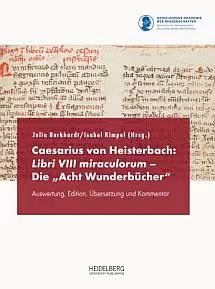
Caesarius of Heisterbach: *Libri VIII miraculorum*—The “Eight Books of Miracles.” Analysis, Edition, Translation, and Commentary.
Julia Burkhardt, Isabel Kimpel (Eds.)
Heidelberg, Heidelberg University Publishing, 2025
The Cistercian monk Caesarius of Heisterbach (ca. 1180–1240) is one of the best-known authors of the Middle Ages. His “Eight Books of Miracles” (Libri VIII miraculorum) are a collection of material intended for instruction, edification, and warning: tales of saints and demons, of people and animals, of small miracles and great misfortunes. In his stories, Caesarius takes the reader on a journey that leads from the Rhineland to the Baltic region and on to Jerusalem. The result is a multifaceted panorama of the political, social, and religious developments of the 13th century.
The new edition of the “Eight Books of Miracles” offers an annotated version of the Latin text, a German translation published for the first time, and an analysis of the work and its manuscript tradition. (Publisher’s description)

Warum alte Texte lesen? Lesen als Mitarbeit am Text
Michael Erler
Heidelberger Akademische Bibliothek
Stuttgart, Alfred Kröner Verlag, 2025
Anyone who studies ancient texts has likely been confronted at some point with the question of the relevance of such reading. Modern philology has given this a great deal of thought. The aim here is to recall that this question was also raised in antiquity—and how it was addressed. This is prompted by more recent evidence from the context of Epicurean philosophy, in which a philological engagement with texts is linked to the claim that one should consider not only the text itself but also the relevance of the reading for its audience. This attitude will puzzle modern philologists. One might be inclined to regard it as yet another distinctive feature of the Epicurean school. Upon closer inspection, however, it proves to be a facet of ancient reading culture that can be traced all the way to the Imperial period and whose characteristics are already discussed to some extent in Plato. This “active” mode of reading also deserves attention because structural elements of ancient texts apparently appeal to this reading attitude and gain definition in light of it. By presupposing and reflecting on the reader’s responsibility for the constitution and interpretation of texts, it provides a historical backdrop for modern positions (“the birth of the reader”) and may also contribute an ancient perspective to the modern debate on utility. (Publisher’s text)
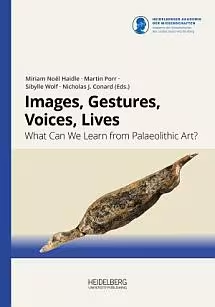
Images, Gestures, Voices, Lives.
What Can We Learn from Paleolithic Art?
Miriam Noël Haidle, Nicholas J. Conard, Sibylle Wolf, Martin Porr (Eds.)
Heidelberg, Heidelberg University Publishing, 2025
The concept of “Paleolithic art” and its study have undergone significant changes in recent decades. The modern concept of “art” is problematic across cultures and over time. The phenomenon cannot be reduced to material visual culture but also encompasses acoustic, haptic, and other dynamic aspects. It must be understood as a diversity of processes that can encompass both the everyday and the extraordinary. In this volume, archaeologists, philosophers, and anthropologists approach “Paleolithic art” from various perspectives, including its conceptualization, aesthetics, and relationships to art history and Art Brut. The contributions address the challenge posed by materiality, evolutionary aspects, physical reenactment by actors, and digital technologies as means of interpreting art objects, as well as the preservation of cultural heritage. The volume offers innovative insights into past practices and contemporary ideas and approaches related to Paleolithic art, based on careful empirical research combined with reflective and sophisticated theoretical approaches.