
Dictionary of Medieval Spanish (DEM)
Duration: 1984 to 2007
The 'Diccionario del español medieval' (DEM) aimed to compile a comprehensive inventory of the entire Old Spanish lexicon, from the earliest attested examples in the 10th century through approximately 1400, including lexicographical processing and a presentation annotated with historical linguistic commentary. It was intended to be the first exhaustive period dictionary of the Spanish language. Beyond Hispanic studies and Romance linguistics, the project’s findings benefit all disciplines that deal with older texts in the Spanish language (literary studies, cultural, legal, social, and general history, philosophy, theology, medieval studies, Medieval Latin, Arabic studies, Jewish studies), or that rely on older language forms as a basis for research (Creole studies, Hispanic American studies), or that require interdisciplinary data from the field of Spanish (research on language contact, interference, and internationalisms, etc.).
The volumes of the dictionary produced as part of this project were published in the form of fascicles. Each volume includes a comprehensive index of word forms as well as an etymological index. Based on well over 600 literary and non-literary works, as well as collections of texts and documents, these volumes cover the historical development of Spanish vocabulary from the 10th century to the early 15th century.
History of the research project
The planned takeover and continuation of the dictionary project by the University of La Laguna (Tenerife, Spain), planned for April 2005, unfortunately could not be carried out in the end due to financial reasons, so the project had to be suspended for the time being in 2007. Thanks to the efforts of Prof. Dr. Jutta Langenbacher-Liebgott and Prof. Dr. Rafael Arnold, as well as funding from the DFG, the project was fortunately able to continue in a modified form from 2016 until October 2022. The DEM (Diccionario del Español Medieval) became the DEMel (Diccionario del Español Medieval electrónico (external link)), which aims to make the research already conducted digitally accessible. In this way, the valuable lexical material on Medieval Spanish—which has been researched and collected over many years as part of the Heidelberg research project—can now continue to be used for scholarly purposes through the DEMel.
On February 14, 2022, following this eventful history of funding, the DEMel was published as an open access database, as also reported in the press release from the University of Rostock (external link) on the occasion of the publication.
In light of the successful publication of DEMel, several events were organized in 2022. At the end of May 2022, Prof. Dr. Rafael Arnold presented the DEMel at the IX Congreso Internacional de Lexicografía Hispánica (La Laguna). In July, Prof. Dr. Langenbacher-Liebgott, together with a Spanish colleague and an Italian colleague, chaired a session at the Congreso Internacional de Lingüística y Filología Románicas (La Laguna) that focused on DEM research. Also in July, an international conference took place at the University of Rostock as part of the DEMel project.
Chair of the Commission:
Prof. Dr. Dr. h.c. mult. Max Pfister
Director of the Research Center:
Prof. Dr. Bodo Müller (1924–2013)
Staff:
- Dr. Eva Güida
- Annette Lattermann, M.A.
- Claudia Nieto-Klotz
- Cristina Morales Kött
Contact
Prof. Dr. Rafael Arnold (external link) is the director of the follow-up project DEMel.
On the DEMel website (external link), you will find extensive information on the history and research of DEM and DEMel.
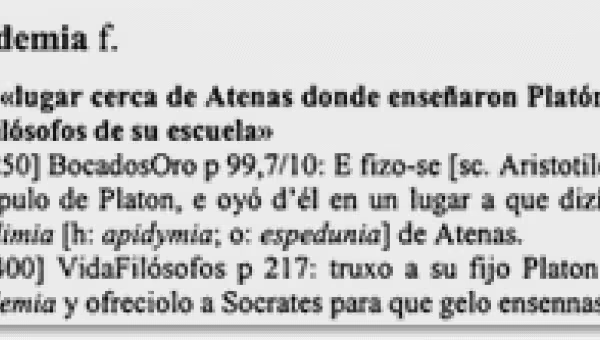
This sample article shows the earliest documented uses of the word "Academy" in Spanish.