
In-Situ Spectroscopy for Reducing Pollutant Emissions
Duration: 1994 to 2003
Diode lasers, which have become widely used in optical communications, also offer fascinating possibilities for rapid in-situ process analysis. At the Institute of Physical Chemistry (PCI) at Heidelberg University, the specific advantages of diode lasers were harnessed for rapid, real-time gas analysis to monitor and control industrial processes aimed at reducing pollutant emissions. Of particular interest in environmental analysis is the sampling-free detection of trace gases in the free atmosphere. For example, water in the stratosphere—an effective greenhouse gas—is presumably produced from methane. To understand the formation and effects of these greenhouse gases, methane and water were measured in the stratosphere at altitudes up to 32 km using a newly developed balloon-borne TDLAS (Tunable Diode Laser Absorption Spectroscopy) spectrometer.
Research Center Director:
Prof. Dr. Jürgen Wolfrum
Researcher:
Dr. Andreas Schulz
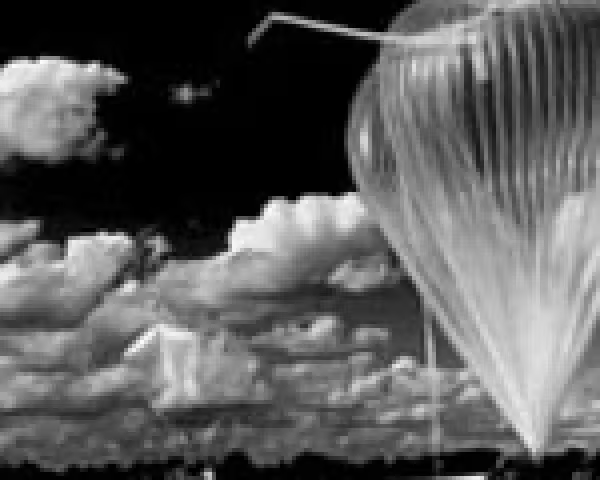
Preparations for the launch of the balloon-borne TDLAS spectrometer in Aire-sur-l’Adour (France).