
Buddhist Stonesutras in China
For the project database, which includes interactive maps, full-text versions of our research publications, transcriptions of the inscriptions, and a character database, please visit
The second half of the 6th century CE represents a significant era for Chinese Buddhism. In 577/578, believers suffered persecution at the hands of the secular Zhou state. At the same time, monks made great strides during this period in translating the Buddha’s scriptures, leading to a completely transformed understanding of his teachings. The religion, which originated in India, was now adapted in many ways to the local tradition. This historical development found expression in unique stone inscriptions. In some cases, the sacred texts were painstakingly carved into the natural rock in characters up to three meters high; in others, inscriptions were integrated into the architectural design of cave temples. With this “network” of stone inscriptions, Chinese Buddhists of that era created what are thus the most culturally and historically significant monuments in northern China.
The mission of this research center, established in 2005, is to provide a complete and systematic documentation of these stone inscriptions, some of which have only been rediscovered in recent years. These inscriptions have survived over the centuries, particularly in the provinces of Shandong, Henan, and Hebei. The scholarly analysis of the historical and biographical information contained in these texts—along with their commentaries—sheds new light on the Sinicization of Buddhism. It is also of particular interest that the texts are embedded in various spatial contexts. They lend the landscape a sacred character: monumental steles proclaim the sacred texts, steep rock faces become places of meditation, and large boulders mark pilgrimage paths leading up the mountains.
The project is based on international collaboration, primarily with Chinese scholars who have been increasingly focusing on questions of religious history again in recent years. In addition, there are close ties to Japanese scholars who are continuing their country’s outstanding tradition of Buddhist studies. In an interdisciplinary effort, researchers from the Department of Geoinformatics at the Karlsruhe University of Applied Sciences (FH) are involved in the project to clarify the topographical context of the carved texts. They are not only creating a master plan of all the inscriptions but also 3D models of the inscription sites, which allow the monuments to be viewed and read on a computer.
In the mid-6th century CE, Chinese Buddhists began to carve their sacred texts into stone. Some worked in the open air on natural rock faces, while others integrated selected scriptures into the iconographic programs of cave temples. These stone sutras served to publicize and disseminate Buddhist teachings among the people. After the persecution of Buddhists in the years 574-577, the idea of preservation gained increasing importance. Influential patrons of Buddhism donated funds to have ever more extensive passages of text carved in stone, thus preserving them for eternity. Finally, monks at the Cloud Dwelling Monastery (Yunju si 雲居寺) near Beijing set out to carve the entire Buddhist canon onto stone slabs to survive the end of the world, which they believed was imminent. The task of this research project is the documentation, interpretation, and presentation of these stone inscriptions.
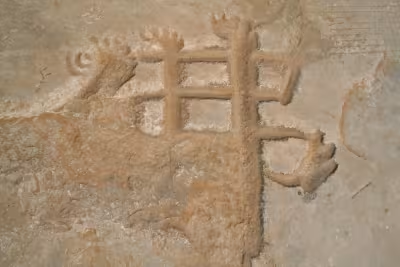
HAdW, Schriftzeichen "Buddha", Berg Ergu, Shandong
Inscriptions on Natural Rock Faces and Cliffs
The first phase of the project, which began in 2005, focused on the documentation of stone inscriptions under the open sky in Shandong province. There, learned monks selected short, significant passages from Buddhist sutras and wrote them in artistic calligraphy directly onto steep rock faces near their monasteries. In a second step, skilled stonemasons carved the up to three-meter-high characters into the rock. These characters have survived to this day. The sacred texts embodied objects of meditation on which the monks concentrated during their spiritual exercises. The deliberate connection between script and stone gives the mountains the character of a sacred landscape.
Examples include Mount Gang, where a continuous text was carved into massive, scattered boulders along a pilgrim path. The aim was to evoke the presence of Buddhas, Bodhisattvas, and sages in a paradisiacal landscape. This place was considered by the faithful to be the true Buddha land. The granite surface of Mount Tie was transformed into gigantic stelae. An entire chapter of a sutra could be inscribed on them in several hundred large-format characters.
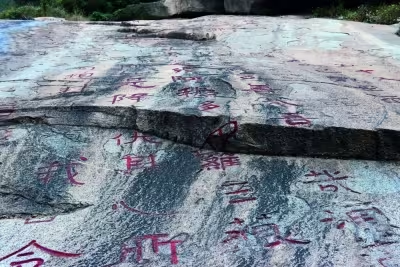
Inschriften auf dem gewachsenen Fels
Inscriptions in Cave Temples
Even longer sutra passages can be found in small-format characters on the inner walls of cave temples. These works of writing are inserted between the sculptures and pictorial groups of the savior figures and thus become part of the religious message about the Dharma (the Buddhist teachings). Such an interweaving of pictorial and non-pictorial representation of religious teachings is rare in world art and of particular epistemological interest.
The Buddhist Canon in Stone at the Cloud Dwelling Monastery
The largest carving project in world history began at the beginning of the 7th century at the Cloud Dwelling Monastery. Initially, texts on stone slabs were also embedded in the walls of a cave here, the so-called "Thunder Sound Cave" (Leiyin dong 雷音洞), which was consecrated in 616 by a relic deposit. Soon thereafter, the monks carved the sacred scriptures only on prefabricated stone slabs. They stored these in caves, which they always sealed with stone doors. Inscriptions outside the caves tell of the monks' fear of the impending end of the world. In the future world age, they hoped, their stones would come to light again as if from a time capsule and proclaim the teachings of the Buddha to future generations.
Methods
Documentation
The primary task of the research center is the systematic and complete documentation of the stone inscriptions. The exact geo-referenced survey makes it possible to understand the inscriptions as objects in space and to recognize the relationships between the inscription groups. In this way, the network of monuments with which the Chinese Buddhists covered and shaped the landscape in that epoch becomes clear for the first time. The photographic documentation includes the carved stones as well as rubbings of the inscriptions with ink and paper. Sometimes, older rubbings show a better state of preservation because the weathering of the stone has progressed in the meantime. Up to 200-year-old transcriptions from the traditional epigraphic Chinese literature are also evaluated if available. The ideal goal is the complete reconstruction of the original text. Translations with detailed scholarly apparatus are also part of the documentation.
Interpretation
Many inscriptions, especially the recently discovered ones, shed new light on the history of Buddhism. There is talk of important Chinese and Indian monks who do not appear in the previously known historical sources. Scientifically relevant questions to the elucidation of which the project will contribute are the practice of confession and meditation rituals, the categorization of apocryphal and canonical texts, and, in general, the political instrumentalization and sinicization of Buddhism in the period in question.
Presentation
In cooperation with scientists from the Faculty of Geoinformation at the Karlsruhe University of Applied Sciences (FH), virtual terrain models and 3D visualizations were created. The processing and evaluation of the collected text and image data go hand in hand with developing a database tailored to the special requirements of Chinese texts and characters. The standards of established Buddhist and Sinological databases and the most modern digitization techniques are used, which consider the complexity of the writing systems in East Asia. The research results are also to be processed and presented in a suitable form for the scientifically interested lay public.
International Cooperation
For some years now, Chinese scholars have been turning their attention increasingly to religious-historical phenomena, as their significance for China's self-image as a cultural nation is being rediscovered. This development greatly benefits the work of the research project. In addition, there are close ties to scholars in Japan who continue the first-class Buddhist tradition of their country. The collection and evaluation of data takes place in close international cooperation. Renowned East Asian researchers and young academics come to Heidelberg to conduct research alongside the project. In doing so, they contribute to the scholarly exchange between Germany and China.