

Cultural Heritage
Duration: 2021–2023
The “Cultural Heritage” working group conducted a critical review and developed an overview of the working methods and opportunities offered by the HAdW’s academy projects with regard to cultural heritage in research. The following perspectives and objectives guided this process:
- Assessment of the current state of affairs
- Discussion and critique of the concept of cultural heritage
- The Academy’s responses to points of criticism
- Perspectives on maximizing the visibility and sustainability of internal Academy research
On June 13, 2022, a report summarizing the findings was presented at the HAdW Executive Board meeting and approved there.
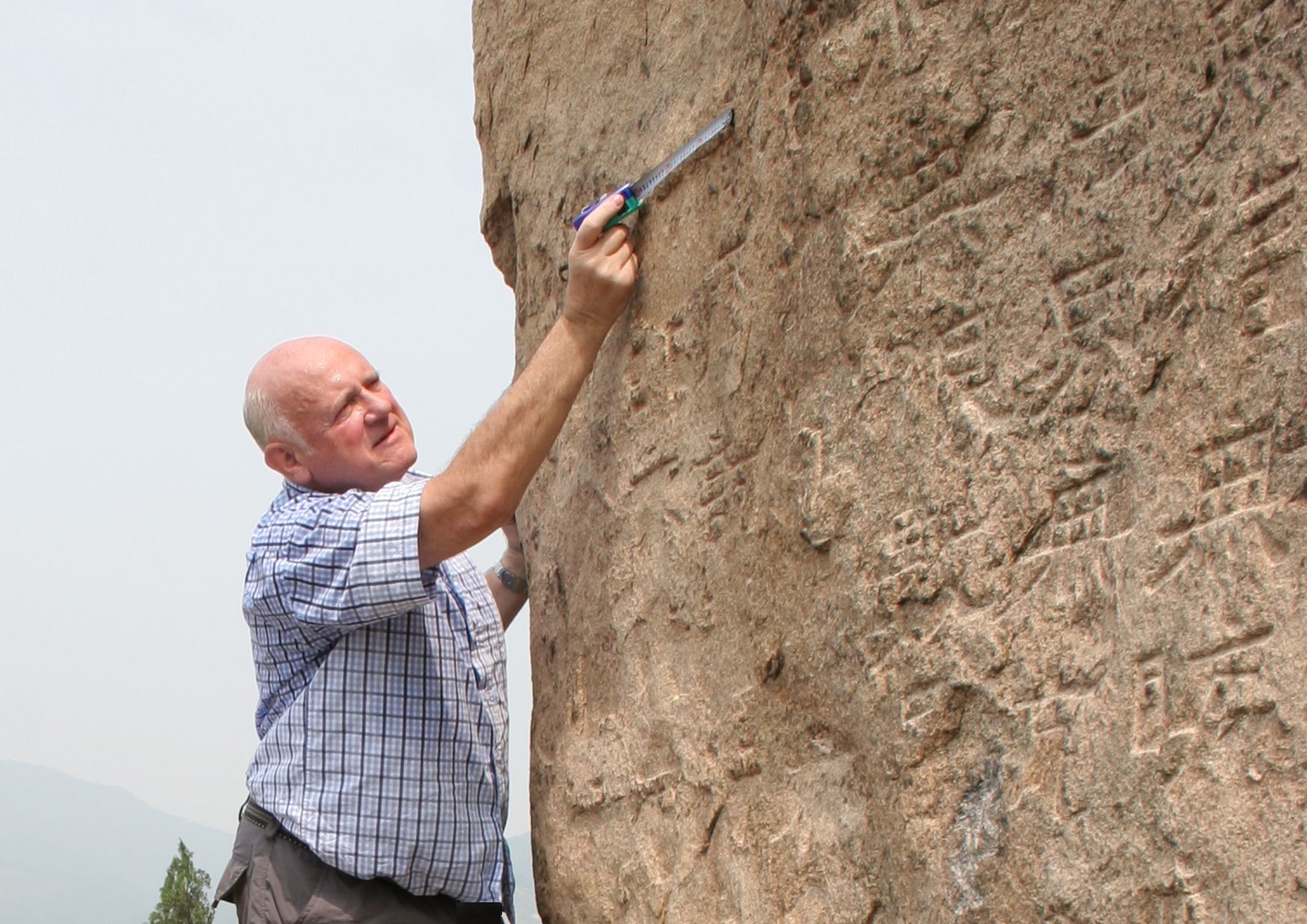
HAdW/Research Project "Buddhist Stone Inscriptions in China"
Working Group Report
The German Academies’ research-based approach to cultural heritage is unique in its breadth and depth, with over 180 research projects worldwide. Through their own competitive and purely science-driven excellence program, the Academies strive to make valuable and rare material, as well as complex subjects, accessible to researchers and the public in a patient, thorough, and sustainable manner. The following principles and objectives guide this effort.
1. State of the Field
The topic of “cultural heritage” is gaining momentum. In 2018, the EU designated the “Year of Cultural Heritage,” degree programs on the subject are emerging; in Germany, there are at least twenty collaborative projects on the topic, as well as UNESCO chairs across Europe. The eight science academies, jointly funded by the federal and state governments, have also made research aimed at preserving cultural heritage a central part of their work. Following a highly competitive selection process, they are cataloging historical resources from various cultures—which have not been studied at all or only in part—through long-term projects, primarily in the humanities and social sciences, lasting an average of 15–20 years, as part of the so-called Academies Program. Approximately 900 employees work in this internationally unique, openly advertised program, which comprises a total of 123 projects across 181 research sites and has an annual budget of approximately 70 million euros. The selection of topics and materials is based solely on the criteria of excellence and academic freedom. Furthermore, cultural heritage is the focus of many scholarly lectures and working groups at the academies.
Like almost all research institutions, the Heidelberg Academy of Sciences and Humanities (HAdW) conducts basic research, sometimes in collaboration with other academies. Among other things, it compiles encyclopedias—notably Das Deutsche Rechtswörterbuch and the Goethe-Woerterbuch—complete works such as those of Karl Jaspers; detailed commentaries on literary works by authors such as Malalas or Nietzsche; extensive editions of correspondence from the early modern period; inscriptions from Buddhist China, European antiquity, or the Middle Ages; literary cuneiform texts from Assyria; premodern documents from Nepal; broad topics such as the spatial and temporal migratory patterns of hominids from 3 million to 20,000 years ago; the structures and functions of temples in ancient Egypt or monasteries in the European High Middle Ages. This foundational work can only be accomplished through patient engagement with the subject matter. What is particularly necessary is the work of cataloging and analyzing fundamental linguistic facts (e.g., in dictionaries) or specific texts relevant to the cultures under study (in critical editions) or concrete sites and material cultural artifacts (in excavation projects and the handling of artifacts)—this is precisely what defines these projects. Such an approach requires a longer time frame that extends beyond the typical duration of project funding—which is usually only a few years—because otherwise the necessary expertise cannot be developed, and thus the goal of thoroughly cataloging large corpora or collections of materials will not be achieved.
Through their engagement with such subjects, the projects—and thus the Academies—therefore make a very specific and, in this respect, indispensable contribution to a genuine understanding of one another in the 21st-century world, both synchronically and diachronically. Indeed, much of what truly constitutes cultural heritage is compiled there in a sustainable manner, presented, and made available for further research. But in this very form, it is not only respected as the heritage of specific groups, but also understood as part of the universal heritage of human civilization(s)—as a unique form of tangible and intangible wealth, as a central repository of knowledge for the future, for academia and the general public, as well as an indispensable contribution to the documentation of humanity’s cultural memory.
2. Points for Discussion
With its focus, however, the Academies Program also finds itself at the center of a growing discussion and criticism of the concept of cultural heritage. On the one hand, there is the vagueness of the term “cultural heritage,” which can encompass almost anything. The UNESCO list alone is extensive. It encompasses objects (e.g., buildings, monuments, artifacts), knowledge (texts, traditional medicine), places (cities, landscapes, historic towns, archaeological sites, ruins, parks, and gardens), and practices (craft techniques, dances, music). Within this diversity, a distinction has also been made since the 1980s between “tangible” (buildings, objects, manuscripts) and “intangible heritage” (festivals, songs, literature, rituals, theater, dances, oral traditions, languages), cultural heritage and natural heritage, and official (state-sanctioned) versus unofficial cultural or natural heritage.
This dramatic increase in definitions and declarations of cultural heritage has led to a particularly significant intrusion of the past into the present. This has given rise to a treasure trove of knowledge of considerable economic significance as well, which—in addition to Academies—includes museums, libraries, monuments, galleries, archives, and digital and analog collections, and which continually leads to new research projects and conferences. Last but not least, cultural heritage is a factor in the attractiveness of locations and tourism.
Of course, these activities themselves are historically conditioned. Prepared by ideas from the Enlightenment and historicism, the concept of cultural heritage emerged in the 18th and, above all, the 19th century alongside many of the institutions mentioned, which are now widespread worldwide. In particular, museums and archives shaped by the nation-state go hand in hand with the methods of typological, geographical, and chronological classification and organization—which are also characteristic of modernity—and to which extensive databases contribute significantly.
This now ubiquitous practice of remembering, collecting, organizing, and preserving historical material is, in its abundance, a phenomenon of modernity. In a certain sense, cultural heritage becomes a mirror of a present that is perceived as fragile. It is rooted in a fear of irrevocable loss, destruction, obliteration, and oblivion—a fear that, according to a widespread understanding, seems to be inherent in modernity due to the constant economic and scientific demands for change and renewal.
The topic of “cultural heritage” thus faces a number of challenges: its broad definition, which makes clear distinctions difficult; the concept of infinite preservation, which, with digitization, leaves little room for forgetting; the Western origins of the concept, coupled with a corresponding understanding of globalization that often disregards non-Western attitudes toward the past; the danger that cultural heritage will be exploited for political purposes, such as in iconoclasm; and the sometimes politically charged question of who cultural heritage actually “belongs” to, which leads to restitution and copyright issues relevant to the Academy.
3. Responses from the Academies
Through its specific focus, the Academies Program addresses these recurring points of criticism. Thus, the HAdW and its sister academies agree with the principle that cultural heritage serves to ask, in the present, what should be preserved for the future from the past. In the broadest sense, this refers to what has been handed down from the past, which continues to exert an influence in the form of “cultural memory” and shapes fundamental patterns of perception and behavior in the present—not least to prevent undesirable developments. In their work, however, the Academies set significantly more specific parameters by focusing on larger bodies of material in order to grasp broader contexts and explore the material in depth. For them, there can be no collecting without scientifically guided, exemplary cataloging that utilizes a variety of methods and possibilities, and without a high—and thus rare—level of expertise. This form of critically exploratory collecting and compilation precludes any claim to completeness.
Furthermore, the Academies do not shy away from the question of who owns cultural heritage. On the contrary, they foster international collaboration, analyze the material together with colleagues from the countries of origin, and thus cultivate a kind of “shared heritage” and “shared scholarship,” in which their own traditions and those of others are explored through international exchange and dialogue. In this way, research is also largely shielded from political or populist influence. In principle, the projects adopt a universal or global (rather than Eurocentric) perspective, which compels an engagement with complex phenomena of entirely different (and, at first glance, foreign) cultures. These cultures remain at a distance from us—spatially, temporally, or normatively. In opposition to culturalist and identitarian tendencies that permit only those who belong to a particular group to engage with such phenomena, the Academy members and project staff seek to explore these phenomena—for themselves and for others—using the tried-and-true methods of science, which are inherently open to innovation. Given the aforementioned distance and the resulting hermeneutic challenges, this also requires perseverance and great patience in dealing with what is at first very foreign or necessarily unknown—upon which, after all, no particular perspective should be imposed.
The long-term projects are thus not “playgrounds” for renowned scientists, but rather emerge from diverse forms of cooperation and are—which is also rather rare in the scientific process— – critically monitored by committees composed of members from other research projects and international experts who bring an informed outside perspective. Furthermore, because the research projects must constantly address questions of cultural and social relevance as part of a rigorous selection and review process, they do not operate on the basis of an intrinsic value of cultural heritage or a naive preservationist dogma. Through the publication of the research findings from the Academy’s projects, cultural heritage often becomes visible and globally accessible for the first time, especially in open digital formats.
4. Perspectives
The long-term projects are working to make their findings available to both the research community and a broader public through the greatest possible visibility and sustainability—for example, through permanently accessible publications and databases of the highest quality.
So if we, as the Academy, insist that we are already fulfilling the demands made of us from various quarters, then we should—especially now (and while acknowledging various shortcomings)—emphasize more clearly that we can tap into the potential inherent in our work even more effectively and make the aforementioned contribution even more efficiently. To this end, we propose:
- to link the various projects and research projects even more closely with one another, particularly in light of the inevitable specialization;
- to digitally network them with one another, both within and between the Academies, while—where possible—breaking down digital silos and seeking interoperable solutions; to keep research results openly accessible even beyond the duration of a project; to create synergies, for example through “Linked Data” and ontologies connected to CIDOC CRM, and/or to make greater use of the possibilities offered by the National Research Data Infrastructure (NFDI) or other consortia;
- to actively involve, in particular, stakeholders from the cultural spheres we study in such networks;
- and, in doing so, to engage in fundamental and current debates and theories regarding the challenges of cultural heritage;
- to continually raise the public profile of our work (and do so even more than we already do);
- and to speak out in particular when our expertise allows for a more appropriate understanding of a specific current (political) situation.
Members of the Working Group
Spokespersons:
- Hans-Joachim Gehrke
- Axel Michaels
Other members:
- Barbara Beßlich
- Peter Eich
- Markus Enders
- Miriam Haidle
- Thomas Holstein
- Lothar Ledderose
- Stefan Maul
- Axel Michaels
- Bernd Schneidmüller
- Florian Steger
- Christoph Strohm
- Dieta Svoboda-Baas
- Sabine Tittel
- Albrecht Winnacker
- Bernhard Zimmermann
Editing of the Final Report
- Hans-Joachim Gehrke (internal link)
- Axel Michaels (internal link)
- Sabine Tittel (internal link)