Encyclopedia of Ancient Cults and Rites (ThesCRA)
Duration: 2000 to 2010
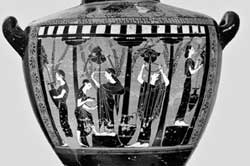
The Thesaurus Cultus et Rituum Antiquorum (ThesCRA) is the first project to systematically catalog ancient sources on the religions and cults of the Greeks, Romans, and Etruscans. This has laid a new foundation for archaeological, cultural, and social-historical research in the field of ancient religion, which has increasingly been recognized in recent times as a fundamental phenomenon of ancient societies. Using an interdisciplinary approach, sources of all types were given equal consideration: works of ancient literature, inscriptions, depictions of cult scenes in the visual arts, as well as finds and findings from excavations—ranging from a single vessel to the plan of an entire sanctuary. The documents and their analysis were published in a thematically organized series of individual volumes. In parallel, an international collaboration established a database that provides significantly more material than the book publication but can only be meaningfully used in conjunction with its accompanying commentary. The project was supported by a total of 38 countries.
The Heidelberg Research Center has produced a volume on ritual instruments and implements, while the Würzburg Research Center, in collaboration with a working group in Perugia, has compiled a two-volume set on sanctuaries and places of worship. For the concluding volumes, which provide a synthesis of the functions of ancient religion, the German working groups prepared contributions on the cults associated with the stages of life, social groups, and public life. In addition, the research centers in Heidelberg and Würzburg contributed to the database by entering all the evidence they had collected for their contributions.
Chair of the Commission
Prof. Dr. Stefan Maul
Director of the Research Center
Prof. Dr. Tonio Hölscher
Staff Members
- Prof. Dr. Ingrid Krauskopf (Heidelberg),
- Dr. Anneliese Kossatz-Deißmann (Würzburg)