Etymological Dictionary of Old French (DEAF)
We mourn the loss of our longtime colleague and dear friend Thomas Städtler, who passed away on June 3, 2024, at the age of 66.
You can find our obituary here.

DEAF
The DEAF is a fundamental dictionary of Old French, covering the period from 842 to the mid-14th century. The entries are arranged alphabetically by word families and are compiled according to strict philological principles (Ad fontes!). For more information, please see our brief description. The project is based on the entire corpus of Old French literature, which is cataloged in the separately published Complément bibliographique. The publication is available online in DEAFél (DEAF électronique) as well as in print in installments of 192 columns. We leave the appraisal of the work accomplished to others; and here we will content ourselves with presenting a few exemplary results that illustrate the encyclopedic aspects of the work.
Duration: 1984 to 2021
Quick Links
DEAFél (https://deaf2ub.adw.uni-heidelberg.de)
About the Project
The DEAF is a basic dictionary of Old French. It is part of the long European tradition of humanities research in general and lexicography in particular, a field in which the German-speaking world plays a significant role. The DEAF covers the period from 842 (the date of the Strasbourg alliance between Louis the German and Charles the Bald against Lothair I, recorded in Old High German and Old French) to the middle of the 14th century (the boundary between this period and Middle French, based on philological and sociocultural criteria).
All available materials are analyzed: dictionaries, glossaries, and literary and non-literary texts. The card index currently contains 1.5 million cards, which refer to approximately 12 million examples. From this vast corpus, the DEAF presents all Old French words along with all their meanings, organizing them according to the dictionary’s article structure. The DEAF is published in book form and online as DEAFél, in an in-depth scholarly format as DEAFplus, or as a digitized and pre-structured collection of materials in DEAFpré. The cited materials are indexed by the https://alma.hadw-bw.de/deafbibl/" target="_blank">DEAF Bibliography, which catalogs all texts, manuscripts, and editions; classifies them within the history of belles-lettres and scholarly literature; dates and locates them; and critically evaluates their quality. Since Old French has been well preserved, the sheer volume of sources is virtually overwhelming.
The DEAF is an etymological dictionary, which means it explains the origin of words, the evolution of their meanings, and their continued use. To clarify the relationships, the vocabulary is organized into families. The headword in each entry is the Old French word that developed directly from the etymon. The presentation of etymology takes neighboring languages into account, such as the continued use of the etymon in other Romance languages or borrowings from Old French into German (example: Galopp and galoppieren).
Bible moralisé, Vienna Manuscript 2554, ca. 1225, f°60v°b
First illustration of a gooseberry bush
Each meaning of a word is summarized in a definition. This definition is structured in the traditional phrastic manner: a general term is narrowed down through defining characteristics until its scope of meaning is clear. For example, gravoire is defined not only as “stylet” (i.e., “stylus”), but also as “petit stylet dont on se servait pour faire la raie” (“small stylus used to part the hair”). Each definition is illustrated by one or more contextual examples, which are not copied from dictionaries but are generally taken from primary sources (Ad fontes!). No matter how precise a definition may be, it only comes to life through a well-chosen context (cf. the practice of the Duden). This is especially true for a dictionary covering a bygone era, since we are unlikely to develop an active feel for older stages of the language. Context can often provide additional information not included in the definition (e.g., that a “Frisiergriffel” could be made of ivory or bone). You can find a typical DEAF article here:
Here, the dictionary enters the realm of https://www.hadw-bw.de/,
Here, the dictionary enters the realm of httpsresearch/research project/dictionnaire-etymologique-de-lancien-francais-deaf/light-from-the-middle-ages">encyclopedia, an aspect that is particularly important for a historical dictionary. The contexts and explicit factual information provided in each individual entry enhance the DEAF’s value for the entire field of medieval studies. This is also the reason why it is not primarily the oldest context that is cited, but rather the one(s) that are most meaningful for illustrating the meaning and the encyclopedic content, e.g., gibeline "Sable," ce sunt gibeline et ermin... e mantes autres chieres bestes (Marco Polo): Sable and ermine were expensive furs at the end of the 13th century.
Manuscript, Paris BN fr. 1548, f°14r°: a man who travels around the world
Encyclopedic text from the year 1246
Since 2008, the DEAF editorial team, in collaboration with the Karlsruhe Institute for Program Structures and Data Organization, has been developing an electronic editorial and publication system (DEAF Dictionary Writing System—DEAF-DWS). Given the remaining duration of the project, a two-stage approach was adopted: the letters D, E, and F—which, for reasons of the history of science, represent the “black hole” of Gallo-Roman lexicography—are being cataloged lexicographically largely in the customary manner. The results will be published both in print and online. At the same time, all materials pertaining to the letters A–C and L–Z are being lemmatized and assigned a rough semantic structure in order to preserve the data already compiled for these parts of the alphabet in the long term and make it accessible for further lexicographical processing. These pre-structured materials are published exclusively in electronic form as DEAFpré. In addition to time savings—particularly in classifying and structuring the materials—and convenient search options, computer-assisted editing and publication offer, for the first time, the opportunity to make the scholarly resources developed by DEAF accessible to a broad audience while simultaneously storing them in a format suitable for long-term digital archiving.
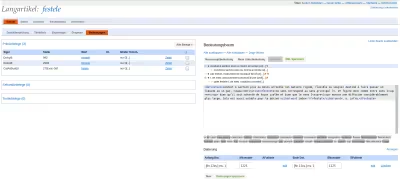
A user interface for the DEAF-DWS article editing system
Old French spans the period from 842 to the mid-14th century, an era that is fundamental to contemporary European history. Of central importance in this regard are, above all, the cultural and social transformations that took place in the context of the Renaissance of the 12th and 13th centuries: Building on ancient scholarship and enriched by Islamic and Jewish scholars, an enlightenment spirit initially emerged in France, giving rise to a form of scholarship critical of dogma, which spread throughout Europe and led to the founding of universities. It was here that the shift from a clerical culture to a lay culture—commonly attributed to the age of Humanism—began. Developments in other areas of European culture during the 12th and 13th centuries can also be summarized under the term translatio studii—the transmission of learning from Greco-Roman antiquity to the French Middle Ages: The rapid development of the sciences finds parallels, for example, in the flourishing of vernacular literature and the emergence of chansons de geste, in the golden age of Romanesque art and the birth of the Gothic style, as well as in the revival of Roman law as the foundation of the European legal system.
In addition to Medieval Latin, the primary linguistic medium of the sociocultural transformations described was Old French, the most influential vernacular language of the European Middle Ages. The number and geographical origin of the surviving sources give an impression of the historical significance of Old French: Its corpus comprises many thousands of texts originating not only from France but also from England, Cyprus, and the Holy Land, where French served as the language of the ruling class for centuries. The prestige of Old French is further evident in an extensive Franco-Italian literary tradition—for example, the Venetian Marco Polo recounts his travels in Old French—and in its influence on alloglot literary traditions: Thus, the most important representatives of the Middle High German classical period (Wolfram von Eschenbach, Hartmann von Aue, and Gottfried von Straßburg) adapted French models in their romances. The commentaries of Rashi and his students from the 11th to the 13th centuries, which contain many thousands of Old French glosses, are still preserved today in all major Jewish editions of the Bible.
Historical lexicography makes a central contribution to research into the cultural foundations of Europe and thus to a better understanding of our contemporary world by viewing vocabulary as the key to Europe’s cultural memory and thereby contributing to the holistic integration of historical and cultural knowledge. Given its central importance to the European Middle Ages, Old French appears particularly well-suited to serve as the linchpin of such a research approach. At the same time, the interdisciplinary nature of historical lexicography—understood as part of a comprehensive study of culture—requires the integration of related philological disciplines—Medieval Latin, German Studies, Semitic Studies, Jewish Studies, etc. —as well as the inclusion of history, particularly historical disciplines focused on the history of ideas and social history, such as the history of science, the history of ideas, and the history of mentalities. By shedding light on the dynamics of language and extralinguistic culture in the context of the European Middle Ages, the historical lexicography of Old French can fulfill the goal of achieving a historically grounded understanding and evaluation of our contemporary world.<
Heidelberg Cod. Pal. lat. 1969
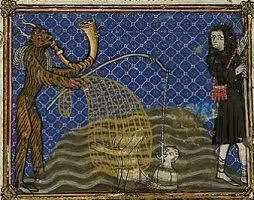
The Devil in a manuscript (ca. 1375) of Guillaume de Digulleville's *Pelerinage de Vie humaine*
Hardos is one of those rather unassuming entries in Volume H that is nonetheless well-suited to illustrating the defining characteristics of the DEAF: scholarly rigor, innovation, and efficiency. It is precisely because of its simple structure that this example is clear and compelling.
Hardos does not appear in any of the dictionaries written in the 20th century, nor is it found in those by Lacurne (1875–1882) and Godefroy (1880–1902). It appears in Henschel’s 1850 supplements to Dom Carpentier’s glossary (1766), following Du Cange (1678). The source of the entry is listed as “Roman de Roncevaux, pag. 44,” which is not very informative, since this title could refer to several different texts. The text in question can ultimately be identified as a version of the Song of Roland in the Châteauroux manuscript; so our word—assuming it actually exists—does not come from some dusty document of dubious standing, but, as one may confidently state once again, from one of the manuscripts of the famous Song of Roland, a masterpiece of French and European literature. The most scientifically reliable edition of this text, by Foerster (1883), contains no glossary, and the two verses cited by Henschel do not reveal the broader context of the scene in which hardos is supposed to appear, leaving no other option but to skim through the text.
The result justifies the effort: the word is indeed found in this manuscript of the text. Henschel had not defined hardos, so it is now necessary to subject the word to a semantic and etymological analysis. A reading of the broader context, familiarity with the complete works, and a comparison with related manuscripts in which the reading ardos appears make it clear that it must be a qualifying adjective denoting an abyss or a deep well. The etymological trail—based, on the one hand, on an attested form and, on the other, on a reasonably clear semantic concept—leads to arduus “steep, arduous,” which was the subject of an article by Gilles Roques in the revised edition of the French Etymological Dictionary (FEW). The identification of the word yields initial findings and raises further questions: hardos is the oldest representative of the entire family in the Gallo-Roman linguistic area, and the ending stands alone (attested only once more in a Neo-Provençal word that is certainly independent): is our form the result of a hereditary development or a derivation? Has the Latin suffix -uus truly disappeared without leaving a trace, except in a few scholarly loanwords (including, notably, ardu)? The relevant articles in the FEW, as well as the morphological studies consulted, provide no answer.
As for the literary aspect, our word reveals a deliberate departure from the fairy-tale and magical elements in the development of the various versions of the Song of Roland. In the archaic Oxford *Roland*, the title hero tries in vain to break Durendal, his holy sword; as he dies, he finally hides it beneath his body so that it does not fall into the hands of the enemy pagans. The author or editor of the Châteauroux version of *Roland*, on the other hand, considers it more appropriate to have the holy sword vanish forever into a poisoned abyss inaccessible to humans. This should be understood as an indication of a shift in mentality: As a child of his time, the 13th-century author views the world somewhat more realistically than his counterpart at the turn of the 11th to the 12th century. This realism—though still far removed from modernity, of course—may have inspired him to make the change.
The question remains: Is it worth sacrificing several hours of a researcher’s life for a single word like this? On the one hand, it must be said, the question cannot be posed in this way, for after all, it is the researcher’s stated mission to serve the advancement of knowledge and science to the best of their ability: Any other stance would contradict the scientific self-image and amount to a waste of resources. On the other hand, and while acknowledging the validity of the question, it is the results themselves that must provide the answer—results that almost inevitably emerge within the framework of pure and serious research. In the case of hardos, this means: An obscure word from a neglected source has been located and identified; thanks to the newly discovered oldest example of a word family, the younger members of this family appear in a different light; the discussion of a morphological question can be revitalized; the understanding of an important text is enhanced by considerations of the history of mentalities—a small piece has been added to the mosaic that constitutes our picture of the past. It seems to be a rich harvest for such a small word, and proof that research is always worthwhile, even when it comes to such unassuming words as hardos.
“Neither the human soul nor the human brain has demonstrably grown in historical times; their capacities were already fully developed long ago! Therefore, our presumption that we live in an age of moral progress is utterly ridiculous when compared to times of great peril, whose unbridled power of the ideal will soars toward the heavens in a hundred soaring cathedrals.»
[Jacob Burckhardt, Reflections on World History]
About 150 years have passed since Jacob Burckhardt made this statement. Nevertheless, the prejudice against the “Dark Ages” persists. The following examples are intended to illustrate this and, at the same time, show how the analysis of medieval texts allows for new assessments not only in terms of language but also in terms of academic disciplines and historical context.
Botany
Interdisciplinarity in Circulus vitiosus:
Paleoethnobotany dates the gooseberry to the 12th century. The French word for gooseberry (and red currant), groseille, is similarly dated by lexicographers. This consistency inspires confidence. However, an examination of the sources reveals that the botanists did not base their conclusions on excavations, illustrations, or the like, but rather on the dating of the French word groseille! Their date, the 12th century, is therefore worthless. Research shows that from the 9th to the 12th century, the word referred to the buckthorn; it was not until the 13th century that it came to mean gooseberry. Incidentally, the DEAF mentions the first illustration of a gooseberry bush: *Bible moralisée*, Vienna manuscript 2554, ca. 1225, f°60v°b.
Bibliotheca Viennensis 2554
Illustration of a gooseberry bush, *Bible moralisée*, Vienna Manuscript 2554, f°60v°b [ca. 1225]
Astronomy
What we know:
“In the West, by contrast, there was virtually no development in astronomy during the same period [i.e., the Middle Ages]. Furthermore, for a long time, the Earth was once again regarded as flat.” (dtv Atlas of Astronomy 15)
This view is a scientific myth of the 19th and 20th centuries that continues to persist in the 21st century.
What the Middle Ages Tell Us:
Image du monde, encyclopedic text from the year 1246 (manuscript Paris BN fr. 1548 f°14r°): homme qui va entour le monde (Caption for the illustration: Man walking around the Earth)
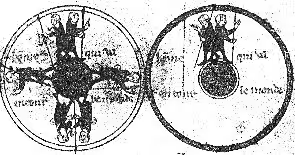
Introductoire d'Astronomie, treatise on astronomy from the year 1270. Chap. IV 2: and for this reason the world was created in such a spherical shape (= the shape of a ball); we say that this is the form that most closely approximates perfection, for in its roundness it has neither end nor beginning. (And so the Earth was created round, with the characteristic of a globe (in the shape of a sphere), since that is the form that comes closest to perfection; for in roundness there is neither beginning nor end.) [Ed. Stephen Dörr]
National Library of Paris
A Man Travels Around the World (Manuscript Paris BN fr. 1548, f°14r° [1246])
Grammar
What we know:
“It can be said that at the beginning of the 16th century, there was no French grammar.” (C. Demaiziere, La grammaire française au XVIe siècle: Les grammairiens picards, Paris 1983, p. 29)
What the Middle Ages Tell Us:
The beginning of the Old French adaptation of Ars minor by Donatus (Manuscript Berner Burgerbibliothek 439, f°76r°, 2nd half of the 13th century):
How many parts of speech are there? viii. etc. Nouns and participles govern and are governed. Pronouns are governed and do not govern at all. (How many parts of speech are there? Eight, etc. Nouns and participles govern and are governed. Pronouns are governed and do not govern themselves. [Ed. Thomas Städtler])
The Grand Larousse de la Langue Française (1973), Vol. 3, p. 2273b lists the earliest attestation of gouverner “to govern” in a grammatical context: 1757, Encyclopédie.
Bern City Library
Grammar in Donat's *Ars minor*, Bern City Library 439, f°76r°, second half of the 13th century
Mathematics
What we know:
“Apart from isolated, often random instances of transmission, the picture of European learning capabilities in the field of material culture is also a bleak one,” writes the FAZ on November 4, 1992, noting a general “ignorance of highly developed Arabic mathematics” during the Middle Ages.
What the Middle Ages tell us:
From Jean de Murs’s *Quadripartitorum numerorum* from 1343: I again multiplied the sixth root of a certain amount by its fifth root, added ten times that amount, and added the number 20, and all of these were equal to the square of that amount. What is the value of x?
Expressed as an equation, this gives:
√ 6x √ 5x + 10x + 20 = x²
From the Praktike de geometrie (3rd quarter of the 13th century): Calculation of the area of a circumscribed circle in an equilateral triangle with a side length of 14 feet: If you place a compass inside the triangle as large as you can, it will contain .50 feet and a quarter of a foot and the 7th of a quarter of a foot.
Result: 50 2/7 square feet.
Medicine
What we know:
“After Galen [late 2nd century], anatomical examinations were no longer performed. Autopsies were once again condemned as repulsive and cruel and deemed unnecessary. The Christian belief in the resurrection of the body may have reinforced the resistance to anatomy. The Western Middle Ages had virtually no knowledge of Galen’s anatomical writings.” (Der Neue Pauly. Encyclopedia of Antiquity, Anatomy [preprint 1996])
What the Middle Ages Tell Us:
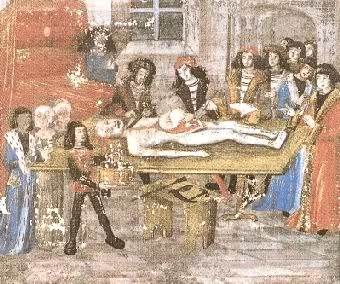
Gui de Chauliac’s description of the autopsies performed by Mondino dei Luzzi and Niccolò Bertruccio in Bologna since 1315 is clear enough: as described by Master Dimus of Bologna, who has written on this subject and has performed dissections many times. And my teacher, Master Bertuces, would seat the dead man on a bench in this manner and divide him into four parts: the nutritive members, the spiritual members, and the members that have a soul. In the fourth, he discussed the extremities (according to Master Dimus of Bologna, who has written on this subject and performed dissections many times. My teacher, Master Bertuces, would place the dead person on a bench and use it to teach four lessons: the organs nourished by blood and those nourished by the spirit, and the organs that possess a soul. In the fourth lesson, he discussed the extremities [Ed. Sabine Tittel].
Montpellier School of Medicine Library
Autopsy in the manuscript of *Grande Chirurgie* by Gui de Chauliac, Bibliothèque Fac. Méd. Montpellier H 184 f°15v° (second third of the 15th century)
Conclusion
The variety of perspectives and examples can bring to mind a kaleidoscope. Beautiful individual tiles tumble about, creating ever-changing, captivating images. But appearances can be deceiving. The DEAF does not see itself as a kaleidoscope, but rather as a mosaic. Each tile is crafted with the utmost scientific precision; one is structurally identical to the next. It is a vast puzzle that comes together to form a picture conveying a vivid and historically accurate impression of an important era in European history. The DEAF’s dictionary structure serves as the window that opens a view of the Middle Ages.
Comments on the DEAF
David Trotter, Romanische Forschungen 123 (2011), pp. 287–290 [288–289]:
“In an academic landscape where long-term projects are struggling, it is reassuring to see that the DEAF has not run out of steam. Congratulations are in order not only for the editors and the scientific committee, but also for the Heidelberg Academy, which supports them. [...] This volume lives up to its predecessors and only serves to underscore the importance of the DEAF, particularly in two respects: with regard to the historical lexicography of French, but also for its exemplary role in lexicographical methodology. Anyone who wants to learn how to compile a dictionary will benefit from reading the DEAF. [...]
Old French was not only an exporter but also an importer of words (many of which would later be passed on to neighboring languages). It played a crucial role in the transmission of knowledge and as a language of culture throughout the educated world of the time. For those who are familiar with it, the DEAF has become the essential key to accessing and understanding this world.”
Ralph Dutli, Literarisches Echo:
In a postscript to his essay “Flying Donkeys. The Impossible Poetry of Fatrasia,” which concludes the volume of his Fatrasia translations, Ralph Dutli writes: “Another stroke of luck: When I moved from Paris to Heidelberg in 1994, I had no idea that I was also moving to a city where Old French, so to speak, maintained a diplomatic mission. It is precisely in my hometown of Heidelberg that the DEAF (‘Dictionnaire Etymologique de l'Ancien Français’) is being compiled—an admirable undertaking to document all Old French words in terms of their meaning and etymology. A team of five (Stephen Dörr, Marc Kiwitt, Frankwalt Möhren, Thomas Städtler, Sabine Tittel) is hard at work on this silent cathedral made entirely of words. If even the air along the Neckar is allowed to buzz with Old French words, then a journey to the Fatrasien is not out of place—a journey to the River Scarpe, which flows through Arras. Poetry is the river that unites all rivers beyond space and time. A message to friends: Scarpe diem, Neck-Arras.” (Ralph Dutli, Fatrasien. Absurd Poetry of the Middle Ages, 2010, p. 138)
Gilles Roques, “Typology of Glossaries in Editions of Medieval French Texts,” Doctoral Seminar No. 1: Languages and Glossaries, Liège, May 17, 2010 (Eurolab: Dynamics of Vernacular Languages in Renaissance Europe. Actors and Places), pp. 6–7. Available online at eurolab.meshs.fr):
“[...] The fact is that the author of a glossary must also be informed about issues in lexicology. In this regard, reliable guides are needed, and, based on the principle that a good lexicologist is a dead lexicologist, I will cite three names whose works are constantly on my mind: Lecoy 1984 and 1988, Henry 1960 and 1996, and Baldinger 1990. As for living scholars, I will mention Möhren 1986 and Städtler 1988, pillars of the monumental *Dictionnaire étymologique de l’ancien français* (DEAF), which is driving the revival of studies on the Old French lexicon, Trotter 2005, who leads the remarkable *The Anglo-Norman Dictionary* (AND), and Matsumura 1999, who is an excellent scholar of our ancient texts and regionalisms.”
Giovanni Palumbo, Medioevo Romanzo 33 (2009), p. 230:
“As usual, the various entries contain, scattered here and there, veritable micro-essays on philology, which provide a sort of permanent review of all the standard critical editions.”
David Trotter, Romanische Forschungen 121 (2009), pp. 550–552:
“No one understands better than dictionary editors that, despite their status and authority, dictionaries are never definitive. For a long time, however, the DEAF has been defying this rule, evolving over the years and through its installments into a quasi-definitive work—and in any case, an unparalleled and irreplaceable one. The first three installments of Volume J demonstrate once again why. First, a well-coordinated and well-trained team. [...] Second, the rigor and—perhaps above all—the intellectual honesty that have long characterized the DEAF. [...] Third (or first...) guarantee of quality: the thoroughness of the work on the texts (ad fontes), whether to verify the meaning of an attestation or to provide content for the articles. [...] A fourth aspect of the DEAF worth highlighting: a constant and commendable commitment to innovation. [...] Finally, a fifth strength: a visibly close and effective collaboration with other lexicographic projects and with other researchers. [...] The typographic presentation is excellent; the binding has withstood the winds of the beaches of the Côtes d’Armor (formerly: the North Coast), where we read these three volumes. At the library, too, the DEAF is highly recommended to specialists in the French language, whether they are medievalists or not, because, as we have already noted, it is a dictionary that, with great expertise, retraces not only the history of the Old French lexicon, but of the French language itself.”
Gilles Roques, “Lexicographical Tools and Lexical Materials in the Field of Medieval French,” in: Maria Colombo/Monica Barsi (eds.), Historical Lexicography and Lexicology of French. Assessments and Perspectives, Monza (Polimetrica) 2008, pp. 25–50 [30]:
“Continued and perfected by a student of Baldinger, F. Möhren, who has just been succeeded by a student of both, Th. Städtler, it constitutes a superb philological achievement of German scholarship, written in French, at a time when German scholarship had, in fact, abandoned the field of philology—at least as it pertains to French.”
Philippe Ménard, Zeitschrift für romanische Philologie 123 (2007), pp. 361–354 [364]:
“We owe the editors a great deal of gratitude for the admirable perseverance they demonstrate. By slowly sifting through old texts, they uncover, hidden in the shadows, words and meanings that had eluded readers who were too skilled and too hasty. Beneath the dust of the centuries, they find gold.”
Robert Martin, Romania 123 (2005), pp. 236–238:
“The compilation of the DEAF continues with a rigor worthy of the highest praise. Following G and H (and the corresponding indexes), the letter I has now been completed and work on the letter J is well underway. The method remains unchanged: one is dazzled by the wealth of documentation and by the exemplary precision of its treatment.”
Philippe Ménard, Zeitschrift für romanische Philologie 120 (2004), pp. 544–547:
“This volume shares the same characteristics as the previous ones: numerous investigations conducted on the sources themselves, in difficult cases on the manuscripts, corrections of dates and meanings, attention paid to the earliest attested instances, extensive information on orthografic variations, discussion of traditional interpretations, analysis of technical texts, deliberate search for rare words and isolated usages, corrections made to the FEW, and significant contributions—particularly in this volume—to the vocabulary of 14th-century scholarly texts.”
David Trotter, A Companion to Ancrene Wisse (2003), p. 89:
“The groundbreaking Dictionnaire Etymologique de l’Ancien Français (DEAF) in Heidelberg (1971–) contains, in its richly detailed discussions of etymology, usage, and semantics, by far the most comprehensive treatment of the lexicon of medieval French that has yet been attempted. It is gratifying to note that Anglo-French is fully integrated into this most impressive dictionary.”
Gilles Roques, Revue de Linguistique romane 65 (2001), p. 272:
“The valiant team at the DEAF continues to pick up the pace, which bodes well for its future—a future to which an ever-growing number of us are deeply committed [...] the methodology is flawless, and we are already looking forward to the first volume of I, which is already in press.”
David Trotter, French Studies 55 (2001), pp. 582–83 [582]:
“The publication of the final fascicle of the DEAF’s ‘H’ is of major significance not only for those working on French (both modern and medieval), but also for the history of the influence of the Germanic languages (English, Dutch, and various forms of German) on French. [...] By any standard, the DEAF is a remarkable dictionary, and these four fascicles (an index is to follow) confirm the depth and breadth of its analysis. [...] What the DEAF provides is nothing less than a complete, minutely detailed rewriting of the history of French vocabulary [...].»
Remo Bracchi, Salesianum 63 (2001), pp. 419–20:
“This volume [=H3] contains masterful treatments both from the perspective of the philological reconstruction of transmitted forms and from that of the outline of semantic features or etymological comparison. Historical erudition and linguistic acumen come together to provide us with articles that are true monographs in their own right.”
Takeshi Matsumura, Language, Information, Text 7 (2000), pp. 89–94 [94]:
“While awaiting the next installment, we must read and reread this issue of the DEAF, which the team led by Frankwalt Möhren has produced with exemplary meticulousness.”
Takeshi Matsumura, Revue de Linguistique romane 62 (1998), pp. 265ff.:
“Here we find the fruits of their work, which has become a tradition: in-depth reflection on etymology (see hardi¹, etc.), precision regarding the evolution of usages, criticism of sources [...], identification of a primary meaning underlying the various occurrences [...], and examination of hapaxes. When one considers the small number of contributors, one cannot help but admire the accelerated pace, which seems, in a sense, like a race against the clock. [...] The DEAF, which must be read and reread time and again, deserves “selfless assistance” from “researchers and language enthusiasts.”»
Franz Lebsanft, Revue de Linguistique romane 62 (1998), pp. 262ff.:
“We are grateful to its meticulous editors, who deserve great credit for taking stock of a discipline so fundamental to the history of the French language and in constant evolution (through the expansion and refinement of source material as well as shifts in perspective) and for setting the standards for any future undertaking in historical lexicography.”
May Plouzeau, Revue des Langues romanes 101 (1997), p. 237ff.:
“... In short, the brilliance of this young dictionary puts all its predecessors to shame. It goes without saying that the content is worthy of this presentation, and there is no room for doubt: the dictionary has found its rhythm; the work breathes with the vitality of a healthy being, and within this living body, the head and the limbs harmoniously share the tasks.”
Jean-Pierre Chambon, Zeitschrift für romanische Philologie 107 (1991), pp. 179–181 [181]:
“It goes without saying that, as it stands, the DEAF is and remains at the forefront of French lexicography and lexicology, within which it has carved out a unique place and plays an extremely stimulating role.”
Jean-Pierre Chambon, Journal of Romance Philology 105 (1989), pp. 532–535 [533]:
“The facts are established with truly exemplary rigor, the analyses are meticulously conducted, and nothing is ever left in the dark. It must be said—or reiterated—here that the DEAF is not merely what its title suggests: it is also the finest model for describing the lexicon of a medieval Romance language. [...] In short, this is a major contribution to Romance lexicology.”
Johannes Kramer, Zeitschrift für französische Sprache und Literatur 99 (1989), pp. 291–293 [293]:
“The most important benefit of the etymological commentary in the DEAF is certainly that it documents the current state of the discussion and thus represents the update—undoubtedly necessary after several decades—of the corresponding entries in the FEW. The DEAF thus, so to speak, puts a stop to the FEW becoming obsolete [...].“
Hans Dieter Bork, Journal of Romance Philology 87 (1975), pp. 102–109 [106]:
“The DEAF does not merely compile unverified foreign materials, but verifies them—in some cases down to the manuscript level—and increasingly draws on its own excerpts.”
Max Pfister, Zeitschrift für romanische Philologie 91 (1975), pp. 176–188 [187–188]:
In addition to the substantial supplementary material it provides for the two standard works on Old French, Gdf and TL, the DEAF will become indispensable for all medievalists due to its outstanding philological and etymological commentary, which lays a new foundation for Old French lexicology and textual criticism. [...] The methodological approach adopted, the clear layout of the publication, and the pace of work and publication demonstrated thus far are exemplary. In the interest of ensuring the continuous continuation of this research, one can only hope that the necessary funding for this important foundational work will continue to be available.
Honor for Frankwalt Möhren
Highest Honor for Frankwalt Möhren"> On March 23, 2018, Frankwalt Möhren was elected as an Associé étranger de l'Académie des Inscriptions et Belles-Lettres (AIBL).
He thus holds one of the 40 seats reserved for associés étrangers in this oldest French learned society, founded in 1663.
Heidelberg Lexicographical Months
As part of the “Heidelberg Lexicographical Months,” the DEAF offers young researchers a four-month internship during which they receive an introduction to lexicographical and textual-philological methods.
Presentation for the Glossaire des Patois de la Suisse Romande
On September 12, 2018, Sabine Tittel gave a presentation in Neuchâtel as part of the “Inauguration of the Glossaire des Patois de la Suisse Romande Web Portal.” Under the title “Les derniers développements du DEAF électronique vers le Semantic Web comme Linked Open Data,” Ms. Tittel presented the possibilities for transforming dictionary data into the RDF graph format.
Presentation for the workshop of the Union of German Academies of Sciences and Humanities
On October 9, 2018, in Leipzig, Sabine Tittel participated in the workshop “(Digital) Forms of Publication” organized by the eHumanities Working Group of the Union of German Academies of Sciences and Humanities and delivered a presentation titled “The Use of RDFa for Linking the Online Edition and Online Dictionary of Medieval French.”
Presentation at the Euralex 2018 Conference
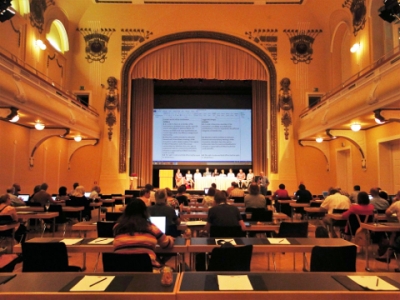
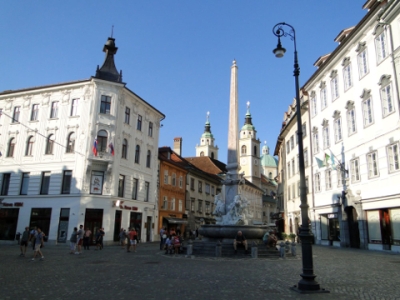
On July 18, 2018, a presentation was given in Ljubljana as part of the EuraLex International Conference, titled “Historical Corpus and Historical Dictionary: Merging Two Ongoing Projects of Old French by Integrating Their Editing Systems." The publication can be found at here.
|
|
|
Lecture as part of the European Master of Lexicography—EMLex 2018
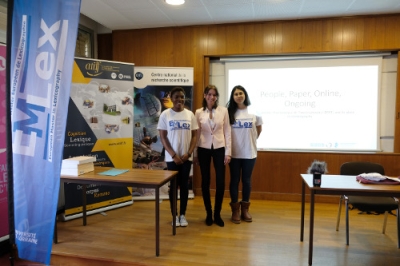
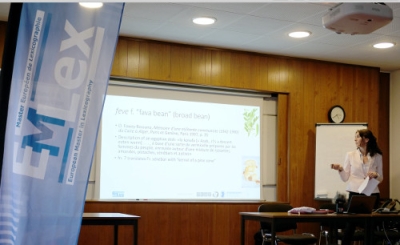
On March 23, 2018, Sabine Tittel gave a lecture in Nancy at the Université de Lorraine as part of the European Master of Lexicography program -- EMLex 2018 -- on the DEAF: "People, Paper, Online, Ongoing. The Dictionnaire étymologique de l'Ancien Français (DEAF) and its place in eLexicography".
|
|
|
Workshop on RomaniO
On March 19 and 20, 2018, a workshop on the research project “RomaniO” was held at the Heidelberg Academy of Sciences and Humanities. – Ontology of the Worlds of Life and Knowledge in the Romance-Speaking Middle Ages Based on Transversal Case Studies in Law, Medicine, and Astronomy.” The DEAF, under the direction of Sabine Tittel, organized this workshop, which was funded by the Heidelberg Academy of Sciences and Humanities. It brought together around 20 experts from the disciplines of French, Occitan, Gascon, and Italian philology, as well as applied computational linguistics (from Germany, Italy, and Switzerland). The participants delivered keynote presentations on various topics, which led to fruitful discussions. The interdisciplinary brainstorming session resulted in further development of the planned RomaniO research project in terms of both structure and content.
|
|
Blog post for the "The Value of Old French" Project
For the ERC project *The Value of Old French*, which is based at King’s College London and is funded by the European Research Council with 1.7 million pounds, Stephen Dörr and Marcus Husar have written a blog post outlining the computer-assisted processing of the vocabulary and the collaboration with the DEAF. You can find the text here.
Workshop "Research Data in the Humanities: Methods for Digital Collection, Processing, and Presentation" organized by the eHumanities Working Group of the Union of German Academies of Sciences and Humanities, October 18–20, 2017
Sabine Tittel participated in the workshop “Humanities Research Data: Methods for Digital Collection, Processing, and Presentation,” organized by the eHumanities Working Group of the Union of German Academies of Sciences and Humanities, October 18–20, 2017, in Mainz, and gave a presentation titled “Transforming the DEAF into Linked Open Data with OntoLex-Lemon,” which sparked a lively discussion.
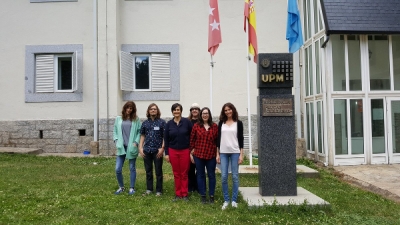
From June 26–30, 2017, Sabine Tittel participated in the “2nd Summer Datathon on Linguistic Linked Open Data (SD-LLOD-17)”, which was organized by the Universidad Politécnica de Madrid in Cercedilla, Spain. The scientific directors were Jorge Gracia (Ontology Engineering Group, Universidad Politécnica de Madrid), John Philip McCrae (Insight Centre for Data Analytics, NUI Galway), and Christian Chiarcos (ACoLi – Goethe University Frankfurt). The workshop aimed to train participants in Semantic Web and Linguistic Linked Data technologies, primarily the OntoLex-lemon model and the NLP Interchange Format (NIF). The largest and most important part of the event was the so-called “datathon,” which consisted of working on individual projects using participants’ own data in “mini-projects.” Sabine Tittel led one of seven projects: “Linking Corpus and Dictionary Data with Linked Open Data.” The goal was to use “Linked Open Data” technologies to link the “word in the text corpus” with the “word in the dictionary” in such a way that this link could, on the one hand, replace the role of the glossary in the text edition and, on the other hand, allow the data obtained in this way to be accessed on the Semantic Web via search queries. Of the 30 participants in total, five were part of the team, whose success was recognized when 66% of all participants voted for the project to receive the “Datathon Best Mini Project Award” at the end of the event. Pictures of the week are posted on Twitter: #sdllod17.
|
|
Workshop “Reuse and Reusability of Research in the Academies Program,” November 9–11, 2016
From November 9–11, 2016, our editor Sabine Tittel participated in the workshop “Reuse and Reusability of Research in the Academies Program” organized by the “eHumanities” Working Group of the North Rhine-Westphalian Academy of Sciences and Arts in Düsseldorf and gave a presentation titled “Dictionnaire étymologique de l’ancien français: Reusability of the DEAF’s Working Environment and Research Data.”
Summer School in Klagenfurt, September 11–16, 2016
The Summer School 2016 on the Edition of Medieval Texts took place in Klagenfurt under the direction of Stephen Dörr (DEAF Heidelberg), Franz Lebsanft (Bonn), Richard Trachsler (Zurich), Raymund Wilhelm (Klagenfurt), and Fabio Zinelli (Paris) in Klagenfurt and was primarily aimed at master’s students, doctoral candidates, and postdoctoral researchers. The morning sessions covered the theory and practice of ecdotics, while the afternoon “workshops” focused on producing a text edition with the goal of publishing it.
XXVIII International Congress of Romance Linguistics and Philology
From July 18–23, 2016, the 28th International Congress of Romance Linguistics and Philology took place in Rome, at which the DEAF was well represented. Thomas Städtler, together with Stefano Asperti, chaired the “Latino e lingue romanze” section. Sabine Tittel, together with Martin Gleßgen, gave a presentation on “Le Dictionnaire de l’ancien gascon électronique – DAGél,” and Stephen Dörr contributed a paper on “Le Roman de la Rose – exemple prototypique de diasystèmes entre tradition manuscrite et imprimés.” Our doctoral candidates Laura Henkelmann and Theresa Schmitt gave a presentation on “Between Astronomy and Geomancy—The Contribution of Medieval Latin to the Understanding of Scientific Texts.”
Medieval Studies Day 2016 Heidelberg, June 25, 2016
On June 25, 2016, in cooperation with the University of Heidelberg, Mannheim, and Karlsruhe, the Medieval Studies Day 2016 took place at the New University of Heidelberg. Here, those interested in the Middle Ages had the opportunity to learn about various fields of research, as well as study and training opportunities related to the Middle Ages, and to actively participate in seminars. As part of this event, the DEAF offered a “workshop visit” on the topic “The Dictionnaire étymologique de l’ancien français (DEAF) — How Is an Old French Dictionary Created in Heidelberg?”
Academic Exchange with the Project “The Values of French Literature and Language in the European Middle Ages” (ERC Advanced Grant at King’s College London)
On June 6, 2016, Simon Gaunt and Simone Ventura from London’s King’s College visited the DEAF’s offices for an academic exchange regarding the project “The Values of French Literature and Language in the European Middle Ages.” A report worth reading on this topic can be found here.
Heidelberg Children’s University, February 27, 2016
On February 27, 2016, the annual Children’s University took place in Heidelberg. As part of this event, the DEAF offered the workshop "Elephants and Unicorns—Reading and Understanding Medieval Texts in Handwritten Books". [Press release]
Workshop organized by the “Electronic Publishing” Working Group of the Heidelberg Academy of Sciences and Humanities and the Union of German Academies of Sciences and Humanities
From September 14 to 16, 2015, a workshop on “Electronic Publishing,” a workshop organized by the Heidelberg Academy of Sciences and Humanities and the Union of German Academies of Sciences and Humanities on the topic “Historical Semantics and the Semantic Web” took place in Heidelberg. Our editor Sabine Tittel gave a presentation on the topic “Semantic Integration of Knowledge on the European Middle Ages: A Project in European Lexicography”. The workshop program can be viewed here
International Colloquium
On September 7–8, 2015, an international colloquium on the topic “La régionalité lexicale du français au Moyen Âge”. The DEAF was represented by Sabine Tittel: La régionalité lexicale de l’ancien français (1100–1350), Thomas Städtler: Regional French in a Latin Context after 1100 and Frankwalt Möhren: Regional Variation in the DEAF.
Medieval Studies Day 2015 Heidelberg, June 27, 2015
On June 27, 2015, the Medieval Studies Day 2015
took place at the New University of Heidelberg in cooperation with the University of Heidelberg, Mannheim, and Karlsruhe, the Medieval Studies Day 2015 took place at the New University of Heidelberg. Here, those interested in the Middle Ages could learn about various fields of research, as well as study and training opportunities related to the Middle Ages, and actively participate in seminars. As part of this event, the DEAF offered the seminar “Predicting the Future in the Middle Ages—A Self-Experiment Based on ‘Geomancy.’”
Closing Session of the COST Action “Medieval Europe” in Florence, March 16 and 17, 2015
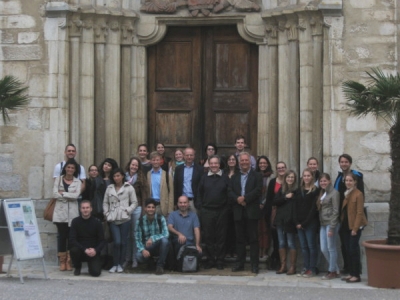
From March 16 to 17, 2015, the Management Committee and the four working groups of the COST Action “Medieval Europe—Medieval Cultures and Technological Resources” held their closing meeting in Florence as guests of SISMEL. Thomas Städtler and Sabine Tittel attended the event. Several presentations addressed the approaches to standardizing information on the Middle Ages that were developed during the COST Action. The two project proposals (submitted to the European Union’s “Horizon 2020” program) “Lexicographic Semantic Integration in the European Middle Ages – LexEMA” (Sabine Tittel) and “Mobility of Medieval Manuscripts in the Middle Ages – MOMENTUM,” which emerged from the COST Action, were presented, and their strengths and weaknesses were discussed.
Heidelberg Children’s University, February 7, 2015
On February 7, 2015, the annual Children’s University took place in Heidelberg from 10 a.m. to 5 p.m. As part of this event, the DEAF offered the workshop "Elephants and Unicorns—Reading and Understanding Medieval Texts in Handwritten Books". The seminar was fully booked, and our young “staff members” headed home full of enthusiasm—eager to delve even further into medieval manuscripts.
COST Action IS1005 – “Medieval Europe: Medieval Cultures and Technological Resources”
Medieval Europe: Medieval Cultures and Technological Resources
Since March 2011, the DEAF has been participating in COST Action IS1005 “Medieval Europe: Medieval Cultures and Technological Resources», which brings together projects from twenty-one European countries and Israel. The COST Action aims to increase accessibility to and integration of medieval research results and tools by combining medievalist scholarship with modern technologies within a Virtual Center for Medieval Studies (VCMS). Thomas Städtler chairs Working Group 3 “Textual Corpora and Reading Tools” of the COST Action and is a member of the Action’s Management Committee and Steering Group.
On May 24, 2011, Thomas Städtler (DEAF), Annette Kehnel (University of Mannheim), and Ludger Lieb (University of Heidelberg) hosted an international colloquium on the theme of the COST Action, in which Agostino Paravicini Bagliani (SISMEL Florence and University of Lausanne) participated as the keynote speaker.
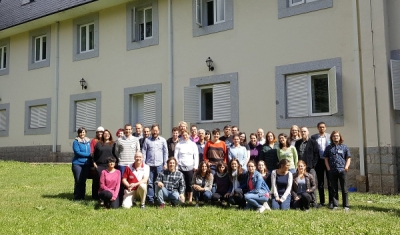
From November 3 to 5, 2011, the Management Committee and the four working groups of the COST Action met in Heidelberg as guests of the DEAF and the Heidelberg Academy of Sciences and Humanities. During this meeting, several existing databases that could serve as models for a larger-scale network of medievalist resources were presented, and possibilities for integration among the participating projects were discussed.
From October 17 to 19, 2013, the Management Committee of the COST Action met in Budapest to discuss the future of the VCMS—Virtual Center for Medieval Studies.
On April 25 and 26, 2013, the workshop “Connecting Textual Corpora and Dictionaries” took place in Krakow, Poland, under the direction of Sabine Tittel, Prof. Michał Rzepiela, and Krzysztof Nowak. For more information about this workshop, visit the website of the Instytut Języka Polskiego.
On January 13 and 14, 2014, the workshop “Structure and Draft of a First Application” took place at the Academy of Sciences in Heidelberg.
On March 16 and 17, 2015, the Management Committee and the four working groups of the COST Action “Medieval Europe – Medieval Cultures and Technological Resources” attended the closing session in Florence. Several presentations addressed the various approaches to standardizing information about the Middle Ages. The two applications (for the European Union’s “Horizon 2020”)—“Lexicographic Semantic Integration in the European Middle Ages – LexEMA” (Sabine Tittel) and “Mobility of Medieval Manuscripts in the Middle Ages – MOMENTUM,” which emerged from the COST Action, were presented, and their strengths and weaknesses were discussed.
To date, the DEAF has made the following scientific contributions toward the objectives of the COST Action:
- From April 15 to 29, 2012, Lisa Šumski visited the Institut de recherche et d'histoire des textes in Paris as part of a Short-Term Scientific Mission funded by the COST Action. The goal of the mission was to explore the possibilities of linking bibliographic information from the DEAFBiblEl (Heidelberg) and Jonas (Paris) databases.
- As part of its activities within Working Group 3, the DEAF designed and implemented a Prototypical Onomasiological Portal for Medieval Romance Dictionaries, which aims to illustrate the potential of a content-based approach to the integration of lexicographical resources.
- From December 16 to 30, 2012, Marc Kiwitt undertook a Short-Term Scientific Mission (STSM) to the Institute of Microfilmed Hebrew Manuscripts at the National Library of Israel in Jerusalem. The goal of the STSM was to explore possibilities for linking the digital resources available at the Institute of Microfilmed Hebrew Manuscripts with the bibliographic database developed at the DEAF, and to examine the potential benefits of these resources for the Virtual Center for Medieval Studies developed within the COST Action.
International Colloquium in Nancy “Electronic Editions, Corpus Studies, and Textual Databases in Medieval Studies,” January 16–17, 2015
On January 16 and 17, 2015, the international colloquium "Electronic Editions, Corpus Studies, and Textual Databases in Medieval Studies", organized by the “Société de Langues et de Littératures Médiévales d’Oc et d’Oïl – SLLMOO.” Sabine Tittel delivered a presentation titled “Combining a Textual Database with Historical Lexicography: The Oldest Linguistic Documents of France and the Etymological Dictionary of Old French,” which sparked a lively discussion about the possibilities for closer future cooperation between electronic editions, corpus projects, and dictionaries.
Summer School in Klagenfurt, September 14–19, 2014
The Summer School on the Edition of Medieval Texts took place in Klagenfurt under the direction of Raymund Wilhelm, Franz Lebsanft, Richard Trachsler, David Trotter, Fabio Zinelli, and Stephen Dörr in Klagenfurt and was primarily aimed at master’s students, doctoral candidates, and postdoctoral researchers. The morning sessions covered the theory and practice of textual criticism, while the afternoon workshops focused on producing a text edition (DixCommNeroW), with the goal of publishing it.
““Atelier lexicographique” in Rostock
Stephen Dörr and Sabine Tittel traveled to the University of Rostock from December 12–13, 2013, for the “Atelier lexicographique – Taller lexicográfico: The Digitization Projects of the Dictionnaire Étymologique de l’Ancien Français and the Diccionario del Español Medieval – Conference and Workshop.” Following presentations by Prof. Dr. Rafael Arnold (Rostock) and Prof. Dr. Jutta Langenbacher (Paderborn), Stephen Dörr, and Sabine Tittel, all aspects of the planned digitization of the material for the Old Spanish dictionary (Diccionario del Español Medieval—DEM) were discussed in depth: type of material, digitization steps, database structure, user interface (GUI), technical implementation, online publication, etc. A close collaboration was agreed upon so that the Old Spanish digitization project can build on the experience of the DEAF.
“27th Congress of Romance Linguistics and Philology,” Nancy, July 15–20, 2013
Sabine Tittel gave a presentation in the section “Source Philology for Which Lexicography?” a presentation titled “What Kind of Philology for Corpus Lexicography.” In addition, together with Martin-Dietrich Gleßgen (Zurich), she gave a presentation titled “Textual Databases and Historical Lexicography: How to Bring Together the Oldest Linguistic Documents of France and the DEAF?” to a large audience. This presentation introduced the DEAF’s new collaboration with the DocLing project—The Oldest Linguistic Documents of France; this collaboration is the first of its kind to combine a comprehensive dictionary project with an equally extensive corpus linguistics project and generated a great deal of interest.
Lisa Šumski delivered a presentation in the “Textual and Editorial Philology” section titled “How to Edit the ‘Ovide moralisé en vers’? Lexical Microvariation and Macrovariation in Book X,” in which the main focus was on the interpretation of lexical variants in the individual manuscripts.
Together with Yan Greub, director of the French Etymological Dictionary, Stephen Dörr organized and chaired the one-day session “Quelle philologie pour quelle lexicographie?,” and chaired it; eleven presentations by speakers from seven countries explored the question of on what editorial basis scholarly dictionaries can and should be compiled. The very large audience and the discussion of the methods demonstrated the high importance that the scholarly community attaches to both editorial philology and lexicography.
Thomas Städtler had the honor of delivering one of the five plenary lectures at the conference. Under the title “Pour une réconciliation entre théorie et pratique: le cas de la sémantique historique,” he spoke about the analytical methods of historical semantic theory, to describe and explain shifts in meaning and lexical change, and on the potential applications of the resulting findings in historical dictionaries of the French language.
During the conference, Thomas Städtler was awarded the Prix Albert Dauzat by the Société de Linguistique Romane for his scholarly achievements.
Thomas Städtler Appointed Adjunct Professor
On July 4, 2013, Thomas Städtler was appointed adjunct professor at the Faculty of Philology at the Albert Ludwig University of Freiburg.
International Conference “Transcrire et/ou traduire” at the University of Klagenfurt
On November 15 and 16, 2012, an international conference on the topic "Transcrire et/ou traduire – Trascrizione/traduzione – Transcribing or Translating? Variation and Linguistic Change in the Manuscript Tradition of Medieval Texts." Lisa Sumski gave a presentation on “Linguistic Variation and Change in the Manuscript Tradition of the Ovide moralisé in Verse: The Oldest Manuscript, Rouen Bibl. Mun. 1044 [O.4], and the Z Group”; Stephen Dörr spoke on the topic “Textes d’autorités – autorité de textes.” Further information can be found here.
Festschrift for Prof. Dr. Frankwalt Möhren
On July 22, 2012, Prof. Dr. Frankwalt Möhren was presented with a festschrift on the occasion of his 70th birthday. Further information and photos can be found here.
Romance Texts of the Middle Ages (RTM)
Together with Raymund Wilhelm, Stephen Dörr edits the series Romance Texts of the Middle Ages (RTM), which is published by Winter Verlag. The volumes in this new series aim to make previously little-known texts accessible in scholarly editions. In doing so, the series seeks to encompass as diverse a range of discursive traditions as possible: specialized and everyday texts are of equal interest here, as are texts from the fields of scholarship, religion, law, literature, and so on. Both individual texts and anthologies will be included. The focus is on textual production across the entire Romanic world during the period prior to the establishment of national language and communication spheres. This allows for the inclusion of “smaller” idioms of purely regional significance, some of which have developed their own writing traditions only to a limited extent. The volumes in this series are conceived as research contributions sui generis. They are therefore also suitable as a basis for university courses.
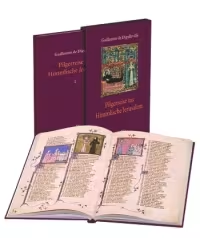
Guillaume de Digulleville. Le Pelerinage de Vie humaine – The Pilgrimage to the Heavenly Jerusalem
Published by the Wissenschaftliche Buchgesellschaft (WBG) in Darmstadt is the edition Guillaume de Digulleville. Le Pelerinage de Vie humaine – The Pilgrimage to the Heavenly Jerusalem, edited by Veit Probst, prepared by Sabine Tittel, Stephen Dörr, Frankwalt Möhren, and Thomas Städtler (with contributions by Wolfgang Metzger, Karin Zimmermann). DEAF sigil: PelVieD.
A devout monk recounts his pilgrimage to the Heavenly Jerusalem. But it was all just a dream. This text, translated into German for the first time, is an allegorical poem in which the first-person narrator encounters various personifications of virtues and vices before finally reaching his destination despite all obstacles and awakening from the dream. The author of this pilgrimage is the Cistercian monk Guillaume de Digulleville (1295–after 1358). Highly educated, he provides an extremely interesting and particularly varied introduction to the scholastic religious thought of the late Middle Ages. This edition finally makes the Heidelberg illuminated manuscript of the work widely accessible. It features a facsimile of the manuscript, the Old French text with a German translation, a detailed commentary, and a glossary. The manuscript features exceptionally rich illumination, with 126 miniatures and a complex decorative system ranging from the meticulous calligraphy of the text and the initials executed in gold and color to the characteristic frames and scrollwork on the pages.
Le Pelerinage de Vie humaine – The Pilgrimage to Heavenly Jerusalem, WBG 2013
The edition was presented to the public on July 2, 2013, in the Manuscript Reading Room of the Heidelberg University Library by Dr. Veit Probst, Director of the University Library, and PD Dr. Thomas Städtler, Head of the DEAF Research Center. Opening remarks were delivered by the President of the Heidelberg Academy of Sciences and Humanities, Prof. Dr. Dres. h.c. Paul Kirchhof, as well as by Jasmine Stern of the Wissenschaftliche Buchgesellschaft Darmstadt. The SWR reported on the presentation in its program “Landesschau aktuell.”
An expanded version of the glossary for the edition Guillaume de Digulleville. Le Pelerinage de Vie humaine – The Pilgrimage to the Heavenly Jerusalem is available as a PDF.
Medieval Day on July 8, 2011
The DEAF was represented at the Medieval Day organized by Heidelberg University and the College for Jewish Studies under the motto “The Fascination of the Middle Ages – Experiencing and Studying the Middle Ages,” and was represented there by Lisa Šumski and Thomas Städtler with an information booth.
Presentation of the new computer-based editorial system:
Presentation on July 2, 2010, featuring lectures by René Witte (Montréal) and Sabine Tittel (DEAF) at the Heidelberg Academy of Sciences and Humanities.
Approaches to Europe’s Cultural Memory:
Article in the Rhein-Neckar-Zeitung dated February 28, 2009.
Prix Honoré Chavée:
The Secrétaire perpétuel of the Académie des Inscriptions et Belles-Lettres, Institut de France, has informed Frankwalt Möhren that the Académie des Inscriptions et Belles-Lettres has awarded him the Prix Honoré Chavée “for his entire body of work and, in particular, for the Dictionnaire Étymologique de l'Ancien Français (DEAF)’ (May 2007).
Children’s University:
The Heidelberg Children’s University visits the DEAF for a lecture and workshop (February 2006).
Conference:
International Intradisciplinary Conference on Lexicography, Berlin, October 2002.
Colloquium:
The Future of Historical Lexicography — The Example of the Dictionnaire Etymologique de l'Ancien Français, Heidelberg, June 28–30, 2001.
Medieval Studies Colloquium at the Department of Romance Languages
Dr. Stephen Dörr
Since the winter semester of 2000/2001, I have been organizing, together with Prof. Dr. Raymund Wilhelm, a regularly held “Medieval Studies Colloquium at the Department of Romance Languages.”
This colloquium features academic presentations on topics in linguistics, literary studies, and textual criticism related to the Romance Middle Ages. The “Medieval Studies Colloquium” is aimed not only at colleagues but also, in particular, at students. It offers a forum designed to promote dialogue between the historians of language and literature at the Department of Romance Languages, the staff working on the Romance dictionary projects at the Heidelberg Academy of Sciences and Humanities, and interested students.
Calendar
Winter Semester 2009/2010
February 4–5, 2010: Colloquium “Edizione dei testi e linguistica storica / Édition de textes et linguistique historique.”
Summer Semester 2007
June 28, 2007: Study Day in Medieval Studies
“Intorno a Dante / Travel Images – Linguistic Reflection – Translation.”
Winter semester 2006/2007
October 29, 2006: Study Day in Medieval Studies
'Translating in the Middle Ages / Übersetzen im Mittelalter'.
Summer Semester 2006
June 29, 2006: Study Day
Bonvesin da la Riva – Written Culture in Medieval Milan.
Winter Semester 2005/2006
January 26, 2006: Study Day in Medieval Studies: 'Text Edition and Linguistic History'.
Summer Semester 2005
June 23, 2005: Eva-Maria Guida (Heidelberg): 'The Vocabulary of Old Spanish from the Perspective of the Diccionario del español medieval (DEM): Findings and Perspectives'.
July 7, 2005: Tino Licht (Heidelberg): “11th-Century Metz Literature: The *Passio Sanctae Luciae metrica* by Sigebert of Gembloux.”
Summer Semester 2004
May 13, 2004: Volker Mohr (Heidelberg): “French” and “English” in Medieval England: An Overview of Research Perspectives in English Studies.
Winter Semester 2003/2004
January 19, 2004: David Trotter (Aberystwyth): Anglo-Norman: The Anglo Part, the Norman Part.
Summer semester 2003
May 27, 2003: Frankwalt Möhren (Heidelberg): Medieval Geometry—Between Papyrus and Computer.
July 17, 2003: Folker Reichert (Stuttgart): Odorico da Pordenone’s Journey to Asia and the Versions of His Account.
Winter Semester 2002/2003
December 10, 2002: Raymund Wilhelm (Heidelberg): Linguistic History and Textual Criticism. On the Old Milanese “Alexiuslied” by Bonvesin de la Riva.
February 4, 2003: Luigi Catalani (Berlin): The Development of the Negation Structure in Middle French.
Summer Semester 2002
May 27, 2002: Monika Tausend (Munich): Romance Dictionaries: Old Occitan. From Raynouard to the *Dictionnaire de l’occitan médiéval* (DOM).
July 15, 2002: Thomas Städtler (Heidelberg): A Manuscript Fragment from Michelstadt: Evidence of a Heroic Epic Believed to Be Lost?
Winter Semester 2001/2002
November 19, 2001: Klaus Heitmann (Heidelberg): Old French Literature of the 10th Century: *La vie de saint Léger*.
February 4, 2002: Edgar Radtke (Heidelberg): A Bolognese accounting note from the first half of the Trecento?
Summer Semester 2001
June 18, 2001: Sabine Tittel (Heidelberg): Gui de Chauliac’s *La Grande Chirurgie*: Partial Edition and Lexical Analysis.
July 2, 2001: Erdmuthe Döffinger-Lange (Stuttgart): The Gauvain section in Chrétien’s *Conte du Graal*.
Winter Semester 2000/2001
January 15, 2001: Silvia Albesano (Pavia): “Volgarizzare” Boethius’s *De consolatione philosophiae*: A Comparison of Two 14th-Century Translators (Grazia di Meo, Alberto della Piagentina).
February 5, 2001: Marc Kiwitt (Paris): The Fevres Treatise on Fever—an Old French Text in Hebrew Script.
European Cultural Heritage and 21st-Century Lexicology
European Cultural Heritage and Lexicology in the 21st Century
The Heidelberg Declaration | The Heidelberg Declaration | The Heidelberg Declaration |
Preamble | Preamble | Preamble |
| Humans attempt to situate themselves in the present through references to history—references they also use to alleviate fears in the face of the uncertainties of the future. At the same time, he guides his actions in accordance with the past as he understands it. This is the raison d’être of the historical sciences and, since antiquity, the historical study of languages. The nineteenth century laid the foundations for modern lexicography, as it did for many other sciences: to it we owe, in particular, the great thesauri that compile the materials still serving as the basis for linguistic research. The twentieth century advanced the linguistic sciences and diversified theoretical approaches. The first year of the 21st century was declared the European Year of Languages, which invites reflection on the status and role of lexicology. | It is characteristic of humankind that we try to find our bearings in the present by referring back to history, using such references also to alleviate our anxieties about the uncertainties of the future. At the same time, our actions tend toward conformity with the past as we perceive it. This is the very reason for the existence of the historical sciences and the historical study of language since antiquity. The nineteenth century established the parameters of modern lexicography, along with those of many other branches of learning: in particular, it is credited with the production of comprehensive reference works that embody the material on which linguistic research is still based today. The twentieth century advanced linguistic studies further and broadened the scope of theoretical inquiry. The first year of the 21st century has been designated the European Year of Languages, and this prompts us to reflect on the status and role of lexicology. | People seek to understand their existence in the present through historical references, and they also use these to alleviate fears of an uncertain future. At the same time, they base their actions on the past, as they perceive it. For this reason, there are historical sciences and, since antiquity, the historical study of language. In addition to numerous other sciences, the 19th century gave shape to modern lexicology, produced major comprehensive works, and compiled materials that still form the foundation of linguistic research today. The 20th century expanded this knowledge and advanced theoretical discourse. The fact that the first year of the 21st century was declared the European Year of Languages provides an opportunity to reflect once again on the self-conception and role of historical lexicology. |
| Europe’s linguistic diversity and the multicultural heritage associated with languages stand in contrast to the idea of a “melting pot” nation. It is understandable that Europeans are turning their attention to questions of their history. Indeed, interest in historical developments is experiencing an increasingly marked upswing, as evidenced, for example, by the production of historical novels and films or the growing number of museum visitors. | Europe’s linguistic diversity and the multicultural heritage tied to its languages run counter to the notion of a “ "melting pot." It is only natural that Europeans should ask questions about their history. Indeed, there is an increasingly noticeable upsurge of interest in historical developments, as is shown, for example, by the production of historical novels and films and by the growing number of museum visitors. | Europe’s linguistic diversity and the multicultural heritage tied to its languages run counter to the idea of a “melting pot” nation. It is understandable that Europeans are turning their attention to questions about their history. In fact, interest in historical developments is experiencing a remarkable upswing. Key terms include: human history, regional and local history, historical novels and films, and museums. |
| Faced with the chaotic flood of information and globalization—and, consequently, the depersonalization of large sectors of life—the richness of Europe’s past takes on a new stabilizing value. Itadd to this is the fact that, by considering historical evolution, the most recent developments can be understood as a continuation and expansion of the knowledge that has been passed down. The wealth of historical data tempers the rapid and feverish pace of modern life. | In view of the flood of disparate information as well as globalization, leading to the depersonalization of large domains of life, the richness of Europe’s past takes on a new stabilizing value. Moreover, in light of historical evolution, the most recent developments may be seen as a continuation and an extension of knowledge already handed down. The mass of historical data tempers the rapid, hectic pace of modern life. | In light of the chaotic flood of information and globalization—and the resulting depersonalization of broad areas of life—the richness of Europe’s past takes on a new, stabilizing value. Furthermore, by viewing at what has developed historically as a continuation and expansion of traditional knowledge. The mass of historical connections helps to soothe modern life, which is often perceived as fast-paced and hectic. |
| Based on these observations, the Symposium on the Future of Historical Lexicology, held in Heidelberg from June 28 to 30, 2001, and bringing together eminent representatives of historical lexicography from France, Great Britain, and Germany, addresses three aspects: | Against this backdrop, the Colloquium on the Future of Historical Lexicography, held in Heidelberg from June 28 to June 30th of June 2001, brings together leading representatives from France, Britain, and Germany to focus on three aspects of the question: | Against the backdrop of such observations, the Colloquium on the Future of Historical Lexicography will take place in Heidelberg from June 28 to 30, 2001, with leading representatives of historical lexicography from France, Britain, and Germany participating. The focus will be on three aspects: |
| - historical lexicology in the 21st century, with the Dictionnaire étymologique de l'ancien français as a focal point; | - historical linguistics in the 21st century, focusing on the Dictionnaire étymologique de l'ancien français; | - 21st-century lexicography, as exemplified by the Dictionnaire étymologique de l'ancien français, |
| - the role of modern techniques in the publication, consultation, and popularization of dictionaries, and the positive use of these techniques by the scientific community; | - the implications of using new techniques in the publication, access for consultation and dissemination of dictionaries, together with the productive use of these techniques in research; | - the application of modern techniques to the publication, dissemination, and consultation of dictionaries and the productive use of these techniques in research, as well as, |
| - the sociocultural challenges of historical research, particularly lexico-historical research, in the present and the future (public discussion titled Language as Memory, with the participation of philologists, historians, and essayists/journalists). | - the sociocultural issues arising from historical research and especially historical lexicology, present and future (an open discussion under the heading Language is Memory, involving philologists, historians, and essayists/journalists). | - in a public panel discussion titled Language is Memory, the question of the social relevance of historical and, in particular, historical-lexicological research in the present and future, with the participation of philologists, historians, and writersand journalists. |
| The colloquium participants emphasize the importance of certain considerations regarding lexicology and lexicography in the future. | Those taking part in the colloquium stress the importance of certain considerations regarding lexicology and lexicography in the future. | The participants in the colloquium attach great importance to certain ideas regarding the self-understanding of future lexicography. |
1. Anthropology | 1. Anthropology | 1. Anthropology |
| Historical lexicology is an inseparable part of historical anthropology and, as such, one of the cornerstones in the representation of humanity’s cultural heritage. Subject to precise scientific requirements, it must define its principles, methods, and tools and to develop them in accordance with the best traditions and the needs of the present. | Historical lexicology forms an inalienable part of historical anthropology and is thus a key component in illustrating the cultural heritage of mankind. In terms of exacting scientific standards, lexicology is duty-bound to define its principles, methodology, and tools, and to advance them in accordance with the best traditions and the requirements of today. | Historical lexicology is an integral part of historical anthropology and thus one of the main pillars for bringing humanity’s cultural heritage to life. As a science, it must define its own principles, methods, and tools and develop them in accordance with the best traditions and the needs of the present. |
2. Cultural Significance | 2. Cultural interest | 2. Cultural Interest |
| Humanity’s interest in its cultural past also justifies its interest in lexicology, which is the science that studies and communicates the contents of the lexicon, the bearers of accumulated cultural heritage. It follows that it conducts the fundamental research without which the values of the past could not bear fruit for the present and the future. | Mankind'interest in its cultural past brings with it an interest in lexicology as the branch of learning that investigates and disseminates knowledge of the words that serve as the vehicles for our accumulated cultural heritage. In this way, lexicology conducts the basic research that is indispensable if the values of the past are to bear fruit in the present and in the future. | The interest that people have in their cultural past also underlies their interest in lexicology as the science that researches and conveys the content of vocabulary as the bearer of our accumulated cultural heritage. It follows it follows that it conducts basic research, without which the values of the past cannot enrich the present and the future. |
3. Continuité | 3. Continuity | 3. Continuity |
| Lexicology of thefuture must draw on the creative forces of the scientific tradition; it must build upon the positive achievements of the past; it must make effective use of new techniques; and in this way, it will foster continuous development. | The lexicology of tomorrow must take advantage of the creative forces within the academic tradition; it must build on the positive achievements of the past, put the new techniques to good use, and thus bring about a development in continuity with the past. | The lexicology of the future must harness the creative forces of the academic tradition, must build upon the positive achievements of the past, must make effective use of new techniques, and will thus bring about further development in continuity with the past. |
4. Interdisciplinarity | 4. Interdisciplinary Approach | 4. Interdisciplinarity |
| Interdisciplinarity is one of the defining characteristics of historical lexicology; its central importance will continue to grow, as technology facilitates even greater exchanges of information. The other anthropological sciences will also benefit from this. | The interdisciplinary nature of historical lexicology is one of its defining characteristics, and its crucial importance will increase even further as technology enables even greater exchanges of information. This will also benefit the other anthropological sciences. | Interdisciplinarity is a defining characteristic of historical lexicology. Its central importance will continue to grow in the future as technology facilitates the exchange of information. The other anthropological sciences will also benefit from this. |
5. Modern and Historical Lexicology | 5. Modern and Historical Lexicography | 5. Modern and Historical Lexicography |
| Lexicology and lexicography of modern languages rely heavily on historical lexicology and lexicography; the evolution of new languages and ongoing changes are rooted in a historical foundation; research must therefore be conducted from the outset within a historical perspective. This applies, by analogy, to bilingual lexicography. | The lexicology and lexicography of modern languages are largely based on historical lexicology and lexicography. The development of new types of speech and the linguistic changes currently taking place arise from a historical foundation, so that research must a priori adopt the historical perspective. This also holds true for bilingual lexicography. | Significant aspects of the lexicology and lexicography of modern languages are based on historical lexicology and lexicography. Even the most recent developments in vocabulary and language are rooted in historical foundations and must, a priori, be viewed from a historical linguistic perspective. The same applies to bilingual lexicography. |
6. Thesauri and Basic Research | 6. Thesauri and Basic Research | 6. Sum of Knowledge |
| Language has its roots in the distant past of our culture. It develops, is influenced by the environment, gives rise to the new as the old fades away, and thus reflects cultural evolution. Historical lexicography collects and analyzes these phenomena in extensive repositories of knowledge. The necessary fundamental research, supported by the growth and continuity of knowledge, ensures its success. | Language is rooted in the distant past of our culture. It develops, is subject to environmental influences, generates new elements while older ones die out, and thus mirrors cultural evolution. Historical lexicography records and analyzes these processes in extensive collections of material; its success is assured by the necessary fundamental research, backed by the steady growth of expertise. | Language is rooted in the distant past of our culture. It grows, is subject to environmental influences, gives rise to new elements while others die out, and thus reflects cultural development. Historical lexicography records and analyzes these processes in comprehensivethesauri. Supported by the growth and continuity of specialized knowledge, the necessary basic research guarantees success. |
7. Savoir versus information | 7. Knowledge versus information | 7. Knowledge versus Information |
| Knowledge presupposes an understanding and insight into the context in which the collected information takes place; it is through integration into a scientific system that information is transformed into knowledge. The usefulness of information, enhanced by the implementation of electronic networks, is guaranteed only by the expansion of knowledge. | Knowledge presupposes a familiarity with and an understanding of the framework into which the collected pieces of information are set; it is by incorporating them into a scientific system that pieces of information are turned into knowledge. The usefulness of such items of information, their number increased by the introduction of electronic networks, is guaranteed only by the growth of knowledge. | Knowledge presupposes knowledge of and an understanding of the networks into which gathered information is integrated; it is through incorporation into the scientific system that information becomes knowledge. Consequently, the usefulness of the information—which is increasing due to electronic networking—becomes apparent only through the demonstrated growth of knowledge. |
8. Materials Used | 8. Processing the source material | 8. Processed Materials |
| With modern techniques for the mechanical processing of texts, large volumes of raw material are made available to us quickly and at low cost. It is up to those who create this material to process it according to best practices, in order to make a genuine contribution to the analysis of written historical sources and the advancement of knowledge. | Modern techniques for automatically processing texts make large amounts of raw material available to us quickly and cheaply. It is the responsibility of the creator of such material to process it in accordance with best practices, so as to ensure a genuine contribution to the analysis of written historical sources and the advancement of knowledge. | Modern text-processing technology makes large amounts of raw material available in a very short time and at low cost. It is the responsibility of who creates these materials to also process them in accordance with the rules of the discipline, in order to make a genuine contribution to the analysis of the written historical record and to promote progress. |
9. Quality Standards | 9. Quality standards | 9. Quality standards |
| The intensification of international scholarly exchanges increasingly requires the maintenance of exacting quality standards. In particular, popular science works draw on the results of solidly substantiated basic research that is compiled through the scientific lexicography of qualified research centers. | The growth of scholarly exchanges at the international level increasingly calls for exacting quality standards to be observed. Popular manuals, in particular, rely on the results of solidly based, fundamental lexicographical work carried out in qualified research centers. | The growing international transfer of scientific knowledge increasingly requires the application of exacting quality standards. Popular works, in particular, rely on the results of well-founded basic research, provided by the scientific lexicography of qualified research centers. |
10. Identification | 10. Identification | 10. Identification |
| In collaboration with those responsible for disseminating research results, the scientific community must ensure that researchers and research institutions are identifiable as scientific authors, even when the results are disseminated via electronic media. In this way, the pride derived from excellent work and the recognition of individualwill continue to provide the motivation for the highest scientific quality. | Working alongside those responsible for disseminating research results, the scholarly community must ensure that academics and academic institutions can be officially recognized as scholarly authors, even when the results are accessed via electronic media. In this way, the pride derived from excellent work and the recognition of the individual’s contribution will continue to serve as a stimulus for work of the highest academic quality. | The scholarly community must work together with those responsible for disseminating the results to ensure that researchers and research institutions are identifiable as scientific authors, even when the results are accessed via electronic media. In this way, pride in excellent work and recognition of the individual’s contribution will continue to serve as an incentive for work of the highest academic quality. |
You can also find the Heidelberg Declaration in "Das Mittelalter" 6 (2001) 1,183; see also Frankwalt Möhren’s article on the conference in the “Bulletin d’Information de la Mission historique française en Allemagne” 37 (Göttingen 2001), 95–100.
Conference Participants and First Signatories of the Declaration
- Prof. Dr. Robert Martin, Sorbonne, Dictionnaire du Moyen Français (DMF) [spiritus rector], former Director of the Institut National de la Langue Française
- Prof. Dr. Frankwalt Möhren, Heidelberg, Etymological Dictionary of Old French (DEAF)
- Prof. Dr. William Rothwell, Manchester, Anglo-Norman Dictionary (AND)
- Prof. Dr. Michael Beddow, Leeds, Germanist and computer scientist, Anglo-Norman Dictionary (AND)
- Prof. Dr. Peter Blumenthal, Cologne, digitized version of the Tobler-Lommatzsch Old French Dictionary (TL)
- Director of the Journal of French Language and Literature, Linguistic Editor
- Dr. Jean-Paul Chauveau, Nancy, Director of the French Etymological Dictionary (FEW)
- Prof. Dr. Jean-Pierre Chambon, Sorbonne, former Director of the French Etymological Dictionary (FEW)
- Dr. Philip Durkin, Oxford, Chief Etymologist, Oxford English Dictionary (OED)
- Dr. Heino Speer, Heidelberg, Das Deutsche Rechtswörterbuch (DRW), Spokesperson for the “Electronic Publishing” Working Group of the Union of German Academies of Sciences and Humanities
- Prof. Dr. Oskar Reichmann, Heidelberg, Dictionary of Early New High German (FWB)
- Anette Auberle, Mannheim, Duden
- Prof. Dr. Theodor Berchem, Würzburg, Romanist, President of the German Academic Exchange Service (DAAD), President of the University of Würzburg
- Prof. Dr. Wulf Oesterreicher, Munich, President of the German Association of Romance Philologists (DRV)
- Prof. Dr. Wilhelm Busse, Düsseldorf, English scholar, former President of the German Association of Medievalists (DMV)
- Prof. Dr. Hans-Werner Goetz, Hamburg, historian, President of the German Association of Medievalists (DMV)
- Wolfgang Herbst, Tübingen, Publishing Director at Max Niemeyer Verlag
- Prof. Dr. Gilles Roques, Nancy, Editor-in-Chief of the Revue de Linguistique Romane (RLiR)
- Prof. Dr. Hans Käsmann, Heidelberg, former editor of Anglia
- Prof. Dr. Marie-Luce Demonet, Poitiers / Tours, Romanist: Rabelais in the Digital Age
- Prof. Dr. Jürgen Miethke, Heidelberg, historian, intellectual history
- Dr. Christoph J. Drüppel, Esslingen, District Archives Director, Lecturer at the Marburg School of Archival Studies
- Prof. Dr. Jacques Darras, Amiens, English scholar, poet, and translator
- Pierre Enckell, Paris, Romanist, lexicographer, and essayist
- Jean d'Yvoire, Heidelberg, Academic Cooperation Attaché, Institut Français
- Sabine Tittel, Heidelberg, Etymological Dictionary of Old French (DEAF)
- Dr. Stephen Dörr, Heidelberg, Etymological Dictionary of Old French (DEAF)
- Dr. Thomas Städtler, Heidelberg, Etymological Dictionary of Old French (DEAF)
Signatories
- Prof. Dr. Dr. h.c. mult. Géza Alföldy, Heidelberg, Ancient History, Director of the research project Epigraphic Database of the Heidelberg Academy of Sciences and Humanities
- Prof. Dr. Nelly Andrieux-Reix, Paris III – Sorbonne Nouvelle, Romanist
- Prof. Dr. Werner Arnold, Heidelberg, Semitic scholar
- Prof. Dr. Heidi Aschenberg, Tübingen, Romanist
- Prof. Dr. Dr. h.c. mult. Antoni M. Badia i Margarit, Barcelona, Director of Estudis Romànics
- Prof. Dr. Walter Berschin, Heidelberg, Founding President of the International Committee for Medieval Latin
- Dr. Maria Besse, Kaiserslautern, Dictionary of German Winemaking Terminology
- Prof. Dr. Dr. h.c. Manfred Bierwisch, Berlin, Germanist, Berlin-Brandenburg Academy of Sciences and Humanities: Dictionaries
- Assoc. Prof. Dr. Michail A. Bojcov, Moscow, Lomonosov University, historian, medieval studies
- Prof. Dr. Marie-Guy Boutier, Brussels, Romanist, dialectologist, and lexicographer (FEW)
- Dr. Sabine Bruck, Heidelberg, editor, Année Philologique
- Dr. Eva Büchi, Nancy, CNRS/ATILF, French Etymological Dictionary (FEW)
- Dr. Stephen Buckwalter, Heidelberg, Germanist, Martin Bucer’s German Writings
- Dr. Daron Burrows, Oxford, Romanist, Vize President of the Anglo-Norman Text Society
- Prof. Dr. Anthonij Dees, Amsterdam, author of Atlas of Forms and Constructions of 13th-Century French Charterse siècle / des textes littéraires
- Prof. Dr. Michel Francard, Louvain-la-Neuve, Romanist
- Prof. Dr. Manfred Fuhrmann, Überlingen, Latinist, Director of the research project Edition of Reuchlin’sCorrespondence at the Heidelberg Academy of Sciences and Humanities
- Dr. Barbara von Gemmingen, Düsseldorf, Romanist, lexicologist
- Prof. Dr. Frauke Gewecke, Heidelberg, Romance linguist, co-editor of Iberoamericana
- Prof. Dr. Martin-Dietrich Glessgen, Strasbourg, Romanist
- Prof. Dr. Hans Goebl, Salzburg, Romanist
- Dr. Eva Güida, Heidelberg, Romance linguist, editor, Diccionario del español medieval (DEM)
- Prof. Dr. Dieter Hagedorn, Heidelberg, Papyrology
- Prof.. Dr. Frank-Rutger Hausmann, Freiburg, Romanist, editor of Romanische Forschungen, literary editor
- Prof. Dr. Klaus Heitmann, Heidelberg, Romanist, former editor of the Archive for the Study of Modern Languages
- Prof. Dr. Arthur Henkel, Heidelberg, Germanist, former editor of Euphorion
- Dr. Françoise Henry, Nancy, ILF Preclassical French Research Team-ATILF
- Dr. Jakob Wolfgang Hillen, Bonn, Publisher
- Prof. Dr. Dr. h.c. Gerold Hilty, Zurich, Romanist, former editor of Vox Romanica, former rector of the University of Zurich
- Prof. Dr. Willi Hirdt, Bonn, Romanist, Tobler-Lommatzsch Dictionary of Old French (TL)
- Dr. Nicoline Hörsch, Heidelberg, Onomasiological Dictionary of Old Occitan/Gascon (DAO/DAG)
- Prof. Dr. Günter Holtus, President of the Société de Linguistique Romane, Editor of the Journal of Romance Philology (ZrP), the Supplementary Volumes to the ZrP, and the Supplements to the ZrP (Romance Bibliography)
- Prof. Dr.. Werner Hüllen, Düsseldorf, English scholar, literary and linguistic scholar, lexicographer
- Prof. Dr. Daniel Jacob, Cologne, Romance linguist, linguist
- Dr. Lisa Jefferson, Oxford, Anglo-Norman Dictionary (AND)
- Dr. Susanne Kaeppele, Heidelberg, Romanist, art historian
- Prof. Dr. med., Dr. phil. Gundolf Keil, Würzburg, Director of the Institute for the History of Medicine at the University of Würzburg, editor of Würzburger medizinhistorische Forschungen
- Marc Kiwitt, Heidelberg, Romanist
- Prof. Dr. Georges Kleiber, Strasbourg, Romanist
- Prof. Dr. Henning Kraus, Augsburg, Romanist, Literary Studies
- Prof. Dr. Ludolf Kuchenbuch, FernUniversität Hagen, historian, ancient history
- Prof. Dr. Jutta Langenbacher-Liebgott, Paderborn, Romanist, Member of the DAAD Executive Board
- Prof. Dr. Franz Lebsanft, Bochum, Romance scholar, former staff member Tobler-Lommatzsch Dictionary of Old French (TL)
- Katja Leyhausen, M.A., Heidelberg, Germanist, Romanist, lexicographer, Das Deutsche Rechtswörterbuch (DRW)
- Prof. Dr. Ricarda Liver, Bern, Romanist, editor of Vox Romanica
- Prof. Dr. Anthony Lodge, St. Andrews, Romanist
- Prof. Dr. Leena Löfstedt, Helsinki/Los Angeles, Romance linguist
- Dr. Heiner Lutzmann, Heidelberg, research project History of Heidelberg University
- Prof. Dr. Takeshi Matsumura, Tokyo, Romanist, philologist, lexicologist
- Dr. Volker Mecking, Romanist, Lyon
- Prof. Dr. Brian Merrilees, Toronto, Romanist, member of the Social Sciences and Humanities Research Council of Canada
- Prof. Dr. Ulrich Mölk, Göttingen, Romanist, Spokesperson for the SFB 'Internationality of National Literatures'
- Priv.-Doz. Dr. Claudine Moulin, Bamberg/Luxembourg, Germanist, Scientific Director of the Dictionnaire de la Langue Luxembourgeoise
- Prof. Dr. Bodo Müller, Heidelberg, Director of the research project Diccionario del español medieval (DEM)
- Prof. Dr. Dr. h.c. Fritz Nies, Düsseldorf, Romanist, literary scholar, former president of the German Association of Romanists (DRV)
- Prof. Dr. Drs. h.c. Max Pfister, Saarbrücken, Lessico Etimologico Italiano (LEI)
- Prof. Dr. David Pharies, Gainesville, FL, Romanist, editor of Diccionario etimológico de los sufijos españoles (Gredos) and the University of Chicago Spanish Dictionary, 5th edition
- Prof. Dr. Jaqueline Picoche, Amiens, Romance linguist, lexicographer
- Prof. F. Quinsat, Poitiers, Arabist and Francist
- Prof. Dr. Folker Reichert, Stuttgart, historian, editor of Foreign Cultures in Ancient Accounts
- Prof. Dr. Pierre Rézeau, Strasbourg, Romanist
- Prof. Dr. Jacques-Philippe Saint-Gérand, Lyon, member of the Association des Sciences du Langage (ASL)
- Yela Schauwecker, M.A., Heidelberg, Etymological Dictionary of Old French (DEAF), Text Edition
- Dr. Christiane Schlaps, Tübingen, Germanist, Editor, Goethe-Woerterbuch
- Dr. Arno Scholz, Stuttgart, Romance languages scholar
- Prof. Dr. Hans-Peter Schwake, Heidelberg, Romanist
- Tiana Shabafrouz, M.A., Heidelberg, Onomasiological Dictionary of Old Occitan/Gascon (DAO/DAG)
- Dr. Alexander Sima, Heidelberg, Semitist, lexicologist
- Prof. Dr. Drs. h.c. Dieter Simon, Berlin, President of the Berlin-Brandenburg Academy of Sciences and Humanities
- Prof. Dr. Gabriele Stein, Heidelberg, English Linguistics, Member of the Academia Europaea
- Prof. Dr. Wolf-Dieter Stempel, Munich, Director of the Dictionnaire de l'occitan médiéval (DOM) research project
- Lisa Šumski, Heidelberg, Romance linguist
- Dr. Monika Tausend, Munich, Editor, Dictionnaire de l'occitan médiéval (DOM)
- Prof. Dr. Jürgen Trabant, Berlin, Romanist, Vize President of the Philosophical and Historical Class of the Berlin-Brandenburg Academy of Sciences
- Prof. Dr. Richard Trachsler, Paris IV-Sorbonne, Romanist, textual editing
- Prof. Dr. David Trotter, Aberystwyth, Romanist, Anglo-Norman Dictionary (AND)
- Prof. Dr. Dr. h.c. Alberto Varvaro, Naples, Romanist, editor of Medioevo Romanzo
- Eveline Wandl-Vogt, Vienna, Germanist, lexicologist, dialectologist
- Dr. Matthias Wermke, Mannheim, Editor-in-Chief of the Duden
- Prof. Dr. Herbert Ernst Wiegand, Heidelberg, Germanist, lexicologist: Theory of the Dictionary
- Prof. Dr. Friedrich Wolfzettel, Frankfurt, Romance linguist, literary scholar
Any scholar who identifies with the statements in the Heidelberg Declaration is invited to join the initial signatories. This site hosts the growing list. Contact: frankwalt.moehren@rose.uni-heidelberg.de
DEAF Bibliography - DEAFBiblél
The literature used by DEAF is cataloged in the Complément bibliographique, which has become the standard reference work for Old French and lists primary sources, secondary sources, and dictionaries. It is available in print (De Gruyter, most recently in 2021, DOI 10.1515/9783110755091) and online as DEAFBiblél. For more information, see the Publications.
DEAF électronique - DEAFél
Since 2010, DEAF has been publishing its dictionary entries online as DEAF électronique (DEAFél) under an open access license. DEAFél consists of two publication sections: DEAFplus and DEAFpré. Since 2018, the data from DEAFplus articles have also been available as Linked Data in RDF.
1) DEAFplus
DEAFplus is the scientifically developed section of the dictionary in its established form. Readers are generally familiar with this section from the print version, though the online version has been expanded to include additional content and features: DEAFplus, for example, provides access to materials that were omitted from the print version due to space constraints (listed under “etc.” and “etc.etc.”). DEAFplus currently covers the complete range of letters from G–K as well as parts of E and F. Under an agreement with the publisher De Gruyter, each new installment of the DEAF is printed and published online two years after the print version. Until volumes G–K have been fully retro-digitized, they are integrated into DEAFplus as raster graphics. Retrodigitization is scheduled to be completed in 2020; the fully processed volumes will be made available online successively.
2) DEAFpré
In parallel with DEAFplus, the materials from the remaining letter ranges have been compiled into word families, roughly structured semantically, and made available exclusively online as so-called short articles under the name DEAFpré. The key difference from the article editing process of DEAFplus is that—due to time constraints—the materials in DEAFpré could not be verified and should therefore be consulted with caution. DEAFpré is a working tool that is constantly being updated. The graphical categorization is provisional, and the semantic categorization was carried out without verifying the sources—that is, based solely on the data recorded on the index cards, which do not always contain all the desirable information.
Nevertheless, the information provided by DEAFpré is considerable: it provides access to all recorded forms of a word as well as to the complete set of attested instances associated with each of the recorded definitions. Furthermore, each abbreviation used is accompanied by a link to the electronic bibliography. Where applicable, dictionaries available online (e.g., ANDEl and DMF) that contain relevant information on a given word are linked. Currently, DEAFpré contains materials covering the letters A–F and L–Z.
Search functions of DEAFél
The search functions consist of two parts: Simple Search and Advanced Search:
1) Recherche simple: The simple search provides access to the headwords, derivations, and various orthographic forms of Old French words. It covers material for the entire alphabet.
2) Recherche avancée: The advanced search, with eight search functions and numerous options for filtering results, provides in-depth access to the dictionary’s information. For example, it allows you to search for a word in idioms, collocations, proverbs, or figures of speech. The onomasiological search, which is based on the definitions of the words, enables users to search for meanings in general or to refine the search by using the corresponding word as a technical term or within a figure of speech. The advanced search covers all article series from DEAFplus (except G–K) and DEAFpré.
For more information on the origins of DEAFplus and DEAFpré and the development of the electronic editorial system, see A new concept for DEAF.
Click here for DEAFél
DEAF as Linked Data
Since 2018, the data from the DEAFplus articles have been converted to the Resource Description Framework format and are thus available as Linked (Open) Data. The following vocabularies and ontologies, which are well-established in academia, were used for the formalized, content-based (semantic, in the sense of computer science) annotation of the data: OntoLex-lemon, LexInfo, Dublin Core, OLiA, RDF, RDFS, SKOS, and FOAF.
For a detailed description of the conversion process, see Sabine Tittel and Christian Chiarcos, “Historical Lexicography of Old French and Linked Open Data: Transforming the resources of the Dictionnaire étymologique de l'ancien français with OntoLex-Lemon, in: Proceedings of the Eleventh International Conference on Language Resources and Evaluation (LREC 2018). GLOBALEX Workshop (GLOBALEX-2018), May 7–12, 2018, Miyazaki, Japan, Paris (European Language Resources Association (ELRA)) 2018, pp. 58–66; Sabine Tittel, “Integration of Historical Lexical Semantics and Ontologies in the Digital Humanities: Incorporating Old French, Middle French, and Old Gascon Materials as Linked Data into the Semantic Web,” 2022, in press.
The data from the electronic Old Gascon dictionary DAGél has been transformed into Linked (Open) Data. The same applies to the conversion to RDF as to the DEAFplus data.
On the LOD.academy portal, the ontology categories for Hallig/Wartburg (DEAF code: HW) are available as LOD; https://lod.academy/site/vocabs/hallig-wartburg. S. Sabine Tittel, Frances Gillis-Webber, Alessandro A. Nannini, "Towards an ontology based on Hallig-Wartburg's Begriffssystem for Historical Linguistic Linked Data,” in: Maxim Ionov, John P. McCrae, Christian Chiarcos, Thierry Declerck, Julia Bosque-Gil, and Jorge Gracia (eds.), Proceedings of the 7th Workshop on Linked Data in Linguistics (LDL-2020), Marseille, May 2020, European Language Resources Association, 2020, pp. 1–10.
Former Research Center Directors
- Prof. Dr. Thomas Städtler
- Prof. Dr. Frankwalt Möhren
Founder of the research project
- Prof. Dr. Kurt Baldinger
Former staff members (as of the project’s conclusion in 2020)
- Maud Becker
- Dr. Stephen Dörr
- Marcus Husar (IT)
- Prof. Dr. Frankwalt Möhren
- Prof. Dr. Thomas Städtler
- Dr. Sabine Tittel
Members of the Advisory Committee
Contact
frankwalt.moehren@rose.uni-heidelberg.de
Visiting Professorships
- Visiting Professorship at the University of Düsseldorf, Winter Semester 1989/90.
- Visiting professorship at the École des Chartes, Paris, Fall 2004.
Collaboration on projects
- Member of the editorial board and proofreader for the project TLF-Étym — Selective revision of the etymological entries in the Trésor de la langue française informatisé.
Other
- Foreign Associate of the Académie des Inscriptions et Belles-Lettres, Institut de France, Paris (since 2018).
- Foreign Corresponding Member of the Académie des Inscriptions et Belles-Lettres, Institut de France, Paris (since 2011).
- Prix Honoré Chavée, awarded by the Académie des Inscriptions et Belles-Lettres, Institut de France, Paris, May 2007.
- Prix Albert Dauzat, awarded by the Société de Linguistique Romane, Aix-en-Provence, 1983.
Bibliography
A. Independent Publications
- The Emotional Reinforcement of Negation through the Expression of a Minimal Value in Old French, Tübingen (Niemeyer) 1980, VII + 264 pp.
[Reviews: G. Straka, RLiR 45 (1981) 492–495; R. Bracchi, Salesianum 43 (1981) 226; J. Stéfanini, BSLP 76 (1981[1982]) 152–155; G. Roques, ZrP 98 (1982) 204–207; F.-J. Klein, RF 94 (1982) 280–284; L. Löfstedt, VRo 41 (1982) 276–278; J. Everett, MF 11 (1982) 138; N.L. Corbett, RoPh 38 (1985) 366–369.] - Lexical and Historical Studies on French Agricultural Texts, 13th, 14th, and 18th Centuries (Seneschaucie, Menagier, Encyclopédie), Tübingen (Niemeyer) 1986, X + 549 pp.
[Reviews: G. Roques, RLiR 51 (1987) 224–228; J. Wüest, RoJb 39 (1988) 152–153; P. Vernay, StM 29,2 (1988) 1001–1003; B. von Gemmingen, AnS 226 (1989) 176–180; Anon., The Years’ Work in Mod. Lang. St. 49 (1989) 37; J.-P. Chambon, ZrP 106 (1990) 175–177.] - DEAF, Complément bibliographique 1974, Québec (Laval) – Tübingen (Niemeyer) – Paris (Klincksieck) 1974, 83 pp.
- DEAF, Bibliographic Supplement 1993, Tübingen (Niemeyer) - Québec (Laval) 1993, XIX pp. + 638 col. + 47 pp. [see C]
- DEAF, Bibliographic Supplement, expanded and updated electronic version, 2002 and later.
- DEAF, Bibliographic Supplement 2007, Tübingen (Niemeyer) 2007, XIX pp. + 1,031 col. + 47 pp.
- DEAF, Bibliographic Supplement 2016, Tübingen (Niemeyer) 2016, XXIX pp. + 1,287 lines + 61 pp.
- (with Sabine Tittel, Stephen Dörr, and Thomas Städtler) Guillaume de Digulleville. Le Pelerinage de Vie humaine – The Pilgrimage to Heavenly Jerusalem, Darmstadt (Wissenschaftliche Buchgesellschaft) 2013 (with contributions by W. Metzger and K. Zimmermann, ed. by V. Probst) [Link to DEAFBibl].
- Il libro de la cocina: A Cookbook Between East and West, Heidelberg (Heidelberg University Publishing) 2016, 268 pp. [Link]. Review by Squillacioti, RLiR 83 (2019) 189–193.
B. Edited Collections
- Proceedings of the 13th International Congress of Romance Linguistics and Philology (Québec 1971), eds. M. Boudreault and F. Möhren, Québec (Presses de l’Université Laval) 1976, 2 vols., LXXXVI + 1209 + 1248 pp.
C. Entries in Dictionnaire étymologique de l'ancien français (DEAF)
Vol. G 1 (1974):
gabarre, [gabelle], gable1, gable2, gacel, [gai], [gaif], gaimenter, gaïn2, galban, gale, [galee], galepier, galerous, galle muschee, galme, [galois], galon, galop, galoppe.
Vol. G 2 (1974):
gamel/gamele, ganguemele, ganguerillié, gansele, garenne, gargarisier, gargate, garges, garmenter.
Vol. G 3 (1974):
garol, gaule, gavle, gazar, geline, gelinier, gence, *genoicure.
Vol. G 4 (1982):
germe3, *gesse, geugon, geuse, geutre, gevesque, gewee, gibeline, giber.
Vol. G 5 (1988):
*gier, gignitif, girolde, glace, glacial, glaire1, glaire2, glaseriane, glasie, glaswerkere, *glauc, glebe, glemure, *glend, gleste, *glocier, gloine, gloon.
Vol. G 6 (1989):
gnacelle, gnif, gnongnon, gnouse, gobette, gocuble, godelminge, godivele, goés, goi, goiere, goiron, goise, *gojon3, gomeis, *gonne, *gordinge, gotelef, *goude, goulesi, goumas, goumon, gounder, gournon.
Vol. G 7 (1993):
grade2, gramose, gratenzen.
Vol. G 8 (1994):
grepper, greste, greywerk, griçoler, griés, grieté, grifer/griper, grigaille, grignier/graignier, grimole, gringalet/guingalet, gris, grislant, grocier, groe1, groer, grognetiere, groïr, groisele, *groler.
Vol. G 9 / G 10 (1995):
gromoissel, grote, groupial, grumel, grundeswilie, gruve, guace, guagoin, guai, guarsache, guasseau, guastrer, guchart, gué, guerne, guibelin2, guilté, guisarme, gurdei.
Vol. H 1 (1997):
h, ha1, ha2, haa, haant, haé, hahai, hahi, hai, haï, haie2, haigne1, haigne2, haio, *haiward, hakebot, haleïz, halo, han, haneke, hanter, hanterie, haon, hara1, hara2, harace, haraz1, haraz2.
Vol. H 2 (1998):
hardos, haré, hari, harke, hatece, hatiplat, hau, haudaim, hautere, have1, have2, have3, haveben, havir1, havir2, havot2, he1, he2, heanse, heau, hebes, hei1, hei2, heï, helileth, helye, henel, henir.
Vol. H 3 (1999):
herder, herdle, herdre, herdu1, herdu2, herebout, heriet, *herlage, herlequin, herlon, herlot, herluïn, hermerel, heu, heü, *heus, hez1, hiiz, hillereberie, *hin, hine1, hine2, his, ho1, ho2, hogastre, hoget, hoi, hoillier, holete, hondin.
Vol. H 4-5 (2000):
*horlon, horns, horson, hosebonde, hot, hote, hottrez, hou1, hou2, *houille, houp, houre, houtrir, hu, huan, huchier, hucour, hudhud, hüet1, hüet2, hui, huissier, hulke2, huo, huper, hure2, huteys, huz, hyne1, hyne2. Additions: gavete, geaim, gim, grebeleüre, grinniun, ha3, ha4, he3, he4, hez2, hke.
Vol. I 1 (2001):
ïa1, ïa2, idne, *ie, iemise, ieppe, ier, ierne, *ieus, ihan, imbelle, *imporve, imprecacion, impregnacion, *inabitable, *inabiter, inbaiver, incendiaire, incense, incensif, incension, incider, incision, incliner, inclit.
Vol. I 2 (2002):
indication, index1, index2, indigence, indigent, indigestible, indigestibility, indigestion, *indignabond, indulgence, induration, inenarrable, inestimable, inevitable, infangenthef, infecondit, infect, infirme, infirmer, inhame, inhock, inhom, insculpter, insipide, instaurer, instiguer, instincion, instrument, insule, interregne, interroi.
Vol. I 3/4 (2003):
[gerouwaide], [glarge], investir, invidicion, irele, iringe, irois, isac, *israeliciien, item, ivoire, ivron, iwerve.
Vol. J 1 (2004):
j, ja, ja chi/chie, jafe, jafreite, jai1, *jai2, jaiet, jailloté, *jaine, jaiole, jalir, jaloie, jaloine, jamas, jance, jane1, *jane2, *janet, jare2, *jargel, *jaroil, *jaroillier, jaschiere.
Vol. J 2 (2005):
jaschiere, jaser, jasse, jate, jauge1, jauge2, jehui, jemble, jo.
Vol. J 3 (2006):
jogler1, jogler2, joindrage, joindre1, joindre2, *joinson, [jonc], jonction, *joner.
Vol. Vol. J 4 - K (2008):
jordanian, joscle, josüé, jou, jugnere, juïf, juïse, julban, junior, jus1, jus2, k, kaf2, kele1, kernille, kersey, koauge, kuskenole.
Vol. F 1 (2012):
faisse, faitas, fasces, fassie.
Section F 2 (2014):
feccion, fessee, feste3, ficelle.
Vol. F 3 (2016):
finporter, *fisse, fissele.
Vol. F 4-5 (2018):
flodegate, flor2, flore, foace, foier, foimain, foire1, foisne, foment, fomentacïon, fomenter, fomite, fonction, fondacïon, foolair.
Vol. E1 (2019):
enche.
Vol. E2-3 (2020):
ennelin, ental dental, enteime, *eptagone, ercolin, escaver, estandart, estanfort, estibourne, etymology, estinc, exorcism.
D. Essays; Published Lectures
- The DEAF (Etymological Dictionary of Old French, Bulletin des jeunes romanistes (Strasbourg) 18/19 (1973) 163–184; [this issue of the BJR was also published separately: K. Baldinger, Introduction aux dictionnaires les plus importants pour l’histoire du français, Paris (Klincksieck) 1974 (Bibl. fr. et rom. D.8)].
- Old French “gaisse, vasse, gacel”, Zeitschrift für romanische Philologie [ZrP] 91 (1975) 108–113.
- The Contribution of Technical Texts to Lexicology: Anglo-Norman Agricultural Terminology, XIV International Congress of Romance Linguistics and Philology, Naples, April 15–20, 1974, Proceedings, vol. 4, Naples (Macchiaroli) – Amsterdam (Benjamins) 1977, 143–157.
- “Huon d’Auvergne” / “Ugo d’Alvernia”: A Subject for French or Italian Lexicography?, Medioevo Romanzo 4 (1977) 312–325.
[See also: Studi francesi 22 (1978) 448–449; BBSRencesvals 12 (1979–80) 83.] - (with Steven Fischer) An Original French Charter from 1302, Beiträge zum romanischen Mittelalter, Special Issue Marking the 100thth anniversary of the ZrP, Tübingen (Niemeyer) 1978, 335–338.
- On the Mechanism of Synonymic Derivation, Festschrift for Kurt Baldinger, Tübingen (Niemeyer) 1979, 465–472.
- Agn. AFRE / AVER. A Study of Word History and the History of Science, Archive for the Study of Modern Languages and Literatures 218 (1981) 129–136.
- Remarks on the Philological Foundations of a Dictionary of Middle French, *Du mot au texte*, Proceedings of the Third International Colloquium on Middle French, Düsseldorf, September 17–19, 1982, ed. P. Wunderli, Tübingen (Narr) 1981, 49–56.
- The Dating of the Vocabulary in Printed Editions of Ancient Texts, Revue de Linguistique romane [RLiR] 46 (1982) 3–28.
[Review: Studi francesi 81 (1983) 593–594.] - On Date Research, Festschrift for Johannes Hubschmid on his 65th Birthday. Contributions to General, Indo-European, and Romance Linguistics, ed. by O. Winkelmann and M. Braisch, Bern–Munich (Francke) 1982, 691–704.
- Philology and Etymology: Old English “Mutterschaf”, ZrP 98 (1982) 533–539.
- (with R. Düchting) Åke Grafström: Bibliographic note on the occasion of his 65th birthday (December 24, 1982), RLiR 46 (1982) 395–399.
- The Printing of Scholarly Works Using Electronic Data Processing, Romance Studies and Data Processing 1981, Proceedings of the “Romance Studies and Data Processing” Section of the German Romance Studies Conference, Regensburg 1981, ed. by U.L. Figge, Dudweiler (AQ-Verlag) 1984 (Linguistics—Computational Linguistics 7), 172–180.
- Afr. CROUN, alias CROIM, “criblure,” a recently created phantom, RLiR 48 (1984) 341–347.
- Structural Semantic Analysis and Context: Names for Sheep in Technical Texts, Proceedings of the 4th International Colloquium on Middle French (Sept. 22–24, 1982), ed. A. Dees, Amsterdam (Rodopi) 1985, 119–142.
- Twenty years in the making: the 'Dictionnaire étymologique de l'ancien français' (DEAF), Ruperto Carola 74, Heidelberg 1986, 52–58.
- Paleo-ethnobotany and Etymology: GROSEILLE, RLiR 50 (1986) 527–541.
- The Material Bibliography of the Encyclopédie: Originals and Pirated Editions, in: D. Harth and M. Raether (eds.), Denis Diderot or the Ambivalence of the Enlightenment. Heidelberg Lecture Series on the International Year of Diderot 1984, Würzburg (Königshausen und Neumann) 1987, 63–89.
[See also: Biblos 36 (1987) 218f; Recherches sur Diderot et sur l’Encyclopédie 4 (1988) 164–165; Lendemains 13 (1988) 118–120; Tijdschrift voor Filosofie 3 (1988) 571; Aufklärung 3,2 (1988) 130–133; Oeuvres et Critiques 14,1 (1989) 144–145; AnS 226 (1989) 208–209.] - Principles of Compilation and Etymology: Systematization of the Attestations in Godefroy’s Supplement and Its Unpublished Materials, Travaux de Linguistique et de Philology 26 (1988) 173–189 [= French Lexicography from the 18th to the 20th Century, International Colloquium on Lexicography, Düsseldorf, Sept. 23–26, 1986, Proceedings ed. by B. von Gemmingen and M. Höfler, Paris (Klincksieck) 1988 [1989] (Proceedings and Coll. 27), 173–189].
- How Proficient Was the Cruscante Francesco Redi in Old Italian? Or: Must Dictionaries Remain Secondary Literature?, Italian Studies 11 (1988) 93–113.
- FEW, Materials of Unknown Origin: Etymologization of Word Types, published in K. Baldinger, Etymologies. Studies on FEW 21–23, 1, Tübingen (Niemeyer) 1988: Nos. 16, 34b, 69, 126, 136, 141, 228, 231, 431, 655, 730, 1329, 1332, 1337, 1339, 1342, 1348, 1430, 1681, 1685, 1721, 1730, 1846.
- Contributions to FEW 21–23: awall. coppet (FEW 222,281a); agn. haspe (FEW 222,280a); afr. mangun (FEW 222,280a); afr. mesgant (FEW 222,280a); etc.
- Challenges in the Lexicography of the Romance Languages: Historical Domain, Proceedings of the 18th International Congress of Romance Linguistics and Philology, Tübingen (Niemeyer) 1989, 4, 33–38.
- Theory and Practice in Stone’s Anglo-Norman Dictionary, ZrP 107 (1991) 418–442 [Review].
- Les matériaux Lacurne, Proceedings of the XIX International Congress of Romance Linguistics and Philology, Santiago de Compostela 1989, Coruña (Fundación Pedro Barrié de la Maza) 1992, 2, 69–75.
- Methodological Considerations on the Analysis of Specialized Texts, in Studies on Romance Specialized Texts from the Middle Ages and Early Modern Period, ed. by G. Mensching and K.-H. Röntgen, Hildesheim–Zurich–New York (Olms) 1995, 139–145.
- (with K. Baldinger) On the Transport of Wine by Water in 1295, ZrP 111 (1995) 51–55.
- Obituary: Johannes Hubschmid, RLiR 59 (1995) 341–343.
- Songniarins. A Mystery Solved with a Little Philology, Estudis de lingüística i filologia oferts a Antoni M. Badia i Margarit, vol. 2, Barcelona (Montserrat) 1995, 5–9.
- A Review of Lexicological Work in Middle French, with a Discussion of the Definition, in Middle French. Proceedings of the 8th International Colloquium on Middle French, Nancy 1994; eds. B. Combettes and S. Monsonégo, Paris (CNRS - INaLF - Didier) 1997, 195–210.
- Unity and Diversity of the Semasiological Field—The Example of the Anglo-Norman Dictionary, in De mot en mot. Aspects of medieval linguistics. Essays in honor of William Rothwell, ed. S. Gregory and D.A. Trotter, Cardiff (University of Wales Press) 1997, 127–146.
- Edition and Lexicography, in Old and New Philology, eds. M.-D. Gleßgen and F. Lebsanft, Tübingen (Niemeyer) 1997, 153–166.
- Critical Lexicography: The Etymology of Fr. gris, It.grigio, TraLiPhi 35/36 (1997) [= Mélanges de lexicographie et de linguistique françaises et romanes dédiés à la mémoire de Manfred Höfler, ed. M. Bierbach et al.], 299–316.
- Afr. haraz: a case of lexicographic engineering, RLiR 61 (1997) 439–452.
- Individually signed contributions in K. Baldinger, Etymologien. Studies on FEW 21–23, 1, Tübingen (Niemeyer) 1988 (ZrP-Beih. 218), 2, 1998 (288): No. 49; 122; 126; 136; 286; 2529; 2536; 2564; 2566; 2648; 2748; 2789; 2815; 2817; 3053; 3070; 3085; 3227; 3234; 3254; 3359; 3590; 3593; 3686; 3727; 3773; 3774; 3851; 3854; 3860; 3867; 3868; 3869; 3870; 3875; 3878; 3935; 4004.
- Crusade Vocabulary: Exotic Decorum or Cultural Adoption?, in M. Bierbach and B. von Gemmingen, Cultural and Linguistic Borrowing: The Assimilation of the Foreign, Bonn (Rom. Verl.) 1999 (Essays on Language and Literature 123), 104–118.
[Review: R. Trachsler, VRo 59 (2000) 214–215.] - Onefold Lexicography for a Manifold Problem?, in D.A. Trotter, Multilinguism in Later Medieval Britain, Woodbridge (Boydell & Brewer) 2000, 157–168.
- Guai victis! The problem of the Roman initial gu, Medioevo Romanzo 24 (2000) [2001] 5–81.
- The Future of Historical Lexicology—A New Awareness (Heidelberg, June 28–30, 2001), [in collaboration with Jean d’Yvoire], Bulletin d’Information de la Mission historique française en Allemagne 37 (2001) 95–100.
- [not signed] Heidelberg Declaration on the Future of Historical Lexicography, The Middle Ages: Perspectives on Medieval Studies 6,1 (2001) 183–185.
[Reprint of the French version of the Heidelberg Declaration, under the title L’héritage culturel européen et la lexicologie du XXIe siècle: La déclaration de Heidelberg, in Estudis romànics, Barcelona, 24 (2002) 203–206.] - Assessment and Perspectives, in Th. Städtler, Scholarly Lexicography in the German-Speaking World, Heidelberg (Winter) 2003, 33–47.
- Le Godefroy: Is It Still a Valid Source in the 21st Century?, in Frédéric Godefroy - Proceedings of the 10th International Colloquium on Middle French, ed. F. Duval, Paris (Éc. des Ch.) 2003 (Mém. et Doc. 71), 279–294.
- Seme and Things, in Historical Semantics in the Romance Languages, eds. F. Lebsanft and M.-D. Gleßgen, Tübingen (Niemeyer) 2004 (Ling. Arb. 483), 71–77.
- Albert Henry, Philologist, in Homage to Albert Henry. Proceedings of the conference held on February 22, 2003, at the Sorbonne, organized by André Guyaux and Marc Wilmet, Royal Academy of Belgium, Class of Letters, Brussels 2004, 33–41.
- Words, Too, Are History, Ruperto Carola 2/2004, Heidelberg 2004, 30–36.
- English standard. An Example of French-English Word and Concept History, in English and Romance Languages, ed. Wolfgang Dahmen et al., Tübingen (Narr) 2005, 53–75.
- The DEAF—Foundation for a Linguistic Atlas of Old French?, in Differential Lexicography of French and the Dictionary of régionalismes de France, Proceedings of the symposium in honor of Pierre Rézeau, Strasbourg 2003, ed. M.-D. Gleßgen – A. Thibault, Strasbourg (University Press) 2005, 99–113.
- The Importance of source criticism in etymology, in É. Buchi, Proceedings of the Seminar on Methodology in Etymology and Lexicon History, Nancy (ATILF) 2006, 17 pp.
- The Beginnings of French Geometry Writings in the 13th Century, in Scientific Writing in the Middle Ages, ed. Cl. Thomasset, Paris (PUPS) 2006, 93–116.
- Man, the Only Historical Being, lecture delivered in June 2006 at the Heidelberg Academy of Sciences and Humanities, series “Insights. For you.”
- The Etymological Dictionary of Old French (DEAF), in Académie des Inscriptions & Belles-Lettres. Proceedings of the 2006 Sessions, Paris (Diff. de Boccard) [2006] 2009, 2117–2129.
- Scholarly Lexicography and the Deeper Meaning, in Fruits from the Tree of Knowledge: A Festschrift for the Research Associates, eds. Ditte Bandini and Ulrich Kronauer, Heidelberg (Universitätsverlag Winter) 2009, 85–96.
- Two Auxiliary Sciences: Historical Philology and Geology. The Case of Alum, in The Origins of Geology from Antiquity to the Middle Ages. Proceedings of the international symposium, March 10–12, 2005, Paris Sorbonne (Paris IV), texts compiled under the direction of Claude Thomasset, Joëlle Ducos, and Jean-Pierre Chambon, Paris (Champion) 2010, pp. 407–436.
- In Search of Meaning: The Vague and Colors, in The 'Logic' of Meaning: On Robert Martin’s Propositions, ed. Frédéric Duval, Metz (University) 2011 (Rech. ling. 32), pp. 259–280.
- Editing, Lexicology, and the Scientific Mind, in: Trotter, David (ed.): Present and Future Research in Anglo-Norman / Current and Future Research on Anglo-Norman: Proceedings of the Aberystwyth Colloquium, July 2011 / Proceedings of the Aberystwyth Colloquium, July 2011, Aberystwyth (Anglo-Norman Online Hub), 2012, 1–13.
- The Semantic Analysis of the Old Lexicon, in: Heinz, M. (ed.): Dictionaries and Translation, Berlin (Frank & Timme) 2012 (Metalexicography 3), 27–58.
- Questions of Intuition in Lexicography, in: Perfumes and Scents in the Middle Ages: Science, Use, Symbols, [Louvain Symposium 2012], texts compiled by Agostino Paravicini Bagliani, Florence (SISMEL, Ed. del Galuzzo) 2015, 181–203.
- Jesus the Blacksmith—Analysis of Meaning and Extralinguistic Knowledge, in: M. Bernsen et al. (eds.): Historical Linguistics as Philological Cultural Studies. Festschrift for Franz Lebsanft on His 60th Birthday, Bonn (University Press) 2015, 451–477.
- The Art of the Editorial Glossary, in: David Trotter (ed.): Manuel de la philologie de l'édition, Berlin (De Gruyter) 2015, 397–437.
- On the Historical Isolation of Law French: The Case of the ‘nouvelle dessaisine’, in: IVe Journée d'études anglo-normandes. L'anglo-normand: spécificités culturelles d'une langue, edited by Robert Martin and Michel Zink, Académie des Inscriptions et Belles-Lettres, Paris (AIBL) 2016, 89–139; id. in CRAI 2015 (2016) 759–812.
- Regional Variation in the DEAF - History and Program, in: M. Glessgen and D. Trotter (eds.), Lexical Regionality in Medieval French, Strasbourg (ÉLiPhi) 2016, 37–50.
E. Radio and Video
- Language —Repository and Mirror of Cultures, SWR2 Aula, Dec. 1, 2001, 830–900.
- Contributions in Frank Niess, Lexicography, SWR2 Campus, Oct. 19,2002, 10:05–10:30.
- Contributions in Frank Niess, Vocabulary as a MirrorCulture—The Work of Historical Lexicographers, SWR2 Wissen, Jan. 8, 2003, 830–900.
- Video recording Institut de France, AIBL, On the Historical Isolation of ‘French Law’. The Case of the ‘Nouvelle Dessaisine’, May 29, 2015.
F. Reviews
- A.J. Greimas, Dictionary of Old French up to the Middle of the 14th Century, Paris (Larousse) 1969; Études littéraires (Québec) 2 (1969) 360–364.
- R. Mantou, Le Censier d’Herchies de 1267, Introduction by J. Nazet, Brussels (Palais des Académies) 1974 (Excerpt from the Bulletin of the Royal Commission of History CXL, pp. 1–255); ZrP 92 (1976) 547–551.
- (with K. Baldinger) Ina Spiele, Li romanz de Dieu et de sa Mere by Herman de Valenciennes, canon and priest (12th century), Leiden (University Press) 1975; ZrP 93 (1977) 142–144.
- International Medieval Bibliography, January–June 1976; July–Dec. 1976; Jan.–June 1977, dir. by P.H. Sawyer, ed. by R.J. Walsh, Leeds (University of Leeds) 1976–1977; ZrP 94 (1978) 640–641.
- A. de Mandach, Naissance et développement de la chanson de geste en Europe: III Chanson d'Aspremont, Manuscript Venice VI and unpublished Anglo-Norman texts British Museum Additional 35289 and Cheltenham 26119, A, The Courts of Agoland and Charlemagne, Geneva (Droz) 1975 (Publ. rom. et fr. 134); ZrP 95 (1979) 174–176.
- F. Vielliard, Bibliotheca Bodmeriana, Catalogues, II: French Manuscripts of the Middle Ages, Cologny–Geneva (Martin Bodmer Foundation) 1975; ZrP 95 (1979) 413–417.
- J. Alton - B. Jeffery, Bele buche e bele parleure. A guide to the pronunciation of medieval and Renaissance French for singers and others, London (Tecla) 1976, 79 pp., with audio cassette; ZrP 96 (1980) 403–405.
- R. Kempton, French literature. An annotated guide to selected bibliographies, New York (Mod. Lang. Ass.) 1981 (Selected Bibliographies in Language and Literature, W.S. Achert, ed., 2); ZrP 97 (1981) 616–617.
- R. White Linker, A Bibliography of Old French Lyrics, University, Mississ. (Romance Monographs) 1979 (Romance Monographs 31); ZrP 97 (1981) 618–620.
- K.V. Sinclair, French devotional texts of the Middle Ages. A bibliographic manuscript guide, Westport, Conn. - London (Greenwood Press) 1979; ZrP 97 (1981) 620–621.
- L. Wolf - W. Hupka, Old French: Origins and Characteristics: An Introduction, Darmstadt (Wissenschaftliche Buchgesellschaft) 1981; RLiR 46 (1982) 189–191.
- G.E. Brereton - J.M. Ferrier, Le menagier de Paris, Oxford (Clarendon) 1981; RLiR 46 (1982) 218–224.
- H.J. Wolf, History of the French Language, Heidelberg (Quelle & Meyer) 1979 (Uni-Taschenbücher 823); ZrP 98 (1982) 448–451.
- A.J. Greimas, Dictionnaire de l'ancien français jusqu'au milieu du XIVe siècle, 2nd ed., Paris (Larousse) 1979; ZrP 98 (1982) 451–453.
- S.N. Rosenberg - H. Tischler, Chanter m'estuet. Songs of the trouvères, Bloomington (Indiana Univ. Press) [+ London - Boston (Faber)] 1981; RLiR 46 (1982) 496–498.
- O. Derniame - M. Hénin - H. Naïs, The Seven Sages of Rome, a 13th-century prose novel, based on manuscript no. 2137 of the National Library of France (B.N.), edited by the Section for the Automatic Processing of Old French Texts at the C.R.A.L. (C.R.A.L. Publication 2), Nancy 1981; ZrP 99 (1983) 189–191.
- R. Doehaerd et al., Cijnsgronden te Herzele 14de eeuw, 1, The Tax Register of the Manor, 2, The Property and Tax Register of Saint Ghislain (Herzele Dossier 5), Brussels 1978; V. Meyhuys - F. Daelemans, The Oldest Domain Accounts of Herzele, 1386–1394 (Herzele Dossier 7), Brussels 1979; R. Mantou, Linguistic Study of the Oldest Domain Accounts, in French, from Herzele (1386–1394) (Herzele Dossier 10), Brussels 1981; ZrP 99 (1983) 420–421.
- R. Post, Romance Loanwords in the West Central German Dialects. Diatopic, Diachronic, and Diastratic Studies on Linguistic Interference Using the Example of Agricultural Terminology, Wiesbaden (Steiner) 1982 (Mainzer Studien zur Sprach- und Volksforschung 6); ZrP 101 (1985) 371–374.
- C. Storey, An Annotated Bibliography and Guide to Alexis Studies (La vie de Saint-Alexis), Geneva (Droz) 1987 (History of Ideas and Literary Criticism); ZrP 104 (1988) 529–530.
- J. Bolton Holloway, Brunetto Latini. An analytic bibliography, London - Wolfeboro (Grant & Cutler) 1986; ZrP 104 (1988) 530–531.
- C.C. Isoz, Sanson de Nantuil, Les Proverbes de Salemon, London (ANTS) 1988 (Agn. Texts 44; 45); RLiR 54 (1990) 632–633.
- D.B. Tyson, Rauf de Boun, *Le Petit Bruit*, London (ANTS) 1987 (Plain Texts Ser. 4); RLiR 54 (1990) 639.
- R.C. Johnston, Orthographia Gallica, London (ANTS) 1987 (Plain Texts Ser. 5); RLiR 54 (1990) 640.
- Françoise Vielliard/Jacques Monfrin, Robert Bossuat’s Bibliographic Manual of French Literature of the Middle Ages. Third Supplement (1960–1980) II: Old French, Chapters IV–IX; Middle French. Paris (CNRS) 1986; RF 105 (1993) 167–169.
- Nigel Wilkins, Catalog of the French Manuscripts in the Parker Library (Parker Library), Corpus Christi College, Cambridge, Cambridge (Parker Libr. Publ.) 1993; The French Manuscripts of the Parker Library, Parker Library, Corpus Christi College, Cambridge. Proceedings of the Symposium, March 24–27, 1993, pp. Nigel Wilkins, Cambridge (Parker Libr. Publ.) 1993; RLiR 58 (1994) 595–599.
- Anglo-Norman Dictionary, fasc. 5–7, ed. by William Rothwell et al., London (Modern Humanities Research Association) 1988–1992; ZrP 112 (1996) 148–150.
- Chrétien de Troyes. Œuvres complètes, eds. D. Poirion et al., Paris (Gallimard) 1994; Chrétien de Troyes. Romans, followed by the Chansons, with an appendix on Philomena, ed. J.M. Fritz et al., Paris (Le Livre de Poche) 1994; RLiR 59 (1995) 620–623.
- V. Klemperer, I Will Bear Witness Until the Very End. Diaries 1933–1945, ed. by W. Nowojski and H. Klemperer, 2 vols., Berlin (Aufbau) 1996; RLiR 61 (1997) 233–234.
- A. Bielfeld, Methods of Collecting Evidence for the 'Vocabolario della Crusca', Tübingen (Niemeyer) 1996 (Beih. ZrP 261); RLiR 61 (1997) 235–236.
- P. Stotz, Handbook of Medieval Latin, vol. 3: Phonology, Munich (Beck) 1996 (Handbook of Classical Studies II.5.3); VRo 57 (1998) 194–196.
- Y. Otaka et al., Mélanges Takeshi Shimmura, Tokyo (France Tosho) 1998; VRo 58 (1999) 229–230.
- S. Gregory - D.A. Trotter, De mot en mot. Aspects of medieval linguistics. Essays in honor of William Rothwell, Cardiff 1997; Zeitschrift für französische Sprache und Literatur 109 (1999) 179–182.
- P.W. Brosman, The Rhine Franconian Element in Old French, New York (Lang) 1999; RLiR 63 (1999) 587–593.
- T. Matsumura, ed., Jourdain de Blaye in Alexandrines, Geneva (Droz) 1999 (T. L. F. 520); RLiR 64 (2000) 282–285.
- Werner Krauss, Linguistics and the History of Words, ed. B. Henschel, Berlin–New York (de Gruyter) 1997 (Das wiss. Werk 8); RF 112 (2000) 92–95.
- Ruth J. Dean, in collaboration with M.B.M. Boulton, Anglo-Norman Literature: A Guide to Texts and Manuscripts, London (ANTS) 1999; RLiR 65 (2001) 583–586.
- Y. Coutant, Terminology of the Medieval Mill in the County of Flanders, Tongeren - Liège (Michiels) 1994 (Mém. Comm. roy. de Topon. et Dial. 18); ZrP 117 (2001) 548–550.
- H. Völker, Script and Variation. Studies on Negation and Noun Inflection in Old French Documents from the County of Luxembourg (1237–1281), Tübingen (Niemeyer) 2003; ZfSL 115,2 (2005) 208–211.
- N. Harano, Vocabulaire de l’ancien français. Proceedings of the Hiroshima Symposium, March 26–27, 2004, Hiroshima (Keisuisha) 2005; VRo 65 (2006) 210–212.
- D. Trotter, Albucasis: Treatise on Surgery. Edition of the Old French translation of Abū’l Qāsim Halaf Ibn ‘Abbās al-Zahrāwī’s *Chirurgie* from the BNF manuscript, français 1318, Tübingen (Niemeyer) 2005 (Beih. ZrP 325); ZfSL 116 (2006) 326–328.
- J.-H. Herbin, ed., La Vengeance Fromondin, Abbeville (Paillart) 2005 (SATF); VRo 66 (2007) 314–315.
- The French Translations of *Otia imperialia* by Gervais de Tilbury by Jean d’Antioche and Jean de Vignay. Edition of the third part by D. Gerner and C. Pignatelli, Geneva (Droz) 2004; Francia-Recensio 2008/3, MÂ.
- Marco Polo, *Le devisement du monde*, vol. III: *L’empereur Khoubilai Khan*. Critical edition edited by Ph. Ménard, edited by J.-Cl. Faucon, D. Quéruel, and M. Santucci, Geneva (Droz) 2004 (T.L.F. 568); vol. IV: Voyages à travers la Chine. Critical edition edited under the direction of Ph. Ménard, edited by J. Blanchard and M. Quereuil, Geneva (Droz) 2005 (T.L.F. 575); vol. V: Through Southern China. Critical edition published under the direction of Ph. Ménard by J.-Cl. Delclos and Cl. Roussel, Geneva (Droz) 2006 (T.L.F. 586); *Francia-Recensio* 2008/3, MÂ.; vol. VI: Livre d'Ynde. Retour vers l'Occident. Critical edition published under the direction of Ph. Ménard by D. Boutet, Th. Delcourt, and D. James-Raoul, Geneva (Droz) 2009, 404 pp. (T.L.F. 597); Francia-Recensio 2009/4, MÂ.
- Anglo-Norman Study Day organized by the Académie des Inscriptions et Belles-Lettres, Palais de l’Institut, June 20, 2008, Proceedings edited by André Crépin and Jean Leclant, Paris (AIBL, Diff. De Boccard) 2009; RLiR 74 (2010) 266–268.
- The Anglo-Norman Language and Its Contexts, edited by Richard Ingham, York (York Medieval Press) – Woodbridge (Boydell & Brewer), 2010, 196 p.; RLiR 75 (2011) 566-570.
- Language and Culture in Medieval Britain. The French of England c. 1100–c.1500, edited by Jocelyn Wogan-Browne, York (York Medieval Press) – Woodbridge (Boydell & Brewer), 2009, 560 pp.; RLiR 75 (2011) 570–575.
- Heinz Erich Stiene, Gervasius of Tilbury, 'Imperial Leisure Hours. Otia imperialia', 2 vols., Stuttgart (Hiersemann) 2009 (Bibliography of Medieval Literature 6/7); Cahiers de Civilisation médiévale 55 (2012) 98a–99b.
G. Brief Reviews
- A. de Mandach, A royal wedding-present in the making, Nottingham Mediaeval Studies 18 (1974) 56–76; ZrP 91 (1975) 667.
- A. de Mandach, The Chivalric Anthology of Marguerite d’Anjou (B.M. Royal 15/E/VI) and the Workshops of Saint-Augustin de Canterbury, Jean Wauquelin de Mons, and David de Hesdin, Proceedings of the 6th International Congress of the Rencesvals Society, Aix-en-Provence 1974, 317–350; ZrP 91 (1975) 667–668.
- A. Önnersfors, Physica Plinii Bambergensis (Cod. Bamb. med. 2, fol. 93v–232r), Hildesheim–New York (Olms) 1975 (Bibl. gr. et lat. suppl. 2); ZrP 92 (1976) 643–644.
- E.C. Armstrong, The Medieval French Roman d'Alexandre, vol. VI: Version of Alexandre de Paris, Introduction and Notes to Branch III, ed. by A. Foulet, Princeton (Univ. Press) 1976 (Elliott Monographs 42); ZrP 93 (1977) 669.
- S. Monsonego, Morphology of the Verb in the Six Manuscripts of Geoffroy de Villehardouin, Index comparatifs, Nancy (Center for Linguistic Research and Application at the University of Nancy II, Section for the Automatic Processing of Literary Texts) 1978 (Cah. du C.R.A.L., 1st series, no. 32); ZrP 94 (1978) 662.
- C. Hunt, Lycidas and the Italian Critics, New Haven–London (Yale Univ. Press) 1979; ZrP 95 (1979) 721.
- Index of the Seven Sages of Rome, Ms. B.N. Fr. 2137, pp. la Section de traitement automatique des textes littéraires médiévaux, Nancy 1982 (Cahiers du C.R.A.L., 1st ser., no. 39); ZrP 98 (1982) 661.
- (with K. Baldinger) B.J. Levy, Nine Verse Sermons by Nicholas Bozon. The Art of an Anglo-Norman Poet and Preacher, Oxford (Society for the Study of Medieval Language and Literature) 1981; ZrP 98 (1982) 662–663.
- Restaurator, International Journal for the Preservation of Library and Archival Material, 5,1-2 (1981-1982): Restoration of Book Paintings and Inks, Symposium at the University of Bremen, May 28-30, 1979, Copenhagen (Munksgaard) 1982; ZrP 99 (1983) 617.
- M.R. Simoni-Aurembou, Parlers et jardins de la banlieue de Paris au XVIIIe siècle, Paris (Klincksieck) 1982; ZrP 99 (1983) 657–658.
- I. Sullens (ed.), Robert Mannyng of Brunne, *Handlyng Synne*, Binghamton, N.Y. (State Univ.) 1983 (Med. and Renaiss. Texts and St. 14); ZrP 100 (1984) 698–699.
- B. Munk Olsen, The Study of Classical Latin Authors in the 11th and 12th Centuries, I, Catalogue of Classical Latin Manuscripts Copied from the 9th to the 12th Century, Apicius–Juvenal, Paris (CNRS) 1982; ZrP 100 (1984) 701.
- J.-J. Gaziaux, Cattle Raising in Jauchelette in the Romanic Region of Brabant: A Dialectological and Ethnographic Study, Louvain-la-Neuve (Cabay) 1982 (Bibliography of the Cahiers de l’Institut de Linguistique de Louvain 22); ZrP 100 (1984) 743.
- E.U. Crosby - C.J. Bishko - R.L. Kellogg, Medieval Studies: A Bibliographical Guide, New York - London (Garland) 1983; ZrP 101 (1985) 513.
- H. Naïs et al., General Index of Lemmae from the B and D Manuscripts of Villehardouin and the 'Seven Sages of Rome', Nancy (Univ. II) 1984 (Cah. du C.R.A.L. 1, 40); ZrP 101 (1985) 532–533.
- A. Viard, Le cuisinier impérial ou L'Art de faire la cuisine et la pâtisserie pour toutes les fortunes, Preface by H. Viard, Paris (Champion) - Geneva (Slatkine) 1985 [reprint of the Paris edition, 1806]; ZrP 101 (1985) 555–556.
- R. Librandi (ed.), St. Alfonso M. de Liguori, Brevi avvertimenti di grammatica e aritmetica, Naples (M. D’Auria) 1984 (Radici 3); ZrP 101 (1985) 588.
- T. Hunt (ed.), Rauf de Linham, Calendar, London (ANTS) 1983 (ANTS, Plain Texts Ser. 1); I. Short (ed.), Philippe de Thaon, Comput, London (ANTS) 1984 (ANTS, Plain Texts Ser. 2); T. Hunt (ed.), Les gius partiz des eschez, Two Anglo-Norman chess treatises, London (ANTS) 1985 (ANTS, Plain Texts Ser. 3); RLiR 51 (1987) 639–640.
- M. Boulton (ed.), Les enfaunces de Jesu Crist, London (ANTS) 1985; RLiR 51 (1987) 640–641.
- T. Heydenreich et al., Denis Diderot 1713–1784, Life—Work—Impact, Erlangen (Universitätsbund Erlangen-Nuremberg/University Library of Erlangen-Nuremberg) 1984; ZrP 103 (1987) 521–522.
- B.M. Olsen, The Study of Classical Latin Authors in the 11th and 12th Centuries, vol. II, Catalog of Classical Latin Manuscripts Copied from the 9th to the 12th Century, Livius–Vitruvius, Anthologies, Essays, Paris (CNRS) 1985; ZrP 103 (1987) 602.
- R. Stuip (ed.), La châtelaine de Vergy, Paris (10/18 - Union générale d'éditions) 1985; ZrP 103 (1987) 620.
- J. Beer (transl.), Master Richard’s Bestiary of Love and Response, Berkeley/Los Angeles/London (University of California Press) 1986; ZrP 103 (1987) 621.
- G. Ineichen, A Short Old French Grammar: Phonology and Morphology [2nd, revised and expanded edition of the title 'Repetitorium der altfranzösischen Lautlehre'], Berlin (Schmidt) 1985; ZrP 103 (1987) 624.
- F. Fazio, Una fonte sconosciuta per Les livres du roy Modus et de la royne Ratio, Bari (Schena) 1985 (Annali della Facoltà di lingue e letterature straniere dell'Università di Bari, 3rd series, VI,1); ZrP 103 (1987) 624–625.
- Répertoire international des médiévistes / International directory of medievalists, 6th ed., Paris – London -Munich - New York (CNRS) 1987; ZrP 104 (1988) 528–529.
- French Etymological Dictionary by Walther von Wartburg, fasc. 143–148 (vols. 24, 25, 22), ed. by C.T. Gossen, J.-P. Chambon, M. Hoffert, Basel (Zbinden) 1982–1987; ZrP 104 (1988) 536–537.
- Jean le Rond d’Alembert. Introduction to the 'Encyclopedia,' edited by G. Mensching, with an essay by him, Frankfurt (Fischer) 1989; ZrP 106 (1990) 730–731.
- Albert Henry, Esquisse d'une histoire des mots wallon et Wallonie, 3rd rev. and expanded ed., Mont-sur-Marchienne (Jules Destrée Institute) 1990 (Coll. 'Notre Histoire'); Vox Romanica 53 (1994) 396.
- C. Galderisi, The Lexicon of Charles d'Orléans in the 'Rondeaux', Geneva (Droz) 1993; ZrP 114 (1998) 769–770.
Thomas Städtler, June 21, 1957 – June 3,2024
Teaching
- Adjunct Professor at the Department of Romance Languages at the Albert-LudwigUniversity of Freiburg (since July 2013).
- Privatdozent at the Department of Romance Languages at the Albert-Ludwig University of Freiburg (2008–2013).
- Visiting professor at the Université Nancy 2, February–April 2008.
- Instructor at the Franco-German Summer School in Romance Etymology, Nancy, ATILF, July 26–30, 2010.
- Lecturer at the Summer School: Le travail lexicographique, Bordeaux, Association Internationale d’Études Occitanes, July 9–12, 2007.
Collaboration on projects
- Member of the Management Committee and the Steering Group of the COST Action “Medieval Europe - Medieval Cultures and Technological Resources” (2011–2015).
- Chair of the Working Group Textual Corpora and Reading Tools of the COST Action “Medieval Europe” (2011–2015).
- International collaborator on the DETCOL project (Développement et exploitation textuelle d'un corpus d'oeuvres linguistiques) (2007–2011).
- Proofreader for the “Base des mots-fantômes” project (ATILF, Nancy).
- External collaborator and proofreader for the “Révision sélective des notices étymologiques du Trésor de la Langue Française. (TLF-Étym)».
- Edition of Baudri de Bourgueil’s Anglo-Norman account of the Crusades, including a comprehensive lexical analysis. Preparation of the compiled materials for the DEAF and AND (joint project of the DFG and AHRC, 2009–2012).
- Ovid in French. The Origins, Evolution, and Reception of the *Ovide Moralisé* (joint project of the DFG and ANR, 2013–2016).
Miscellaneous
- Albert Dauzat Prize, awarded by the Société de Linguistique Romane, Nancy, 2013.
Music Links
Bibliography
A. Monographs
- On the Origins of the French Grammatical Language. Text Editions and Vocabulary Studies, Tübingen (Niemeyer) 1988. Supplements to the Journal of Romance Philology 223. X + 303 pp.
[Reviews and Announcements: B. Merrilees, *Romania* 109 (1988) 397–411; *Year’s Work in Modern Language Studies* 50 (1988) 26; G. Price, *French Studies* 44 (1990) 110–111; G. Roques, *RLiR* 54 (1990) 302–302; L. Löfstedt, *Vox Romanica* 49/50 (1990/91) 527–528; S. Heinimann *ZrP* 107 (1991) 213–215; E. Werner *AnS* 228 (1991) 421–424; S. Kowallik *ZfSL* 101 (1991) 320; J. Kramer, *Studi Francesi* 36 (1992) 413–414; H.-J. Niederehe, *Romanische Forschungen* 104 (1992) 190–192; Ch. Schmitt, *Romanistisches Annual* 43 (1992) 187–189] - (with Sabine Tittel, Stephen Dörr, and Frankwalt Möhren) Guillaume de Digulleville. Le Pelerinage de Vie humaine – The Pilgrimage to Heavenly Jerusalem, Darmstadt (Wissenschaftliche Buchgesellschaft) 2013 (with contributions by W. Metzger and K. Zimmermann, ed. by V. Probst).
B. Editorial Work
- Scholarly Lexicography in the German-Speaking World, Heidelberg (Carl Winter Verlag) 2003, XII + 548 pp.
- (with Stephen Dörr) Ki bien voldreit raisun entendre. Mélanges in Honor of Frankwalt Möhren’s 70th Birthday, Strasbourg (Éditions de linguistique et de philologie) 2012 (Bibliothèque de Linguistique Romane 9), XXX + 337 pp.
- Guillaume de Digulleville: The Pilgrimage to the Heavenly Jerusalem, Darmstadt (Wissenschaftliche Buchgesellschaft) 2014
- (with Craig Baker, Marianne Besseyre, Mattia Cavagna et al.) Ovide Moralisé, Book I, Paris (F. Paillart) 2018 (Société des Anciens Textes Français), 2 vols., 988 pp.
C. Article in Dictionnaire étymologique de l’ancien français [DEAF]
Fascicle G5 (1988):
gigant, gimel, gimnologizere, *ginosophiste, giroudot, [*givre], gladiateur, [glai], [glaive], *glarie, [gliier/glicier], [gloire], *glopoiier, [glose].
Fascicle G6 (1989):
[glotir], [glu], gnomé, godebert, godeman, godemecin, godemine, godemite, godin, godiniere, goditoët, goësche, goet, goffrinech, gogue, goherel, goille, *gojon1, gojon2, gole, goleis, golene, golias, golie, goloper, golos, golot, golte, gomalt, gome1, gome2, gomer, gomoree, gonboné, gondele, gone, gonfanon, gont, gorderiemen, gorge, gorgocier, gorgueillon, *gorjos, gorle, gorre, gort1, *gort2, gosse, gost, goster, gote, gothieus, *gouascher, goud, goudeliz, goudet, goue, gouge, goulier, goume1, goume2, goupil, gourge, gout, goutefiere, gove.
Fascicle G7 (1993):
gover, governail, governer, goz, graal, grabaton, grace, graciier, gracios, gradation, grade1, gradif, graduel, grael1, grafe, grafiner, gragan, graife, [grain], graindain, graindre, graioler, gramaire1, gramaire2, gramatique1, gramatique2, gramon, grandisme, grant, grape, grappe, grate1, grate2, gratice, gratifier, gratuité, gratuler, gravatif, grave1, grave2, graveda.
Fascicle G8 (1994):
gravilleïs, gravir, gravisme, gravissement, gravité, gré1, gré2, gregier, gregorien, *grement, grenchoun, grene, grenon1, gres1, gres2, gresser, *greüs, greüsier, grevamen, grever, grief, grim, grimuche, *grin, grinellé, griscon, grisnier, grisoyer, gristel, groignier, groin, groisse, *groissor.
Fascicle G9/G10 (1995):
grometical, grommer, gronce, grondir/grondre, gronir, gros, groser, grosisme, grosse, *groté, *grumbaz, grumez, guaraut, guardireve, guarnelo, guasmul, gudderi, gueaaille, guerbis, guercin, guerfil, *guerineur, *guerlandois, guernart, guerp, guerpir, guerre, guerredon, guervise, *guessoi, gueste, gui, guiart, guidel, guigne1, guigne2, guignier1, guignier2, guignon, guihale, guiier/guider, guile, guimauve, guinde, guinon, guiper, guis, guische, guischet, *guischier, guit, guite, guiten, guitepire, guiton, gulucion, guolande, gurdeler, gurgulacion, gustatif, gutuy, gymel, gymnastique, *gynecocratie, *gyneconomie, *gyneconomos, gyri.
Fascicle H1 (1997):
habredache, hache1, hache2, hachipas, hackenail, hacutin, hadie, haguier, haignier, haignon, *haile, hailletel, haillon, haincelin, *hainouart, haïr, haire, haistaut, haldrobe, haler, halhaste, halife, halloer, halot, hamoingnier, hanche, *hanchier, hanekoke, hangeman, *hanker, hansac, hanscote, hanzir, hape, haquenee, hardi1.
Fascicle H2 (1998):
hardi2, hardie, hardoier, hardouin, haricier, harle, harlige, haroie, has1, has2, *hascher, haschiere, *haser, hasler, hasseus, haste, hature, haugeceme, haurir, hauseleamye, *havax, havredas, hawen, hayement, heaume, hebre, hecquier, heel, heet, hefmoder, heibote, heihove, heimelborch, heitevisch, hel, hele1, *helenger, helffurlingwort, helione, helm, helpe, hengwite, *henne, hennequin, henuer, her, herance, herbergier.
Fascicle H3 (1999):
here1, here2, hergnos, heriel, herion, *heriton, hermoiz, herneis, hertiu, heru1, heru2, *hesticie, hestol, hetoudeau, heueçongne, heuquette, *heurespois, heuwier, heux, heyde, hezas, hibondee, hibou, hicier, hiercopin, hignehan, higue, hildevraeth, hir, hiraut, hisde, hobeler, hobin, hoc, hochier, hockeday, *hoctel, hodilinki, hoigne, hoingnier, holagre, holsake, honir, *honke, honte.
Fascicle H4/H5 (2000):
hopembier, hoper, *horendre, houcque, houestre, hourel, hourer, housbote, househire, houtmarc, *hoverer, hoyrin, huche, hucongne, hudel, huerresson, huetsete, huge, huitart, huitefale, huitepure, hukestere, hule, hulie, humbeloc, hundestunge, hundred, hure1, hurebale, hurger, huricle, hurter, huscarle, hututu, huuel, huusoukinghe, huutvaert, huvardy, huvele, huvet.
Fascicle I1 (2001):
i1, i2, iauoutelle, *ibont, *icalct, *icocedron, *icoine, *iconome, *iconomie, *iconomique, *ictiofages, identity, ides, idiot, ieblecket, *ieke, *iekel, *iemal, *ïene, ies, ignorant, sloth, igneïié, ignition, ignorable, ignorance, to ignore, unknown, ijeme, iken, he, illegal, illegitimate, illicit, illinicion, illiricïen, iluec, imbecility, imbibition, immediate, *immisericors, *immoderate, immolation, filthy, immortality, immortal, immunity, immutable, to change, imperfect, imparity, to impart, impassible, impatient, impedition, to impede, impediment, to impel, to hang, impenitent, to think of, imperable, emperor, imperative, imperation, imperfection, impersonal, impertinent, impeticion, implecion, implement, implet, imply, implore, intolerable, impropriety, impropriety, imprudence, impudence, immodest, starvation, inaugurate, carnality, incarnation, incarnate, originator, incest, incident, uncircumcised, uncircumscribed, incitement, incite, uncivil, included, inclusion, inclusively, incoative, *incöer, safety, incommelin, incommensurable, inconvenience, immutable, incomparably, incompassible, incompatible, incompetent, incomplete, incomprehensible, inconcessible, incongruous, incontinence, incontinent1, incontinent2, incorporeality, incorruptible, incorruption, incredible, incredulous, disbelief, uncreated, increment, rebuke.
Fascicle I2 (2002):
increpation, incubus, to incriminate, inde, indecent, indeclinable, indeficient, indefiniement, *indefinité, indestint, indicative, Indian, indifference, indifferent, indignation, unworthy, to outrage, indignity, indiose, indissoluble, indocible, indole, indolence, induction, to induce, induces, to induct, inductive, industry, ine, inexplicable, *infaciable, infallible, infamous2, infamous2, infancy, unfaithful, infidelity, minute, infinite, infinitive, infondre, *inforcier, misfortune, misfortune, infraction, infre, infrigidation, fruitless, infus, infusion, ungenerable, engineer, ingenious, ingenuous, ingest, ingestion, inglorious, ingress, inhibition, *inhibit, initial, iniciier, inicion, *injonccion, injure, inlaguier, innaturel, *innigiler, innoble, innocence, innocent1, innocent2, innovacion, innover, innumerable, inobedience, inobedient, inonction, inondacion, inonder, inquinacion, arrogance, insatiable, insatiability, incurable, insanity, insane, ignorance, ignorant, insensitivity, insensitive, inseparable, insert, insert, insert, inside, insidious, distinguished, insinuation, to insinuate, insipidity, to insist, *insite, instability, unstable, to install, instance, instant, unbearable, intellect, intellectibility, intellectual, intellectuality, intellectual, intelligence, intelligible, intercalary, to intercede, intercised, prohibit, interemption, interest, interfection, interfuge, interime, interjection, interpretable, interpretation, interpreter, interpret, interrogation, interrogate, *introise, introite, intromission, enthronement, enthrone, intrude, *inumain, *inumanité, *inumer, inutile.
Issue I3/I4 (2003):
investigacion, investiguer, invictissime, invigiler, invincible, inviscacion, invisquer, invitacion, invitatoire, invitement, inviter, invocable, invocacion, involontaire, invoquer, *ioman, iota, *iperphanie, ipia, *ipobaume, *ipophanie, ipoquistidos, ipostase, ipotame, iraconde, iracondie, iraistre, irascible, ire, iré, irony, *isaru, *iscier, isme, ismon, *isoden, isope, *ispisos, isselite, istoire, istorial, *historiographer, *istu, *Italy, itinerary, iv, iver1, *winter, wintery, to winter, *iwit.
Issue J1 (2004):
jacee, jacinte, jacobin, *jacobite, jacques, jactance, jacture, jaculus, jadis, jael, jaerghetide, jagonce, jaiant, jalos, jalu, jangler, janguot, *janney, jante3, japis, jaque, jare1, jarle, jarre, jarscare, *jascoine.
Issue J2 (2005):
*jascoine, jasdi, jasmin, jaune, je, jeu, jobarbe, joc, *jocond, *joconder, jocondité, joër.
Fascicle J3 (2006):
joër, joïr, jolif, jor.
Fascicle J4-K (2008):
jornage, jovedi, jovir, jueble, juesdi, juge, jugier, *jugulare, juguler, juil, juin, jujube, julep, juper, juratoire, jurer, jurrent, *jus3, *juseus, *jusive, jusquiame, jussel, justice, justification, justifiier, *juvableté, *juveor, kac, kauclier, kaurenel, *none, keisel, kenape, kercmester, kertel, keute, kieute, kirieleison, *konciel.
Issue F1 (2012):
f, fa, fable, fabler, fabulacion, facet, *facetel, facond, faconde, facondieus, facondité, faile, failie, faitiz, falange, falco, fale, falsifier, familiarité, familiede, famle, famolain, famos, famulaires, famule, fanc, fane, fantasie, fantastique, farcel, farder, farlouper, fastel, fastengé, fastidier, fastner, fastrasie, fat, fatigacion, fatigos, fatiguer, *faucastre, fauchier1, *fauchier2.
Fascicle F2 (2014):
faunet, faunier, faunos, fauste, fauterne, fautriere, favele, faveler, faxee, feltrey, femele, feminin, fendour, fendre, ferment, ferocier, ferocissime, ferruge, fervide, festinance, festination, festiner, fidelité.
Fascicle F3 (2016):
fiens, fieus, figurative, figuration, figure, fil1, filandre, fille2, *filopecune, fime, fiole, fir, fisc, *fisle, fisonomie, fissel, fissure, *fius, flage, flagicios, flaide, flain, flaissie.
Fascicle F4-5 (2018):
flaitile, flake, flamesche, flandrois, flaor, flape, flasche, flaschir, flaure, flave, flaviier, flection, flengue, flepier, flerie, *flet1, flete, fletir, flexibility, flexible, fliche, flique, flo, flodemark, floenne, flohaut, flomus, floquer, Florence, florin, floternel, fluctuation, fluctuate, *fluctuos, fluxibilité, fluxible, fluxion, fobert, focal, focile, fogier, foïr, foire2, fondefle, fondeor, fonder, fonge.
Fascicle E1 (2019):
e1, ebe, ebil, ebreing, ebrieu, *ebrios, edel, effeminacion, effeminer, *effectuos, effet1, effet2, effusion, *effutement, egerer, egestion, egetaine, egipcien, *egiptial, eine, elacion, elegletier, eligité, elin, elleuper, embevrer, emboivre, *embruschier, embut, *emlesgier, emolument, emomptoire, empedement, empestal, empreignier.
Issue E2-3 (2020):
enfeste, *engluive, engolsier, engrader, engraunde, enmugler, ensocir, entragne, eo, ephebe, epicene, epicercle, epicicle1, epitalamye, epus, eretique, ergne, ernol, *erroneos, esberucier, *escalot, escanbot, escoïz, escolastre, escun, escuruel, esmaiole, esnual, esophoire, espaer, *espagnol, espasme, espesche, espit, espoillier, esquiter, essaboïr, essechon, essel, estaberge, estaim, estipot, estor2, estraiment, etheroclite, etrivaine, eube, eubulie, euchariste, eustocie, eviscerer, excentrique, exeques, expletif, extasie.
D. Essays and Articles
- From “mouth that can eat without anything getting in the way” to “hell.” A philological note on line 2991 of *Besant de Dieu*, in: *Travaux de Linguistique et de Philologie* 30 (1992) 65–67.
- On the vit and the coille, in: Revue de Linguistique Romane 59 (1995) 131–135.
- The FEW and the DEAF. A Contrastive Characterization, in: Cahiers de lexicologie 69 (1996) 145–157.
- Toward a Philological Interpretation of Old French Motet Texts, in: M.-D. Gleßgen/F. Lebsanft (eds.), Old and New Philology, Tübingen 1997, 189–200.
- Early Evidence of French Grammatical Terminology, in: Travaux de Linguistique et de Philologie 37 (1999) 123–129.
- Individually signed contributions in K. Baldinger, Etymologien. Untersuchungen zu FEW 21-23, 1, Tübingen (Niemeyer) 1988 (ZrP-Beih. 218), 2, 1998 (288), 3 (2003) (315): 447; 674; 676; 1291; 1323; 1501; 2675; 2752; 2991; 3012; 3194; 3264; 3509; 3583; 3592; 3617; 3642; 3700; 3724; 4264; 4309; 4446; 4489; 4536; 4560; 4954; 5133; 5443; 5485.
- The Asterisked Words in Godefroy’s Lexicon, in: Proceedings of the Frédéric Godefroy Symposium, pp. Frédéric Duval, Paris 2003, 207–278.
- Two Fragments of the Lost Old French Epic Poem *Chanson de Croissant*; in: *Bewahren und Erforschen: Festschrift for Kurt Hans Staub on His 70th Birthday*, ed. by Wolfgang Schmitz, Michelstadt 2003, 282–305.
- On the Treatment of Euphemisms in Historical French Lexicography, in: Historical Semantics in the Romance Languages, ed. by Franz Lebsanft and Martin-Dietrich Gleßgen, Tübingen 2004, 129–139.
- Nor is there any need for everything to be understandable to everyone (J. Grimm). Observations on the Compilation and Presentation of Etymological Entries in the Trésor de la langue française informatisé, in: Buchi (Éva) (ed.), Proceedings of the Symposium “Historical French Lexicography: On the Update of Etymological Entries in the Trésor de la langue française informatisé” (Nancy/ATILF, November 4, 2005), Nancy, ATILF (CNRS/Université Nancy 2/UHP), electronic publication), 2006, 6 pages.
- The Translator as Creator of Neologisms: The Case of Nicole Oresme, in: Proceedings of the Symposium Scientific and Technical Lexicons, ed. by O. Bertrand, H. Gerner, and B. Stumpf, Editions de l’Ecole Polytechnique, Palaiseau 2007, 47–61.
- Two Fragments from the Lost Chanson de Geste *Chanson de Croissant*, in: *Romania* 125 (2007) 213–228.
- (with Éva Buchi) The Pragmaticalization of the Adverb "enfin" from the Perspective of Romance Linguists ("Finally, from the perspective of French linguists who conduct their research within the framework of Romance linguistics"), in: World Congress of French Linguistics (Paris, July 9–12, 2008). Collection of abstracts, CD-ROM of proceedings, edited by J. Durand, B. Habert, B. Laks, Paris (Institut de linguistique française), 159–171.
- "Le pardon du foutre"—An Old French Anticlerical Satire, in: Mélanges Gilles Roques [in press].
- Why a Lady Lost Her Nose in Marie de France. On Line 235 of the Lai "Bisclavret", in Fruits from the Tree of Knowledge. A Festschrift for the Research Associates, eds. Ditte Bandini and Ulrich Kronauer, Heidelberg (Universitätsverlag Winter) 2009, 435–442.
- Dictionnaire étymologique de l'ancien français (DEAF) – Old French Etymological Dictionary, in Research Projects of the Heidelberg Academy of Sciences and Humanities 1909–2009, eds. Volker Sellin - Eike Wolgast - Sebastian Zwies, Heidelberg (Universitätsverlag Winter) 2009, 179–184.
- (with Sabine Tittel) How Painful Is the Tightrope Walk? Reflections on Scholarly Lexicography in the Early 21st Century Using the Example of the DEAF, presentation on September 5, 2009, as part of the “6th Working Meeting of German-Language Academy Dictionaries," September 3–5, 2009, Berlin-Brandenburg Academy of Sciences and Humanities; electronic publication at "German Dictionary by Jacob Grimm and Wilhelm Grimm (DWB)" as a PDF file.
- Evolutionary Lexicography: The Case of the History of the *Dictionnaire du Moyen Français*, in: *Zeitschrift für französische Sprache und Literatur*, 120 (2010) 1–13.
- ...And they enriched each other. Observations on the Interferences between Medieval Latin and Medieval French, in: Lexical Influences from Other Languages on Medieval Latin, eds. Maurilio Pérez González and Estrella Pérez Rodríguez, Valladolid (University of Valladolid) - León (University of León) 2011, 299–317 [PDF file].
- [with Francine Mora, Marylène Possamaï-Pérez, and Richard Trachsler] Ab ovo: The manuscripts of theOvide moralisé: the birth and survival of a text, in: Romance Philology 65 (2011) 121–142 [PDF file].
- The Treatment of Anglo-Normanisms in the Etymological Dictionary of Old French (DEAF), in: Trotter, David (ed.): Present and Future Research in Anglo-Norman / Current and Future Research on Anglo-Norman: Proceedings of the Aberystwyth Colloquium, July 2011 / Proceedings of the Aberystwyth Colloquium, July 2011, Aberystwyth (Anglo-Norman Online Hub), 2012, 179–185.
- On the Impossibility of Writing a Dictionary of Old French, in: Stephen Dörr / Thomas Städtler (eds.), Ki bien voldreit raisun entendre. Mélanges in Honor of Frankwalt Möhren’s 70th Birthday, Strasbourg (Éditions de linguistique et de philologie) 2012 (Bibliothèque de Linguistique Romane 9), 247–258.
- Reflections on Text Type and Discourse Tradition in the Description of Text Corpora and Their Relation to Lexicographical Research, in: Ingelore Hafemann (ed.), Perspectives on Corpus-Based Historical Linguistics and Philology: International Conference of the Academy Project “Ancient Egyptian Dictionary” at the BBAW, December 12–13, 2011 (Thesaurus Linguae Aegyptiae 4), Berlin (Berlin-Brandenburg Academy of Sciences and Humanities) 2013, 385–393 [PDF file].
- Toward a Reconciliation Between Theory and Practice: The Case of Historical Semantics, in: Buchi, Éva et al. (eds.), Proceedings of the 27th International Congress of Romance Linguistics and Philology (Nancy, July 15–20, 2013), Vol. I, Nancy (ATILF) 2016, 87–100. [PDF file].
- Regional French in a Latin Context after 1100, in: Glessgen, Martin / Trotter, David (eds.), La régionalité lexicale du français au Moyen Âge, Strasbourg (ÉLiPhi) 2016, 269–286.
- The Rest Is Not Silence, but More—But What Exactly? Afr. sorplus, in: Anna-Susan Franke, Vicente Álvarez-Vivez (eds.), Romaniae Pontes. Contributions to the Language of Gallo- and Iberoromania, Berlin (Peter Lang) 2018, 351–363.
- [with Yan Greub] The Lexicon of the *Ovide Moralisé*, in: Craig Baker, Marianne Besseyre, Mattia Cavagna et al. (eds.), *Ovide Moralisé*, Book I, Paris (F. Paillart) 2018 (Société des Anciens Textes Français), Vol. 1, 169–181.
- Lexicography in Germany [translated by Félix Valentín Bugueño Miranda], in: Bugueño Miranda, Félix Valentín, Campos de Borba, Laura (eds.), Manual de (Meta)Lexicografia, Goiânia - Goiás (Editora Espaço Acadêmico), 2019, 113–118.
E. Reviews and Announcements
- Michael A. Covington, Syntactic Theory in the High Middle Ages, Modistic Models of Sentence Structure, Cambridge (Cambridge University Press) 1984, 163 pp.; Zeitschrift für romanische Philologie 102 (1986) 639–641.
- Irène Rosier, La grammaire spéculative des Modistes, Lille (Presses Universitaires de Lille) 1983, 223 p.; Zeitschrift für romanische Philologie 103 (1987) 126–127.
- Bernhard Bischoff, Paleography of Roman Antiquity and the Western Middle Ages, 2nd revised edition (Fundamentals of German Studies, 24), Berlin (Erich Schmidt) 1986, 377 pp.; Zeitschrift für romanische Philologie 103 (1987) 601.
- Nelly Andrieux-Reix, Ancien français, Fiches et vocabulaire (Etudes littéraires, 17), Paris (Presses Universitaires) 1987, 248 pp.; Zeitschrift für romanische Philologie 104 (1988) 539–540.
- Tobler-Lommatzsch, Dictionary of Old French. Adolf Tobler’s posthumous materials, edited and published by Erhard Lommatzsch, continued by Hans Helmut Christmann, 88th installment, First installment of Volume 11, U - venteler, Wiesbaden (Steiner) 1989, col. 1–192; Vox Romanica 49/50 (1990/91) 524–527.
- French Etymological Dictionary. A presentation of the Gallo-Roman lexicon, by Walther v. Wartburg (+), published by Jean-Pierre Chambon, vol. no. 151, tome XXV (revised edition of tome I), aspergere - *assulare2, pp. 481–576, Basel (Zbinden) 1990; Revue de Linguistique Romane 55 (1991) 547–551.
- Le Roman des Sept Sages de Rome. A Critical Edition of the Two Verse Redactions of a Twelfth-Century Romance, prepared by Mary B. Speer, Lexington, Kentucky (French Forum, Publishers) 1989, 398 pp.; Revue de Linguistique Romane 55 (1991) 607–608.
- Chrétien, Guillaume d'Angleterre, critical edition by A.J.Holden (Textes Littéraires Français, 360), Geneva (Droz) 1988, 237 pp.; Zeitschrift für romanische Philologie 107 (1991) 201–203.
- Gautier d'Arras, *Ille et Galeron*, ed. Yves Lefèvre, Paris (Champion) 1988, 257 pp.; Zeitschrift für romanische Philologie 107 (1991) 481–484.
- Tobler-Lommatzsch, Dictionary of Old French. Adolf Tobler’s posthumous materials, edited and published by Erhard Lommatzsch, continued by Hans Helmut Christmann, 89th installment, second installment of Volume 11, venteler - vïaire, Stuttgart (Steiner) 1991, col.193-384; Vox Romanica 51 (1992) 284-288.
- Tobler-Lommatzsch, Dictionary of Old French. Adolf Tobler’s posthumous materials, edited and published by Erhard Lommatzsch, continued by Hans Helmut Christmann, 90th installment, third installment of Volume 11, vïaire–vistece, Stuttgart (Steiner) 1993, col. 385–576; Vox Romanica 53 (1994) 350–353.
- Chrétien de Troyes, Cligés, edited by Stewart Gregory and Claude Luttrell, Cambridge 1993, xxxviii + 389 p. (Arthurian Studies 28); Vox Romanica 53 (1994) 328–329.
- Guillaume de Palerne, edition with introduction, notes, and glossary by Alexandre Micha (Textes Littéraires Français, 384), Geneva (Droz) 1990, 351 pp.; Zeitschrift für romanische Philologie 110 (1994) 533–537.
- Jacques Thomas (ed.), Renaut de Montauban, Critical Edition of the Douce Manuscript (Textes Littéraires Français, 371), Geneva (Droz) 1989, 807 pp.; Zeitschrift für romanische Philologie 110 (1994) 537–539.
- Sven Sandqvist (ed.), Le Dyalogue Saint Gregoire, edition with introduction, notes, and glossary (Etudes Romanes de Lund, 42), Lund (Lund University Press) 1989, 2 vols., 1021 pp. - Olle Sandqvist (ed.), *La vie de Saint Grégoire*, published with an introduction, notes, and glossary (Etudes Romanes de Lund, 43), Lund (Lund University Press) 1989, 238 pp.; Zeitschrift für romanische Philologie 110 (1994) 541–544.
- Martin Hessenauer, La lumière as Lais—Pierre de Peckham’s Presentation of Scholastic Theology, Wiesbaden (Reichert) 1989; Revue de Linguistique Romane 59 (1995) 322–323.
- Sven Sandqvist (ed.), La vie de saint Évroul, a 14th-century Norman poem, published with an introduction, notes, and a glossary (Etudes Romanes de Lund, 48), Lund (Lund University Press) 1992, 212 pp.; Zeitschrift für romanische Philologie 111 (1995) 295–299.
- La Sinonima delos nonbres delas medeçinas griegos e latynos e arauigos. Study and critical edition by Guido Mensching, Madrid (Arco Libros) 1994, 405 pp.; Romanistisches Annual 46 (1995) 406–409.
- L'Œuvre lyrique de Blondel de Nesle. Texts. Critical edition with introduction, notes, and glossary by Yvain G. Lepage (Nouvelle Bibliothèque du Moyen Age, 22), Paris (Champion) 1994, 581 pp.; Zeitschrift für romanische Philologie 113 (1997) 125–128.
- Girart d'Amiens: Escanor, a late 13th-century Arthurian romance in verse, critical edition by Richard Trachsler (Textes Littéraires Français, 449), Geneva (Droz) 1994, 2 vols., 1085 pp.; Zeitschrift für romanische Philologie 113 (1997) 131–133.
- Denis Foulechat, *Le Policratique de Jean de Salisbury* (1372), Books I–III, critical edition with introduction, notes, and glossary by Charles Brucker (Publications Romanes et Françaises, CCIX), Geneva (Droz) 1994, 449 pp.; Zeitschrift für romanische Philologie 113 (1997) 136–139.
- Tobler-Lommatzsch, Dictionary of Old French. Materials from Adolf Tobler’s estate, edited and published by Erhard Lommatzsch, continued by Hans Helmut Christmann, 91st installment, fourth installment of Volume 11, vistece - vonjement, Stuttgart (Steiner) 1995, col. 577–768; Vox Romanica 56 (1997) 316–318.
- Gabriel Bianciotto (ed.), Le roman de Troyle, Rouen (Publications de l'Université de Rouen 75) 1994, 2 vols., 859 pp.; Archiv für das Studium der neueren Sprachen und Literaturen 235 (1998) 210–214.
- Maria Colombo Timelli, French Translations of Donatus’s *Ars minor* in the Middle Ages (13th–15th Centuries), Florence (La Nuova Italia Editrice) 1996, 244 pp.; *Revue de Linguistique Romane* 62 (1998) 558–560.
- Jan Fennis, Trésor du langage des galères, Tübingen (Niemeyer) 1995, 3 vols., XIII + 2012p. (Lexicographica Series Maior 61–63); Vox Romanica 57 (1998) 305–308.
- Le canzoni di Eustache le Peintre, critical edition edited by Maria Luisa Gambini, Fasano (Schena) 1997, 337p.; *Vox Romanica* 58 (1999) 277–279.
- Tony Hunt, Sermons on Joshua, London (Birkbeck College) 1998, 2 vols., 31 pp. + 38 pp.; Zeitschrift für romanische Philologie 117 (2001) 317–322.
- Alan Hindley, Frederick W. Langley, Brian J. Levy, Old French–English Dictionary, Cambridge (Cambridge University Press) 2000, xv + 621 pp.; *Vox Romanica* 61 (2002) 342–344.
- Tobler-Lommatzsch, Dictionary of Old French. Adolf Tobler’s posthumous materials, edited and published by Erhard Lommatzsch, continued by Hans Helmut Christmann, completed by Richard Baum and Willi Hirdt, with the collaboration of Brigitte Frey, 92nd installment, fifth and final installment of Volume XI (vonjement - zure), Wiesbaden (Franz Steiner Verlag) 2002, cols. 769–938; Vox Romanica 62 (2003) 278–288.
- Claude Buridant (ed.), Le moyen français. Le traitement du texte (édition, apparat critique, glossaire, traitement électronique). Proceedings of the 9th International Colloquium on Middle French, held May 29–31, 1997, by the Center for Romance Linguistics and Philology and the’Institut National de la Langue Française, Strasbourg: Presses Universitaires 2000, X + 276 pp.; Romanische Forschungen 116 (2004) 533–535.
- Tobler-Lommatzsch, Dictionary of Old French. Electronic edition designed and produced by Peter Blumenthal and Achim Stein, Wiesbaden (Franz Steiner Verlag) 2002; Vox Romanica 63 (2004) 336–338.
- Guernes de Pont-Sainte-Maxence, The Life of Saint Thomas of Canterbury, edited, translated, and annotated by Jacques T. E. Thomas, Leuven–Paris (Peeters) 2002, 2 vols., 352 and 423 pp. (Ktēmata 15 and 16); Vox Romanica 63 (2004) 329–331.
- Frédéric Godefroy, Dictionary of the Old French Language and All Its Dialects from the 9th to the 15th Century (1880–1902), Electronic edition published by Claude Blum, presented by Jean Dufournet, Paris (Champion Electronique) 2002, 1 CD-ROM and a 48-page manual; Vox Romanica 64 (2005) 322–324.
- Anna Chryssafis, The Creation of Learned Words in Medieval French. A Study of Selected texts from the late 13th and early 14th centuries, notably the *Roman de la Rose* and *La Consolation de Philosophie* by Jean de Meun, Edsbruk, Akademitryck, 2003, iv + 235 pp.; Zeitschrift für romanische Philologie 121 (2005) 741–742.
- G. A. Bertin (ed.), Le Moniage Rainouart III, vol. II, Paris (Paillart) 2004, 260 pp.; *Vox Romanica* 66 (2007) 291–293.
- Gautier de Coincy, Le miracle de la chaste impératrice. Translation, text, and notes by Annette Llinarès Garnier, Paris (Champion) 2006, 243 pp. (Translations of French Classics of the Middle Ages 75); Vox Romanica 66 (2007) 299–301.
- William Rothwell et al. (eds.), Anglo-Norman Dictionary. Second edition. A revised and expanded edition of the dictionary first published by the Modern Humanities Research Association in conjunction with the Anglo-Norman Text Society (1977–1992). A – E (Publications of the Modern Humanities Research Association, 17), London: Maney Publishing for the Modern Humanities Research Association, 2005, L + 1107 pp.; Zeitschrift für französische Sprache und Literatur 118 (2008) 87–90.
- Céline Guillot / Serge Heiden / Sophie Prévost (eds.), In Search of Meaning: Literary, Historical, and Linguistic Studies in Honor of Christiane Marchello-Nizia (Langages). - Lyon: ENS, 2006, 364 pp.; Journal of French Language and Literature 118 (2008) 284–288.
- Tobler-Lommatzsch, Dictionary of Old French. Materials from the estate of Adolf Tobler, edited and published by Erhard Lommatzsch, continued by Hans Helmut Christmann, completed by Richard Baum, with the collaboration of Brigitte Frey, 93rd installment, First installment of Volume XII: Complete Bibliography, Wiesbaden (Franz Steiner Verlag) 2008, VII + 172 pp.; Vox Romanica 69 (2010) 308–311 [PDF file].
- Alain Corbellari, Yan Greub, Marion Uhlig (eds.), Philologia ancilla litteraturae. Essays on Medieval French Philology and Literature Presented to Professor Gilles Eckard by His Colleagues and Former Students, Geneva (University of Neuchâtel/Librairie Droz), 2013, 308 pp.; Revue de Linguistique Romane 78 (2014) 239–242. [PDF file]
F. Translations
- [with Pia Keßler, Birgit Röthinger] Karin Lievens, The Fifth Floor of Joy. Three Years with the Guerrillas in El Salvador [K.L., El quinto piso de la alegría, Cologne (Ediciones Sistema Radio Venceremos) 1988], Hamburg 1989.
- [with Pia Keßler, Roswitha Richter] Jacques Barrau, Drawings from a Camp. The Neckarelz Concentration Camp Satellite Camp [J.B., Dessins d’un camp. Le camp de Neckarelz, Karlsruhe (Verlag Michael Schmid) 1992], Karlsruhe 1992.
How do you cite DEAF?
Citation format for print
- DEAF: ilarity DEAF I 71,31.
- DEAFél
- DEAFplus: ilarité DEAFplus, URL: https://deaf-server.adw.uni-heidelberg.de/lemme/ilarité [Date accessed].
- DEAFpré: vernache DEAFpré, URL: https://deaf-server.adw.uni-heidelberg.de/lemme/vernache [Date accessed].
Citation in electronic form
- DEAF: ilarity DEAF I 71.31.
- DEAFél
Publication of the DEAF
The DEAF was published annually in issues of 192 columns each (Max Niemeyer, Tübingen / De Gruyter, Berlin). The last issue was published in 2020.
- Volume D-E, 2019–2021, founded by Kurt Baldinger, continued by Frankwalt Möhren, published under the direction of Thomas Städtler, XIII pages + 711 columns.
ISBN 978-3-11-077605-8. - Volume F, 2012–2018, founded by Kurt Baldinger, continued by Frankwalt Möhren, published under the direction of Thomas Städtler, IX + II pages + 832 columns.
ISBN 978-3-11-063875-2. - Volume G, 1974–1995, by K. Baldinger et al., XII + XLI pages + 1,724 columns. ISBN 978-3-484-50082-4.
- Index G, 1997, by Martina Fietz-Beck, IX + 237 pages. ISBN 978-3-484-50164-2.
- Volume H, 1997–2000, under the philological direction of Frankwalt Möhren, XII pages + 819 columns. ISBN 978-3-484-50600-8.
- Index H, 2000, by Sabine Tittel, VII + 136 pages. ISBN 978-3-484-50605-9.
- Volume I, 2001–2003, edited by Frankwalt Möhren, XIV pages + 604 columns. ISBN 978-3-484-50606-7.
- Volumes J–K, 2004–2008, by F. Möhren, Th. Städtler, S. Dörr, S. Tittel, 814 + 138 columns + XI pages. ISBN 978-3-484-50613-8.
- Index I - J - K, 2010, by Sabine Tittel. ISBN 978-3-484-50617-6.
For the bibliography, see here .
Bibliographic Supplement
The dictionary is supplemented by the Bibliographic Supplement, which is now the standard bibliographic reference work on Old French. It lists all primary sources (songs, inventories, court records, hagiographies, cookbooks...), secondary sources (dictionaries of authors, studies on costume history, courtly life, nautical terminology...), and tertiary sources (dictionaries based on secondary sources or, in turn, on other dictionaries...). In principle, it classifies all texts by literary genre, identifies all manuscripts, dates and locates all texts and manuscripts, lists all editions, and offers critical assessments of their quality. The Complément bibliographique is thus a key to Old French literature, medieval scholarly research, and French lexicography.
The DEAF bibliography is constantly being expanded: the number of known sources is ever-increasing, and knowledge about these sources grows daily. The most recent published version of the bibliography (DEAFBibl 2021, XXXV pages + 1,089 columns + 289 pages, published by De Gruyter, Berlin; read the introduction to the printed edition https://www.hadw-bw.de/sites/default/files/documents/DEAFBibl_Intro_2021.pdf">here) now contains most of the necessary information and provides details on 6,901 sources, dates 2,800 ancient texts, and cites 6,193 manuscripts at 10,213 locations.
DEAFBibl 2016 contains all previously established sigla and offers a wide range of indexes and concordances that make the information accessible from various perspectives, turning the bibliography into a tool for philology in general. The DEAF siglum system is used by dictionary editors, scholarly journals, and specialized publications.
- Bibliographic Supplement, 1974, by Frankwalt Möhren, Québec (Laval) – Tübingen (Niemeyer) – Paris (Klincksieck), 83 pages.
- Bibliographic Supplement, 1993, by Frankwalt Möhren, Tübingen – Québec, 19 pages + 638 columns + 47 pages. ISBN 978-3-484-50172-3.
- Bibliographic Supplement, 2007, by Frankwalt Möhren, Tübingen, XIX pages + 1,031 columns + 47 pages. ISBN 978-3-484-50616-9.
- Bibliographic Supplement , 2016, Berlin (De Gruyter), by Frankwalt Möhren, XXIX pages + 1,287 columns + 61 pages. ISBN 978-3-11-044088-1.
- Bibliographic Supplement , 2021, by Frankwalt Möhren, Berlin (De Gruyter), XXXV pages + 1,089 columns + 289 pages. ISBN 978-3-11-075491-9.
- Bibliographic Supplement , version published online since 2002 and continuously updated.
The electronic version: DEAFBiblél
The electronic version of the bibliography (DEAFBiblél
The electronic version of the bibliography (DEAFBiblélhadw-bw.de/deafbibl/" target="_blank">DEAFBiblél), which reflects a work-in-progress and is regularly updated, has become an independent research tool alongside the dictionary.
Its abbreviation system is used by dictionary editorial teams, academic journals, and specialized publications. It is currently consulted monthly by approximately 1,300 visitors, who submit over 3,000 search queries. An agreement with the publisher ensures free access to DEAFBiblEl. In return, we would appreciate it if researchers who use this research tool would share their corrections and observations with us. Similarly, the incorporation of bibliographic data from our Complément bibliographique into the annotated bibliographies of other dictionaries requires adherence to scholarly standards (see the Heidelberg Declaration).
As of June 2018, DEAFBiblEl contains:
- 6,966 abbreviations;
- 2,860 titles;
- 1,088 medieval authors;
- 2,825 dates;
- 1,807 localizations;
- 10,279 manuscripts;
- 6,066 editors and scholars;
- Locations of manuscripts:
- 428 x pic.;
- 531 agn.;
- 42 x wall.;
- 39 x Bourg.;
- 75 x lorr.;
- 60 x champ.;
- etc.;
- Additionally: 49 x Hebrew: manuscripts in Hebrew script.
- 5,605 concordances with dictionaries and bibliographies:
- 2,067 entries in the TL;
- 843 x FEW;
- 372 x AND;
- 63 x LevyTrés;
- 464 x Dean;
- 732 x Boss;
- 451 x Boss2;
- 238 x Hol;
- 75 x Wo;
- 56 x WoS;
- 43 x WoC;
- 167 x Vising;
- 38 x Stein;
- 8 x Transmedia.
The information on the individual sigla is largely complete but is being further improved. Sigla explanations that are still incomplete (marked with the symbol ÷) will be gradually completed. The printed indexes “Chronology,” “Scriptae,” and “Textes en prose” are not available here.
However, the search functions in DEAFBiblEl offer more extensive search options. The search engine recognizes both complete entries—such as “BN fr. 368”—and partial information, such as a simple manuscript number: if you search for “368” in the search field Manuscripts, the search engine will find BN fr. 368, Ars. 3684, BN fr. 24368, BN nfr. 6368, BN nfr. 23686, and also Ars. 2247 [1368] (!), etc.; a search for “pic.” in the manuscript field yields, for example, BN fr. 25566 [pic. (Arras) prob. 1295], BN fr. 2039 [pic./wall. 2nd half of the 14th century], Bern 113 [bourg., qqs. traits pic., late 13th century], BN fr. 60 [pic., late 14th century], as well as BN fr. Coll. de Picardie 159.
This advantage also comes with a drawback: if the sought-after element is not contained within information marked up with XML, the search will yield no results. A playful approach on the part of the user is advantageous here.
This bibliography naturally lists edited texts. However, it also includes call numbers that refer to unedited or only partially edited texts. These call numbers can be displayed by searching for “inédit” in the “Editor/Researcher” field of the search engine. The list generated in this way, however, in no way constitutes a directory of desiderata in this field (cf. T. Matsumura, *Actes Hiroshima Voc* 118f.).
Mentioned unpublished works:
AlexisPr3, AmAmPr2, AmDieuK, AmphYpL, AnsCartPr, Apol1, AspremLan, AspremMazM, AuberiB, BalJosPr3, BelleHelPr2, Bersuire, BersuireP, BibleAgn, BiblePar, BibleSeptEtatsM, BrutNobleC, BrutNobleL, ChevErrW, ChirRog3M, ChirRog4, ChirRog5, ChronBaud1K, ChronRoisAnG, ChronSaintProf, ChronSaintProf, CommPsIB, CommPsIC, CommPsII, CompSGen, ConsBoèceBon, ConsBoècePierreT, ConsBoèceRenAbr, Corb, CoutChartreux, CoutNormGr, CptChâtArt, CroisBaudriM, CroisSpaldM, DialGregTrav, Digeste, DistinctCharlH, EchecsAmPrK, EchecsBakC, EchecsBernS, EchecsNicA, EdConfPr1M, EdConfPr2, EpSBernDil, EvNicPrLA, FaucMedL, GlEvr3, GuiChaul, GuillSat, HistAnc2RB, HistCharlPh, InstJustRich, JBelethLégDor, JostPletR, JParoy, JVignayMir, LapidMand2, LégDorAn1, LégDorAn2AgnèsD, LégDorAn4AlexiusK, LégDorAn5MargO, LégDorBelMargO, LégDorVignD, LégJMailly, LHorn, LionBourgOctF, LunaireSal2Z, LunaireSal3, LunaireSalRen, MaccabPr2M, MarNDR, MédBerne, MirBonnes, MisereOmme, MPolPip, OgDanAl2, PCrapCurB, PCresc, PeliarmB, PParPs, ProphSeb, PsHex, PsLong, PurgSPatrCott, RegDijon2, RenContr1R, RenMontPr1, RenMontPr2, RobGrethEv, SDenisPr6, SecrSecrPr1, SecrSecrPr2H, SecrSecrPr5, SecrSecrPr8, SecrSecrPr9, SecrSecrPr10, SenLucilE, SenLucilLib, SeptPechVesp, Serm, SFrançPr1, SGenDér, SGenPr2, SGenPr3, SJérEp53R, SJérPréf, SMadDéc, SMadPr2, SMadPr3, SMadPr4, SMadPr5, SMadPr6, SMarieJésus, SongeAch1B, TancredOrd, TroieJofr, TroiePr1C, TroiePr2, TroiePr3, TroiePr6, TroiePr7, TroiePr8, TroisEnM, TroisMariesAnne, TroisMariesJean, VégèceRichT, VisTondArs.
Technical Support: Sabine Tittel and Marcus Husar.
Publications on the Digital DEAF
Sabine Tittel, Dynamic access to a static dictionary: A lexicographical “cathedral” lives to see the twenty-first century – the Dictionnaire étymologique de l’ancien français, in: Granger, Sylviane / Paquot, Magali (eds.), “eLexicography in the 21st Century: New Challenges, New Applications,” Proceedings of eLex 2009, Louvain-la-Neuve, October 22–24, 2009, Cahiers du Cental 7 (2010) 295–302.
Sabine Tittel, The “Electronic DEAF” – A Future for Lexicography, in: Revue de Linguistique Romane, 74 (2010) 301–311.
Sabine Tittel, Christian Chiarcos, Historical Lexicography of Old French and Linked Open Data: Transforming the resources of the Dictionnaire étymologique de l'ancien français with OntoLex-Lemon, in: Proceedings of the Eleventh International Conference on Language Resources and Evaluation (LREC 2018). GLOBALEX Workshop (GLOBALEX-2018), May 7–12, 2018, Miyazaki, Japan, Paris (European Language Resources Association (ELRA)) 2018, pp. 58–66.
Sabine Tittel, Historical Corpus and Historical Dictionary: Merging Two Ongoing Projects on Old French by Integrating Their Editing Systems, in: Jaka Čibej, Vojko Gorjanc, Iztok Kosem, Simon Krek (eds.), Proceedings of the XVIIIth EURALEX International Congress: Lexicography in Global Contexts, July 17–21, Ljubljana, Slovenia], Ljubljana (Ljubljana University Press, Faculty of Arts), 2018, pp. 453–465. DOI: 10.13140/RG.2.2.22835.12328.
Guillaume de Digulleville. *Le Pelerinage de Vie humaine* – *The Pilgrimage to the Heavenly Jerusalem* (PelVieD)
Update:
Since the print edition published by the Wissenschaftliche Buchgesellschaft Darmstadt was out of print shortly after its release, the Heidelberg University Library has now published a digital version, see https://doi.org/10.11588/diglit.70826.
First edition
Published by the Wissenschaftliche Buchgesellschaft (WBG) in Darmstadt is the edition Guillaume de Digulleville. Le Pelerinage de Vie humaine – The Pilgrimage to Heavenly Jerusalem, edited by Veit Probst, prepared by Sabine Tittel, Stephen Dörr, Frankwalt Möhren, and Thomas Städtler (with contributions by Wolfgang Metzger and Karin Zimmermann). DEAF call number: PelVieD.
A devout monk recounts his pilgrimage to the Heavenly Jerusalem. But it was all just a dream. This text, translated into German for the first time here, is an allegorical poem in which the first-person narrator encounters various personifications of virtues and vices before, in the end, he reaches his destination despite all obstacles and awakens from the dream. The author of this pilgrimage is the Cistercian monk Guillaume de Digulleville (1295–after 1358). Highly educated, he provides an extremely interesting and particularly varied introduction to the scholastic religious thought of the late Middle Ages. This edition finally makes the Heidelberg illuminated manuscript of the work widely accessible. It features a facsimile of the manuscript, the Old French text with a German translation, a detailed commentary, and a glossary. The manuscript features exceptionally rich illumination with 126 miniatures and a complex decorative system, ranging from the meticulous calligraphy of the text and the initials executed in gold and color to the characteristic frames and scrollwork on the pages.
The edition was presented to the public on July 2, 2013, in the Manuscript Reading Room of the Heidelberg University Library by the Director of the University Library, Dr. Veit Probst, and the Head of the DEAF Research Center, PD Dr. Thomas Städtler. Opening remarks were delivered by the President of the Heidelberg Academy of Sciences and Humanities, Prof. Dr. Dres. h.c. Paul Kirchhof, as well as by Jasmine Stern of the Wissenschaftliche Buchgesellschaft Darmstadt. The SWR reported on the presentation in its program “Landesschau aktuell.”
The glossary for the edition of Guillaume de Digulleville. *Le Pelerinage de Vie humaine*—*The Pilgrimage to the Heavenly Jerusalem*—is available in an expanded version https://www.hadw-bw.de/sites/default/files/documents/PelVieD_Glossar.pdfhere as a PDF; the index of personal names is available here.

Online publication DEAFél
Online publication by DEAFBiblél
DEAF’s cooperation partners and staff
Knowledge Networks in Medieval Romance Speaking Europe (ALMA) - HAdW
Analysis and Computer Processing of the French Language
– ATILF, NancyAnglo-Norman Dictionary, Aberystwyth
Dictionnaire du moyen français – DMF, Nancy
Galloromanic Linguistic Documents, University of Zurich
Electronic Dictionary of Old Gascon – DAGél
The Values of French, King’s College, London
TRansfer Of Literature and Learning to the NORRøn World – TrollNorr, University of Bonn
Database of Phantom Words, ATILF, Nancy
The editors of DEAF are signatories of the BERLIN APPEAL “CULTURAL HERITAGE IS THE FUTURE OF EUROPE”.
See European Cultural Heritage Summit.
Address:
Heidelberg Academy of Sciences and Humanities
Karlstraße 4
69117 Heidelberg
Email: sabine.tittel@hadw-bw.de