
Kybernetik, Künstliche Intelligenz, Robotik: Wer regelt eigentlich unsere Zukunft?
Off-site meeting in Stuttgart in collaboration with the City of Stuttgart and the University of Stuttgart
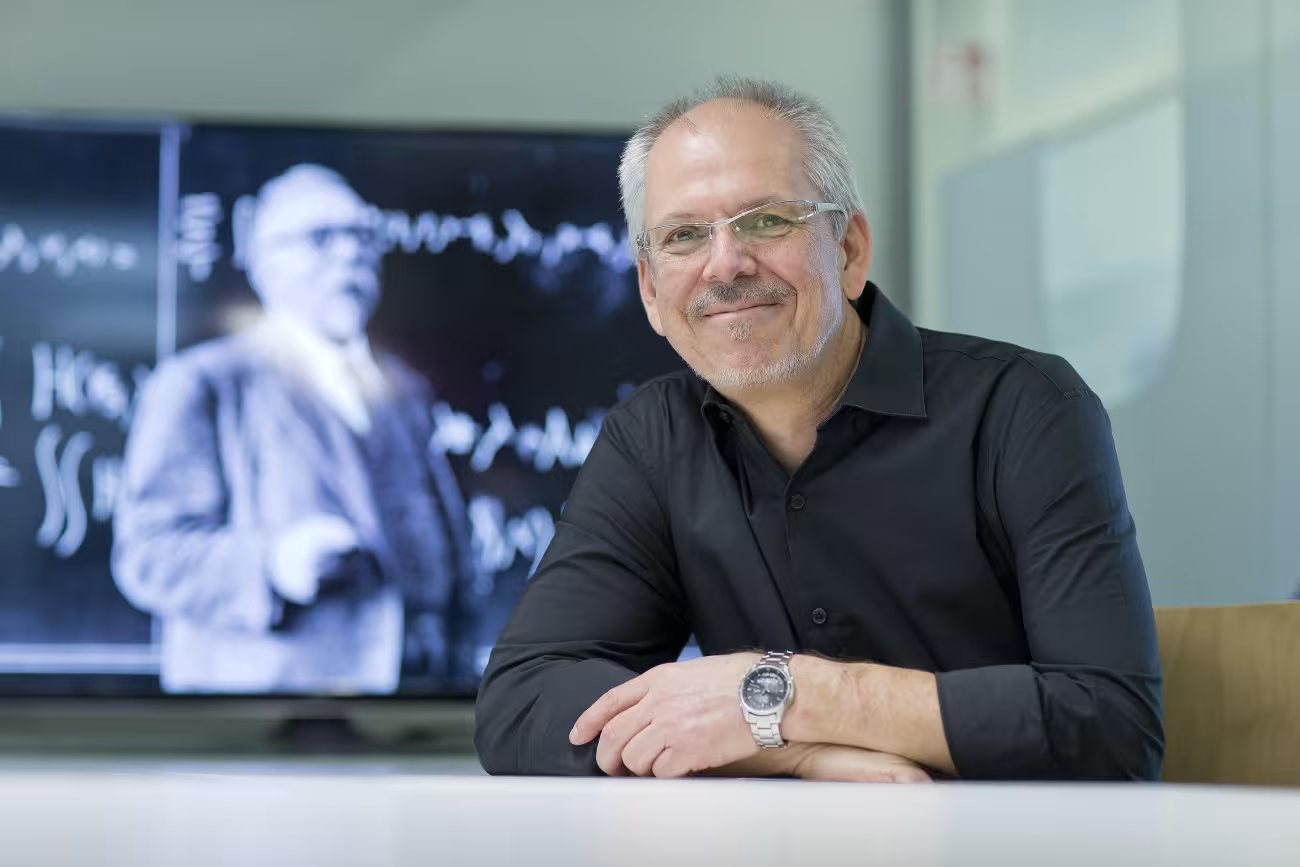
As part of the Off-Site Meeting, which takes place each year in cooperation with a different state university, Academy member Frank Allgöwer will give a public lecture in Stuttgart.
This time, the state capital, Stuttgart, is also a cooperation partner. The event is part of the “Knowledge Meets the City” series.
Whether it’s autonomous robots in factories and healthcare, artificial intelligence that makes medical diagnoses and is transforming job roles, nuclear fusion as the promise of new energy sources, or quantum computers for tasks that have been virtually impossible to solve until now: hardly any area of life remains untouched by new technologies that are developing at a breathtaking pace. Artificial intelligence is the most visible tip of a much more far-reaching development.
To understand it, it’s worth taking a look at cybernetics. It deals with dynamic systems that pursue goals, gather information from their environment, adapt their behavior accordingly, and in turn change their environment through their actions. Its central concept is the cybernetic control loop: a system perceives its state, compares it to a target, acts when deviations occur, and corrects its behavior based on the feedback. It is precisely this kind of feedback that shapes not only technical systems today, but increasingly also work, the economy, politics, and society.
We are currently feeling the impact of this most directly in two areas. First, self-learning and increasingly autonomous systems are rapidly changing the nature of the human work that is still needed—from call centers to software development, from factory floors to university research laboratories. Second, these technologies are finding their way into highly sensitive areas such as military defense. There, they can analyze information, identify objects or potential targets, and prepare courses of action—with significant implications for responsibility, control, and human decision-making autonomy.
Both examples illustrate a fundamental trend: We are transferring decision-making authority and scope for action—which until now have been the preserve of humans—to systems that learn and act autonomously. The potential consequences range from great benefits—greater prosperity, security, and solutions to pressing problems—to shifts in power, new dependencies, and the loss of effective human control.
In his lecture, Prof. Frank Allgöwer, a control engineer and cyberneticist at the University of Stuttgart, explains why cybernetic thinking is needed today more urgently than ever: not only as a technical tool, but as a general way of thinking that enables us to understand and shape the interactions between intelligent technologies, people, and social institutions.
Prof. Dr.-Ing. Frank Allgöwer is the director of the Institute for Systems Theory and Control Engineering at the University of Stuttgart.
Date: October 24, 2026
Location: Stuttgart City Hall, Marktplatz 1, 70173 Stuttgart
Start time: 10:00 a.m.
The event will be held in German.
Kybernetik, Künstliche Intelligenz, Robotik: Wer regelt eigentlich unsere Zukunft?