
Focus on Romance Studies and Medieval Studies at Heidelberg
The "Heidelberg Focus on Romance Medieval Studies" (FRM Heidelberg) aims to strengthen medieval studies in Heidelberg with a focus on Romance textual philology, linguistics, and literary studies.
The FRM Heidelberg is based at the Heidelberg Academy of Sciences and Humanities and is closely linked in terms of content to the two projects Knowledge Networks in Medieval Romance Speaking Europe (ALMA) and Bible glossaries as hidden cultural carriers, both of which are projects in Romance studies and history that deal with medieval resources, make them accessible, and conduct research on them.
The Department of Romance Studies and the Department of History at Heidelberg University are to be closely involved in the FRM’s activities.
At the former research project of the HAdW Dictionnaire étymologique de l’ancien français (DEAF)—where Stephen Dörr and Sabine Tittel, the founders of the FRM Heidelberg, received their scholarly training—an immense body of expertise in textual criticism and medieval French texts has been accumulated over the decades. This knowledge now lives on in the two projects mentioned above, which began their work in 2022 and 2023. They are being disseminated as part of university instruction (in degree programs in Romance Studies and the Interdisciplinary Master’s Program in ‘Medieval Studies’).
With the founding of the FRM Heidelberg, this is now to be placed on a stronger, institutionalized footing and further expanded.
Approximately twice a year, lectures or colloquia will be organized, to which the FRM Heidelberg will invite national and international guests. We hope that this academic exchange will benefit the faculty members of the institutes, the students, colleagues, and, of course, the ALMA and Bible Glossaries projects as well.
We would like to extend our heartfelt thanks to Pia Lorenz for designing and creating the FRM logo.
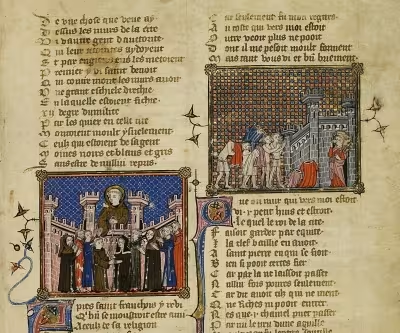 Public Domain
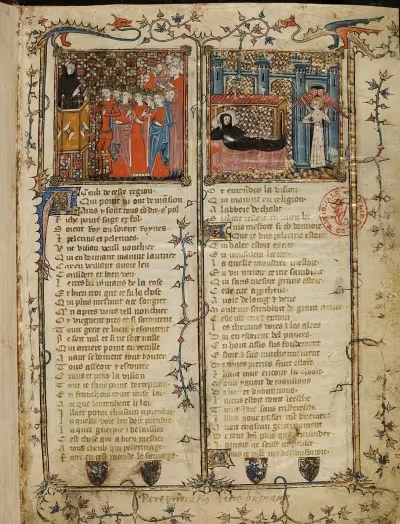
Illumination in Guillaume de Digulleville, Pelerinage de Vie humaine (Heidelberg University Library, Cod. Pal. lat. 1969 [c. 1375], folio 2r), https://digi.ub.uni-heidelberg.de/diglit/cpl1969/0009/, Public Domain
Discursive Traditions in Medieval Romania - Research Workshop, Klagenfurt, December 16, 2025
On December 16, an international conference on the topic of discourse traditions will take place in Klagenfurt, organized by the Department of Romance Languages there and the Academy project “Bible Glossaries as Hidden Bearers of Culture.” Representatives from the Academy projects “Knowledge Networks in Medieval Romance Speaking Europe (ALMA)” and “Bible Glossaries as Hidden Bearers of Culture” will participate.
Medieval Cultures of Knowledge in the Mediterranean Region: Polycentric Knowledge Transfer and the Development of Romance Technical Languages
For the Mediterranean region—and thus for the Romance languages—contact between the Arab, Jewish, Byzantine, and Latin worlds played a decisive role throughout the Middle Ages. The emergence of cultures of knowledge—and in particular the history of medicine—was also profoundly shaped by these interconnections that transcended linguistic and religious boundaries. The ALMA project, which has been funded by the Academies Program since fall 2022, aims to examine the development of the Romance languages of knowledge from 1100 to 1500 and to shed light on the cognitive-conceptual and linguistic aspects of this process. One of the domains that the project examines paradigmatically is that of medicine—a domain significantly shaped by cultural contact and knowledge transfer between ancient Greek, Jewish, and Arabic traditions and the emerging reception of these traditions in Medieval Latin and Romance vernaculars. The planned conference will examine this polycentric transfer of knowledge as one of the central prerequisites for the linguistic development processes analyzed by ALMA. In dialogue with researchers from the fields of history, the history of knowledge and science, textual philology, and linguistics, the study will examine the constellations that enable processes of contact and transfer—processes of demarcation or appropriation—in the domain of medical knowledge. This will lay the groundwork for embedding conceptual and linguistic changes within their respective contexts of reception and production and for making their historical conditioning transparent.
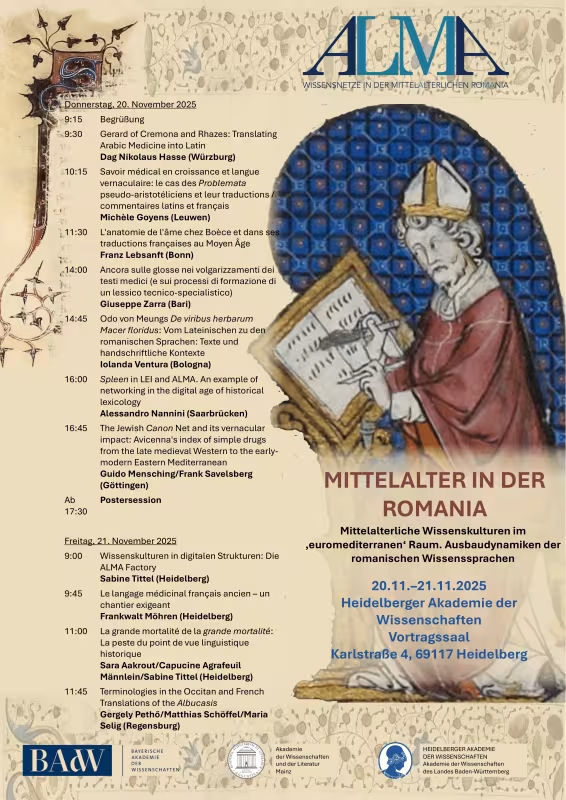 ALMA
ALMA
"List and Enumerations in Medieval Western Literature: A Comparison of the 'Romance Enumerations Repertory' and Bible glossaries as hidden cultural carriers," University of Bergamo, October 28–29, 2025
As part of the collaboration between the University of Bergamo and the Heidelberg Academy of Sciences and Humanities, an international conference on lists and enumerations will take place on October 28 and 29, at which the Academy’s project “Biblical Glossaries as Hidden Carriers of Culture” will be represented by three delegates.
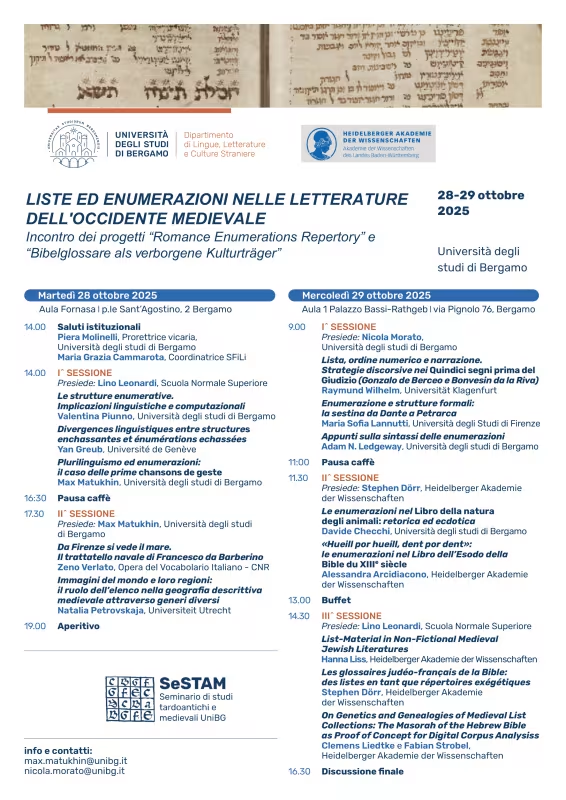 Bible Glossaries
Lecture: "What About Nouns in Maqre Dardeqe?"
On May 21, 2025, at 6:15 p.m., in the Ernst-Robert-Curtius Hall of the Department of Romance Languages at Heidelberg University, Judith Kogel will give a public lecture organized by the “Bibelglossare” project and the Abraham Berliner Center on the Maqre Dardeqe.
The Maqre Dardeqe is an alphabetically organized glossary (the oldest manuscript dates to around 1410) in which lexemes of Biblical Hebrew are listed alphabetically according to their roots. The root is followed by an Old/Middle French word; unlike in other Judeo-French glossaries, however, this word is not vocalized. The text is therefore of great interest to both Hebrew studies and Romance studies.
Ms. Kogel is a recognized expert on Judeo-French texts in general and on the Maqre Dardeqe in particular.
Download the poster for the lecture “What about nouns in Maqre Dardeqe” (PDF)
Celebration of the "Bible Glossaries" Project Partnership - University of Bergamo
The FRM Heidelberg would like to draw attention to the following event:
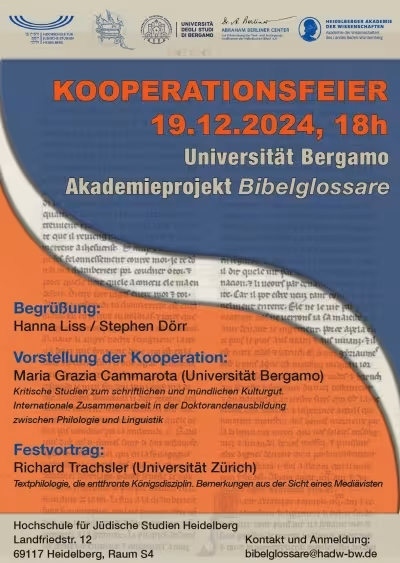
The project Bible glossaries as hidden cultural carriers and the University of Bergamo will celebrate the launch of their joint collaboration on December 19, 2024, at 6:00 p.m. Following opening remarks by Hanna Liss and Stephen Dörr, Maria Grazia Cammarato (University of Bergamo) will present the details of the collaboration, followed by a keynote address by Richard Trachsler (University of Zurich).
Everyone is warmly welcome; please register at bibelglossare@hadw-bw.de.
 Stephen Dörr
Cooperation Celebration
Advanced Seminar / Introductory Seminar+ "Textual Philology in Practice: Collaborative Work on the Edition of a Medieval French Manuscript"
The 2024–2025 winter semester will begin soon, and starting October 24, 2024, every Thursday from 9:00 to 11:00 a.m. (on time), in Room 020 of the Romance Studies Department at the University of HD, S. Tittel’s advanced seminar / introductory seminar+ on digital philological editing will take place.
Auditors are very welcome.
Description:
In this practice-oriented course focused on the methods of the digital humanities, we will work together to create a (partial) edition of one or more medieval manuscripts containing French medical or legal texts. The goal of the course will be to develop an edition of text fragments using both a simple text editor and algorithm-based, automated transcription. The transcriptions will be annotated using XML/TEI; an introduction to XML and XML/TEI will be part of the course—though prior knowledge is certainly helpful. To participate in this course, you will need your own computer (MS Windows, Mac OS, Linux), a text editor installed on it, e.g., Visual Studio Code [free] or oXygen [paid, but a university-wide license is currently being acquired] (please test before the course begins to ensure the installation was successful and that you can edit files without any issues). The theoretical, textual-philological foundation builds upon the seminar on editorial philology from the summer semester of 2024. Having taken that seminar is advantageous but not a prerequisite for participating in the course announced here.
A prerequisite for successful completion is regular and active participation, as well as the creation of your own small edition as a counterpart to a term paper.
Summer School on Textual Criticism in Klagenfurt, September 15–20, 2024
The “École d’été 2024 – Philologie romane et édition des textes” will be held at the University of Klagenfurt this year from September 15 to 20.
The summer school has been in existence for many years and is organized by Stephen Dörr (Heidelberg), Franz Lebsanft (Bonn), Richard Trachsler (Zurich), Raymund Wilhelm (Klagenfurt), and Fabio Zinelli (Paris). It enjoys great popularity and has been highly successful in providing young scholars with a solid education in textual criticism and in fostering international networks. The work done during the summer school typically culminates in a joint book publication.
For more detailed information, see the summer school’s website.
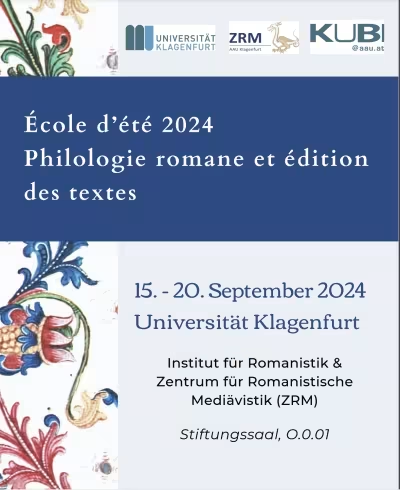 Stephen Dörr
Summer School "Romance Philology and Text Edition"
Workshop on Allographic Texts of the Romanic Middle Ages on June 4, 2024
On Tuesday, June 4, 2024, a seminar titled “French and Italian Allographic Texts in the Middle Ages” will take place in Heidelberg at the College for Jewish Studies, Landfriedstraße 12 (Room S3). At this event, scholars from the Academy project Bible glossaries as hidden cultural carriers as well as the project Manuscripta Italica Allographica (MIA), funded by the Italian Ministry of Education, will deliver a total of six presentations.
The program will follow; no registration is required.
Plakat "Journée d'étude: Allografische Texte des Mittelalters"
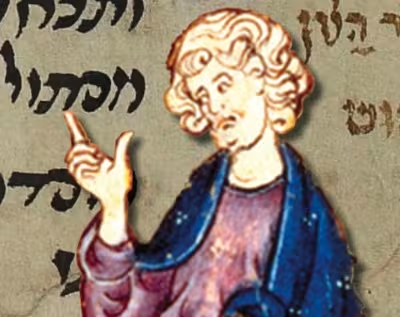 Stephen Dörr
Excerpt from the poster for "Study Day: Allographic Texts of the Middle Ages"
Heidelberg University's Medieval Day
ALMA is participating in Medieval Day at Heidelberg University, which will take place on June 8, 2024, from 2:00 p.m. to 8:00 p.m., featuring activities on Universitätsplatz and at the Neue Uni. A PDF with the program can be found here.
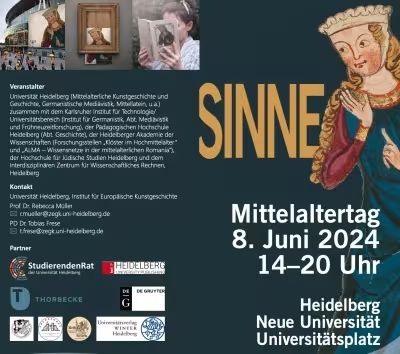 University of Heidelberg
Excerpt from the poster for Medieval Day in Heidelberg on June 8, 2024
Lecture / Seminar: "Textual Criticism: A Key to Understanding Our Language and History"
During the summer semester of 2024, S. Tittel taught a lecture and seminar on editorial philology.
Whether the reader chooses the bilingual edition of the French *Parzival* in the small Reclam volume or a multi-volume scholarly edition—they are holding not only different kinds of books, but in some cases also different versions of the same text. Behind this lie the methods and schools of textual criticism—that is, the scholarly study of the analysis of (historical) textual sources. Textual criticism is key to understanding our history and culture, as it provides textual sources not only for linguistics and literary studies but also for historical research. In the history of textual criticism, there are several scholarly schools that apply different methods of textual criticism—that is, the practical analysis of a textual source—to produce a scientifically sound edition. We aim to present these schools along with the debates among them, some of which are polemical in nature. In addition, important auxiliary disciplines such as codicology and paleography will be outlined. Special attention will be given to the significant interplay between editorial philology and lexicography on the one hand, and between editorial philology and history on the other. Finally, the course will also address the methods of compiling and publishing a text edition: traditional publication in book form versus digital and online publication using technologies and methods from the field of the digital humanities. The course combines lectures with academic exercises (in individual or group work) designed to put the theory into practice and solidify it: we will edit small passages from medieval manuscripts ourselves and conceptualize what a larger scholarly work on the manuscripts we examine might look like. To bridge the gap between the exercises and the realities of professional work, the course will also include participation in a research project focused on editorial philology.
Opening Ceremony on February 28, 2024
On Wednesday, February 28, 2024, at 6:30 p.m. , the opening ceremony of the FRM Heidelberg will take place in the Ernst-Robert-Curtius Hall of the Department of Romance Languages (Room 218) at Heidelberg University: Prof. Dr. Raymund Wilhelm (University of Klagenfurt) will deliver an opening lecture titled “The Spread of Discursive Traditions and the Development of Romance Cultural Languages—Religious Poetry in the quatrain monorime d’alexandrins in the 13th and 14th Centuries.” The event is open to everyone, and the FRM Heidelberg looks forward to a lively exchange with a large audience over a glass of wine.
Opening Remarks, Stephen Dörr / Sabine Tittel:
Ladies and Gentlemen,
Sabine Tittel and I, Stephen Dörr, are delighted that you have accepted our invitation to the opening of the Focus on Romance Medieval Studies. Before we turn the floor over to our keynote speaker, Raymund Wilhelm, we would first like to explain why we established this center.
As you may know, Sabine and I have spent many years working side by side, so to speak (to be precise: since 1997, when Sabine joined the team). We were part of the editorial team for the Dictionnaire étymologique de l’ancien français, the DEAF, at the Heidelberg Academy of Sciences and Humanities, which was originally founded by Kurt Baldinger in 1965 and was continued by Frankwalt Möhren until 2007, and finally by Thomas Städtler. The other half—the “East Team” in the office, which sat across from us as the “West Team”—was made up for the longest time by Frankwalt Möhren and Thomas Städtler (and other colleagues in the period following Frankwalt Möhren’s transition to “pseudo”-retirement). After the DEAF project was discontinued in 2020, we were assigned different tasks: Sabine joined the Altgaskognisches Wörterbuch (DAG) and the “Nepal Project” at the Academy of Sciences and Humanities, and then a research initiative here at Heidelberg University, while I joined the Lessico Etimologico Italiano (LEI) in Mannheim.
To our great surprise and delight, we were then able to secure funding for two major academy projects in 2022 and 2023, respectively: Sabine, together with Maria Selig of the Bavarian Academy of Sciences and Wolfgang Schweickard (Elton Prifti has since joined the project leadership team) of the Mainz Academy of Sciences, on the ALMA project— “Knowledge Networks in Medieval Romania,” and I, together with Hanna Liss of the Heidelberg College for Jewish Studies, the project “Bible glossaries as hidden cultural carriers.”
Both projects thus focus on the Middle Ages and thereby carry forward at least part of the DEAF’s work. Furthermore, we are both committed to continuing to apply the scholarly methods—the DEAF tradition—and passing them on to the next generation of scholars. We also aim to support this by officially launching the field of Romance Medieval Studies today. However, that alone was not the reason for founding the FRM. Rather, we have come to realize over the past few decades that medieval studies in particular have fallen far behind in German-language Romance studies. A prime example of this is textual philology.
In recognizing this, we are in good company. As Franz Lebsanft wrote in his 2012 article “Le xxie siecle: le crépuscule de la philologie romane en Allemagne?”: “In the field of historical linguistics, it is primarily the major projects in historical lexicography that sustain interest in medieval studies, even if we must admit that this interest is very limited and occupies a rather marginal position in university education [...]. On the other hand, dictionaries have not served as catalysts for a revival of theoretical issues in textual criticism in Germany, which, incidentally, is not their primary task either.”
Three years later, in 2015, Raymund Wilhelm wrote Text Editions in German Romance Studies: Current Trends and Prospects for an Uncertain Future (with a Look at the Italian Situation): “Major lexicographical projects, such as the DEAF or the LEI, which are affiliated with the Heidelberg Academy of Sciences and the Mainz Academy of Sciences, respectively, are, in fact, marginal within the academic world. Furthermore, these projects are not driven by major theoretical interests; in textual criticism, they largely follow—or followed until recently—what we might call a ‘convenient Bédierism,’ programmatically limiting themselves to a single (not even necessarily the ‘best’) manuscript … Romance philology as a field of medieval studies survives—though we do not know for how much longer—primarily thanks to non-university institutions.”
To ensure that Romance medieval studies regains greater recognition—and thus that research in the field of the Middle Ages is once again conducted more intensively—we have decided to pool our resources under the umbrella of the FRM. We plan to organize and promote several conferences and lectures each year.
In addition to today’s lecture by Raymund Wilhelm, we can already announce a study day for the summer semester, on June 4, 2024, at the College of Jewish Studies, focusing on allographic texts of the Romance Middle Ages, primarily in English and French.
Sabine will continue to focus on the Middle Ages in her teaching. And we can also envision collaborating on teaching initiatives and supporting the students. At this point, I would also like to draw attention to the Klagenfurt Summer School on Editorial Philology, where participants learn how to prepare an edition of a medieval text [see the entry further up on this page].
Developments in Romance studies—which unfortunately now make it impossible to choose Romance studies as a second specialization in the “Interdisciplinary Master’s in Medieval Studies”— and the recent discussions about what can be done from the Romance Studies perspective to counter this trend, demonstrate just how important it is to reinvigorate medieval studies in Romance languages—both in teaching and in research!
To the students here today, we can already say: There are great topics for academic theses (master’s theses, doctoral dissertations) that revolve around medieval sources and themes! And with that, I’m very pleased to hand the floor over to Raymund Wilhelm, who, as a renowned medievalist and philologist, will demonstrate how linguistics and literary studies can intertwine!
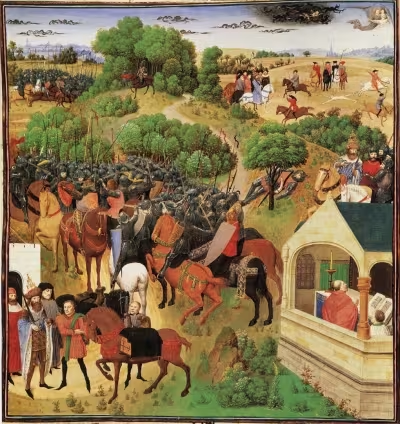 Public Domain
From *The Song of Roland*, Simon Marmion,*Grandes Chroniques de France*, St. Petersburg, Hermitage Manuscript.fr.88 [Dutch Burgundy, mid-15th century], copy belonging to Philip the Good, folio 154v, https://commons.wikimedia.org/w/index.php?curid=1913372.
Pilgrimage of Human Life (PelVieD)
The edition of Guillaume de Digulleville’s *Pelerinage de Vie humaine* was published by the DEAF 2013 team in collaboration with contributions from Wolfgang Metzger and Karin Zimmermann and under the editorship of Veit Probst by the Wissenschaftliche Buchgesellschaft in Darmstadt. The limited edition sold out very quickly.
The book is now available online on the Heidelberg University Library website, see https://doi.org/10.11588/diglit.70826.
For further information, see the DEAF call number PelVieD.
Heidelberg University Library