
Epigraphic Database of Roman Inscriptions (EDH)
Duration: 1986 to 2021
Since 2022, the EDH has been accessible through Heidelberg University. There, it can be accessed via the Specialized Information Service for Classical Studies Propylaeum (external link).
The mission of the Heidelberg Epigraphic Database (EDH) is the systematic cataloging of ancient Latin and bilingual (primarily Latin-Greek) inscriptions in a comprehensive database. Due to its interdisciplinary design and methodology, it ranks among the world’s leading database projects for the rapid collection and reliable historical analysis of epigraphic evidence. The distinctive features of the EDH lie in the regional classification system, the flexible combinability of the stored metadata, and the cross-linking of the Epigraphic Text Database (external link) with the three other sub-databases of the EDH: the Epigraphic Bibliography (external link), the Epigraphic Photo Library (external link), and the Epigraphic Geography Database (external link).
Their goal is to make the epigraphic documentation of the provinces of the Roman Empire as complete and reliable as possible for online research by the year 2020 (the project’s completion date). Pursuant to a resolution by the Commissione epigrafia e informatica of the AIEGL (external link) in 2003 to establish the International Epigraphic Database Federation EAGLE (Electronic Archives of Greek and Latin Epigraphy), the EDH has since been responsible for maintaining the inscriptions from the Roman provinces, while the inscriptions from Italy that had already been recorded by the EDH were transferred to the Epigraphic Database Rome (EDR) (external link). The purpose of the EAGLE Federation is to make as many Latin and Greek inscriptions from antiquity as possible accessible on the Internet according to uniform criteria. To this end, the EDR was founded in close cooperation with the EDH and modeled after it.
With the completion of the intended database, the project was successfully concluded at the end of 2021.
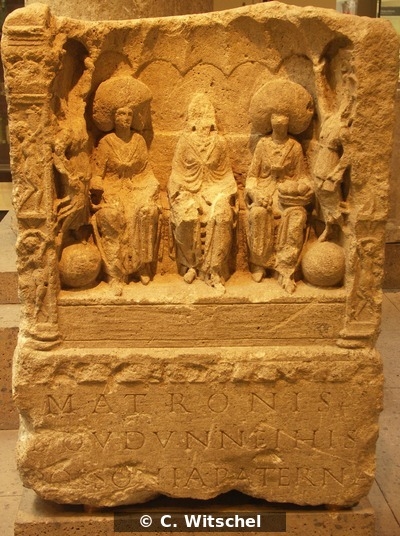
Dedicatory Inscription from Cologne
The Concept
The Epigraphic Text Database (external link) is the centerpiece of the EDH and comprises approximately 81,000 inscriptions. These are almost exclusively previously published texts that have not only been edited in the major inscription corpora—which, in many cases, still adhere to modern textual-critical standards that are often no longer sufficient—but have also, and in particular, been published, revised, and discussed in thousands of scholarly articles. The texts and metadata of the inscriptions are thus presented against the backdrop of the current state of research. One of the fundamental principles guiding the EDH’s methodology is not to adopt readings from editions and other secondary literature without verification. Rather, whenever possible, these are verified at a minimum using drawings or photographs—the latter largely drawn from the collections of the Epigraphic Photo Library—and ideally also through direct examination, with the exact basis for verification displayed to the user via the Processing Status field.
The processing of inscriptions for the Epigraphic Text Database is based, on the one hand, on an extensive card index that has been growing steadily since the project’s inception, in which the publications recorded in L' Année Épigraphique (external link) since 1888, and, on the other hand, in accordance with the EDH’s regional working principle, on the relevant corpora and local publications. In addition, the EDH maintains a lively exchange with domestic and international researchers and research institutions in order to incorporate their specific, often regionally distinct expertise into the EDH through external collaboration.
On the History of the EDH
The project was initiated in 1986 by Géza Alföldy († 2011) as a five-year initiative within the framework of the Gottfried-Wilhelm-Leibniz Program and has been further funded since 1991 by the Fritz Thyssen Foundation (external link). Since 1993, the EDH has been a research project of the Heidelberg Academy of Sciences and Humanities. The goal of the research project is to record and process Latin and bilingual (Latin-Greek) inscriptions from the Roman Empire in a comprehensive database and to present them in a user-friendly manner on the Internet.
The epigraphic documents are presented with verified transcriptions and accompanied by approximately 1.4 million pieces of research-relevant metadata, as well as photographs. The EDH has thus established itself internationally as a tool for the comprehensive review, supplementation, and interdisciplinary analysis of epigraphic evidence.
Since September 1997, the Inscription Database, containing all available information on inscriptions and their carriers, has been gradually made available to the public via the Internet. Since 2004, the Heidelberg Epigraphic Bibliography has also been available online. Since 2007, the complete collection of the Heidelberg Epigraphic Photo Library has been available online, along with key information on the inscribed texts depicted, and is linked to the corresponding records in the epigraphic database. The exact locations of the sites are determined via entries in the Geography Database, which was established in 2012 and is linked to the inscription database.
Under the auspices of the Commissione epigrafia e informatica of the AIEGL (Association Internationale d'Epigraphie Grecque et Latine), a decision was made in 2003 to establish the international epigraphic database federation EAGLE-europeana-Network. Currently, in addition to the regular expansion of the epigraphic dataset on the Roman provinces in the EDH, work is underway on a concept to ensure the reusability of the data and infrastructure through the use of open standards and methods of the digital humanities.
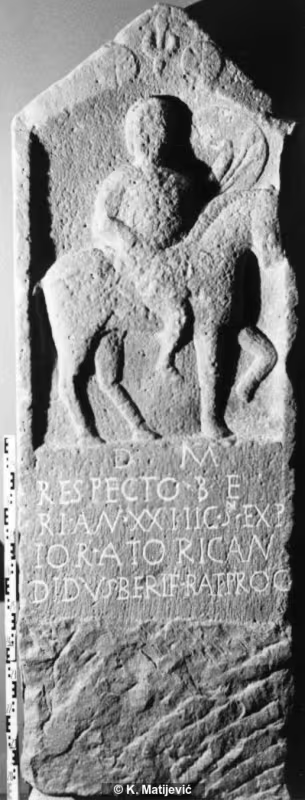
Grave Stele from Heidelberg (http://edh-www.adw.uni-heidelberg.de/edh/inschrift/HD031872)