
September 22, 2026
Hans-Georg Kräusslich Re-elected as President of the Heidelberg Academy of Sciences and Humanities – Thomas Maissen Becomes New Vice President
The Heidelberg Academy of Sciences and Humanities has re-elected virologist Hans-Georg Kräusslich as president for another three years. His new term begins on October 1, 2026. Historian Thomas Maissen was elected as the new vice president. He will also take over the position of Vize President of the Philosophical and Historical Class from Sabine Dabringhaus.
Kräusslich, a virologist at Heidelberg University’s Faculty of Medicine, has led the Academy since 2023. He previously served as Vize President of the Mathematical and Natural Sciences class—and thus as vice president on the Executive Board—from 2015 to 2019.
“I am very pleased about my reelection, which I see as a confirmation by the Academy members of our work over the past few years,” says Kräusslich. “The Heidelberg Academy of Sciences and Humanities represents the scientific community in the state of Baden-Württemberg and is a strong voice for science as a whole. It remains a special venue for interdisciplinary and cross-cultural discourse, with a mission to explore cultural heritage through long-term, impactful basic research and to provide society and policymakers with expert and transparent scientific advice. Of particular importance to me is the scholarly exchange with the members of the Academy, the Young Academy, and the research projects. The spirit of collaboration within the Academy intrinsically fosters the emergence of new ideas and research topics that transcend the boundaries of one’s own Field of expertise and can thus make significant contributions to the study of key issues for the future.”
Greater Engagement with the Public and Young People
A key focus of his second term will be on strengthening scientific discourse and engagement with young people. As the State Academy of Baden-Württemberg, the Heidelberg Academy of Sciences and Humanities intends to further expand its programs for high school students and promote direct dialogue on current issues. “Young people in particular have many questions and want to engage with current developments. With their expertise, our members can provide important impetus and initiate early dialogue on topics such as fake news or the opportunities and risks of artificial intelligence,” said Kräusslich. The Academy views dialogue between the scientific community and the public as a central mission. Through public events and new formats for schools, it intends to continue contributing to conveying scientific findings in an accessible manner and strengthening societal discourse.
Thomas Maissen: “An Institution with Great Responsibility”
Effective October 1, historian Thomas Maissen will take over the position of Vize President of the Philosophical and Historical Class from Freiburg-based historian Sabine Dabringhaus. Together with chemist Lutz Gade, Vize President of the Mathematical and Natural Sciences class, and President Hans-Georg Kräusslich, he will then form the Academy’s new Executive Board.
The Heidelberg Academy is a matter close to Maissen’s heart. He has been an elected member since 2006. He regularly attended Academy meetings even while he was director of the German Historical Institute in Paris for ten years. Over the years, he has been actively involved in many ways, including through events on current topics such as “Natural Time—Cultural Time?” As Vize President, he wishes to continue the successful work of his predecessor and states: “The Heidelberg Academy of Sciences and Humanities is the state academy of Baden-Württemberg and at the same time enjoys international influence thanks to its partners located around the world and its outstanding research projects. Helping to steer such an institution is both a privilege and a great responsibility. Especially in politically turbulent times, when academic freedom is at stake in many places, our Academy should provide a space for civil yet controversial intellectual debates that transcend disciplinary, gender, and generational boundaries. In this regard, I am particularly looking forward to welcoming new members from diverse backgrounds.”
Prof. Dr. Dr. h. c. Hans-Georg Kräusslich studied medicine in Munich and earned his doctorate in 1985. Following a research fellowship in the U.S., he founded a research group on HIV replication and transmission at the German Cancer Research Center in 1989. After five years as director of a Leibniz Institute in Hamburg, he has headed the Department of Virology at Heidelberg University since 2000. He served as spokesperson for two Collaborative Research Centers and the Cluster of Excellence “Cellular Networks.” From 2019 to 2023, Kräusslich served as dean of the Heidelberg Medical Faculty. He has published over 250 scientific articles and is active on numerous scientific committees. The virologist has been a member of the Heidelberg Academy of Sciences since 2007. He is also a member of the Leopoldina and has received numerous awards, including an honorary doctorate from Charles University in Prague in 2021 and the Staufer Medal in Gold in 2022, which was awarded to him for outstanding services to the state of Baden-Württemberg.
Prof. Dr. Thomas Maissen has been a professor of modern history with a focus on the early modern period at Heidelberg University since 2004. Among other roles, he served as co-director of the DFG Cluster of Excellence “Asia and Europe in a Global Context” and as a fellow at the Institute for Advanced Study in Princeton. From 2013 to 2023, he served as director of the German Historical Institute in Paris (DHIP). Since returning to his professorship at Heidelberg University, he has served as spokesperson for the project “The Aggressor: Self-Perception and Perception by Others of an Actor between Nations,” funded by the Daimler and Benz Foundation. His research focuses in particular on the history of memory and political ideas.
Maissen has been a member of the Heidelberg Academy of Sciences and Humanities since 2006.
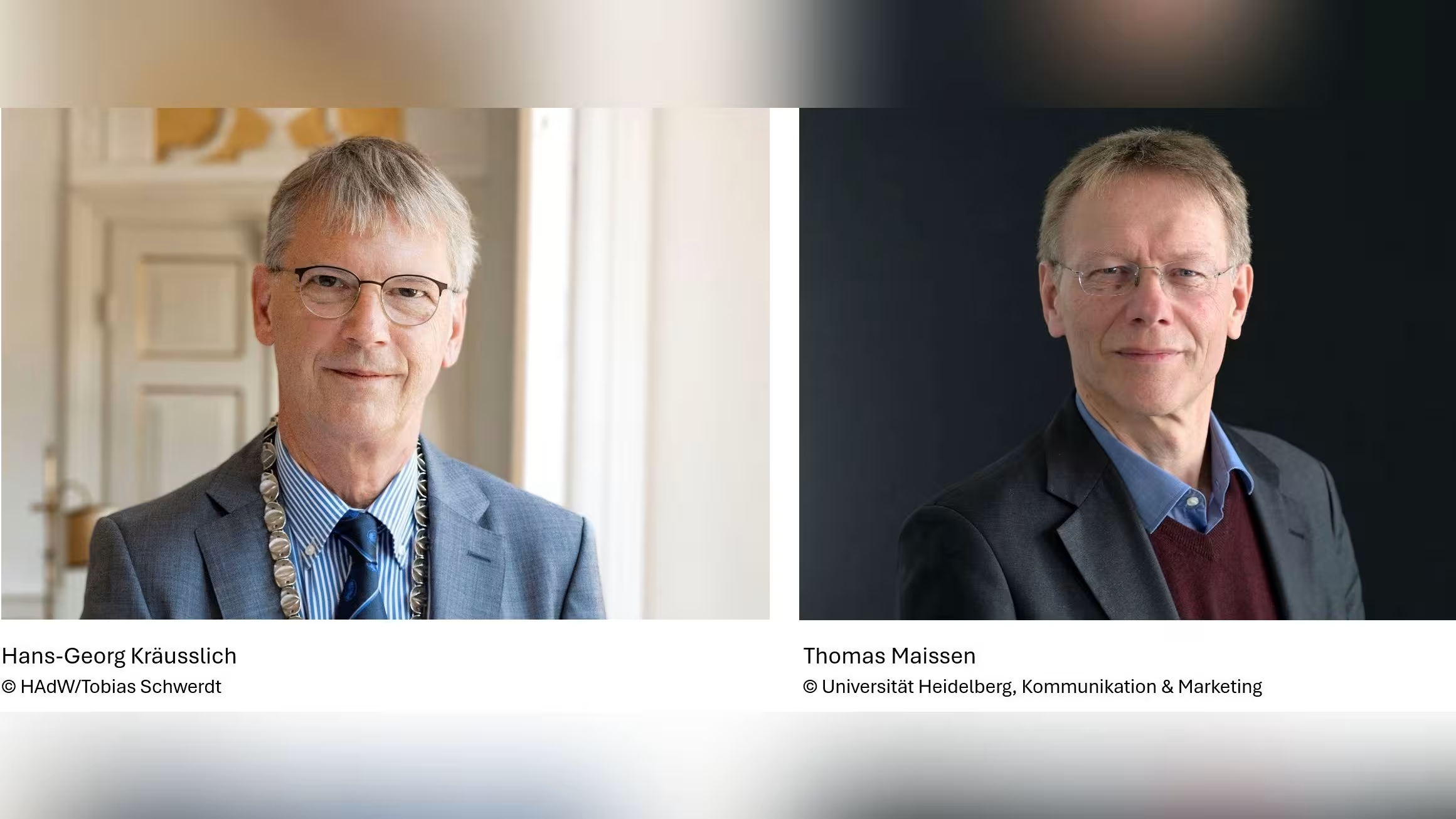 HAdW/Tobias Schwerdt (left) and Heidelberg University/KUM (right)