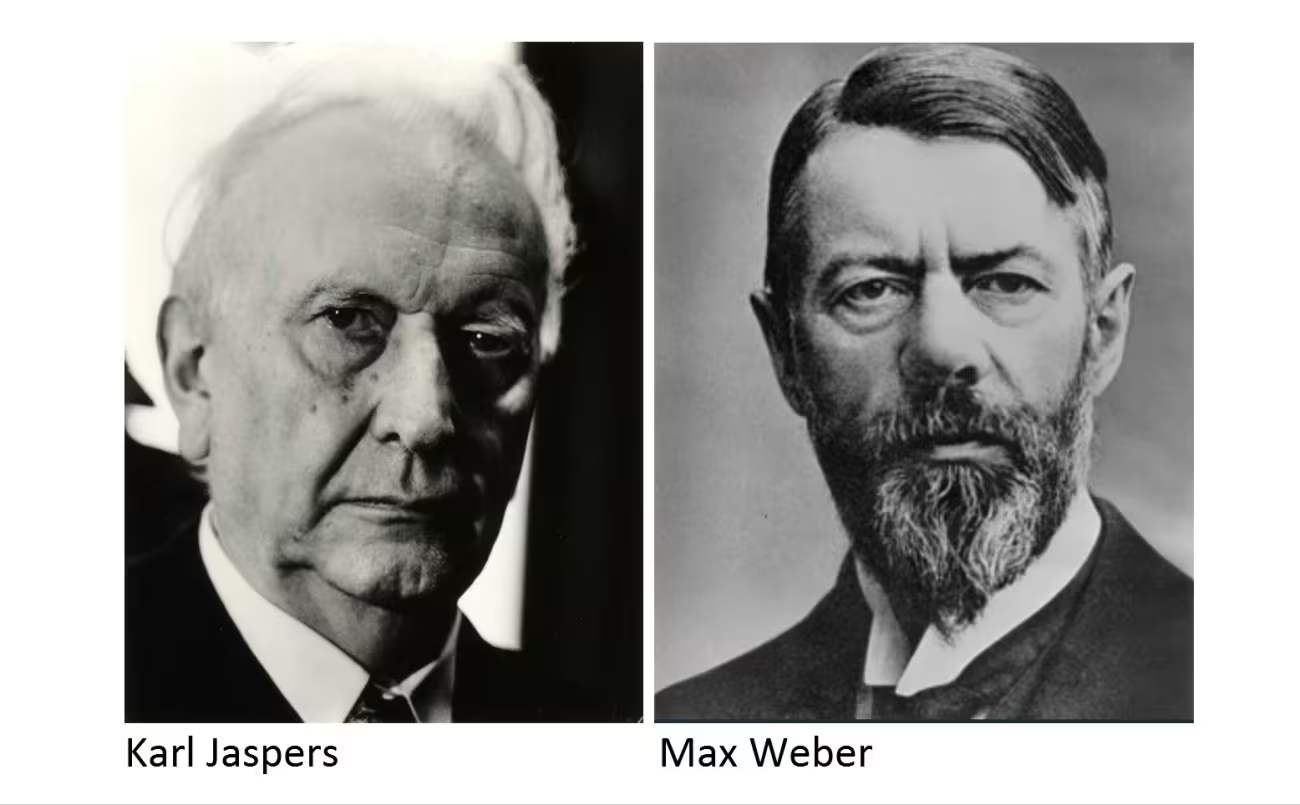
Karl Jaspers and Max Weber
Workshop of the interacademic research project “Karl-Jaspers-Gesamtausgabe (KJG)”
The topic of the workshop organized by the Karl-Jaspers-Gesamtausgabe (KJG) is the recently launched edition of the writings on Max Weber (KJG I/19), whom Jaspers described as the “greatest German of our age”; and through him, one can also see “what a philosopher is today.”
First, Edith Hanke, longtime editor and editor-in-chief of the Max Weber Complete Works (MWG), will report on the completion of the edition in 2020 and on her current project: the digital edition of the MWG. Dirk Fonfara then discusses the structure of the KJG volume dedicated to Max Weber. It primarily contains works published during Jaspers’ lifetime, including: Max Weber. A Memorial Address (1921) and Max Weber. Politician, Researcher, Philosopher (1932, 4th ed. 1958). However, Jaspers’ characterization of Weber in the monograph differs significantly from that in the memorial address, as Bernd Weidmann explains in more detail. The volume also includes previously unpublished or only partially published posthumous texts: for example, the draft of a speech on the occasion of the 10th anniversary of Max Weber’s death (1930), a “Concluding Characterization” from the lecture series “Philosophy of the Present” in the winter semester of 1960–61, and “Final Notes” from the late 1960s, e.g., regarding Weber’s illness. The volume is rounded out by selected relevant correspondence concerning Max Weber.
It is not without significance that Max Weber’s nephew, Eduard Baumgarten, provided Jaspers with letters between December 1962 and February 1963 that prove Max Weber was in an intimate relationship with his former doctoral student, Else Jaffé-von Richthofen. Did this revelation about Max Weber as a person have a negative impact on Jaspers’s image of Max Weber as a philosopher? How did Jaspers later react to invitations to events marking Max Weber’s 100th birthday (1964) and to the suggestion by his publisher, Klaus Piper, to reprint the Weber writings in the anthology *Aneignung und Polemik* (published in 1968)?
The event is open to the public. Interested parties are cordially invited.
Please register informally at: dirk.fonfara@hadw-bw.de
Date: November 11, 2024
Location: Lecture Hall of the Heidelberg Academy of Sciences and Humanities
Start time: 2:00 p.m.
Speaker: Dr. Edith Hanke (BAdW)
Speakers: Dr. Dirk Fonfara and Dr. Bernd Weidmann (both HAdW)
Contact: dirk.fonfara@hadw-bw.de