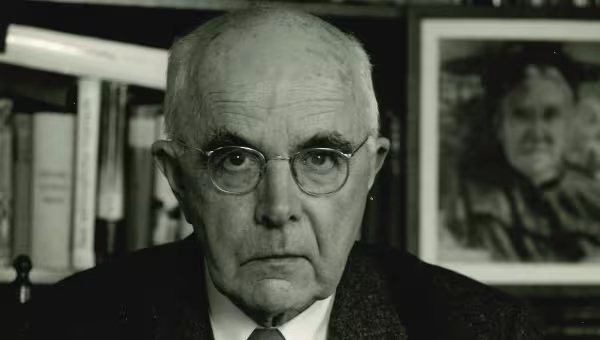
Karl Freudenberg Award

The Karl Freudenberg Award was established in 1986 to mark the 100th anniversary of Karl Freudenberg’s birth by the Freudenberg Group (external link) in 1986 to mark the 100th anniversary of Karl Freudenberg’s birth, with the aim of promoting young scientists in Baden-Württemberg. The award recognizes scientific work in the natural sciences, particularly in chemistry and biology.

The prize is endowed with 10,000 euros.

Who is eligible for nomination?

Researchers should be no older than 35 years of age. The proposed work must have been published or submitted for publication within the past two years. If multiple authors have made significant contributions to the award-winning work, the award may be awarded to them in equal shares; however, it cannot be divided among several independent works.

Who may submit nominations?
  • All members of the Mathematical and Natural Sciences class of the Heidelberg Academy of Sciences and Humanities
  • All heads of academic institutions at the universities of Baden-Württemberg (rectors, deans, Managing Directors, institute directors)
  • All Managing Directors of non-university research institutions in Baden-Württemberg
  • Self-nominations are not permitted
The Donor

Founded in 1849 by Heinrich Christian Heintze and Carl Johann Freudenberg as a tannery, the Freudenberg Group (external link), one of the most important developments in sealing technology was launched: the Simmerring. With this, the company began diversifying into a wide range of business sectors and has since evolved into a globally active technology company.

Karl Freudenberg was born on January 29, 1886, as the third son of Hermann Ernst Freudenberg, who ran the company as part of the second generation alongside his brother, and grew up with nine siblings.  He studied chemistry and, after holding various positions, was appointed to a professorship at Heidelberg in 1926, a position he held until his retirement in 1956. Freudenberg researched the structure of cellulose and its polymerization mechanism. He also formulated the optical displacement theorem.

In 1926, he was admitted as a full member of the Heidelberg Academy of Sciences and Humanities. From 1943 to 1949, he served as Vize President of the Academy.

Karl Freudenberg died on April 3, 1983, at the age of 98.

The Award Recipients

The award was presented for the first time in May 1988. The first recipient was Professor Dr. Wolfram Sander (external link), who currently holds the Chair of Organic Chemistry at Ruhr University in Bochum. Read in our magazine "Athene" 2/2018 (PDF) on page 15 and following, how he recalls the 30th Award Ceremony in 2018 in an interview.

The award winners since 1988:

JahrNameTitel
2026Rosławska, AnnaSubmolecular-scale control of phototautomerization
2025Baur, MaximilianCatalytic synthesis of in-chain keto-functionalized polyethylene materials
2024Schunck, NatalieIn vivo Olefin Metathesis in Microalgae Upgrades Lipids to Building Blocks for Polymers and Chemicals
2023Delaunay, SylvainMitochondrial RNA modifications shape metabolic plasticity in metastasis
2022Anggara, KelvinIdentifying the Origin of Local Flexibility in a Carbohydrate Polymer
2022Mateus, AndréThe functional proteome landscape of Escherichia coli
2021Yan, JingCoupling of NMDA receptors and TRPM4 guides discovery of unconventional neuroprotectants
2020Exposito-Alonso, MoisesDiverse Arbeiten auf dem Gebiet der molekularen Entwicklungs- und Evolutionsbiologie
2019Lu, YiForschungsgebiet: magnetische und supraleitende Zustände in Materialien mit stark korrelierten Elektronen
2018Döring, Kristina„Profiling Ssb-Nascent Chain lnteractions Reveals Principles of Hsp70-Assisted Folding“
2017Bleith, TimReaktionsmechanismen der enantioselektiven, eisenkatalysierten Hydrosilylierung von Ketonen und der enantioselektiven, zinkkatalysierten Alkylierung von Oxindolen
2016Hansmann, MaxCorrelating the Reactivity of Gold and Boron Electrophiles
2015Böhmer, Anna ElisabethCompeting Phases in Iron-Based Superconductors Studied by High-Resolution Thermal Expansion and Shear-Modulus measurements
2014Floßdorf, MichaelStochastic T cell fate decisions
2013Mauceri, DanielaNuclear Calcium-VEGFD Signaling Controls Maintenance of Dendrite Arborization Necessary for Memory Formation
2012Mutschler, HannesA Novel Mechanism of Programmed Cell Death in Bacteria by Toxin-Antitoxin Systems Corrupts Peptidoglycan Synthesis
2011Schock-Kusch, DanielEntwicklung neuer Substanzen zur Bestimmung der Nierenfunktion: Farbmarkierte Fruktosane
2010Diederichs, SvenVerbindung des Gebiets der Molekularbiologie von nicht-codierenden RNAs mit Fragestellungen der Tumorbiologie
2009Lisker, ThorstenVirgo Cluster Early-Type Dwarf Galaxies
2008van der Laan, MartinRekonstitution der Membraninsertion von mitochondrialen Vorstufenproteinen
2007Ludwig-Peitsch, Wiebke KatharinaDas Aktin-bindende Protein Drebrin E2: Molekulare Funktionen und diagnostische Bedeutung
2006Müller, Ann-KristinFunktionelle Charakterisierung Plasmodium Sporozoiten-spezifischer Gene im Malaria-Mausmodell
2005Legler, Daniel F.Signalübertragung in Membranmikrodomänen entscheidet über Leben und Tod von Tumorzellen
2004Berges, JürgenDynamik fern des Gleichgewichts und Thermalisierung von Quantenfeldern
2004Schwappach, BlancheZelluläre Lokalisationssignale für den intrazellulären Transport und die Qualitätskontrolle von Kanalproteinen
2003Lyko, FrankArbeit zur Entdeckung des DNA-Methylierungssystems in Drosophila
2002Goldfuß, BerndStruktur, Reaktivität und Selektivität elementorganischer Reagenzien und Katalysatoren
2001Meyer, FrancKooperierende Metallzentren in Mehrkernkomplexen multidentaler Pyrazolatliganden
2000Loose, MarkusEin CMOS-Bildsensor mit automatischer Kalibrierung und logarithmischem Antwortverhalten
1999Hunger, JohannesGenetische Algorithmen und neuronale Netzwerksimulationen zur Kraftfeldparameterentwicklung am Beispiel der Modellierung von Tripod-Metall-Komplexen
1999Schulz, ChristofEntwicklung und Anwendung eines Laserinduzierten Fluoreszenzverfahrens zur quantitativen Bestimmung momentaner Stickoxidverteilungen in Verbrennungsmotoren
1998Niehrs, ChristofArbeiten zur Aufklärung des molekularen Mechanismus der Kopfinduktion
1997Schmidt, ChristianEntwicklung eines neuen Atomstrahl-Spinecho-Spektrometers für die Untersuchung des dynamischen Verhaltens zweidimensionaler Systeme
1996Wolff, JensMehrfach Donor-Akzeptor-substitierte pi-Systeme: Zusammenhänge zwischen Konformation, elektronischer Struktur und nichtlinear optischen Eigenschaften
1995Niemz, MarkolfZu elementaren Wechselwirkungsarten zwischen Laserlicht und biologischem Gewebe
1994Lobreyer, ThomasEine neuartige Synthesestrategie zu CVD-geeigneten Prozeßgasen
1993Mechtersheimer, GunhildTowards the phenotyping of soft tissue tumors by cell surface molecules
1992Grützmacher, HansjörgPhosphor- und Zinnverbindungen mit schwachen II-Bindungen: Synthesen, Strukturen und Reaktivität
1991Lichter, PeterHochauflösungskartierung von Chromosom 11 über in situ Hybridisierung mit Cosmidklonen
1990Lindpaintner, KlausStrukturelle Veränderungen des Renin-Gens in spontan hypertensiven Ratten: Untersuchungen zur Beziehung zwischen Genotyp und Phänotyp
1989Klempnauer, Karl-HeinzÜber das nukleäre Tumorgen Myb
1988Sander, WolframÜber Carbonyl-Oxide und Dioxirane


Nomination Deadline

Annually, March 1–June 30

What must be submitted?
  • Cover sheet

  • Justification for the proposal (maximum of two pages)
  • Curriculum Vitae
  • List of Publications
  • HAdW

The documents should be submitted as a single PDF file and sent to hadw[at]hadw-bw.de .

When will the decision be made?

The Academy will announce its decision at the beginning of the year. The award recipient and their mentor will be notified of the result in writing.

Do you have any questions?

You can reach us by phone at 06221 54-3265 or by email at hadw[at]hadw-bw.de .

If you wish to send the documents by mail, please send them to:

Heidelberg Academy of Sciences and Humanities
Executive office
Karlstraße 4
69117 Heidelberg