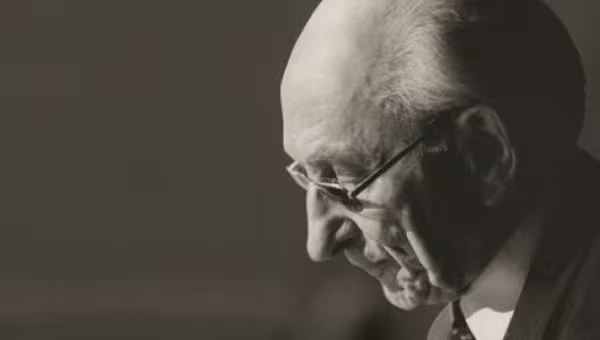
Walter Witzenmann Award

In recognition of the great importance of research in the humanities and social sciences, the company Witzenmann GmbH (external link) established the Walter Witzenmann Award in 1997 to support early-career researchers in Baden-Württemberg. Preference is given to works that address significant social and cultural changes and/or the possibilities and impacts of technological transformation, and—in the case of historical studies—demonstrate a connection to the present.

The award is endowed with 10,000 euros.

Who is eligible for nomination?

Researchers should be no older than 35 years of age. The proposed works must have been accepted as scholarly achievements by a university or research institute in the state of Baden-Württemberg and must have been published or submitted for publication within the past two years. If multiple authors have made significant contributions to the awarded work, the award may be awarded to them in equal shares.

Who may submit nominations?
  • All members of the Philosophical and Historical Class of the Heidelberg Academy of Sciences and Humanities
  • The leadership of all academic institutions at universities in Baden-Württemberg (rectors, deans, Managing Directors, heads of institutes)
  • the leadership of all non-university research institutions in Baden-Württemberg (Managing Directors)
  • Self-nominations are not permitted

In 1854, Heinrich Witzenmann and a business partner founded a jewelry factory in Pforzheim. Their invention of the metal hose opened up a new, promising industry for the two entrepreneurs, leading them to abandon jewelry manufacturing. Today, the Witzenmann Company (external link) operates worldwide as a manufacturer of metal hoses, expansion joints, and automotive parts, among other products, with more than twenty subsidiaries.

The entrepreneur and local politician Walter Witzenmann (external link) (1908–2004) studied economics and sociology; in 1935, he earned his Ph.D. under Alfred Weber in Heidelberg. He then worked at Witzenmann, which he later led for decades as the third-generation head of the company.

Walter Witzenmann passed away on August 15, 2004, the year in which Witzenmann GmbH celebrated its 150th anniversary.

Major cultural and technological changes and transformations in societies: Since 1998, a wide variety of works from a broad range of research fields have been honored in this context.

All previous award recipients:

JahrNameTitel
2026Kanz, HannahOffline-Sein. Eine Ethnographie von Praktiken der Entnetzung
2025Linder, SimonEine streitende Kirche in digitaler Gegenwart. Warum eine Theologie der Digitalität nach Synodalität und Streitkultur verlangt
2024Zschoche, Paula JohannaHaftung der Gewerkschaft für Arbeitskämpfe
2023Jebe, JohannaRegeln, Schrift, Correctio – Karolingerzeitliche Entwürfe von Mönchtum im Spiegel der Schriftproduktion aus St. Gallen und Fulda
2022Bossert, Leonie N.Gemeinsame Zukunft für Mensch und Tier – Tiere in der Nachhaltigen Entwicklung
2021Rothenburg, DanielToo Much Water. Irrigation, Salinity, and Communities in the Murray-Darling-Basin, Australia. An Enviromental History
2020Stille, MaxIslamic Sermons and Public Piety in Bangladesh: The Poetics of Popular Preaching
2019Reinhardt, KarolineKant und die Migration. Eine Untersuchung zur systematischen Aktualität des Weltbürgerrechts
2018Cubelic, Simon„Die koloniale Restauration des Dharmaśāstra. Das Obligationenrecht in Sarvoru Śarmans Vivādasārārņava“
2017Rauber, JochenStrukturwandel als Prinzipienwandel. Theoretische, dogmatische und methodische Bausteine eines Prinzipienmodells des Völkerrechts und seiner Dynamik.
2016Begass, ChristophDie Senatsaristokratie des Oströmischen Reiches, ca. 457–518. Prosopographische und sozialgeschichtliche Untersuchungen
2015Domisch, JörgZur Frage eines Besitzübergangs auf den Erben im klassischen römischen Recht
2014Dangel, TobiasHegel und die Geistmetaphysik des Aristoteles
2013Thomale, ChrisLeistung als Freiheit ‒ Erfüllungsautonomie im Bereicherungsrecht
2012Maier, Felix K.Überall mit dem Unerwarteten rechnen – Die Kontingenz historischer Prozesse bei Polybios
2011Eickmeyer, JostDer jesuitische Heroidenbrief. Zur Christianisierung und Kontextualisierung einer antiken Gattung in der Frühen Neuzeit
2010Stockhammer, Philipp WolfgangKontinuität und Wandel ‒ Die Keramik der Nachpalastzeit aus der Unterstadt von Tiryns
2009Herzberg, Stephan UlrichWahrnehmung und Wissen bei Aristoteles
2008Sigelen, AlexanderZacharias Geizkofler (1560‒1617). Fürstendienst und Familienpolitik. Eine biographische Fallstudie zur politischen Kultur im Heiligen Römischen Reich um 1600
2007Beßlich, BarbaraDer deutsche Napoleon-Mythos. Literatur und Erinnerung (1800‒1945)
2006Krüger, ChristineSind wir denn nicht Brüder? Deutsche Juden im nationalen Krieg 1870/71.
2005Tumat, AntjeDichterin und Komponist: Ästhetik und Dramaturgie in Ingeborg Bachmanns und Hans Werner Henzes »Der Prinz von Homburg«
2004Deutsch, AndreasDer Klagspiegel und sein Autor Conrad Heyden. Zu Entstehung, Inhalt und Bedeutung eines Rechtsbuchs der Rezeptionszeit
2003Valk, ThorstenMelancholie im Werk Goethes. Genese ‒ Symptomatik ‒ Therapie
2002Jung, SabineDie Logik direktdemokratischer Verfahren
2001Korn, LorenzAyyubidische Architektur in Ägypten und Syrien ‒ Bautätigkeit im Kontext von Politik und Gesellschaft 564‒658 / 1169‒1258
2000Lobinger, ThomasRechtsgeschäftliche Verpflichtung und autonome Bindung. Zu den Entstehungsgründen vermögensaufstockender Leistungspflichten im bürgerlichen Recht
1999Brockhaus, CathrinAphra Behn und ihre Londoner Komödien: Die Dramatikerin und ihr Werk im England des ausgehenden 17. Jahrhunderts
1998Roth, Johannes GeorgAlfeni Digesta. Untersuchungen zu einer spätrepublikanischen Juristenschrift
Nomination period:

March 1 – June 30 each year

What must be submitted?
  • Cover sheet

  • Justification for the proposal (maximum of two pages)
  • Resume
  • List of publications
  • award-winning work as well as the two doctoral and/or habilitation reports.

The documents should be submitted as a single PDF file and sent to hadw[at]hadw-bw.de.

When will the decision be made?

The Academy will announce its decision at the beginning of the year. The award recipient and their mentor will be notified of the result in writing.

Do you have any questions?

If so, you can reach us by phone at 06221 54-3265 or by email at hadw[at]hadw-bw.de.

If you wish to send the documents by mail, please send them to:

Heidelberg Academy of Sciences and Humanities
Executive office
Karlstraße 4
69117 Heidelberg