
Knowledge Networks in Medieval Romance Speaking Europe (ALMA)
Due to the transition to our new website, there may be occasional technical issues at this time. We are already working to resolve them and appreciate your understanding.

ALMA is an inter-academic project of the Heidelberg Academy of Sciences and Humanities (HAdW), the Bavarian Academy of Sciences (BAdW), and the Academy of Sciences and Literature in Mainz (AdW Mainz). Under the direction of Prof. Dr. Maria Selig (BAdW), Prof. Dr. Elton Prifti, Senior Prof. Dr. Dres. h.c. Wolfgang Schweickard (AdW Mainz), and Priv.-Doz. Dr. Sabine Tittel (HAdW), three research centers have been established in Heidelberg, Munich, and Saarbrücken, with a total of seven staff members. The research centers take turns serving as the lead institution for the project. Initially, the Heidelberg Academy will serve in this role. The total duration is set at 22 years.
The project aims to investigate the interaction between language and knowledge (and scholarship) in the Romance cultural sphere, where, from the 12th to the 15th century, new vernacular knowledge networks emerged and the vernacular languages (Old French, Old Italian, etc.) were developed into technically complex languages of knowledge.
The ALMA project combines methods from linguistics, textual philology, and the history of knowledge with technologies from the digital humanities and ontology engineering. It produces manuscript editions in the exemplary domains of “medicine” and “law” and, on this empirical basis, examines central concepts and terminology within the individual fields of knowledge. The historical-philological research findings are converted into Linked Open Data for integration into the Semantic Web and into language-independent, historicized ontologies that do not reflect the modern world but will take into account the specific characteristics of medieval explanatory models. This expands the potential user base of the ontologies far beyond the specific field of Romance studies to include all historical disciplines and reflects the project’s epistemological objectives and interdisciplinary relevance.
“ALMA, truly a project with a soul,” Xavier Casassas Canals.
Copyright:
1. Gui de Chauliac, Grande Chirurgie, manuscript at the Bibliothèque Universitaire Historique de Médecine – Université de Montpellier, H 184 [2nd half of the 15th century], folio 10vo. SCDI Montpellier – Photographic Service.
2. Id., folio 14vo.
3. “Fresco, Ambrogio Lorenzetti, Siena, Palazzo Pubblico, Allegory and Effects of Good and Bad Government” [between 1338 and 1340]. Public domain.
4. “Chirurgia magna Chirurgia magna Guidonis de Gauliaco... nunc demum suae primae integritati restituta à Laurentio Jouberto, p. 40.” Wellcome Collection, CC-BY-4.0.
French version
We apologize for not being able to provide a French version of our website at this time; however, you can view the old version by clicking on this link (external link). We are working to resolve this issue as soon as possible and thank you for your patience.

The main objective of the project is to investigate the interaction between language and knowledgein the Romance-speaking cultural sphere of the High and Late Middle Ages, where, between approximately 1100 and 1500, new vernacular knowledge networks developed, increasingly supplanting the previously dominant Latin ones. The project traces this process in the medieval varieties of Gallo-Romanic—French, Occitan, and Gascon—and of Italo-Romanic.
The increasing use of writing in numerous areas of life and the emergence of new educational institutions in the growing medieval cities, for example, fostered the emergence of new groups of experts, new ways of transmitting and generating knowledge, and thus the expansion of the vernaculars as a medium of written communication: While writing in Western Europe was almost exclusively in Latin until around 1150, there was now an increasing shift toward the vernacular languages. This linguistic shift was not complete, as Latin would continue to dominate the vernacular varieties as the language of administration, education, and scholarship for a very long time. The new vernacular forms of knowledge communication are more regional, more fragmented, and in some cases only loosely interconnected. They do not always contribute to the development of independent, innovative bodies of knowledge. They often remain dependent on Latin models and are therefore frequently imitative. Nevertheless, vernacular knowledge communication is an important factor in the process that will further develop—or even erode—the traditional, canonized, and authoritatively administered bodies of knowledge of the Latin tradition.
The language shift is not abrupt either, but takes place in several stages, and individual regions begin to write in the vernacular at different times and with varying intensity. At first glance, the transition from (Middle) Latin to the vernaculars may appear to be a superficial phenomenon—a simple shift between mutually interchangeable linguistic forms. From a socio-historical, cultural, and genre-historical perspective, however, such an assessment is incorrect, since Latin in the Middle Ages was linked to specific user groups and specific contexts of use that do not correspond to those of the vernaculars. When the vernacular varieties also become means of conveying knowledge in writing, the networks of knowledge undergo a transformation.
The conceptual and associated terminological expansion of the vernacular languages—two central levels of analysis in the project—serve both as an indication of and a catalyst for social change, in which a renewal of the intellectual landscape on the path to the Renaissance manifests itself. The languages of knowledge (and scholarship) not only bring an important component of Europe’s cultural heritage into focus. The Romance languages are also significant vehicles of cultural exchange, which in the Middle Ages established European identity as a knowledge society.
Methodology
The project deliberately interweaves methods from lexicology and lexicography, textual philology, and the history of knowledge and science with approaches from the digital humanities, the Semantic Web, and ontology engineering.
1. Text Editions and Corpus: Corpus Linguistic Analysis
Using digital methods, the rich Romance tradition in the field of knowledge communication is being cataloged and digitally processed into two exemplary text corpora in the domains of medicine and law for historically oriented research. These cross-linguistic text corpora cover a significant cultural area of medieval Romance-speaking Europe and serve as the basis for reconstructing the central concepts and conceptual networks of these knowledge domains. The cross-linguistic approach to creating domain-specific parallel corpora represents a long-standing need in previous research.
The corpora consist of digital text editions of previously unprocessed manuscripts newly created by ALMA, as well as retro-digitized editions originally published in book form. All texts are converted into a uniform XML/TEI format, tokenized, annotated, and lemmatized. The corpus texts are analyzed using quantitative-empirical methods of corpus linguistics (absolute and relative frequency analyses, co-occurrence analysis) to generate initial insights into relevant technical terms and key concepts.
“Medicine” Domain
The field of medicine plays an important role, as it reflects contact with the Greco-Arabic tradition, which introduces new groups of experts to the written communication of knowledge.
An example of one of the most significant texts in the medical corpus is the vernacular translations of Chirurgia magna [according to the text, 1363; oldest manuscript with a French translation, 2nd third of the 15th century] of Gui de Chauliac (ca. 1300–1368), a physician active in 14th-century France who served as personal physician to three popes. Contrary to what its name might suggest, this work’s scientific significance is not limited to the field of surgery.
Instead, the Chirurgia magna represents a high point of medieval medicine based on ancient knowledge, heralding the transition to modern medicine: By intertwining surgery—which at that time was regarded as a field separate from medicine—with medicine, Gui de Chauliac stands at the dawn of a more comprehensive concept of medicine characteristic of the modern era. At the same time, the Chirurgia magna is a compilation representing the complete medical and surgical knowledge of its time. Also significant here is the discussion of the dissection of human cadavers as a medical teaching method, which many of Guy de Chauliac’s contemporaries did not employ. Thanks to other documented medical innovations—such as the classification of pneumonic and bubonic plague, or the refinement of existing methods for healing and treating bone fractures—the Chirurgia magna remained a popular textbook and handbook well into the 17th century, serving as a direct bridge between medieval and modern medicine.
“Law” Domain
The “Law” domain is particularly relevant due to its centuries-long tradition of conveying legal terms and concepts in both vernacular and Latin.
Two of the key texts here are the Assises de Jérusalem [before 1266] by Jean d’Ibelin and the anonymous Grand coutumier de Normandie [late 13th century]. The Assises de Jérusalem is a compilation of customary law in the Latin-Christian Kingdom of Jerusalem from the mid-thirteenth century. Its author was the politically highly influential Jean d’Ibelin, Count of Jaffa and Ashkelon, one of the most prominent nobles of the Latin Middle East of his time. The work is of exceptional importance for several reasons:
First, it is by far the most comprehensive of several contemporary legal texts from its cultural sphere. Second, the Assises de Jérusalem are considered one of the most comprehensive—if not the most comprehensive—medieval treatises on Christian-European feudal law. Furthermore, it addresses formal and substantive issues concerning the royal court of justice, the constitution of the kingdom, and its governing structure. The text is also particularly relevant to the ALMA project because it was written in French without a direct Latin source and, moreover, provides insight into the impressive reach of new vernacular knowledge networks extending all the way to the Middle East.
2. Linguistic Analysis
The results of the corpus-linguistic, statistical analysis form the basis for the competence-linguistic elaboration of the vocabulary using the qualitative-hermeneutic approach of historical linguistics. Based on the relevant concepts and terms identified in the texts for analysis, lexical-semantic studies are developed from an onomasiological, concept-based perspective. These studies analyze the history of concepts (histoire du concept) as well as their connection to the history of words (histoire du mot), across languages and in the context of the emergence of new knowledge networks.
These studies also incorporate findings from related disciplines such as astronomy, botany, and pharmacology. Furthermore, they compare vernacular texts with the original Medieval Latin texts as well as with previously analyzed text corpora, particularly for Medieval Spanish and Catalan. The lexicological work is further validated by drawing on the lexicographical materials compiled in historical dictionaries: specifically, the lexicography of Gallo- and Italo-Romance languages, particularly the dictionaries Dictionnaire onomasiologique de l’ancien gascon - DAG (HAdW), Dictionnaire étymologique de l’ancien français - DEAF (HAdW), Dictionnaire de l’occitan medieval - DOM (BAdW) and Lessico etimologico italiano - LEI (AdW Mainz), French Etymological Dictionary - FEW and Dictionnaire du moyen francais - DMF, as well as Iberoromania and (Medieval) Latin.
3. Cross-disciplinary Analyses of the Development of Knowledge Networks
Building on these findings from lexical-semantic studies, separate, cross-disciplinary investigations examine and describe the development of vernacular knowledge networks and language expansion. Potential examples include contexts such as “plague,” “anatomy,” “donation practices,” etc.
4. Digital Humanities, the Semantic Web, and Ontology Engineering
One of the project’s innovative aspects lies in combining a language-data-based and cross-linguistic approach with the tools of ontology engineering: The primary goal is to translate the historical-philological research findings identified in the project into domain-specific, historicized ontologies (in Web Ontology Language – OWL). These further develop the conceptual framework of the examined knowledge domains into structured knowledge. As historicized ontologies, they do justice to the specific nature of medieval explanatory patterns: They make it possible to reveal the breaks in continuity between medieval and modern systems of knowledge and scholarship, rather than obscuring them through anachronistic classifications. Their cross-linguistic and subject-oriented approach makes them hubs for the content-driven linking of research data. This expands the ontologies’ user base far beyond the specific field of Romance studies to all disciplines engaged in historical research.
Linked Open Data
The corpus texts, the lexical-semantic studies, and a critical research bibliography (ALMABibl) are converted into the Resource Description Framework (RDF) and are thus available for ontology-based access. To achieve interoperability, ALMA employs ontologies, vocabularies, and repositories established as (de facto) standards for the discipline and its historical linguistic resources when modeling as Linked Open Data:
- OntoLex-Lemon, Ontologies of Linguistic Annotation – OLiA for the description of linguistic terminology, Model for Language Annotation - MoLA for language description, etc.,
- as well as those for place names (Geonames, Getty Thesaurus of Geographic Names – TGN), personal names (Virtual International Authority File – VIAF; Gemeinsame Normdatei – GND) etc.
The project will also utilize Linked Open Data modeling and historical domain ontologies for the innovative reuse of relevant lexicographic resources from the dictionaries of the DEAF, DOM, and LEI Academies (and, where applicable, DAG).
Publications
The findings generated by ALMA will be made available to the public through various types of publications: syntheses of results from specific research areas will be published in the form of monographs, conference proceedings, or articles in scholarly journals. A large portion of the research results is published on the project’s open-access online portal: the corpus texts, the lexical-semantic studies (closely linked to the online versions of the DAG, DEAF, DOM, and LEI, as well as other dictionaries), the ALMABibl research bibliography, and the domain ontologies.
The Linked Open Data resources are made queryable via a triplestore.
Copyright:
1. Visualization of the TextFactory pipeline, ALMA.
2. “Trotula,” holding a urine bottle, manuscript from the Wellcome Collection, London, MS. 544 [early 14th century]. Miscellanea medica XVIII. CC BY 2.0
3. “Trotula de Salerno, De passionibus mulierum,” manuscript from Salerno [1544].” Public domain.
4. Illustration from a text in eScriptorium.
5. RDF data.
Project Collaborations
- Etymological Dictionary of Old French - DEAF, Heidelberg Academy of Sciences and Humanities.
- Bible glossaries as hidden cultural carriers, Heidelberg Academy of Sciences and Humanities.
- Aldebrandin-en-ligne, Prof. Dr. Fleur Vigneron (Université Grenoble Alpes) / Prof. Dr. Maaike van der Lugt (Université Versailles Saint-Quentin-en-Yvelines, Paris-Saclay).
- Analysis and Computer Processing of the French Language - ATILF, Gilles Souvay (Nancy).
- Anglo-Norman Dictionary - AND, Dr. Geert de Wilde (Aberystwyth University).
- Base du français médiévale - BFM, Céline Guillot-Barbance / Dr. Serge Heiden / Dr. Alexei Lavrentiev, ENS de Lyon.
- Historical Corpus of French Medical Texts - CHrOMed, Prof. Dr. Michèle Goyens (KU Leuven; in collaboration with Céline Szecel, Ildiko van Tricht, and Françoise Guichard-Tesson; ATILF/Nancy collaboration: Prof. Sylvie Bazin-Tacchella, Gilles Souvay [IT], Matthieu Delabarre [IT])

Memberships
Sabine Tittel / ALMA is an associate member of the “Netzwerk Offenes Mittelalter” (Open Middle Ages Network), https://offenesmittelalter.org/.
Scientific Advisory Board
The Scientific Advisory Board includes experts in the history of medicine and law, the Iberian-Romanic-Arabic knowledge sphere, specific linguistic subdisciplines, as well as the Digital Humanities and Ontology Engineering.
Historical Subdisciplines
- Legal History: Prof. Dr. Frédéric Duval (Paris); Prof. Dr. Martin-Dietrich Glessgen (Zurich); Dr. Klaus Grübl (Munich); Prof. Dr. Johannes Kabatek (Zurich)
- History of Medicine: Prof. Dr. Michèle Goyens (Leuven); Prof. Dr. Kay Peter Jankrift (Münster)
- Arabic Studies: Prof. Joaquín Bustamante Costa (Cádiz)
Sources and Resources
- Old French: Prof. Dr. Frankwalt Möhren (Heidelberg)
- Old Spanish: Prof. Dr. Jutta Langenbacher-Liebgott (Paderborn)
- Old Occitan: Prof. Dr. Maria Sofia Corradini (Pisa); Prof. Dr. Guido Mensching (Münster)
- Old Gascon: Prof. Dr. Martin-Dietrich Glessgen (Zurich)
- Medieval Latin: Prof. Dr. Cardelle de Hartmann (Zurich)
- Corpus Linguistics: Prof. Dr. Martin-Dietrich Glessgen (Zurich); Prof. Dr. Michèle Goyens (Leuven); Dr. Klaus Grübl (Munich)
Digital Humanities, Ontology Engineering, Software Development
- Linked Data: Prof. Dr. Christian Chiarcos (Frankfurt am Main)
- Ontology Engineering: Prof. Dr. C. Maria Keet (Cape Town)
- XML/TEI: Dr. Laurent Romary (INRIA, Paris Research Center)
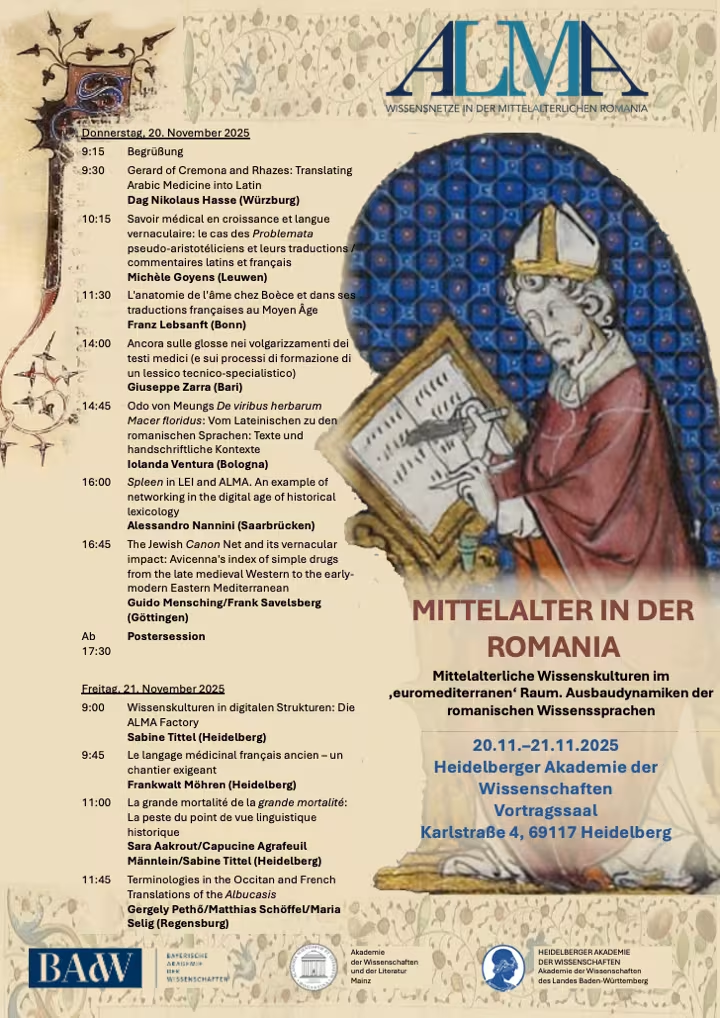
Conference, November 2025: "The Middle Ages in Romania"
On November 20–21, 2025, the ALMA project will host an international conference at the Heidelberg Academy of Sciences and Humanities on the topic “The Middle Ages in Romania—Medieval Cultures of Knowledge in the ‘Euro-Mediterranean’ Region. Dynamics of Expansion in the Romance Languages of Knowledge.”
For the Mediterranean region—and thus for the Romance languages—contact between the Arab, Jewish, Byzantine, and Latin worlds played a decisive role throughout the Middle Ages. The emergence of knowledge cultures—and in particular the history of medicine—was also profoundly shaped by these interconnections across linguistic and religious boundaries. The conference focused on this polycentric transfer of knowledge as one of the central prerequisites for the linguistic development processes analyzed by ALMA.
In dialogue with researchers from the fields of history, the history of knowledge and science, textual philology, and linguistics, the conference examined the constellations that enable processes of contact and transfer—whether processes of demarcation or appropriation—in the domain of medical knowledge.
A few impressions from the conference
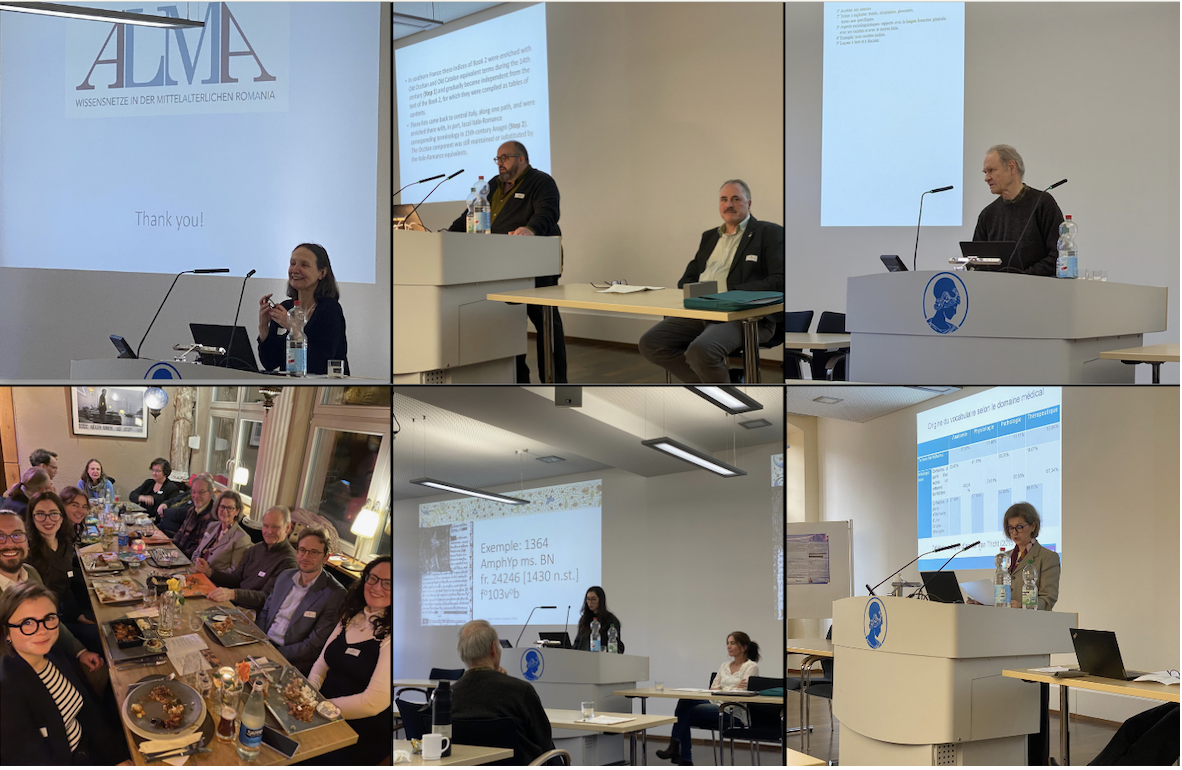
- First row, from left to right: Maria Selig; Frank Savelsberg, Guido Mensching; Frankwalt Möhren.
- Second row, from left to right: Giulia Barison, Alessandro Naninni, Sara Aakrout, Sabine Tittel, Guido Mensching, Dag Nikolaus Hasse, Maria Selig, Iolanda Ventura, Franz Lebsanft, Michèle Goyens, Frankwalt Möhren, Giuseppe Zarra, Yasmin Posillipo; Sara Aakrout, Sabine Tittle; Michèle Goyens. (All: Copyright ALMA)
 ALMA
ALMA
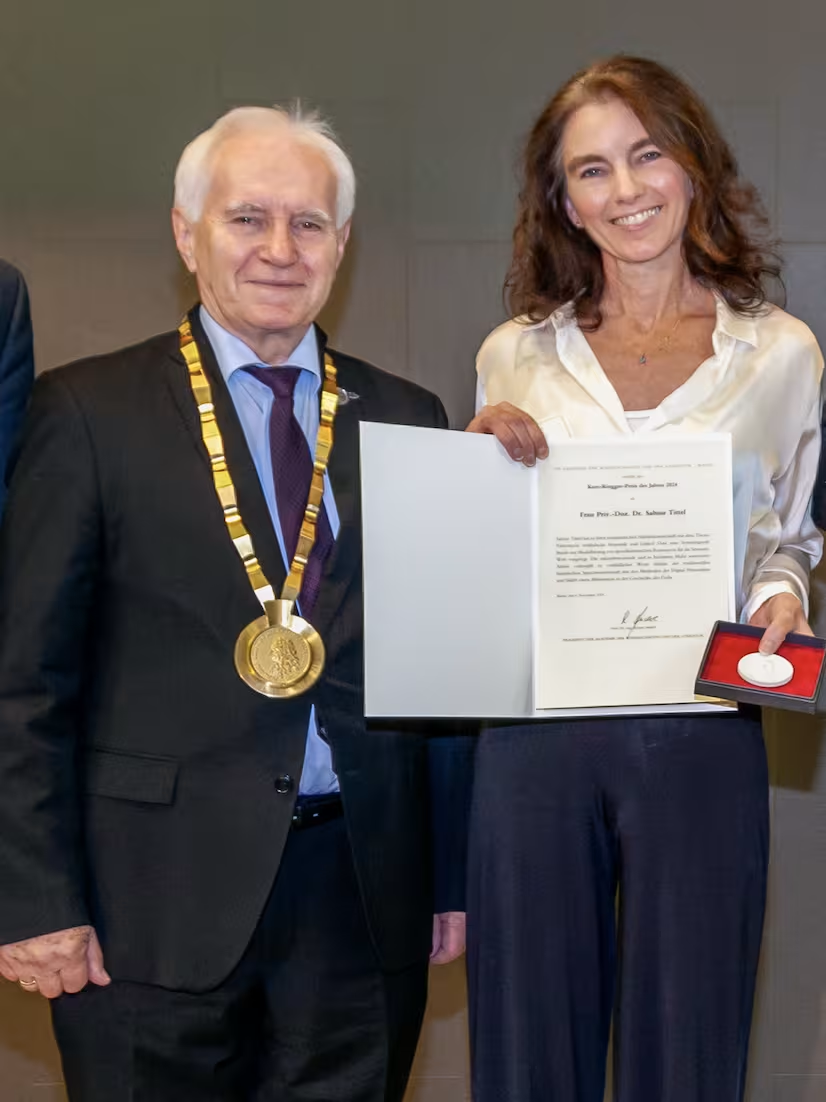
Presentation of the 2024 Kurt Ringger Award to Sabine Tittel
As part of the 75th-anniversary celebrations of the Academy of Sciences and Literature in Mainz, Sabine Tittel was awarded the Kurt Ringger Award on November 8, 2024, for outstanding work in the field of Romance Studies for her habilitation thesis “Historical Lexical Semantics and Linked Data: Modeling Resources of Medieval Galloromania for the Semantic Web.”
See See also the report at RheinMainKultur.de.
 Astrid Garth/ADW Mainz
Prof. Dr.-Ing. Reiner Anderl, President of the Mainz Academy of Sciences and Literature, presents the Kurt Ringger Award to Priv.-Doz. Dr. Sabine Tittle (Heidelberg).
International Colloquium, October 25–16, 2024
Under the title “Écrire le droit dans la Romania Plurilinguistique (12th–14th centuries),” Viola Mariotti (ALMA) will host an international colloquium with international participants on October 25 (New University, Lecture Hall 12) and October 26 (Department of Romance Languages, Ernst-Robert-Curtius Hall) 2024, an international colloquium featuring international participants.
Further details about the event can be found here. The program and abstracts of the presentations can be downloaded here.
Heidelberg University's Medieval Day
ALMA (Gustavo Covolo Campedelli, Sabine Tittel) will participate in this year's Medieval Day at Heidelberg University, which will take place on June 8, 2024, from 2:00 p.m. to 8:00 p.m., with activities on Universitätsplatz and at the Neue Uni. A PDF with the program can be found here.
Conference “Medieval Knowledge Cultures in the Mediterranean Region. Polycentric Knowledge Transfer and the Development of Romance Technical Languages"
On February 20 and 21, 2025, ALMA will host an international, interdisciplinary conference on one of the core topics of the research project: "Medieval Knowledge Cultures in the Mediterranean Region: Polycentric Knowledge Transfer and the Development of Romance Technical Languages."
The conference is being organized by all three ALMA research projects under the auspices of the Bavarian Academy of Sciences and will take place at the Heidelberg Academy of Sciences and Humanities. A public commemorative lecture is planned for the evening of February 20, 2025.
Heidelberg Medieval Day 2024
Lecture: “Knowledge Networks in Medieval Romance-Speaking Europe.” The ALMA Project and Its Approach to Understanding the Languages of Science and Scholarship
During the colloquium “Science by Words. How to Express Science in Antiquity and the Middle Ages / La Science par les mots. Exprimer la science dans l’Antiquité et au Moyen Âge," which took place on May 29 and 30, 2024, in Leuven, Belgium, Sabine Tittel presented the ALMA project with a lecture titled “Knowledge Networks in Medieval Romance-Speaking Europe.” The ALMA Project and Its Approach to Understanding the Languages of Science and Scholarship."
ALMA Internal Workshops
- July 30–31, 2026 - "Text Networks - Knowledge Networks" / “Introduction to ALMA Factory” (organized by Maria Selig and Sabine Tittel; Heidelberg) with Giulia Barison, Yasmine Posillipo, Alessandro Naninni (Saarbrücken), Matthias Schöffel, Maria Selig (Munich), Sara Aakrout, Federico Novello, Sabine Tittel (Heidelberg). INSERT IMAGES FROM THE WORKSHOP
- March 26–27, 2026 - "Evaluation of the Development of LLMs for POS Tagging and Lemmatization" (organized by Ragini Menon, Matthias Schöffel; online) with Giulia Barison, Yasmine Posillipo (Saarbrücken), Matthias Schöffel, Maria Selig (Munich), Ragini Menon, Hao Nguyen, Sabine Tittel (Heidelberg).
- "How to publish XML editions and their HTML abstracts on eXist-db" / "How to include IIIF store information into XML editions" (organized by Sabine Tittel; online) with Yasmine Posillipo, Giulia Barison (Saarbrücken), Matthias Schöffel (Munich), Sara Aakrout, Federico Novello, and Sabine Tittel (Heidelberg).
- April 17, 2024 - "XML/TEI for Text Editions II and Algorithms for Manuscript Transcriptions" (organized by Elton Prifti, Yasmine Posillipo, Giulia Barison, Saarbrücken; Saarbrücken) with Giulia Barison, Yasmine Posillipo, Elton Prifti, and Rita Lettieri (Saarbrücken), Matthias Schöffel (Munich), Viola Mariotti, and Sabine Tittel (Heidelberg).
February 7, 2024–February 8, 2024 – “XML/TEI for Text Editions I” (organized by Viola Mariotti, Sabine Tittel; Heidelberg) with Giulia Barison, Yasmine Posillipo, Elton Prifti, and Rita Lettieri (Saarbrücken), Matthias Schöffel (Munich), Sébastien Biay (Paris), Viola Mariotti, Gloria de Meleghy, Ragini Menon, and Sabine Tittel (Heidelberg).
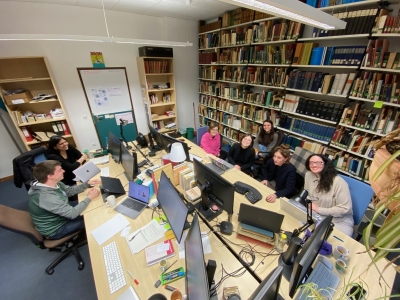
Group photo from the workshop “XML/TEI for Text Editions: from left to right, Matthias Schöffel, Ragini Menon, Rita Lettieri, Giulia Barison, Gloria de Meleghy, Viola Mariotti, Yasmine Posillipo. (Copyright ALMA)
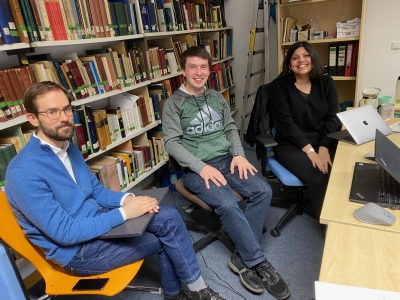
From left to right: Sébastien Biay, Matthias Schöffel, Ragini Menon. (Copyright ALMA)
- February 2, 2024 - "From PDF to Digital Edition" (Yasmine Posillipo, Elton Prifti, Saarbrücken; online): Workflow, problems, and solutions for the retro-digitization of a "clean PDF" of a text edition (case study using an Italian text).
- November 27, 2023 - "Introduction to Visual Studio Code" (Ragini Menon, HD; online): Introduction to the Visual Studio Code editor, including tips and tricks.
- November 13, 2023 - "Introduction to Linked Open Data and Ontologies" (Sabine Tittel, HD; online): An introduction to Semantic Web technologies and their use within the project; this workshop was also open to project team members Bible glossaries as hidden cultural carriers.
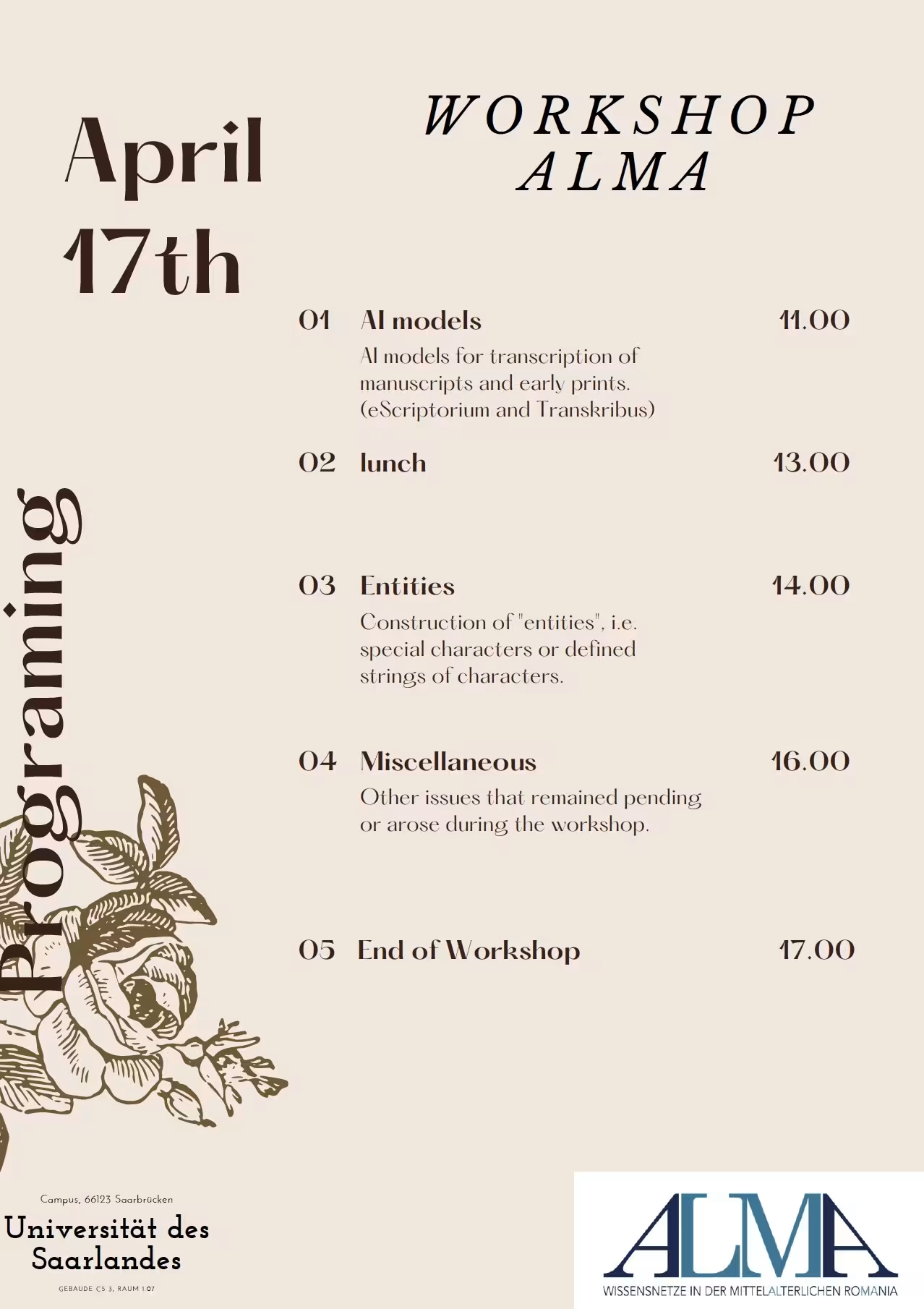
Program for the ALMA Workshop on April 17, 2024, in Saarbrücken
ALMATHONs - Coding Days
- Oct. 22–23, 2025 – ALMATHON#5 (organized by Sabine Tittel; Heidelberg) with Martin Stämmler (Wasbüttel), Ragini Menon, Hao Nguyen, Sabine Tittel (Heidelberg), Frank Grieshaber (HAdW).
- Nov. 15–16, 2024 - ALMATHON#4 (organized by Sabine Tittel; Heidelberg) with Xavier Casassas Canals (Salzburg), Xin Peng, Ragini Menon, and Sabine Tittel (Heidelberg).
- July 5–7, 2024 – ALMATHON#3 (organized by Sabine Tittel; Heidelberg) with Xavier Casassas Canals (Salzburg), Xin Peng, Ragini Menon, and Sabine Tittel (Heidelberg).
Nov. 24–25, 2023 – ALMATHON#2 (organized by Sabine Tittel; Heidelberg) with Xavier Casassas Canals (Salzburg), Jiufeng Li, and Sabine Tittel (Heidelberg) programming “con alma.”
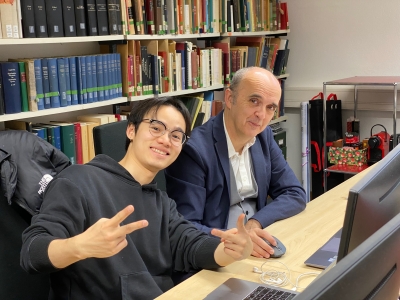
From left to right: Xavier Casassas Canals (Salzburg), Jiufeng Li. (Copyright ALMA)
February 10–12, 2023 - ALMATHON#1 (organized by Sabine Tittel; Heidelberg) with Xavier Casassas Canals (Salzburg), Viola Mariotti, Ragini Menon, Dana Simedrea, Sabine Tittel (Heidelberg), Elton Prifti (Saarbrücken), supported by Andreas Dafferner and Frank Grieshaber (HAdW).
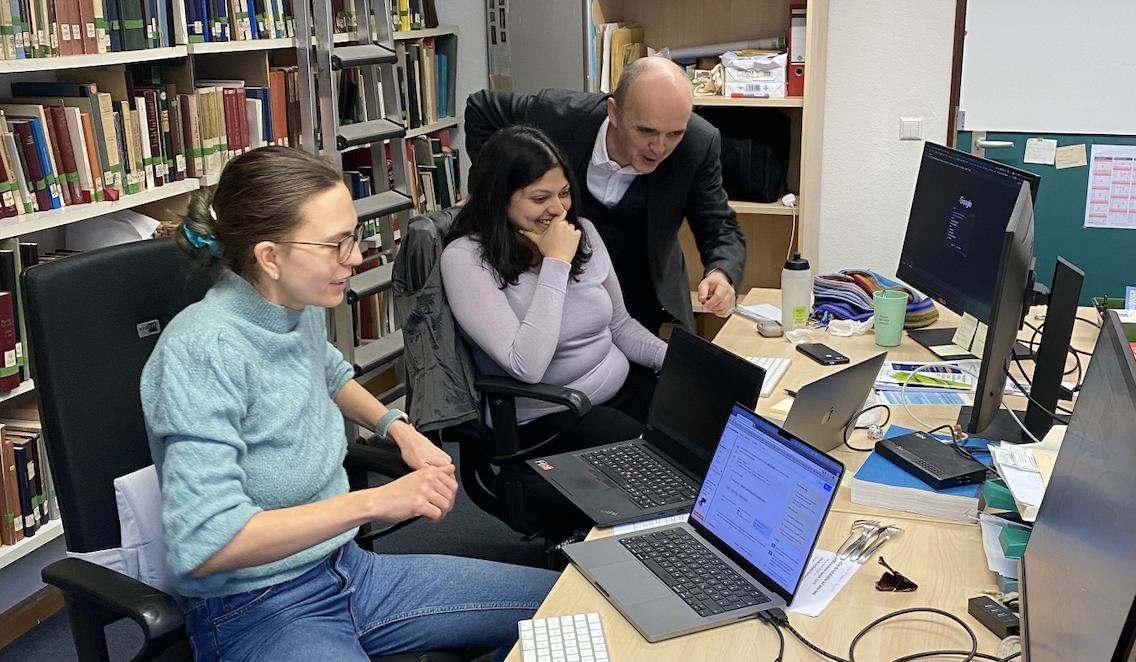
From left to right: Dana Simedrea, Ragini Menon, and Xavier Casassas Canals. (Copyright ALMA)
 ALMA
ALMA
ALMA at the opening of the Heidelberg Center for Digital Humanities
On July 21, 2023, the newly established Heidelberg Center for Digital Humanities (HCDH) was officially inaugurated; ALMA was represented at the opening event with a poster presentation, and S. Tittel participated in person in the roundtable discussion; see the report by the Trier Center of Excellence for Digital Humanities.
ALMA Project Presentation for the Department of Romance Languages
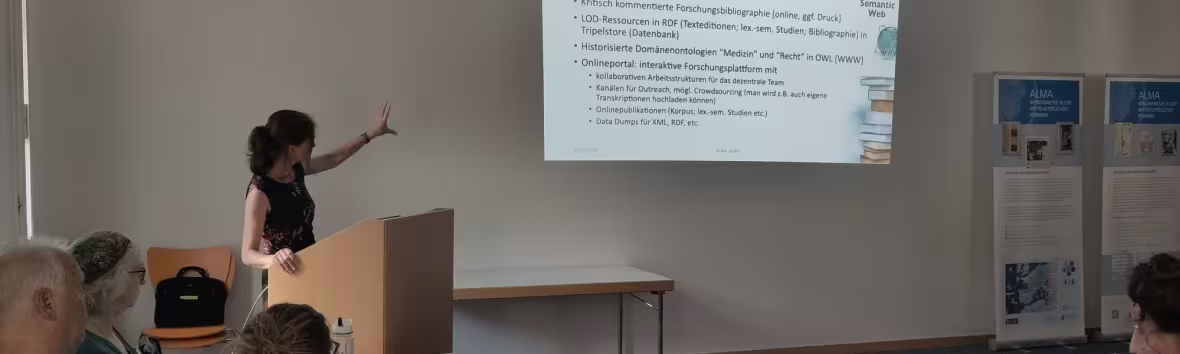
On June 20, 2023, we presented our ALMA project to the students and faculty of the Department of Romance Languages at Heidelberg University. All project members (in alphabetical order: Gustavo Campedelli, Viola Mariotti, Ragini Menon, Leo Reitmaier, and Sabine Tittel) gave short presentations providing insights into the project’s textual-philological, linguistic, and information technology workflows.
The presentations took place as part of a joint “double project presentation” with the HAdW project Bible glossaries as hidden cultural carriers, whose team led by Prof. Dr. Hanna Liss and Dr. Stephen Dörr was also in attendance. A small reception rounded out the event.
 ALMA
ALMA
Sabine Tittel
ALMABibl Workshop
On November 4, 2022, the first full-day workshop on ALMA took place at the Heidelberg Academy of Sciences and Humanities.
Maria Selig, Sabine Tittel, Frankwalt Möhren, Elton Prifti, and Wolfgang Schweickard laid the groundwork for the design and structure of the ALMABibl bibliography. This bibliography will catalog and critically annotate the primary literature (text sources), secondary literature, and tertiary sources (which are based on primary and secondary sources as well as other dictionaries) used in ALMA’s research. It will incorporate existing material from the bibliographies of the dictionaries LEI, DOM, and DEAF with new literature.
ALMABibl is to be structured according to the DEAFBibl model. This means that it will not merely provide bibliographic details such as author, editor, publisher, etc. Rather, it will, among other things, list text titles—including their variants—catalog the manuscripts of the textual tradition, date them, and identify their linguistic varieties; it will list medieval authors and, where appropriate, critically evaluate the philological editorial criteria. The bibliography will classify the primary texts according to literary genres and domains, with a focus on technical language in law and medicine.
The goal of ALMABibl is not only to provide access to the literature used by ALMA but also to serve as a standalone research tool for the academic community.