Bibelglossare als verborgene Kulturträger
Judeo-French Cultural Exchange in the High Middle Ages
The Academy project Bible Glossaries as Hidden Cultural Carriers: Judeo-French Cultural Exchange in the High Middle Ages began in January 2023. It is led by Prof. Dr. Hanna Liss (Heidelberg University of Jewish Studies) and Romance scholar Dr. Stephen Dörr.
The project is designed to run for a total of 18 years and contributes to the Judeo-French linguistic and literary tradition, which is being examined for the first time in an interdisciplinary manner in terms of its cultural, linguistic, and theological-historical significance. The goal is the editing and contextualization of Hebrew-French biblical glossaries as well as French commentaries written in Hebrew script that are found in the Hebrew Biblical and Talmudic commentary literature (tosafot). Throughout the project, the work will be integrated into a digital working environment to make the research accessible beyond the scope of the project.
Multilingualism is a manifestation of elite education today as it was in the European Middle Ages. The Jewish diaspora in medieval northern France mastered Hebrew and Aramaic, since their main knowledge resources (Bible, Talmud, and Responsa literature) were written in these languages. However, Old French was their vernacular as it was for the Christian population, and a significant Jewish Francophone group was highly receptive to French culture and literature. This medieval Judeo-French literacy is documented in various literary, scientific, and religious texts dating from the 12th to the 14th centuries. Their peculiarity lies in the fact that the Old French texts were written in Hebrew script. Most relevant is the fact that the Jews supplemented commentaries on important religious texts like Bible and Talmud with Old French glosses and collected them in Hebrew-French Bible glossaries.
The glossaries are exceptional testimonies to a (Jewish and Christian) French (Biblical) reading culture that developed simultaneously in Western Europe. They serve as foundational texts for researching the interrelationships between Jewish intellectual history and the non-Jewish environment. Their analysis complements the historical portrayal of a painful antagonism in Christian-Jewish relations with a picture of a culturally fruitful interdependence between French vernacular literature and Jewish educated society, which has so far been recognized and appreciated only to a limited extent.
By applying state-of-the-art digital tools, the project will establish a solid praxeological, philological, and linguistic foundation for presenting Jewish religious education as part of the shared intellectual heritage of the French-speaking world in the Langue d’oïl region. By bringing together unique expertise from Jewish Studies, Romance Studies, and Middle High German philology, the project will contribute to a fundamental reassessment of Jewish culture in medieval France, demonstrating that Jews aspired to be a powerful part of European educational culture.
For the most part, the glossaries are being edited and subjected to historical-philological analysis for the first time as part of this project. A total of approximately 105,000 entries are being examined.
The texts serve as exceptional testimonies to Jewish and Christian French (Biblical) reading cultures in Western Europe. The glossaries therefore serve as foundational texts for researching the interrelationships between Jewish intellectual history and the non-Jewish environment. The historical portrayal of a painful antagonism in Christian-Jewish relations is complemented by a picture of culturally fruitful interdependence, which has so far been recognized and appreciated only to a limited extent.
Using state-of-the-art digital tools, the project establishes a solid praxeological, philological, and linguistic foundation for presenting Jewish religious education as part of the shared intellectual heritage of the French-speaking world.
BIMA 2.1
BIBLICAL MASORAH DATABASE 2 (developed by Clemens Liedtke, MA)
BIMA 2 is a collaborative digital and open source work environment, database, and user interface. BIMA 2 allows editors to transcribe, translate, and analyse any source text in a workspace, in which image and text are immediately visually linked by means of coloured text paths directly drawn on the surface of the high-quality images of manuscripts pages. BIMA 2 displays the manuscripts via IIIF-protocol.
Head of Research
- Prof. Dr. Hanna Liss (Jewish Studies)
- Dr. Stephen Dörr (Romance Studies)
Staff Members
- Dr. Sabine Arndt (Post-Doc, Jewish Studies)
- Dr. Katelyn Mesler (Post-Doc, Jewish Studies)
- Fabian Strobel (PhD Candidate, Computational Linguistics, Digital Humanities)
- Isabelle Schmiederer (PhD Candidate, Medieval German Studies)
- Regina Bacher (Student Assistant, Jewish Studies)
- Elina Léocadie (Student Assistant, Romance Studies)
- Nora Nedjai (Student Assistant, Romance Studies)
- Hannah Oberholz (Student Assistant, Medieval Studies)
- Luize Ottati de Lima (Student Assistant, Romance Studies)
- Josina Reinhold (Student Assistant)
- Julia Schöfthaler (Student Assistant, Romance Studies)
Project oversight committee
- Prof. Dr. Rafael Arnold
- Prof. Dr. Cyril Aslanov
- Prof. Dr. Annette Gerok-Reiter
- Prof. Dr. Jan Gertz (Vorsitzender)
- Prof. Dr. Nikolas Jaspert (Sv. Vorsitzender)
- Prof. Dr. Andreas Kuczera
- Prof. Dr. Stefan Maul
- Prof. Dr. Judith Olszowy-Schlanger
- Prof. Dr. Arwed Weidenmüller
- Prof. Dr. Raymund Wilhelm
Liss, Hanna and Dörr, Stephen, “Hebrew-French Bible Glossaries and the Question of Jewish-French Cultural Exchange in the High Middle Ages: A Reevaluation,” Corpus Masoreticum Working Papers 2, 2022, 22–50 (open access)
Claudio Lagomarsini, "Glosse talmudiche in ebraico, anzi in francese medievale" in: Il sole 24 ore 12.4.2024: https://amp24.ilsole24ore.com/pagina/AFeb38PD
Sabine Arndt and Stephen Dörr, “Le Commencement de sapience par Hagin le Juif: un lexique entre tradition et innovation,” Mélanges Joëlle Ducos (forthcoming, 2025).
Stephen Dörr, “Die Sprache der Juden im französischen Mittelalter,” in: The Values of the Vernacular: Essays in Medieval Romance Languages and Literatures in Dialogue with Simon Gaunt, ed. by Hannah Morcos, Maria Teresa Rachetta, Henry Ravenhall, Natasha Romanova and Simone Ventura, Roma, Viella (print 2025)
Stephen Dörr, Review of Ariane Pinchon, ed., Wauchier de Denain, Li Seint Confessor, Paris (Honoré Champion) 2024 (Les classiques français du Moyen Âge, 204), Francia-Recensio 2025/1, Mittelalter – Moyen Âge (500–1500), DOI: https://doi.org/10.11588/frrec.2025.1.109368.
Stephen Dörr, Review of Peter Nahon, Les parlers français des israélites du Midi, Strasbourg 2023, RF 137 (2025) 162-166.
Stephen Dörr, Review of Franz Staller, ed., Fragment eines hebräisch-altfranzösischen Bibelglossars aus der Universitätsbibliothek Salzburg: kritische Edition, sprachgeschichtliche Analyse und historisch-geographischer Kontext (Situation der jüdischen Minderheit in Lothringen zwischen 1220 und 1350), Innsbruck: Studia Verlag Innsbruck 2023, 292 p., Zeitschrift für romanische Philologie 140 (2024), 992-996.
Hanna Liss, “Early Hebrew Printing and the Quality of Reading: A Praxeological Study”, in: Premodern Jewish Books, their Makers and Readers in an Era of Media Change, ed. by Katrin Kogman-Appel and Ilona Steimann, Brepols, Turnhout, 2024, 251–274.
Hanna Liss, “Between Imagination and Exegesis: The Masora Figurata Illustrations of the Two Menorot in Vatican ebr. 14”, In Images – A Journal of Jewish Art and Visual Culture 16 (2023), 1–19
Hanna Liss, “‘Hebraica and Gallica Veritas’: The Function of the Hebrew‐French Glossaries in 12th Century Jewish and Christian Exegesis”, in: From Theodulf to Rashi And Beyond - Texts, Techniques, and Transfer in Western European Exegesis (800 – 1100), ed. by Johannes Heil and Sumi Shimahara, Leiden/Boston: Brill, 2022, 119–146.
Hanna Liss and Stephen Dörr, “Hebrew-French Bible Glossaries and the Question of Jewish-French Cultural Exchange in the High Middle Ages: A Reevaluation,” Corpus Masoreticum Working Papers 2, 2022, 22–50 (https://journals.ub.uni-heidelberg.de/index.php/cmwp/article/view/89053).
Hanna Liss, “Teaching in Tiny Letters. Eliyyah ben Berekhyah ha-Naqdan’s Way of Teaching as Displayed in MS Biblioteca Apostolica Vaticana ebr. 14,” Corpus Masoreticum Working Papers 1, 2022, 1–20 (https://journals.ub.uni-heidelberg.de/index.php/cmwp/article/view/87168).
Katelyn Mesler, “Did Perets Trabot Write the Makre Dardeke? A Case Study in the Confusion of Names” (submitted to La Revue des Études Juives)
Katelyn Mesler, Introduction to “Florilegium (Cambridge, University Library, MS Ff.6.53).” Posted Oct. 2024. https://cudl.lib.cam.ac.uk/view/MS-FF-00006-00053/1
June 1 2026, Department of Romance Studies, Ernst-Robert-Curtius-Saal
19 Uhr c.t.: Lecture by Prof. Dr. Guido Mensching, Dr. Frank Savelsberg, Mehrsprachige Wortlisten als Spiegel jüdischer Netzwerke. Die Transmission von Avicennas Kanon der Medizin, Buch II, und dessen Index im romanischsprachigen Mittelmeerraum
June 10 2026, Heidelberg University of Jewish Studies, S 4
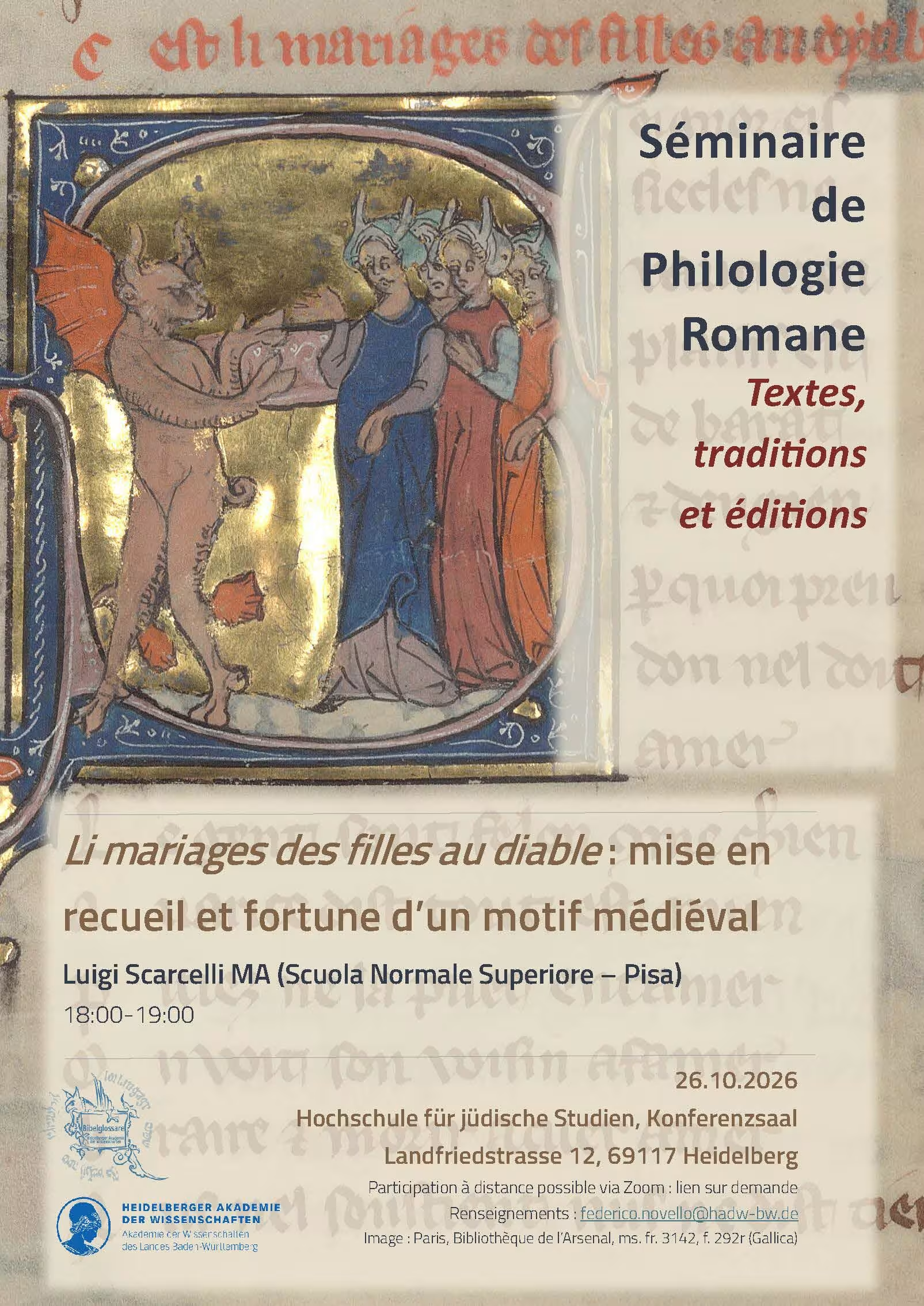
16 Uhr 15 - 17 Uhr 45: Séminaire de Philologie Romane. Textes, traditions et éditions:
Dr. Federico Novello (ALMA, Heidelberger Akademie der Wissenschaften), Introduction : L’édition des textes entre méthode et responsabilité critique
Arianna Grancini BA (Étudiante en Master, Università degli Studi di Milano), Qui le cours de la lune vora savoir : un petit traité d'astronomie inédit issu du ms. Milano, Biblioteca Braidense, AD. XII. 53
Dr. Stephen Dörr (Bibelglossare, Heidelberger Akademie der Wissenschaften), Discussion et perspectives : Pourquoi faire l'édition de textes astronomiques en ancien français?
July 1 2026, Department of Romance Studies, Ernst-Robert-Curtius-Saal
18 Uhr c.t.: Vortrag Prof. Dr. Maria Luisa Meneghetti, Quo vadis ecdotica? Sur quelques approches récentes
dans le domaine de l’édition des textes
July 13 2026, Department of Romance Studies, Ernst-Robert-Curtius-Saal
19 Uhr c.t.: Vortrag Dr. Emma Belkacemi-Molinier, Modus parabolicus: traduire la parabole dans la Bible du XIIIe siècle.
The project collaborates with the following researchers and institutions:
- ALMA – Wissensnetze in der mittelalterlichen Romania (Heidelberger Akademie der Wissenschaften)
- Corpus Masoreticum (DFG-Projekt in Heidelberg)
- University Library Heidelberg
- Universiy Computing Center/heiCloud
- AlHaTorah
- Doctoral Program University of Bergamo
- Project Manuscripta Italica Allographica (MIA)
- Prof. Claudio Lagomarsini (University of Siena)
22. Juni 2023, Online-Veranstaltung DH-Insights des Heidelberg Center for Digital Humanities
12:00 Uhr: Vortrag Prof. Dr. Hanna Liss/Clemens Liedtke, M.A.: 'Corpus Masoreticum' und 'Hebrew-French Glossaries': Hebräisch-französische Textkulturen des Mittelalters in Heidelberger DH-Projekten'
(Zugangsdaten über den Verteiler des HCDH)
28. Juni 2023, Hochschule für Jüdische Studien Heidelberg
18 Uhr c.t.: Vortrag Dr. Erica Baricci, Università degli Studi dell'Insubria, Como: The Ma'asé Ester. A Judeo-Provençal Poem about Esther
3.–5. Juli 2023, International Congress on the Study of the Middle Ages Leeds 2023
3. Juli 2023, 237 ENTANGLEMENTS BY NUMBERS: NETWORKS OF ASTRONOMY AND MATHEMATICS
Vortrag Sabine Arndt: Lost in Translation – The Arabic, Latin, and Hebrew Versions of Pseudo-Euclid’s Book of Mirrors
5. Juli 2023, 1137 JEWISH-CHRISTIAN ENTANGLEMENTS IN THE MIRROR OF MEDIEVAL MANUSCRIPTS AND CHARTERS
Vortrag Hanna Liss: Clavis Verborum Biblicorum
26. Oktober 2023, La Bible du XIIIe siècle – Journée d'études
Ort: Hochschule für Jüdische Studien, Heidelberg
Vorläufiges Programm:
9:30 Kaffee
10:00 Hanna Liss (Hochschule für jüdische Studien/ Heidelberger Akademie der Wissenschaften): Welcome note and introduction: “A common French reading? The Origins of the Project Hebrew French Bible Glossaries and the Question of the Function of the Old French Translations in Jewish Commentary Literature
10:45 Stephen Dörr (Bibelglossare als verborgene Kulturträger/ Heidelberger Akademie der Wissenschaften): Les gloses judéo-françaises et la Bible du XIIIe siècle: premières observations.
11:30 Thierry Revol (Strasbourg): La Bible anglo-normande: gloses et traductions, la réflexion linguistique à l’œuvre
13:00 Gemeinsames Mittagessen
14:00 Alessandra Arcidiacono (Bibelglossare als verborgene Kulturträger/ Heidelberger Akademie der Wissenschaften): L’Exode dans la Bible du XIIIe siècle: premiers pas pour une édition critique.
14:45 Caterina Bellenzier (Università di Siena): Traduction indépendante ou révision ? La Bible du XIIIe siècle comme base de travail pour l'analyse des relations entre la Bible anglo-normande et la Bible de Jean de Sy.
15:30 Roberta Decolle (Università di Siena): Entre identité et variation: notes sur la traduction du lexique biblique dans quelques versions en langue romane
16:15 Claudio Lagomarsini (Università di Siena): Les trois rédactions de la Bible du XIIIe siècle (premier volume)
17:00 Zusammenfassung und Ausblick
Organisation: Alessandra Arcidiacono, Stephen Dörr (Akademieprojekt: Bibelglossare als verborgene Kulturträger)
Rom, Università della Sapienza, Contatti e conflitti, 24.-26. Januar 2024
25. Januar, Vortrag Alessandra Arcidiacono: L'alterità nell'Antico Testamento. Mosè: "uno straniero in terre straniere"
Bergamo, Seminario internazionale del corso di dottorato Studi filologici e linguistici sul patrimonio scritto e orale (SFiLi)
23. Mai 2024, Vorträge Hanna Liss und Stephen Dörr zum Thema: I glossari biblici, depositi culturali nascosti -- Ricerche in corso e prospettive
4. 6. 2024, Journée d'´études 'Les textes allographes français et italiens au moyen-âge'
Ort: Hochschule für jüdische Studien, Heidelberg.
Programm:
10:00 Hanna Liss
Welcome & Introduction
10:15 Sabine Arndt
Between Translation and Commentary: the Function of Old French in Medieval Hebrew Glossaries
11:00 Kate Mesler
Three Lapidaries in the Leipzig Hebrew-French Glossary
11:45 Daniele Baglioni / Marco Maggiore
Manuscripta Italica Allographica: A New Project for the Study of Allographies in the Italo-Romance Area
12:45 Pause déjeuner
14:00 Federico Boschetti
The making of a digital scholarly edition of Italian allographic manuscripts
14:45 Davide Mastrantonio
Notes on syntactic and textual features of the Elegia giudeo-italiana
15:30 Bernardino Pitocchelli
Entre tradition et innovation: à propos des changements dans les traductions judéo-italiennes de la Bible au XVIe siècle
16:30 Stephen Dörr
Résumé et perspectives
Organisation: Alessandra Arcidiacono, Stephen Dörr (Akademieprojekt: Bibelglossare als verborgene Kulturträger)
19. 12. 2024, Feierliche Eröffnung der Kooperation mit der Universität Bergamo
Ort: Hochschule für jüdische Studien, Heidelberg. 18 Uhr
Begrüßung: Hanna Liss /Stephen Dörr
Vorstellung der Kooperation: Maria Grazia Cammarota (Universität Bergamo)
Kritische Studien zum schriftlichen und mündlichen Kulturgut. Internationale Zusammenarbeit in der Doktorandenausbildung
zwischen Philologie und Linguistik
Festvortrag: Richard Trachsler (Universität Zürich)
Textphilologie, die entthronte Königsdisziplin. Bemerkungen aus der Sicht eines Romanisten
Address
Prof. Dr. Hanna Liss
University of Jewish Studies
Landfriedstraße 12
69117 Heidelberg, Germany
Dr. Stephen Dörr
General inquiries to bibelglossare@hadw-bw.de
Web Editors of this page
- Dr. Stephen Dörr
- Prof. Dr. Hanna Liss