ROCEEH

Das Projekt

Die menschliche Evolution ist eine Geschichte kultureller Entwicklung und Ausbreitung. Bereits vor mehr als drei Millionen Jahren fertigten Hominine die ersten Steinwerkzeuge mit Schneidekante an, erweiterten damit die bis dahin übliche Werkzeugpalette und ermöglichten letztendlich den modularen Einsatz mehrerer Werkzeuge. Drei Faktoren trafen zusammen, um einen kulturellen Wirkungskreis zu erzeugen, der nach wie vor die Grundlage für unseren Umgang mit der Welt bildet: die Intensivierung und Differenzierung unseres materiellen und sozialen Engagements, die Interaktion mit der Umwelt, sowie ein verstärktes Bedürfnis die Welt zu verstehen.

Die Geschichte der menschlichen Kulturentwicklung entfaltete sich in drei voneinander abhängigen Expansionsereignissen: Expansion der Performanz, Expansion des Ressourcenraums und Expansion des Lebensraums. Die Expansion der Performanz, ausgedrückt in den miteinander verbundenen Veränderungen von Körper, Geist und Verhalten, interagiert dabei eng mit der Expansion des Ressourcenraumes. Die Nutzung von Werkzeugen erschloss den Zugang zu neuen Ressourcen und schuf gleichzeitig neue Bedürfnisse, Möglichkeiten und Einschränkungen, sowohl für den Menschen als auch für seine Umwelt. Das Netzwerk von Beziehungen zu und der Wechselwirkungen mit Umweltfaktoren (Artgenossen, Rohstoffen, Artefakten, u.a.) nahmen im Laufe der menschlichen Evolution enorm zu und führten zu einem dichten Spektrum kultureller Leistungen in einer Vielzahl von Umgebungen.

Im Zeitraum zwischen 3 und 2 Millionen Jahre vor heute konzentrierte sich die menschliche Entwicklung auf den afrikanischen Kontinent. In den darauf folgenden zwei Millionen Jahren breitete sich die Gattung Homo in mehreren Wellen von Afrika in Richtung Asien und Europa aus. Neue Arten bildeten und vermischten sich, während alte Gruppen verschwanden. Dies stellt den dritten Ausbreitungstyp dar, die Expansion des Lebensraums, und ist eng mit den beiden anderen Typen Expansion der Performanz und Expansion des Ressourcenraums verknüpft.

Die Aufgabe der Forschungsstelle "The Role of Culture in Early Expansions of Humans" (ROCEEH) besteht darin, ein systemisches Verständnis der "Menschwerdung" zu entwickeln, das die 3 Arten der Expansion, ihre Verbindungen untereinander und die verschiedenen Entwicklungsdimensionen integriert. Das Projekt umfasst den Zeitraum von 3 Millionen Jahren bis 20.000 Jahre vor heute und umspannt das Gebiet von Afrika bis Eurasien. Dabei liegt der Fokus primär auf der Entwicklung menschlicher kultureller Fähigkeiten sowie auf deren Hintergrund und Merkmalen.

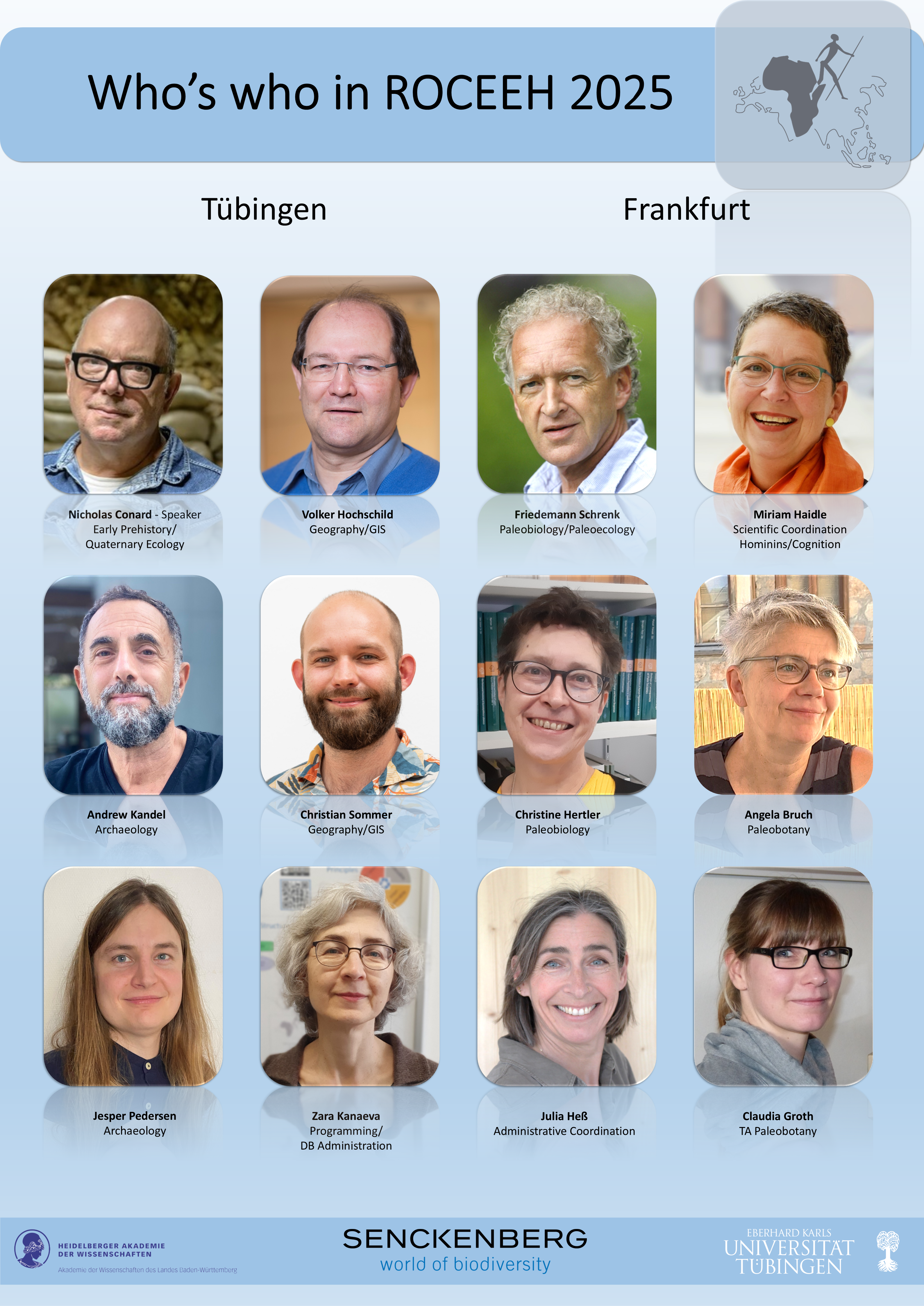
ROCEEH ist ein multidisziplinäres Forschungsprojekt (Laufzeit von 2008 bis 2027) an der Schnittstelle zwischen Kultur- und Naturwissenschaften. Dieses umfassende Projekt besteht aus einem Team von Kulturwissenschaftler*innen, Archäolog*innen, Paläoanthropolog*innen, Paläobiolog*innen, Geograf*innen und einer Datenbankspezialistin am Forschungsinstitut Senckenberg in Frankfurt und an der Universität Tübingen.

Hintergrund

Die Forschungsstelle ROCEEH ist wesentlicher Bestandteil des Akademienprogramms "Erschließung, Sicherung und Vergegenwärtigung weltweiter kultureller Überlieferungen" der Union der Akademien. Unsere Arbeit basiert direkt auf dem expliziten Auftrag des Akademienprogramms, "...unser kulturelles Erbe zu entdecken und zu erforschen, es in der Gegenwart zugänglich zu machen und seine Bedeutung für die Gegenwart hervorzuheben und es für die Zukunft zu bewahren".

ROCEEH entdeckt, kontextualisiert und bewahrt die Vergangenheit des kulturellen Erbes der Menschheit. Die Forschungsstelle erforscht die Geschichte der Menschheit in o.g. Zeitraum mithilfe der Entwicklung kultureller Konzepte, die eine Untersuchung, wie sich menschliche Kultur entwickelt hat, zu ermöglichen. ROCEEH befasst sich mit den Fragen im Zusammenhang mit dem, was wir unter "Menschwerdung" verstehen. Dieser Ansatz wird durch Feldforschung an relevanten Fundstellen hervorgehoben, um die markanten Muster des frühen kulturellen Wandels zu dokumentieren. ROCEEH macht die Vergangenheit unseres kulturellen Erbes zugänglich, indem es Daten über archäologische Fundstätten und die damit verbundenen Fossilgesellschaften (assemblages) zusammenträgt. Diese systematisch gesammelten Daten werden in der ROCEEH Out of Africa Database (ROAD) archiviert, die derzeit Informationen von mehr als 2.100 Stätten und 13.000 Assemblages enthält, die auf der Durchsicht von über 3.900 Artikeln, Büchern, Dissertationen und Berichten in vielen Sprachen basiert (Stand Juli 2021). ROCEEH nutzt diese einzigartige Datenbank, um den Reichtum der kulturellen Vergangenheit des Menschen zu erforschen und ihre Relevanz für die Gegenwart durch gezielte Fallstudien sowie durch wissenschaftliche und öffentliche Aufklärung hervorzuheben. Die Forschungsstelle bewahrt die Vergangenheit des kulturellen Erbes der Menschheit für die Zukunft, indem es einen langfristigen Katalog bereitstellt, der alle in ROAD gespeicherte Stätten zusammenfasst. Die hieraus erstellbaren Berichtsdatenblätter bieten einen systematischen Überblick über die archäologischen Stätten mit Einzelheiten über ihre Geographie, Datierung, Stratigraphie, kulturellen Überreste, Paläoanthropologie, Paläoökologie und Bibliographie.

ROAD entdecken

Das Projekt stellt sich vor

Kurzporträt "ROCEEH" (YouTube) (externer Link)

Veranstaltungen/Kongresse/Workshops

Die Forschungsstelle ROCEEH organisiert vom 8. bis zu. 10. Oktober 2025 das Symposium

Diversifying Networks
How Culture Infuses the Environment

die Veranstaltung findet am Forschungsinstitut Senckenberg statt. Alle Informationen und das Programm können Sie dem zweiten Zirkular entnehmen.


Den Abstraktband können Sie hier herunterladen: http://www.roceeh.uni-tuebingen.de/diversifying_networks2025/Diversifying_Networks_Abstractband.pdf


Neuigkeiten

3.9.2025

Von Tübingen in die Steinzeit

Heute wurde in dem Podcast "Im Gespräch" des Senders Deutschlandfunk Kultur ein Interview mit Nicholas Conard zum Thema "Archäologie auf der Schwäbischen Alb" ausgestrahlt. Der Podcast ist hier zu hören und als Download erhältlich.

20.8.2025
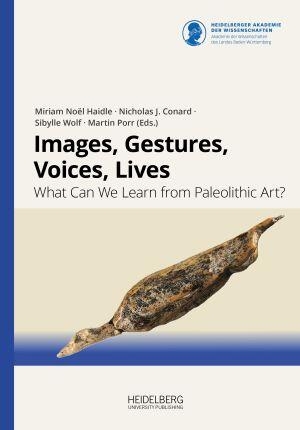
Wir freuen uns über die Veröffentlichung des Buches "Images, Gestures, Voices, Lives. What can we learn from Paleolithic Art?", aus der Reihe ROCEEH Communications, einer Open Access und Print-on-Demand erscheinenden Publikationsreihe, die von der Forschungsstelle ROCEEH herausgegeben wird. Im Buchhandel ist das Buch auch als Hardcover erhältlich.

Cover IMGL

Das Konzept der „paläolithischen Kunst“ und ihre Erforschung haben sich in den letzten Jahrzehnten erheblich verändert. Der moderne Begriff der „Kunst“ ist kulturübergreifend und diachron problematisch. Das Phänomen lässt sich nicht auf die materielle visuelle Kultur reduzieren, sondern hat auch akustische, haptische und andere dynamische Aspekte. Sie muss als eine Vielfalt von Prozessen verstanden werden, die sowohl das Alltägliche als auch das Außergewöhnliche umfassen können. In diesem Band nähern sich Archäologen, Philosophen und Anthropologen der „paläolithischen Kunst“ aus verschiedenen Blickwinkeln, einschließlich ihrer Konzeptualisierung, Ästhetik, Beziehungen zur Kunstgeschichte und zur Art brut. Die Beiträge befassen sich mit der Herausforderung durch die Materialität, mit evolutionären Aspekten, mit der körperlichen Nachstellung durch Schauspieler und digitalen Technologien als Mittel zur Interpretation von Kunstobjekten sowie mit dem Schutz des kulturellen Erbes. Der Band bietet innovative Einblicke in vergangene Praktiken und zeitgenössische Ideen und Ansätze im Zusammenhang mit der paläolithischen Kunst, die auf sorgfältiger empirischer Forschung in Verbindung mit reflektierten und anspruchsvollen theoretischen Ansätzen basieren.

Haidle, M.N., Conard, N.J., Wolf, S. & Porr, M. (Hrsg.): Images, Gestures, Voices, Lives. What Can We Learn from Paleolithic Art?, Heidelberg: Heidelberg University Publishing, 2025 (ROCEEH Communications, Band 2). DOI: https://doi.org/10.17885/heiup.1453.

22.07.2025

Image removed.Wir gratulieren der Faya-Paläolandschaft zur Aufnahme in die UNESCO-Welterbeliste! (https://whc.unesco.org/en/list/1735/)
Die weltweit ältesten und lückenlosesten Nachweise früher menschlicher Präsenz in trockenen Gebieten über 200.000 Jahre, sind aus Faya bekannt. Es lieferte Belege für die lange vermutete südliche Route der modernen menschlichen Expansion „aus Afrika“ über die Meerenge von Bab al-Mandap. Die lange Abfolge der Besiedlung der Faya-Paläolandschaft deutet darauf hin, dass die Arabische Halbinsel nicht nur ein Korridor, sondern eine eigenständige Region der menschlichen kulturellen Evolution war. Seit seinen Anfängen unterstützt das ROCEEH Projekt, finanziell und personell, die Forschung in Jebel Faya und benachbarten Stätten.

13.06.2025

Der 25. Newsletter der Forschungsstelle ROCEEH ist erschienen!

26.3.2025

In der Kurzfilmreihe "Aufgepasst! Kulturelles Erbe neu entdeckt" der Heidelberger Akademie der Wissenschaften ist eine zweite Folge erschienen: In Zusammenarbeit mit der Forschungsstelle ROCEEH wurde der Film "Hightech aus der Höhle!" realisiert, der sich mit dem Nadelfund aus der Höhle von Aghitu-3 in Armenien befasst. Der Film ist auf Youtube oder in der Mediathek der Akademie zu finden.


Neue Publikationen

20.8.2025
Smith, Krister T., Bruch, Angela A. (2025): Persistent greenhouse conditions in Eocene North America point to lower climate sensitivity. Communications Earth & Environment & (1), p. 352. DOI: 10.1038/s43247-025-02288-z.

25.06.2025
Bader, G. D., Sommer, C., Linstädter, J., Masia, D. P., Blessing, M. A., Forrester, B., & MacDonald, B. L. (2025): Decoding hunter-gatherer-knowledge and selective choice of lithic raw materials during the Middle and Later Stone Age in Eswatini. Journal of Archaeological Science, 180, 106302. DOI: 10.1016/j.jas.2025.106302

Hallett, E.Y., Leonardi, M., Cerasoni, J.N., Will, M., Beyer, R., Krapp, M., Kandel, A.W., Manica, A., & Scerri, E.M. (2025): Major expansion in the human niche preceded out of Africa dispersal. Nature (2025). DOI: 10.1038/s41586-025-09154-0

05.06.2025
Christopher S. Beekman, Andrew W. Kandel, Joan Anton Barceló, Rachael  Kiddey, Hélène Timpoko Kienon-Kaboré, Corey S. Ragsdale, Kouakou Sylvain Koffi, Gninin Aïcha Touré, Laura Mameli, Jeffrey H. Altschul,  Christine Lee, Ibrahima Thiaw (2025): A collaborative synthetic view of migration in archaeology: Addressing challenges for policymakers. Journal of Anthropological Archaeology 78: 101667.
DOI: 10.1016/j.jaa.2025.101667

7.5.2025
Mata-Gonzales, M., Starkovich, B.M., Zeidi, M. & Conard, N.J. (2025): Prey choice and changes in site occupation intensity during the Middle and Upper Paleolithic at Ghar-e Boof (southern Zagros Mountains, Iran). Archaeological and Anthropological Sciences 17:95. DOI: 10.1007/s12520-025-02191-w.

Blanco-Lapaz, A., Luzi, E., Serangeli, J. & Conard, N.J. (2025): The secret of the lake. The role of fish during the Middle Pleistocene at Schöningen (northern Germany). Conference paper: Hugo Obermaier Society for Quaternary Research and Archaeology of the Stone Age, 66th Annual Meeting in Faro, Portugal. ISBN: 978-3-946387-62-6, pp. 27-28.

23.4.2025
Jarl, J., Gasparyan, B., Kandel, A.W., Smith, A., Bruch, A.A. (2025): A high-resolution paleoenvironmental record based on phytoliths from the Armenian Highlands: The Upper Paleolithic of Aghitu-3 Cave. Journal of Archaeological Science: Reports 64, 105148. DOI: 10.1016/j.jasrep.2025.105148.

Hertler, C., van der Geer, A.A.E., Puspaningrum, M.R., Reschke, J.-O., Anwar, I.P. & Hölzchen, E. (2025): Stegodon SEA-crossing: Swim, shrink, and disperse. Earth, History and Biodiversity 4, 100026. DOI: 10.1016/j.hisbio.2025.100026.

Bruch, A.A., Kern, A.K., Stebich, M., Weitzel, N., Bolus, M. (2025): Large-scale vegetation shifts during substantial warming — Proxy-based biome reconstructions of MIS 6 and MIS 5e in Europe. Quaternary Science Reviews 356, 109308. DOI: 10.1016/j.quascirev.2025.109308.

Ausgrabungen

Die nächsten paläolithischen Ausgrabungen im Schwäbischen Jura finden zwischen dem 5. Mai und dem 29. August 2025 im Hohle Fels statt. Für weitere Informationen bitte hier klicken.

Hominine Habitate und Habitatrekonstruktion

The paleobiological unit focuses on the reconstruction of human habitats from three million until 20,000 years ago. This period relates to the development of culture (see research unit 'Culture') and corresponds to the Late Pliocene and Pleistocene in terms of geology. The Pleistocene bears witness to the appearance and evolution of the genus Homo in Africa, the initial dispersal within and beyond Africa, the early spread across Eurasia, and many other regional migration events to follow. We describe the environments inhabited by humans, and characterize and explain the specific relationships that led humans to prefer or avoid particular habitats, thereby restricting their geographic distribution. Our task is to analyze vegetation, climate, faunal, and landscape parameters for resource availability and use these factors as a major aspect in the development of resource cultures that accompany the process of “becoming human” (in cooperation with research units 'Hominins' and 'Culture').

The genus Homo evolved in Sub-Saharan Africa. Despite having access to stone technology as well as changing dietary preferences, representatives of the genus Homo were restricted to this area for a period of hundreds of thousand of years. Early human environments are generally described by their main components, for instance climate, vegetation, fauna, biomes, landscape forms, and other relevant features of the landscapes. Such descriptions of the environment encompass all environmental factors within the spatio-temporal realm defined by the distribution of a biological or social hominin group of interest. Summaries of such parameters permit the characterization of hominin environments in a general sense in order to make them comparable. We apply the concept of “ecospace” in such characterizations. By comparing the ecospace of different regions of the world at different times or among diverse hominin taxa, we can describe the habitats available for human habitation. Therefore, our analyses begin with detailed descriptions of hominin habitats, including those environments which humans had not yet inhabited.

It is the specific ecology that relates human individuals, groups, and species with their habitats. In order to ensure survival, hominins will stay in habitats where they can supply themselves with all resources required. Therefore, a group relates to its environment primarily through resource availability. The resource space provides all of the basic requirements for a group, including food (plants and animals), water, shelter, combustibles, raw materials, and other material or immaterial items. Each group exploits the resources provided by their habitat guided by specific cultural capacities and according to their individual and/or social performances. Thus, the resource space of a group may differ through time as cultural performances or conditions in their environment change. The resource space may even vary for different groups coexisting at the same time in the same region. To understand and assess the implications of changing environmental conditions through geological time on the resource space of early humans and their changing culture, and thus on their potential to expand, we compile data on:

− Paleogeographic changes (e.g., sea level, mountain uplift, drainage systems and/or glaciation patterns)

− Climatic changes (e.g., temperature, precipitation, climatic seasonality)

− Vegetation dynamics (e.g., vegetation type, openness of vegetation, biomes)

− Ecological profiles of faunas (e.g., ecological composition, density, frequency, biome linkage).

We collect such data in ROAD. The data stem from literature research, supplemented by the results of our own studies, including fieldwork, work in museum collections, and in the laboratory.

Relating humans with their habitats is performed in two different ways:

1) By mapping human groups and features of their environments and dynamics (supported by research unit 'Integration')

2) By characterizing and analyzing specific resource spectra upon which human groups depended (supported by research units 'Hominins' and 'Culture') and dynamic changes at various scales.


Hominine und Hominine Rekonstruktion

In the paleoanthropological part of the project, we explore the biocultural differentiation in hominin evolution between three million and 20,000 years ago. In the course of this process, hominin species, especially of the genus Homo, acquired new modes of living and entered previously inaccessible environments. The process is characterized by physical, cognitive, and behavioral developments resulting from the broadening of ecological relations associated with a progressive release from habitat restrictions, and an increasingly generalist biological settings that allowed for wider ranges of distinct cultural modes of living. As a result, these developments enlarged the potential of human expansion and enabled hominins to explore and occupy new ecological niches and geographical areas.

At the onset of the research center, we focused on the study of physical parameters, but through time, we broadened the list of traits relevant to “becoming human.” Progress during the last years with regard to physical, cognitive, and behavioral developments made it clear that understanding the nature of “becoming human” as a process with interdependent cultural and biological factors requires the study of features of all of these spheres and the exploration of their interdependencies with each other and the social and material environment. A locomotor apparatus specialized for bipedal endurance running has its complement in generalized hands with possibilities for power as well as precision grip, which together allow for diverse object manipulations.

Changing energy budgets accompany increasing brain size. Neuron density and neural metabolism go hand in hand with digestive systems of a mainly less specialized masticatory apparatus. Altered gastrointestinal organs shift dietary composition and probably gut microbiomes as well. The decrease in sexual dimorphism is likely a sign of broader social tolerance. Extensions of the childhood phase in human life histories enable longer learning phases in engagement with increasingly complex social and material environments. Extensions of the post-reproductive phase combined with intensification of alloparental care provide the opportunity of reducing birth spacing, thus increasing birth rate and augmenting cultural transfer across not only one, but several, generations.

Human evolution went hand-in-hand with a markedly growing range of social activities. These activities gained importance in the amalgamation and transfer of knowledge and skills closely linked to increasing complexity in technological behavior. Active transfer of knowledge and skills relies on social tolerance and group cohesion, which in turn require additional effort in prosocial behavior and communication. Increasing cooperative activities facilitated specialization. The number of interacting conspecifics and the frequency as well as range of social interactions increased exponentially during human evolution. Parallel to and interdependent with social engagement, material engagement expanded in human evolution, resulting in engagements between individuals, their conspecifics, and material elements of the environment. The development of cumulative culture gave rise to an intensification in traditions and innovations. Associated cognitive developments relate to the fields of learning, perception, memory, planning, understanding of causalities, and execution of complex processes and relationships.

Following the identification of physical, cognitive, and behavioral parameters related to “becoming human,” we examine these traits separately and in relation to one another. This supports the identification, characterization, and evaluation of hominin ecological relations. Based on these, we can assess ecological specificity and the expansion potential of hominin populations. By identifying relevant physical, cognitive, and behavioral parameters and studying their interrelatedness, this research unit provides fundamental documentary and conceptual work, which serves as a basis for further analyses of ecological relations and potentials for expansion in cooperation with the other research units.


Kulturelle Evolution

The research unit ‘Cultural Evolution’ represents the archaeological part of the research center. Here we explore the increasing role that culture played as hominins expanded their home range in Africa and Eurasia between three million and 20,000 years ago. This long span of time begins with the advent of stone artifacts and ends during the Last Glacial Maximum. Simply stated, we consider three factors as potential drivers of expansions into new regions: 1) the unfolding of material culture as represented in the archaeological record; 2) the broadening of the cultural niche; and, 3) increases in cultural capacities. In terms of material culture, we study the increases in cultural capacities and cultural performances during four main periods of human behavioral evolution spanning the Oldowan, Acheulean, Middle Paleolithic/Middle Stone Age and Upper Paleolithic periods.

As we investigate the spatial and chronological distribution of different cultural developments, signs of innovations which delivered an increased potential for niche and territorial expansion for early humans become visible. Advancements in the production of stone tools, the diversification of the tool kit, developments in the acquisition of different raw materials, the increased use of organic artifacts, the use and control of fire, the production of fitted clothing, and the ways that these behaviors contributed to improving the subsistence strategies of humans can all be seen as critical innovations. Moreover, the presence of artifacts with symbolic meaning, such as ornaments, figurative art, or musical instruments, are important indicators of behavioral modernity, a trend which arises at the end of the Middle Stone Age in Africa and during the transition from Middle to Upper Paleolithic in Eurasia.

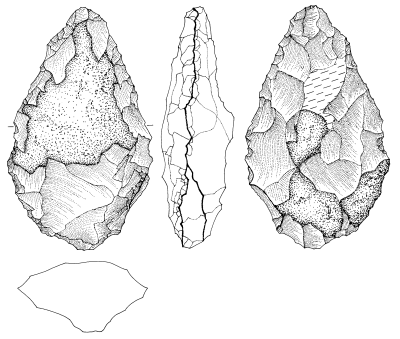
We examine the links between key technological and symbolic innovations that occur in the context of the spread of modern humans out of Africa and across Eurasia. We assess artifact assemblages, for instance, based on richness and their place within an economic and settlement system. We do this by studying lithic reduction sequences, interpreting the function of lithic and organic assemblages, and by analyzing the choice and provisioning of raw materials. Artifact typology also plays a role as a cultural marker in the case of handaxes, Levallois technology, Howiesons Poort segments, or split-based bone points, as these artifacts help to assess cultural affiliations. Analyses of tool diversity and other indices calculated from lithic assemblages allow us to deduce land use and mobility patterns of hominin groups.

We record data on lithics and organic artifacts, as well as additional traits such as the use of pigments, the presence and nature of burials, personal ornaments, artworks, and similar archaeological data not only from existing publications, but also via the study of existing collections and within the context of our own excavations. Sites providing excellent conditions to study these different aspects are located, for example, in Africa, Arabia and the Levant, along the Mediterranean coast and the Danube Corridor, as well as in South and East Asia. These data allow us to interpret the archaeological assemblages in question and spatially analyze them and specific traits they contain using our integrative GIS approach.


Integration

In addition to specialized tasks related to the different levels of integration, as described in more detail below, the research unit ‘Integration’ implements and maintains a research network that brings domestic collaborators, foreign contributors, and co-workers together. We hold periodical meetings and workshops, organize international conferences, and upon completion of different project modules, present the results to a larger scientific audience.

This research unit is subdivided into three parts: Part 1 focuses on GIS, database development, and environmental modeling; Part 2 examines indicators, models, scenarios–cultural characterization of hominins in their environment; and Part 3 studies theoretical issues, heuristic comparisons, methodological structuring, development of hypotheses, and testing.

Part 1: GIS, Database, Environmental Modeling

Part 1 ‘Integration’aims to provide an integrative database structure for the project. This is realized through a Geographical Information System (GIS) used for spatiotemporal analysis of the data. Thus, data collected by the other research units, as well as that provided by cooperation partners, are consolidated and, after thorough quality control, made available for interdisciplinary research. Furthermore, we generate new information about the early expansions of humans by conducting sophisticated parameter connection using web-based information systems.

The studies are carried out on different spatial (survey maps, regional maps) and temporal scales with corresponding modeling (e.g., interpolation, geostatistics, object orientation). They include reconstructions of paleoenvironment (e.g., climate, vegetation, land/sea distribution), as well as cultural development (e.g., centrality, periphery) and the spatiotemporal changes in different epochs (e.g., habitats and their utilization, demographic trends, "paleotraffic geography"). Simultaneously, the studies encompass control and precision analysis of the localization of the sites. These studies support analyses of the causes of expansions, test basic hypotheses, and develop transformation models.

Such a project requires the long-term arrangement of the database system with standardized metadata for permanent data storage and flexible data management with simultaneous updates of datasets of spatial (sites) and itemized information (attached specifications). This includes:

− Data evaluation (e.g., collection by digitalization, data mining)

− Data management, administration and analysis

− Data presentation in the form of a web-based information system

− Controlled data exchange between project partners (metadata portal)

− Controlled external access with brief retrieval periods

− Presentation of the project results.

Part 2: Indicators, Models, Scenarios

The focus of Part 2 is the integration of various kinds of empirical data into a uniform modeling background. The model reflects culturally specific ways in which humans relate to their environments in order to ensure provisioning with required resources. The specific relationships direct land-use and resource patterns, as well as mobility behavior, as reflected in migration and dispersal patterns on a larger scale.

Agent-based modelling (ABM) provides an ideal modeling framework in this respect, particularly for two reasons. First, a diversity of factors can be integrated regardless of their disciplinary background, as long as their impact on the spatial behavior of humans and human groups can be principally quantified. Second, because ABM is a simulation-based approach, it allows us to develop a framework in which competing hypotheses can be tested for their explanatory performance. Furthermore, ABM is ideally suited for experimentation in prehistoric systems. This research unit develops case-specific models on a variety of chronological and spatial scales. Every model integrates datasets provided by other parts of the ROCEEH project.

Part 3: Theoretical Issues

The aim of Part 3 is twofold: First, we provide the theoretical-methodological framework of the project and monitor ongoing methodological reflections; second, as we ensure the validity of these transdisciplinary results over the long-term, we define basic concepts clearly in a process that incorporates all participating scientific disciplines. For example, previous discussions involved precisely defining terms such as: 1) Homo vs. human; 2) dispersal, expansion, migration, translocation; 3) different forms of expansions–ecospace, resource space, range; 4) supply systems; 5) development vs. evolution; and 6) nature vs. culture.

Our scientists examine transdisciplinary questions that cannot be accommodated by just one of the discipline-specific research units. These questions comprise aspects which are methodologically central to the project, such as tracing population expansions in the archaeological context, or examining factors believed to be central to the development and dispersal of modern human populations. Approaches to the study of the adaptive value of different technologies, the importance of tradition versus innovation in a society, the evolution of individual communicative abilities including language and social organization all need to be studied in a broader context. Additionally, approaches from other disciplines which are beyond the main scope of the project (e.g., from ethnography, economics, sociology, linguistics, genetics) can be reviewed and critically evaluated for their potential of tracing developments in the archaeological record. Thus, the integrative research unit generates additional hypotheses thorough heuristic comparisons that can be subsequently tested using the pool of data created by the other research units. The results of these studies are integrated into the modeling of early human expansions, their causes, and consequences.

Becoming Human
​Neanderthal material und resource cultures and land use patterns in changing environments

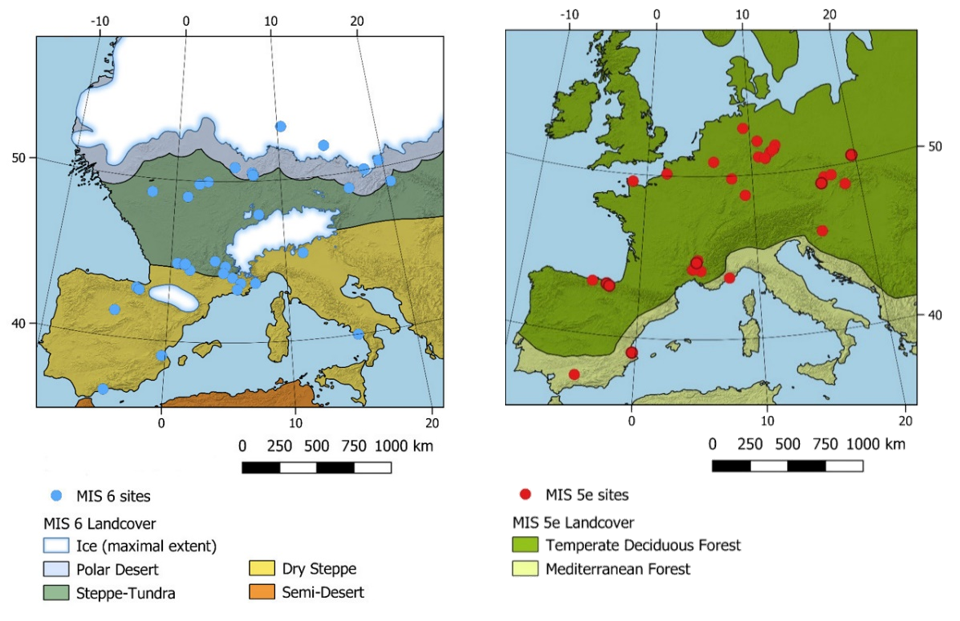
In order to deduce behavioral and land use patterns of Neanderthals in changing environments, we selected 53 assemblages from 36 localities dating to MIS 6 as a distinct cold period and 55 assemblages from 34 localities dating to MIS 5e as a distinct warm period. Since we only considered well stratified and well-dated assemblages, this ROAD-dataset is probably the most reliable and comprehensive one for this time-span. For these selected assemblages, we analyzed material culture and seasonal dynamics in the availability of herbivores and plant food resources.

As first interim results, we found out that, despite significant climatic changes between MIS 6 and MIS 5e, lithic technology and resource cultures of early Neanderthals changed only slightly. They show flexible and adaptive solutions to deal with seasonally varying availability of resources.

Further analyses, applying for instance methods of association rule mining (machine learning and data mining) as well as in-depth analyses for given geographic areas and comparisons between these areas are currently underway. Moreover, we presently design an ABM which allows to test and compare a variety of (regionally specific) subsistence strategies.

ROCEEH

Quantitative Analyses: GIS, Data Mining and Machine Learning

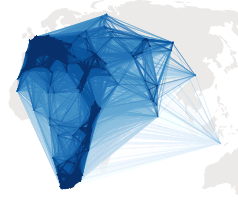
With a growing amount of data available through ROAD, external databases and global geodata, quantitative analyses are useful both to reduce the amount of data to highlight aspects of interest, and to generate new or missing information from existing data. Methods from the family of machine learning and data mining are suitable for the analysis of highly diverse data, which is why they can be well applied to archaeological questions that integrate a variety of cultural, anthropological, and paleoenvironmental dimensions. However, this approach also poses a challenge because even 'large' prehistoric datasets are small compared to common applications and often biased. For this reason, we avoid black-box systems in our work and prefer explorative data analyses in which the expert knowledge of domain specialists is incorporated in many steps: in the selection of the training data, the generation of the feature space, the interpretation of the model and, of course, the critical reflection of the results. Our current focus lies on Frequent Pattern Mining to examine the relationship between lithic tool types and mobility patterns and the Species Distribution Models to reconstruct early humans’ ecological niches.


Expansions of Hominin Performances
The search for symbolic behavior

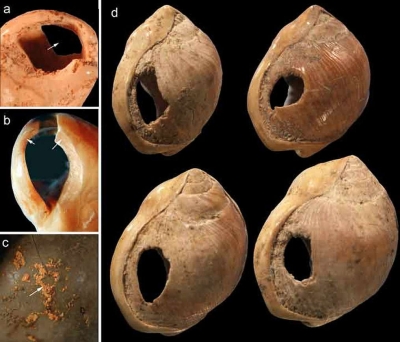
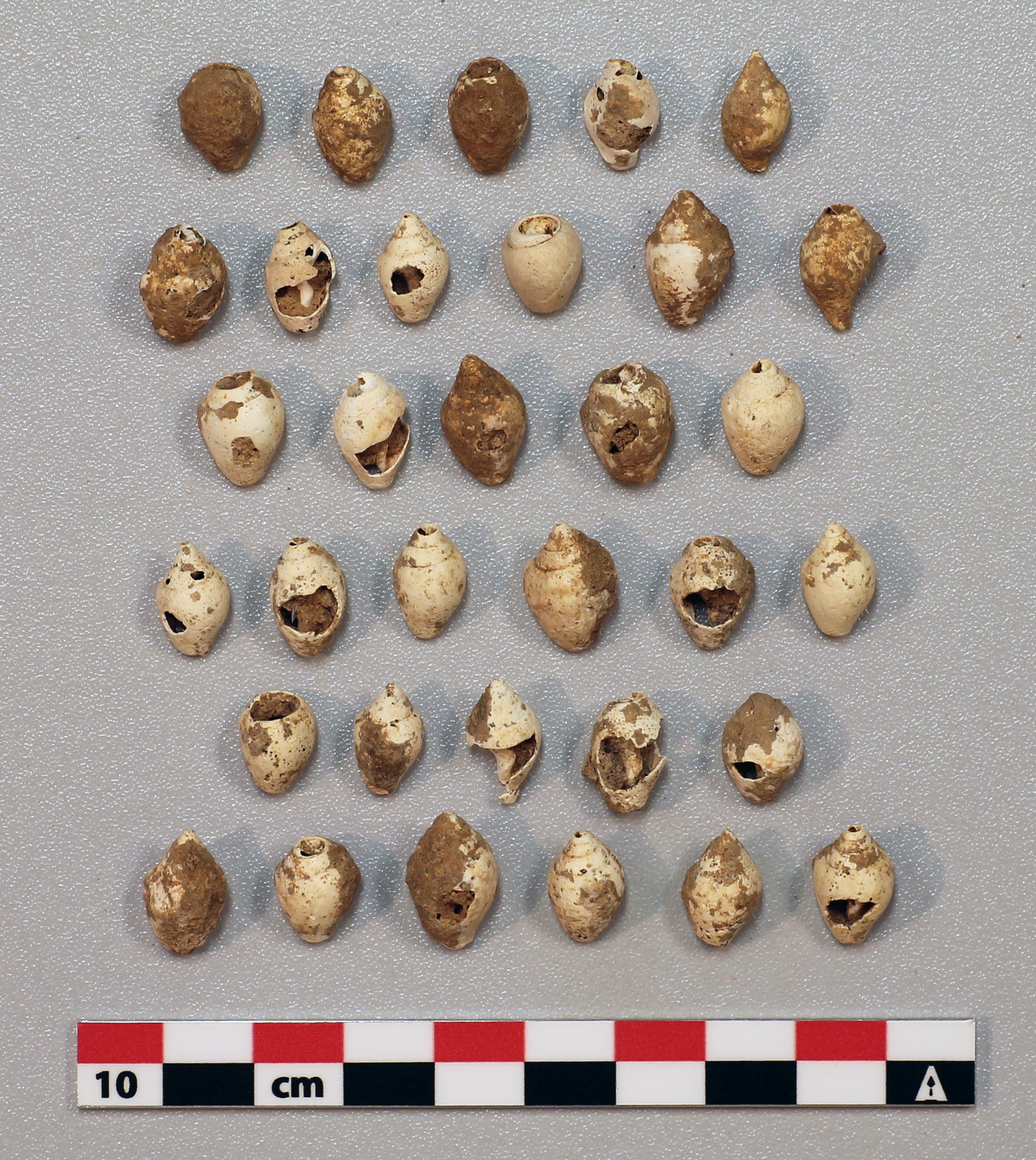
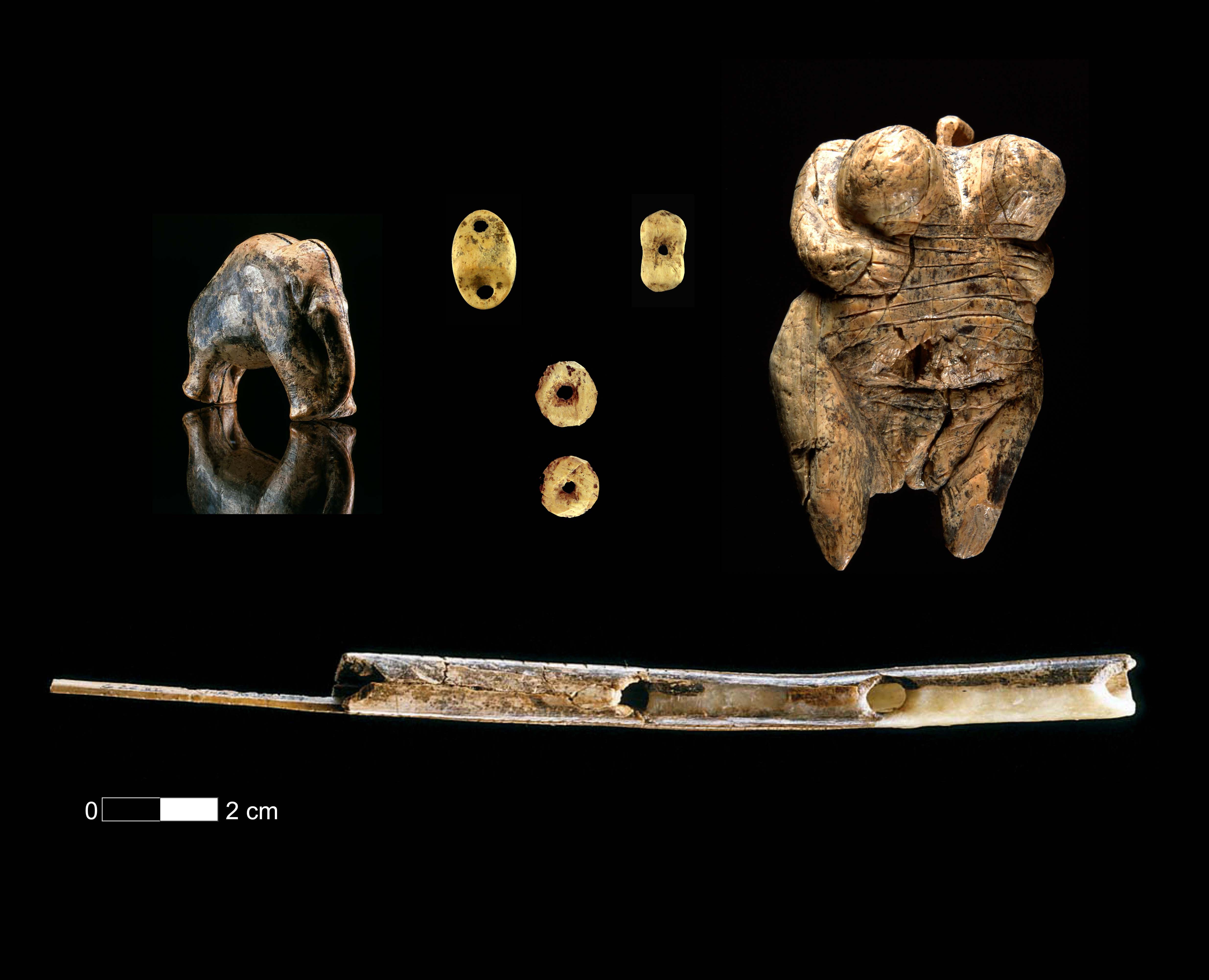
ROCEEH explores the expansion of cultural capacities associated with the origin of symbolic behavior, including expressions of art and music. Many of its own research projects provide evidence for cognitive complexity in early modern humans, for example, through carved figurines, flutes and personal ornaments made of worked ivory, antler and bone from the Swabian Jura of Germany and perforated shells from the Levant and Caucasus. These artifacts give us ideas about how the makers of these innovative objects viewed personal and group identity.

The Upper Paleolithic inhabitants of Sefunim Cave (Israel) collected shells from the Mediterranean coastline to use as ornaments. (Photo: Uni Tübingen)

Art, musical instruments and personal ornaments are found at several sites of the Swabian Jura in southwestern Germany. (Photo: Uni Tübingen)


Transition from Neanderthals to modern humans

One focal point of ROCEEH is to study the changes in human behavior that occurred during the time that modern humans first expanded out of Africa and encountered Neanderthals in Eurasia. Several research projects cover this pivotal time, as technological behaviors which dominated for almost two hundred thousand years were broadly replaced by new ways of doing things that were associated with the arrival of modern humans. Not only do we observe dramatic changes in stone tools, we also see new types of behaviors. These expansions of hominin performances show an increased use of new materials—especially ivory, antler, bone and shell—to make organic tools such as points and needles as well as symbolic artifacts related to the expansion of art and music. A key region for studying the transition from late Neanderthals to early anatomically modern humans is the Swabian Jura in southwestern Germany with its famous cave sites, six of which were assigned UNESCO World Cultural Heritage status in 2017.

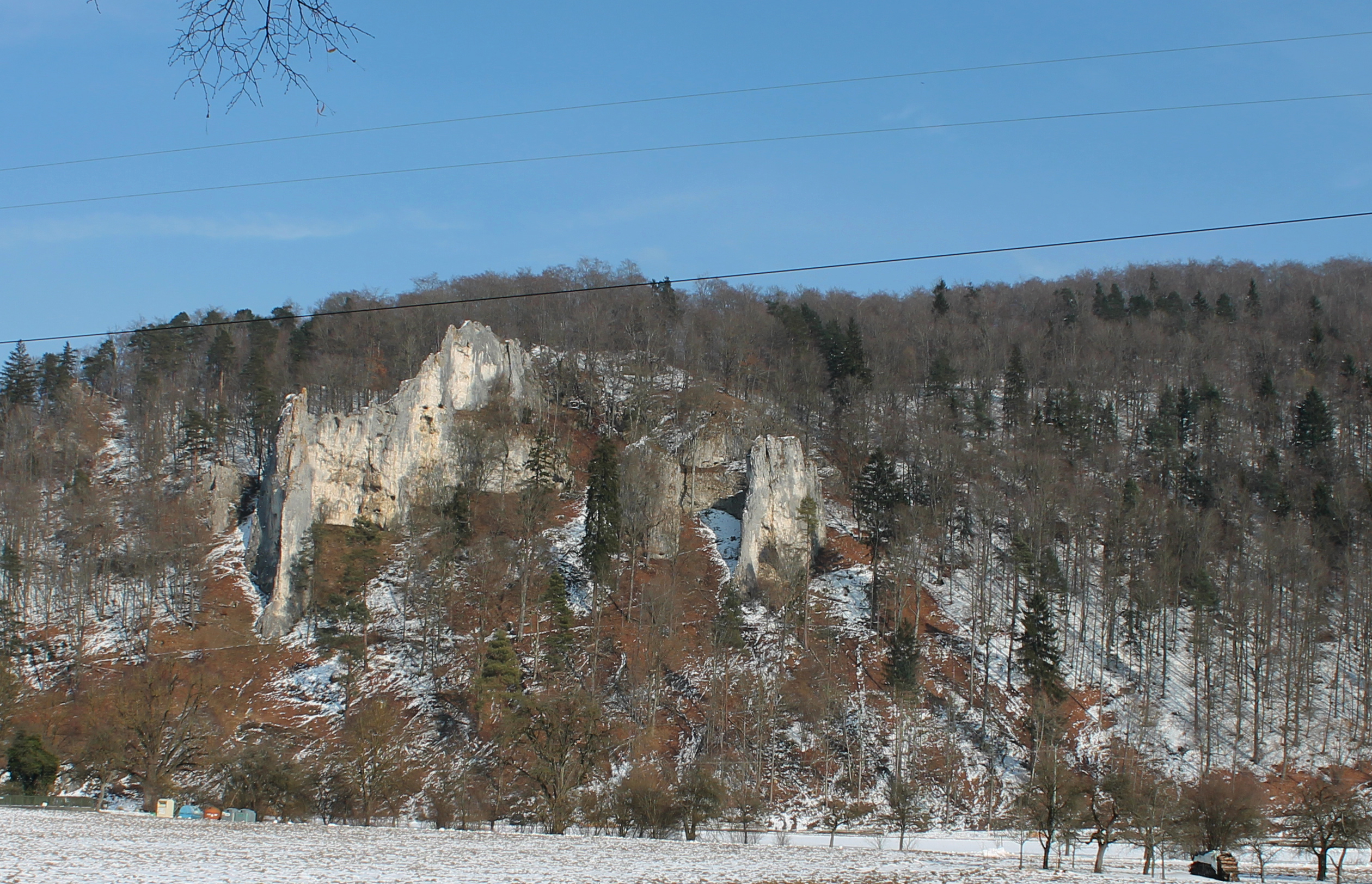
A view of the limestone cliffs at Geißenklösterle (Germany) as seen from the floor of the Ach Valley. (Photo: Uni Tübingen)
 

Expansions of Hominin Resource Space
PlantBITES - A database for Plant Resources in Early Human Environments

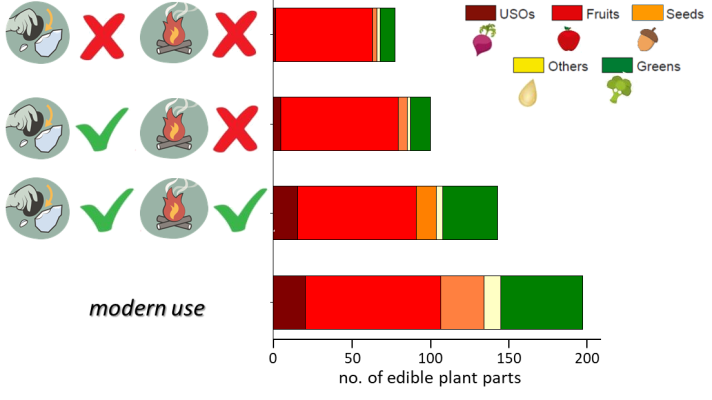
The database PlantBITES is a tool to consider the full range of dominant plant species in different vegetation units, their seasonal availability and their use potential. The database serves to assess the amount and variety of obtainable food (and other) resources that were available to early humans. It also examines the necessary techniques for exploitation and use of plant resources. Such data crucially contribute to answer questions about how early humans with different technological abilities could have used plants in different environments.

The number of available edible plant parts increases with increasing technological skills. In this example, savannas of Southern Africa provide especially more edible seeds and leaves according to different cultural performances. Underground storage organs (USOs) are roots, tubers, rhizomes; ‘greens’ include leaves, stems, sprouts, flowers, buds; ‘others’ are sap, bark, and wood. (Graphic: B. Groscurth)

Modelling Environmental Dynamics and Hominin Dispersals Around the Mid-Pleistocene Revolution (METHOD)
International Focus Group (IFG) #1604F funded by INQUA

Contact:
info[at]method-ifg.com

Project participants:
Christine Hertler, Frankfurt/Main, Germany
Jesús Rodríguez, Burgos, Spain
Ana Mateos, Burgos, Spain
Maria Rita Palombo, Rome, Italy

The Mid-Pleistocene Revolution (MPR) marks a period of profound reconfigurations in global ecosystems caused by climate change driven by variations in orbital forcing taking place around one million years ago. Changes in climate drastically affect vegetation, thus leading to significant faunal turnovers in Europe and elsewhere. Hominins responded to these changes in various ways, on the level of populations by adapting their reproductive strategies thus controlling population densities, on the level of behavior by acquiring new ways of resource acquisition and management, and finally also by shifting distribution patterns and dispersing into new environments.The METHOD IFG network studies environments and hominin responses across diverse spatial, chronological and biological scales. We make use of a range of techniques of modelling (e.g. agent-based modeling, network modelling) and simulation. Furthermore, we create a web-based toolbox to explore a larger range of databases.

Publications
  • Rodríguez, J., Mateos, A., Hertler, C., Palombo, M. R. (2016): Modelling human presence and environmental dynamics during the Mid-Pleistocene Revolution: New approaches and tools. Quaternary International 393: 19-23.
  • Rodríguez, J., Mateos, A., Hertler, C., Palombo, M. R. (2016): The power of models: Mathematical approaches to the study of human-fauna interactions in the Pleistocene. Quaternary International 413:2-6.
  • Volmer, R., Hertler, C. (2016): The effect of competition on shared food resources in carnivore guilds. Quaternary International 413: 32-43.
  • Hölzchen, E., Hertler, C., Timm, I., Lorig, F. (2016): Evaluation of Out of Africa hypotheses by means of agent-based modeling. Quaternary International 413: 78-90.
  • Timm, I., Lorig, F., Hölzchen, E. Hertler, C. (2016): Multi-scale Agent-based Simulation of Long-Term Dispersal Processes: Towards a Sophisticated Simulation Model of Hominin Dispersal. In: Barceló, J. A., del Castillo, F. (eds.): Simulating Prehistoric and Ancient Worlds. Springer, Cham, Switzerland. pp. 141-158.


Environmental studies and landscape reconstruction

Many of ROCEEH’s research projects delve into the relationship between humans and their environment. Some of these projects examine how early humans explored their habitats and found different natural resources to sustain themselves. Other projects study the effects that changing climate had on the environment to help reconstruct the interaction between the lifeways and habitats of these people. Using an integrated approach, we address many aspects of past landscapes including paleofauna, paleovegetation and geomorphology. We investigate these aspects applying methods such as faunal analysis, palynology, non-invasive geophysical techniques, GIS and remote sensing.

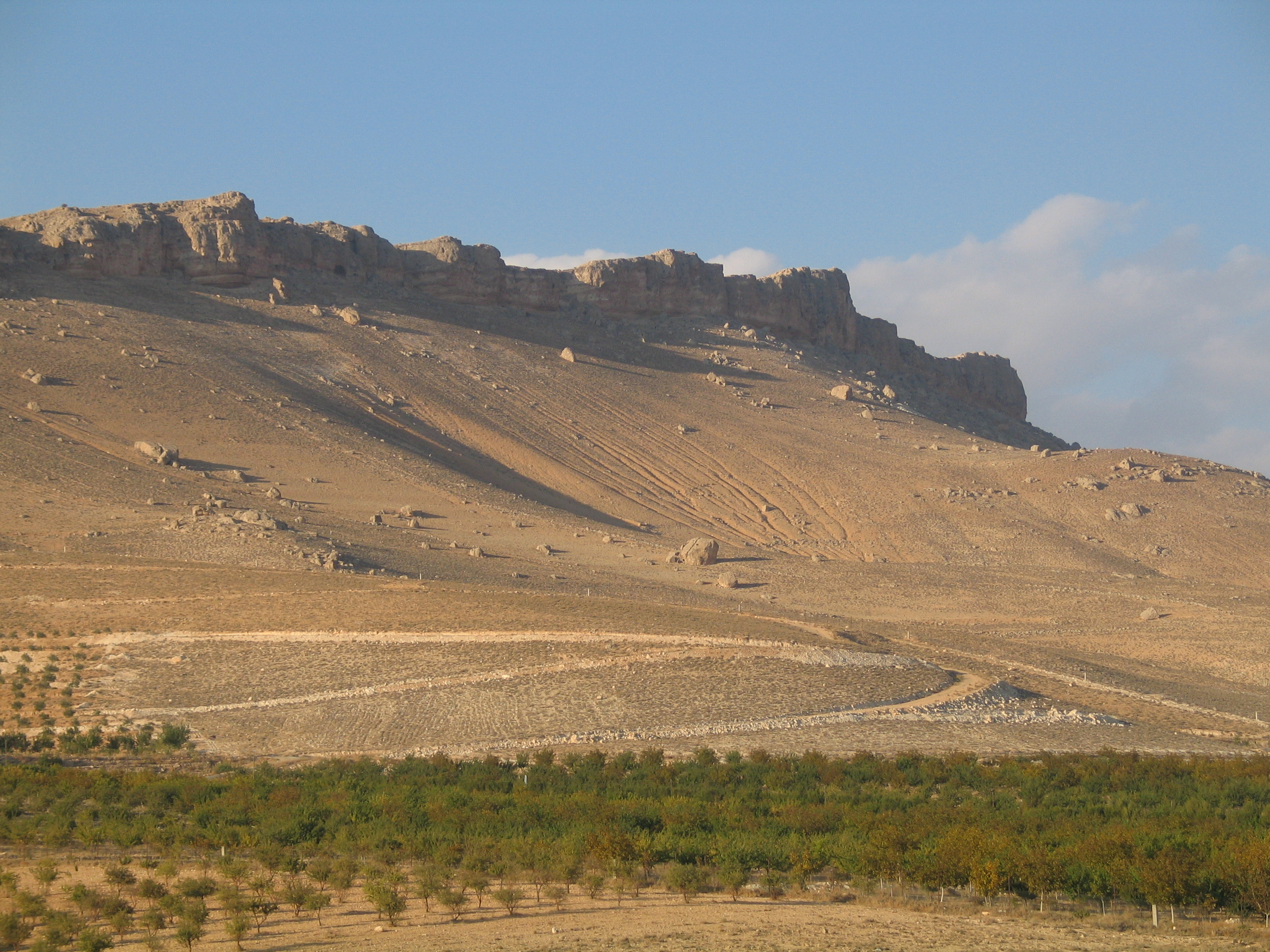
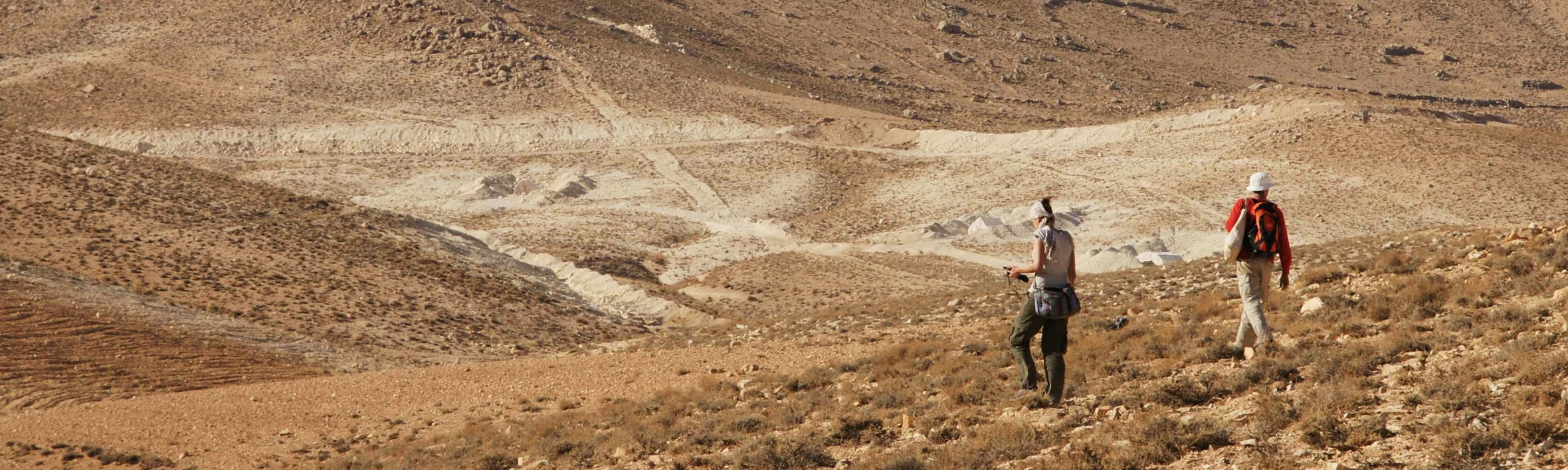
A prominent cliff line transects the Paleolithic survey of the region near Ma'aloula (Syria), north of Damascus. (Photo: Uni Tübingen)


Expansions of Range
ROCEEH Out of Africa Database (ROAD)

At the core of the project is the compilation of data about archaeological and paleoanthropological sites within the chronological and geographic range. Information about the sites and their associated assemblages is accessible in different types of publications and databases. By collecting data systematically and placing it at the disposal of other researchers, ROCEEH freely offers access to information that is otherwise not readily accessible. Thus, ROCEEH enhances the knowledge available about the cultural heritage of our deep past. These data are organized in a multidisciplinary, web-based, geo-relational database known as ROAD (ROCEEH Out of Africa Database) with advanced geographical information system (GIS) functionality. Thus ROAD unifies geographical data about sites with information about their stratigraphy and the cultural finds those layers contain. In addition, ROAD assimilates information on human fossil history, fauna, flora, and climate, and provides this information to model early human habitats. In addition to compiling data systematically, the ROCEEH team analyzes the content of the ROAD database through case studies which examine different cultural phenomena. The results are integrated into a digital atlas detailing the development of humans and the environment.


Field Work

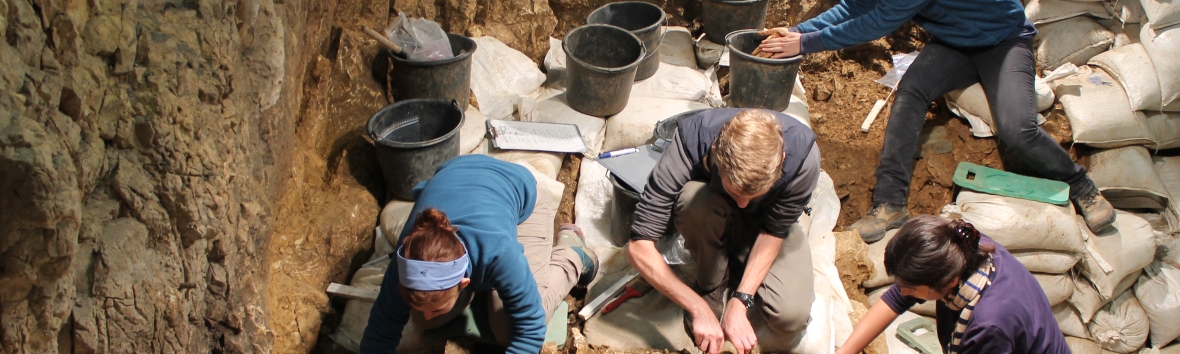
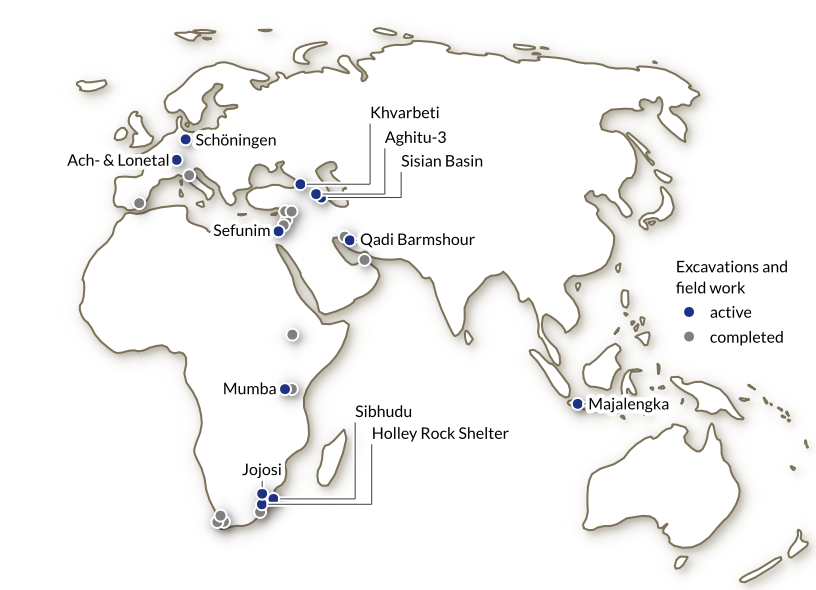
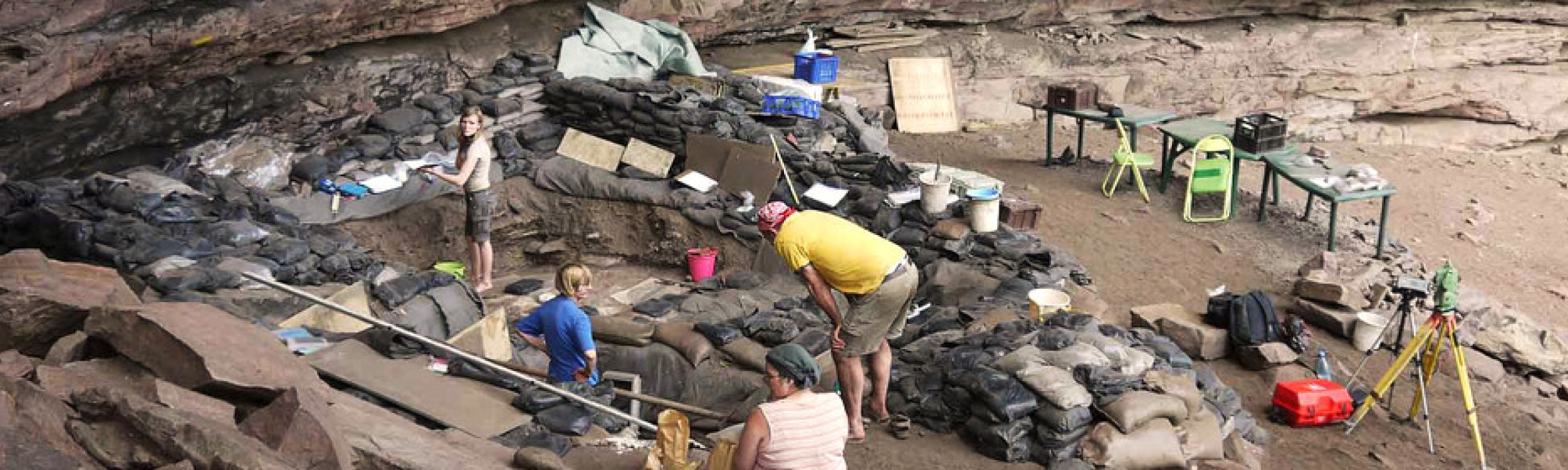
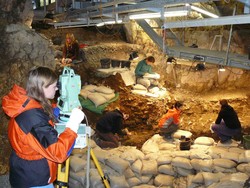
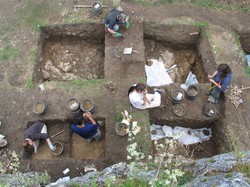
The ROCEEH research center is involved in many excavations around the world.

Find more information about ROCEEH's fieldwork in the research center in Tübingen  and Frankfurt.


Koordination der Arbeitsstellen
  • PD Dr. Miriam N. Haidle
  • Dipl. Biol. Julia Heß
     
Arbeitsstelle Frankfurt/Main

Leitung

  • Prof. Dr. Friedemann Schrenk

Mitarbeiterinnen und Mitarbeiter

  • Dr. Angela Bruch
  • Claudia Groth
  • Dr. Christine Hertler

Doktoranden

  • Susanne Krüger(Paläobiologie)
  • Jan-Olaf Reschke (Paläobiologie)
  • Quy T.K. Tran (Archäobiologie)
  • Lisa Schiersch (Paläobotanik)
     
Arbeitsstelle Tübingen

Leitung

  • Prof. Nicholas J. Conard, PhD
  • Prof. Dr. Volker Hochschild

Mitarbeiterinnen und Mitarbeiter

  • Dipl. Inf. Zara Kanaeva
  • Dr. Andrew W. Kandel
  • Dr. Jesper Borre Pedersen
  • Dr. Christian Sommer

Doktoranden

  • Xiangmei Kong (Frühgeschichte)
  • Firas Jabbour (Frühgeschichte)
  • Bárbara Rodríguez Álvarez (Paleokognition)
  • Svenja Schray (Frühgeschichte)
     
Mitglieder der projektbegleitenden Kommission
  • Prof. Dr. Zvi Ben-Avraham (Tel Aviv)
  • Prof. Dr. Manfred Ehlers (Osnabrück)
  • Dr. Marian Vanhaeren (Bordeaux)
  • Prof. Dr. Thomas Holstein (Heidelberg), Vorsitzender
  • Prof. Dr. Lothar Ledderose (Heidelberg)
  • Prof. Dr. Irmgard Männlein-Robert (Tübingen)
  • Prof. Dr. Claudia Maienborn (Tübingen)
  • Prof. Dr. Joseph Maran (Heidelberg), stellv. Vorsitzender
  • Prof. Dr. Jürgen Richter (Köln)
  • Prof. Dr. Wulf Schiefenhövel (Andechs)
  • Prof. Dr. Marie Soressi (Leiden)
  • Prof. Dr. Mark Stoneking (Leipzig)
Graduiertennetzwerk

Das Graduiertennetzwerk von ROCEEH bringt Doktoranden, Alumni aus Frankfurt und Tübingen sowie assoziierte Kandidaten und Postgraduierte aus anderen Projekten und Institutionen zusammen. Derzeit arbeiten in unserem Netzwerk Studenten aus fünf Disziplinen zusammen: Archäologie, Anthropologie, Paläobiologie, Bioinformatik und Geografie. Das ROCEEH Graduiertennetzwerk bietet Forschungsmöglichkeiten, Themen und manchmal sogar Stellen an. Bei regelmäßigen Treffen diskutieren wir unsere neuesten Ergebnisse und holen uns Anregungen für neue Ideen und gemeinsame Projekte. 2020 haben wir z.B. die ROCEEH Online-Konferenz "Human Origins - Digital Future (HODiF)" mitorganisiert.

Wir profitieren in vielerlei Hinsicht als Teil des ROCEEH-Forschungszentrums. Wir haben Forscher mit unterschiedlichen Hintergründen als Ansprechpartner, die uns viele Möglichkeiten zum interdisziplinären Austausch bieten. Wir nehmen an verschiedenen Konferenzen, Workshops und Geländeprojekten teil. Wir profitieren von ROCEEH, indem wir Kommentare zu unserer Arbeit von einer interdisziplinären Gruppe von Betreuern erhalten, die uns mit potenziellen Kooperationspartnern verbinden, unseren individuellen Horizont erweitern und unsere kreative Arbeit bereichern.


ROCEEH Events

2023

ROCEEH-Konferenz 'Ritual in Human Evolution - Interdisciplinary Perspectives'
4.-6. Oktober 2023, Tübingen
Organisiert von R. Dapschauskas, S. Wolf, N.J. Conard, M.N. Haidle, M. Keysan

2 ROCEEH-Workshops: ROAD Database
September/Oktober 2023, Sangiran und Jakarta, Indonesien
Organisiert von Christine Hertler

COST Action 19141 - Integrating Neanderthal Legacy (iNEAL). Workshop: Exploring and Using the ROAD Database, Madrid, Spain, 27 September 2023 (main organizer: Andrew Kandel), 30 participants

ROAD-Workshop: Working on modelling the ROAD Database managed
Juni 2023, Paris
Organisiert von Christine Hertler im Rahmen von LATEUROPE 2023-2027

ROAD-Workshop: LATEUROPE Modelling
11.-14. April 2023, Frankfurt/Main
Organisiert von Christine Hertler im Rahmen von LATEUROPE 2023-2027


2022

ROAD Seminar – Introduction to Using the ROAD Database, University of Tübingen, October 2022 to February 2023, 10 participants

COST Action 19141 - Integrating Neanderthal Legacy (iNEAL) Workshop: ROCEEH & the ROAD database–A case study in classification, online, 6 December 2022 (co-organizer: Andrew Kandel), 20 participants

European Society for the study of Human Evolution (ESHE). University of Tübingen, 22-24 September 2022 (co-organizer; co-funding by ROCEEH), 7 participants

Wenner-Gren Symposium. Modelling a Collaborative Archaeological Synthesis of Human Migration for a Long-Term, Global Perspective, Abidjan, Cote d’Ivoire, 4-8 April 2022 (co-organizer: Andrew Kandel), 50 participants

Konferenz 'Modes - Forms - Structures'
9.-11. März 2022, Karlsruhe
Organisiert von Mathias Gutmann (KIT, Karlsruhe), Marco Tamborini (TU Darmstadt) und Christine Hertler (ROCEEH)


2021

EUROPEANS-Workshop 'Simulating Human Behaviour - Targeted Design of Agent-Based Models'
4.-8. Oktober 2021 online
Organisiert von Christine Hertler, Jan-Olaf Reschke, Ingo Timm, Ericson Hölzchen, Jan-Ole Berndt, Jesus Rodríguez und Ana Mateos

COST Action 19141 - Integrating Neanderthal Legacy (iNEAL) Workshop: An Overview of the ROCEEH Out of Africa Database (ROAD), 6 October 2021 (co-organizer Andrew Kandel), 40 participants


2020

ROCEEH Konferenz 'Human Origins - Digital Future'
27.-31. Juli 2020 online 
The ROCEEH Conference “Human Origins—Digital Future” presented and discussed integrative aspects and approaches to the development, use, and future securing of large scientific databases, especially within the context of anthropological research. The primary research question asks how databases with their innovative information technology can be used to gain new knowledge by retrieving and extracting archaeological, paleoanthropological, paleobiological, and paleogeographic information.
With this conference, we addressed core issues of digitialization, including possibilities and problems of large, multi-layered databases. Although digital tools are widely applied in scientific projects, questions of linkage, targeted expansion, evaluation, and sustainable safeguarding of databases remain unresolved. New approaches including innovative methods of data mining and machine learning as well as deep learning and artificial intelligence were addressed.
3rd circular

ROAD Workshop for ROCEEHs - SQL Queries/Working with ROAD and ROADWeb, University of Tübingen, 6 February 2020, 10 participants

ARIADNE-Workshop
27.-29. Januar 2020, Prato, Italien
ARIADNE/ROAD-Workshop to connect database contents and infrastructure together with Prof. Franco Niccolucci and the ARIADNE team.
organisiert von V. Hochschild, Zara Kanaeva, A. Kandel und C. Sommer


2019

METHOD IFG Workshop 2019: Modeling Humans and their behavior around the MPR–from data to models
29.-30. April 2019, Rom, Italien
organisiert von Maria-Rita Palombo, Donatella Magri, Christine Hertler, Jesus Rodriguez and Ana Mateos at the Dept. of Geosciences at Sapienza University of Rome

Advanced Database Workshop for South Asia
3.-28. Juni 2019, Tübingen
course on the practical use of ROAD focusing on the prehistory of South Asia.
organisiert von Andrew Kandel, Zara Kanaeva und Christian Sommer


An Overview of ROCEEH and the ROAD Database – Key Concepts and Project Goals, University of Köln, December 2019, 20 participants, Vorlesung von Andrew Kandel


Humboldt / German-Israeli Symposium, Frontiers of Humanities. Symposium on Prehistoric Archaeology, Academy of Sciences, Jerusalem, 17-20 November 2019 (co-organizer Andrew Kandel), 75 participants

MSA Workshop, University of Tübingen, 20 June 2019, 25 participants

Carbon-14 Workshop, Introduction to OxCal and the South African Radiocarbon database, Emma Loftus (Cambridge), University of Tübingen, May 2019, 15 participants


2018

METHOD Training Lab 2018-5: Computational Models in Palaeolithic Archaeology and Palaeoecology
27. November 2018, Burgos, Spanien
organized by Ana Mateos and Jesús Rodríguez at the Centro Nacional de Investigación sobre la Evolución Humana (CENIEH) and co-organized by Christine Hertler and Maria Rita Palombo

METHOD Workshop 2018-6: "We boldy went" - Advances and progress modelling the MPR
28.-29. November 2018, Burgos, Spanien
organized by Ana Mateos and Jesús Rodríguez at CENIEH and co-organized by Christine Hertler and Maria Rita Palombo


ROAD Workshop - An introduction to ROCEEH and the ROAD database – Key concepts and project goals, Chandigarh, India, 23-29 Aug. 2018, 25 participants


Internationale Senckenberg Konferenz: Images, gestures, voices, lives. What can we learn from Palaeolithic art?
30. Mai - 2. Juni 2018, Tübingen
organized by ROCEEH and Senckenberg Centre for Human Evolution and Palaeoenvironment.
The Conference was funded by the DFG Deutsche Forschungsgemeinschaft and the Senckenberg Gesellschaft für Naturforschung.
venue:
Alte Aula, University Tübingen
Münzgasse 30
72070 Tübingen


2017

KULT-UR-MENSCH – Kulturkonzepte für die Erforschung der Menschwerdung
Conference: Concepts of Culture for Research on Becoming Human
Heidelberger Akademie der Wissenschaften, Heidelberg, Germany, Nov 23-25, 2017

Organizers: Miriam Haidle, Christine Hertler and the ROCEEH Team

Program,Position Paper & group shot

Modelling Environmental Dynamics and Hominin Dispersals Around the Mid-Pleistocene Revolution (METHOD)Workshop 2017-II:
“Keep calm and boldly go” – Which factors in the environment drive early human expansions and have an impact on their settlements?
in Mauer, Germany, Apr 24–27, 2017

Organizers: Christine Hertler, Ericson Hölzchen & Zara Kanaeva

Abstract


2016

100+25 years of Homo erectus: Dmanisi and beyond
International Senckenberg Conference in Tbilisi, Georgia, Sep 20-­24, 2016

organized by:
Georgian National Museum
Senckenberg Research Institute and Natural History Museum Frankfurt/Main
ROCEEH Research Centre, Heidelberg Academy of Sciences and Humanities

Abstract & Report

Modelling Environmental Dynamics and Hominin Dispersals Around the Mid-Pleistocene Revolution (METHOD)Training Lab 2016-I:
Data availability, management and storage – Working with Databases in Sassari, Italy, Sep 13-15, 2016

Coorganizers and Programme Representatives Christine Hertler, Ericson Hölzchen, Zara Kanaeva, Michael Märker


2015

International ROCEEH Conference on Human Expansions
at Senckenberg Biodiversity and Climate Research Centre, Frankfurt, Germany, Jul 13-17, 2015

Poster & Report


2013

Workshop "The Role of the Southern Caucasus on Early Human Evolution and Expansion - Refuge, Hub or Source Area?"
at Georgian National Museum , Tbilisi, Georgia, Oct 15-20 2013

Abstracts

EAAPP conference 2013
in Mombasa, Kenya, Jul 28-Aug 1, 2013

The research centre supported the conference which was organized by the East African Association of Paleoanthropology and Paleontology.


2012

Workshop "Early Pleistocene Environmental Changes in Southern Caucasus – Reconstruction of Climate and Vegetation Development in Armenia and Georgia at the Time of Early Human Expansion into Eurasia"
Botanical Institute of the Armenian Academy of Sciences in Yerevan, Armenia, Jul 25-31, 2012

Program & Abstracts

"Environmental backgound of early hominin dispersal in Western Eurasia"
Senckenberg Research Station Weimar, Germany, Apr 19-20, 2012

Workshop

Program

Symposium "Environment and culture of early humans in China and beyond"at Senckenberg Museum, Frankfurt, Germany, Feb 26-Mar 3, 2012


2011

Symposium "The Nature of Culture" 
in Tübingen, Germany, Jun 15-18, 2011

Click here to learn more about ROCEEH's international symposium in June 2011 which focused on the evolution of cultural capacity... (read more)

3rd EAAPP conference
in Addis Ababa, Ethiopia, Aug 8-12, 2011

The research centre supported the conference which was organized by the East African Association of Paleoanthropology and Paleontology.


2010

"Hominin Environment, Ecology and Dispersal"
Bernard Price Institute of Palaeontology and Institute for Human Evolution, Johannesburg, South Africa, Nov 9-10 2010

Workshop South Africa 2010

Program & Abstracts


2009

2nd EAAPP conference
in Arusha, Tanzania, Aug 16-20, 2009

The 50th anniversary of the first hominid find in Olduvai in 2009 was celebrated with a commemorative conference.

The research centre supported the conference which was organized by the East African Association for Palaeoanthropology and Palaeontology.

A report on this conference is now available online.

Joint Symposium of ROCEEH and BiK-F "Human Expansions and Global Change in the Pleistocene - Problems and Methods"
at Senckenberg Research Institute and Natural History Museum Frankfurt, Germany, Nov 16-19, 2009
including ROCEEH Workshops: Reconstructing Environments: Quantitative Methods and Infrastructure for the Assessment of Early Human Expansions

Program & Abstracts

"The Interaction Between Environment and Human Expansions in Southern Africa"
Iziko South African Museum Cape Town, South Africa, Feb 23-24, 2009

Workshop South Africa 2009

Program & Abstracts


Konferenzen

Von ROCEEH-Mitgliedern organisierte Meetings, Sessions und Workshops

2023

Big Historical Data Conference

22.-25. November 2023, Jena

ROCEEH Session: Insights from reusing large prehistoric and interdisciplinary  databases

Contact: christian.sommer@uni-tuebingen.de

Die Konferenz wird in einem hybriden Format abgehalten, dass sowohl eine persönliche Teilnahme und Online-Teilnahme ermöglicht. Kostenloser Online-Zugang über die Website https://bhdc.earth.


INQUA 2023

14.-20. Juli 2023, Rom, Italien

Session 45 "Plants as Resources for Early Humans - Availability and potential exploitation of useful wild plants through Pleistocene human history" organisiert von A. Bruch und K. Hahn

Abstract

Session 109 "Quaternary environments and human evolution: fossil record, phylogeny, palaeobiology, palaeoecology and cultural models" organisiert von P. Sukumaran, C. Hertler und P.R. Chauhan

Abstract

Session 131 "A global view on Early Pleistocene climate and vegetation dynamics" organisiert von K. Sniderman und A. Bruch

Abstract


Kongress CAA 2023

3.-6. April 2023, Amsterdam, Niederlande

Session 33 "Bayesian Inference in Archaeology: new applications and challenges" organisiert von S. Carrington, A. Cortell-Nicolau, E. Crema und C. Sommer

weitere Informationen unter: https://2023.caaconference.org/programme/sessions/


2022

Congress of the Indo-Pacific Prehistory Association

7.-12. November 2022, 22nd Meeting of the Indopacific Prehistroy Association, Chiang Mai, Thailand

Session "Exploring Distant Shores: Simulationg Dispersal Across Archipelagoes", organisiert von Mika Rizki Puspaningrum und Christine Hertler

Abstract Session 16

top Konferenzen


NECLIME Annual Conference 2022

21.-24. November 2022, online

organisiert von Eliso Kvavadze, Maia Bukhsianidze und Angela Bruch

Scientific program and abstract volume
Report


12th Annual Meeting of the European Society for the Study of Human Evolution (ESHE)

21.-25. September 2022, Tübingen

mitorganisiert von Andrew Kandel und ROCEEH mit einem ROAD Datenbank-Workshop am 21. September


Eighth Biennial Conference of the Eastern African Association of Palaeoanthropology and Palaeontology (EAAPP)

31. Juli - 7. August 2022, Arusha, Tansania

mitorganisiert und unterstützt von ROCEEH


2021

Workshop 'NECLIME early career scientists network'

8. Oktober 2021 online

Organisiert von Adele Bertini und Angela Bruch


NECLIME Online Conference 2021

19.-21. April 2021, online

organisiert von A. Bruch, T. Utescher, A. Kern, M. Kováčová und M. Stebich

Conference report


2020

Aufgrund der Corona-Pandemie fanden keine Konferenzen statt.


2019

47th Annual Conference in Computer Applications and Quantitative Methods in Archaeology (CAA)

23-27 April 2019, Krakow, Polen

Session 2: Progress in WebGIS and DB solutions for Archaeology

organisiert von M. Matsumoto, E. Uleberg, V. Hochschild, M. Märker und C.  Willmes


METHOD IFG Workshop 2019: Modeling Humans and their behavior around the MPR–from data to models - Closing Workshop

29-30 April 2019, Rom, Italien


Modelling Environmental Dynamics and Hominin Dispersals Around the Mid-Pleistocene Revolution (METHOD)

organisiert von D. Magri, E. Hölzchen und C. Hertler


NECLIME Workshop: Taxonomy of Neogene Palynomorphs

Weimar, Germany, 17.-20. Juni 2019

NECLIME working group

NECLIME news


International Union for Quaternary Research (INQUA)

Dublin, Irland, 25.–31. Juli 2019

Zwei von ROCEEH mitorganisierte Sessions:

  • Session 20: Before and after the earliest Homo dispersal in Eurasia: Early-Middle Pleistocene faunas and vegetation and the dynamics of the Human Resource Space (Raffaele Sardella, Daniel Demiguel, Lorenzo Rook, Angela Bruch, Christine Hertler, Natalia Rudaya) abstract
  • Session 12: Human and non-human responses to the mid-Pleistocene transition (Ericson Hölzchen, Lutz Maul, Maria Rita Palombo) abstract


East African Association for Paleoanthropology and Paleontology, 7th biannual conference

Nairobi, Kenya, 1.–4. August 2019

ROAD Workshop, Treffen von ROCEEH mitfinanziert

schedule

abstracts


Caves as Natural and Cultural Monuments Internationale Konferenz

Yerevan, Armenien, 11.–13. September 2019

Website


Neogene Climate Evolution in Eurasia (NECLIME) Jahrestreffen

St. Petersburg, Russland, 25.-27. September 2019

organisiert von S. Popova, T. Utescher und D. Gromyko

mitorganisiert von A. Bruch

  • The resource space of Early Homo in Europe - implications from vegetation dynamics and plant food resource availability in the Caucasus (A.A. Bruch, A. Papikyan, I. Gabrielyan, E. Kvavadze)
  • Early Pleistocene climate and regional environments in Southern Spain - A palyonological study of lake sediments in Baza Basin, SE Spain (Y. Altolaguirre, A.A. Bruch, L. Gibert)
  • A contribution to vegetation reconstruction based on palaeocarpological material from Lake Sevan's Holocene peat bog (E. Hakobyan, I. Gabrielyan, E. Martinetto, A.A. Bruch)

NECLIME news


German-Israeli Symposium, Frontiers of Humanities


17.-20. November 2019, Jerusalem, Israel

Symposium: Prehistoric Archaeology

organisiert von A. Kandel


2018

Ecosystem isolation and connection: rise and demise of biota in the Pontocaspian region Interim colloquium of RCMNS and EU PRIDE final conference in Tbilisi, Georgia, 27.-29. August 2018


10th European Palaeobotany and Palynology Conference EPPC in Dublin, Irland, 12.-17. August 2018

  • Session 3: Neogene and Quaternary Terrestrial Ecosystems in the Southern Caucasus (Jordi Agusti & Angela A. Bruch)
  • Session 25: Cenozoic plant diversity gradients in time and space and their impact on early humans (ROCEEH/NECLIME) (Angela A. Bruch, Alexandra-Jane Henrot, Louis François, Natalia Rudaya & Torsten Utescher)


CAA in Tübingen, Germany, 19.-23. März 2018

ROCEEH war Mitorganisator der 2018 Computer Applications and Quantitative Methods in Archaeology (CAA) international conference.

ROCEEH organisierte mehrere Sessions und Workshops:

  • Session 10: Expanding horizons: confronting issues of scale, resolution, and representation in the study of human expansions (Benjamin Davies & Nicholas Conard)
  • Session 17: Early human land use strategies during Middle and Late Pleistocene glacial and interglacial times in Europe (Angela A. Bruch & Michael Bolus)
  • Session 27: Map management and Webgis applications for archaeological data base solutions (pdf) (Espen Uleberg, Mieko.Matsumoto, Michael Märker, Christian Sommer & Volker Hochschild)
  • Session 36: Advantages and Limitations of Spatial Applications in Archaeology (Geraldine Queneherve, Michael Maerker & Felix Bachofer)
  • Workshop 9: The ROAD database as data management and search tool (Zara Kanaeva & Andrew W. Kandel)
  • Workshop 6: Remote sensing with open source tools for geoarcheological survey (Felix Bachofer & Christian Sommer)

2017

ROCEEH war Mitorganisator des 18. Jahrestreffens des NECLIME (Neogene Climate Evolution in Eurasia) Konsortiums am Botanischen Institut der Nationalen Akademie der Wissenschaften in Yerevan, Armenien, 18.-24. September 2017.

Im Kontext der NECLIME-Konferenz organisierte ROCEEH einen 3tägigen Workshop (im Rahmen des PlantBITES Projekts), hier wurden junge Wissenschaftler:innen aus Georgien und Armenien in die von NECLIME entwickelten quantitativen Techniken der Paläoumweltrekonstruktionen eingeführt.


2016

INQUA IFG “Modelling Environmental Dynamics and Hominin Dispersals Around the Mid-Pleistocene Revolution (METHOD)” in Sassari, Italien, 13.-15. September 2016

Von ROCEEH mitorganisierter Workshop

Training Lab 2015-I C. Hertler: Data availability, management and storage – Working with databases


2015

DCH 2015 Berlin, Germany, 28.-30. Oktober 2015

ROCEEH war Mitorganisatorin der Digital Humanities Konferenz.

  • Session 4: Sebastian Vogel, Michael Märker, Florian Seiler The SALVE Research Project: Sarno River plain – Ancient Life in the Vesuvian Environment
  • Session 5: Volker Hochschild, Michael Märker ROAD - A Plattform for Interdisciplinary Research on Early Humans
  • Session 8: Michael Märker, Geraldine Quénéhervé, Felix Bachofer Landscape Reconstruction and Archaeological Site Prediction in the Lake Manyara Area, Northern Tanzania


CAA in Siena, Italien, 30. März-3. April 2015

ROCEEH organisierte zwei Sessions:

  • 5G How to reveal geographic relations in Databases on cultural heritage (Michael Märker, Espen Uleberg, Volker Hochschild, Mieko Matsumoto)
  • 5L Modelling large-scale human dispersals: data, pattern and process (Michael Märker, Christine Hertler, Iza Romanowska)

CAA website


2014

UISPP in Burgos, Spanien, 1.-7. September 2014

  • A21b "Technological change and behavioral variability in the MSA" (Regine Stolarczyk)
  • A2d Contextualizing Schöningen (Miriam Haidle)
  • A2f. Pleistocene human dispersals: climate, ecology&social behavior (Angela Bruch)
  • A21a: Neanderthals on their own terms: new perspectives for the study of Middle Paleolithic behaviour. (Michael Bolus & Michael Märker)
  • A21c Movements in and Out for Africa: Assemblage variability and population dynamics in Northeast Africa and Southwest Asia during the MSA and Middle Paleolithic (Knut Bretzke & Nicholas Conard)
  • B13 Mathematical approaches for the study of human-fauna interactions in the Pleistocene (Christine Hertler, Rebekka Volmer & Ercison Hölzchen)
  • B37 Lithic, Evolution, Science (Miriam Haidle)
  • B53 The archaeology of early fire use (Miriam Haidle)

UISPP 2014


CAA in Paris, Frankreich, 22.-25. April 2014

  • Session S24/ Friday 25.04. Modelling approaches to study Early humans in space and time Convener: Michael Märker, Christine Hertler and Yasuhisha Kondo
  • Session S13/ Friday 25.04. Databases on cultural heritage and their geographic visualization Convener: Michael Märker, Espen Uleberg, Volker Hochschild

CAA website


EGU General Assembly in Wien, Österreich, 27. April-2. Mai 2014

with Session SSP4.2 "Always look on the bright side… - Environmental constrains of early human expansions" by Finn Viehberg, Angela Bruch, Minoru Yoneda

abstract


9th European Palaeobotany and Palynology Conference in Padova, Italien, 26.-31. August 2014

with Session "Cenozoic vegetation quantification with models and proxy data (a NECLIME and ROCEEH contribution)" by L. François, A. A. Bruch, T. Utescher


2013

EGU General Assembly in Wien, Österreich, Apr 7.-12. April 2013

Session SSP4.1 " Should I stay or should I go - the role of climate in early expansions of humans" by Finn Viehberg, Angela Bruch, Minoru Yoneda

abstract


14th Congress of Regional Committee on Mediterranean Neogene Stratigraphy RCMNS in Istanbul, Türkei, 8.-12. September 2013

ROCEEH / VW workshop " The role of the Southern Caucasus on early human evolution and expansion - refuge, hub, or source area?" in Tbilisi, Georgien, 15.-20. Oktober 2013 von Angela Bruch, David Lordkipanidze


2012

International Organisation of Palaeobotany Conference (IOPC) in Tokyo, Japan, 23.-30. August 2012


Meeting European Society for the study of Human Evolution (ESHE) in Bordeaux, Frankreich, 21.-22. September 2012


Interim Colloquium Regional Committee on Mediterranean Neogene Stratigraphy (RCMNS) in Bukarest, Rumänien, 27.-30. September 2012


Conference Neogene Climate Evolution in Eurasia (NECLIME) in Sofia, Bulgarien, 1.-4. Oktober 2012


Alumni

Dr. Yul Altolaguirre Zancajo

Paläobotanik, Frankfurt

Titel der Dissertation: “High-resolution palynological analysis of the Early Pleistocene regional environment before, during and after the first expansion of early Homo into Southern Spain” (DOI: 10.21248/gups.67186.)


Dr. Felix Bachofer

Geographie, Tübingen

Titel der Dissertation: "Remote Sensing in Landscape Reconstruction Applications - Paleo-Landscape Research in a Semiarid Environment in Northern Tanzania"

Email an felix.bachofer[at]dlr.de

Aktuelle Forschung: DLR Earth Observation Center, ORCID und Research Gate


Dr. Gregor Bader

Archäologie, Tübingen

Titel der Dissertation: "On the variability of Middle Stone Age lithic technology during MIS3 in KwaZulu-Natal, South Africa"

Email an gregor.bader[at]uni-tuebingen.de

Aktuelle Forschung: ORCID und Senckenberg Centre for Human Evolution and Palaeoenvironment, Tübingen


Dr. Knut Bretzke

Archäologie, Tübingen

Titel der Dissertation: "Diachronic studies of Paleolithic landuse in western Syria"

Email an bretzke[at]uni-tuebingen.de


Dr. Armando Falcucci

Archäologie, Tübingen

Titel der Dissertation: "A critical assessment of the Aurignacian: Insights from Fumane Cave in northern Italy"

Email an armando.falcucci[at]ifu.uni-tuebingen.de

Aktuelle Forschung: Universität Tübingen


Dr. Riczar Fuentes

Archäologie, Tübingen

Titel der Dissertation: "Detecting microscopic aspects of Late Pleistocene to Early/Mid Holocene lithic technology in Island Southeast Asia: Perspectives from North and Central Sulawesi" (Publikation)

Email an rfuentes[at]ateneo.edu

Aktuelle Forschung: Universität Ateneo de Manila


Dr. Duilio Garofoli

Paläokognition, Tübingen

Titel der Dissertation: "Neanderthal cognitive equivalence: epistemological problems and a critical analysis from radical embodiment"

Aktuelle Forschung: Academia


Dr. Liane Giemsch

Archäologie, Tübingen

Titel der Dissertation: "Makuyuni. Fundstellen des Acheuléen am Lake Manyara, Tansania. Ein Beitrag zur Erforschung der mittelpleistozänen Kultur in Ostafrika" (Publikation)

Email an liane.giemsch[at]stadt-frankfurt.de

Aktuelle Forschung: Archäologisches Museum Frankfurt


Dr. Ericson Hölzchen

Paläobiologie, Frankfurt

Thesis title: "Concept 'Out of Africa' by means of Agent-based Modeling (ABM)"

(zugehörige Publikationen: Hölzchen, E. et al. (2021): Discovering the opposite shore: How did hominins cross sea straits?. PLoS One 16(6), e0252885. DOI: 10.1371/journal.pone.0252885. - Hölzchen, E. et al. (2022): Estimating crossing success of human agents across sea straits out of Africa in the Late Pleistocene. Palaeogeography, Palaeoclimatology, Palaeoecology 590, 110845. DOI: 10.1016/j.palaeo.2022.110845. - Hölzchen, E. et al. (2016): Evaluation of Out of Africa hypotheses by means of agent-based modeling. Quaternary International 413, Part B, 78–90, DOI: 10.1016/j.quaint.2015.11.022.)

Email to hoelzchen[at]uni-trier.de

Current research: ROCEEH, DKFI


Dr. Trine Kellberg Nielsen

Universität Aarhus, Dänemark, externe Forschungsarbeit in der Archäologie der Universität Tübingen

Titel der Dissertation: "Aarhus University, Denmark, external research at Archaeology, Tübingen - “Northern Neanderthals – A systematic assessment of pre-modern human colonisation of South Scandinavia"

Email an trinekellberg[at]cas.au.dk

Aktuelle Forschung: Neanderedge Aarhus University


Dr. Regine Klein

Paläokognition, Tübingen

Titel der Dissertation: "Innovationen im Middle Stone Age Südafrikas: Die Analyse von Knochenartefakten und Heat treatment unter einer handlungsorientierten Perspektive." (Publikation)

Email an regine.klein[at]web.de oder regine.stolarczyk[at]uni-tuebingen.de


Dr. Davor Löffler

Paläokognition, Tübingen

Titel der Disseration: "Rekursion zivilisatorischer Kapazitäten als Entwicklungsmuster in der Zivilisationsgeschichte. Untersuchung der Möglichkeit einer Verknüpfung des paläoanthropologischen Modells der Erweiterung kultureller Kapazitäten mit Arno Bammés Theorie axialer Zäsuren“ publiziert als "Löffler, Davor. Generative Realitäten I: Die Technologische Zivilisation als neue Achsenzeit und Zivilisationsstufe. Eine Anthropologie des 21. Jahrhunderts. Weilerswist: Velbrück Wissenschaft 2019, 784 Seiten" (Publikation)

Email an contact[at]davorloeffler.com

Aktuelle Forschung: Dr. Davor Löffler promovierte an der Freien Universität Berlin in Soziologie mit einer interdisziplinären Arbeit zur Technikanthropologie und Sozialevolution in transformationswissenschaftlicher Absicht. Er ist derzeit als Lehrbeauftragter für Globalisierungsgeschichte und Futurologie am Departement für Soziologie an der Universität Basel und für Wissensgeschichte an der Leuphana Universität Lüneburg tätig. Seine Forschung konzentriert sich auf die Frage nach dem Begriff des Menschen im 21. Jahrhundert und den korrespondierenden sozialen Transformationen auf Basis neuer Technologien.


Dr. Geraldine Quénéhervé

Geographie, Tübingen


Dr. Steffen Scharrer

Paläobotanik, Frankfurt

Titel der Disseration: "Frühpleistozäne Vegetationsentwicklung im Südlichen Kaukasus: pollenanalytische Untersuchungen an Seesedimenten im Vorotan-Becken (Armenien)" ( Publikation)

Email an steffen.scharrer[at]t-online.de


Dr. Viola Schmid

Archäologie, Tübingen

Titel der Dissertation: "The C-A layers of Sibudu Cave (KwaZulu-Natal, South Africa) in the light of the MSA lithic technologies in MIS 5"

Email an viola.schmid(at)oeaw.ac.at

Aktuelle Forschung: Östereichische Akademie der Wissenschaften, Östereichisches Archäologisches Institut, Wien


Dr. Rebekka Volmer

Paläobiologie, Frankfurt

Titel der Dissertation: „Struktur und gemeinsame Nutzung von Nahrungsressourcen in fossilen Carnivoren-Gilden“ (Publikation)

Email an rebekka.volmer[at]senckenberg.de


Dr. Manuel Will

Archäologie, Tübingen

Titel der Dissertation: "Lithic technology and behavioral variability during the Middle Stone Age of southern Africa: implications for the evolution and dispersal of early modern humans" ( Publikation)

Email an manuel.will[at]uni-tuebingen.de


Dr. Reza Zakerinejad

Geographie, Tübingen

Ausgrabungen
Hohle Fels Cave

Hohle Fels is situated in the Ach river valley at the base of a Jurassic limestone outcrop, just northeast of the town of Schelklingen. With a volume of about 6,000 cubic meters, the cave is one of the largest of the Swabian Jura. Hohle Fels Cave provides an important record of the cultural stratigraphy of the Middle Paleolithic, Aurignacian, Gravettian and Magdalenian periods, but is particularly well-known for its Aurignacian and Gravettian finds. Hohle Fels Cave provides one of the rare opportunities to investigate the Middle to Upper Paleolithic transition from Neanderthals to Anatomically Modern Humans using modern excavation methods. Noteworthy finds include a female figurine and flutes from the Early Aurignacian layers representing the oldest evidence of figurative art and musical instruments worldwide.

Vogelherd Cave

The Paleolithic site of Vogelherd is located in the Lone river valley northwest of the town of Niederstotzingen. The site was excavated in 1931 in just 12 weeks and provided examples of mammoth ivory figurines from the Aurignacian as well as important lithic and faunal assemblages from the Middle and Upper Paleolithic. Excavation of the back dirt from 2005 to 2010 yielded many important Paleolithic finds, mainly from the Aurignacian deposits, including numerous examples of figurative art and personal ornaments. Vogelherd is a key site for investigating the transition from Neandertals to Anatomically Modern Humans.

Schöningen

The site of Schöningen is situated at the edge of a large brown coal mine in Lower Saxony. In the 1990s the site yielded eight wooden lances and several horse skeletons from ca. 300,000 year old deposits. These finds document that the cultural performances and social interactions of archaic Homo were more sophisticated than previously known.

2025
  • Bader, G. D., Sommer, C., Linstädter, J., Masia, D. P., Blessing, M. A., Forrester, B., & MacDonald, B. L. (2025): Decoding hunter-gatherer-knowledge and selective choice of lithic raw materials during the Middle and Later Stone Age in Eswatini. Journal of Archaeological Science, 180, 106302. DOI: 10.1016/j.jas.2025.106302.
  • Baumann, C., Kandel, A.W. & Hussain, S.T. (2025): Evidence for the catalytic role of humans in the assembly and evolution of European Late Pleistocene scavenger guilds. Quaternary Science Reviews 349, 109148, ISSN 0277-3791, DOI: 10.1016/j.quascirev.2024.109148.
  • Beekman, C.S., Kandel, A.W., Barceló, J.A., Kiddey, R., Kienon-Kaboré, H.T., Ragsdale, C.S., Koffi, K.S., Touré, G.N., Mameli, L., Altschul, J.H., Lee, C., Thiaw, I. (2025): A collaborative synthetic view of migration in archaeology: Addressing challenges for policymakers. Journal of Anthropological Archaeology 78, 101667, ISSN 0278-4165, DOI: 10.1016/j.jaa.2025.101667.
  • Blanco-Lapaz, A., Luzi, E., Serangeli, J. & Conard, N.J. (2025): The secret of the lake. The role of fish during the Middle Pleistocene at Schöningen (northern Germany). Conference paper: Hugo Obermaier Society for Quaternary Research and Archaeology of the Stone Age, 66th Annual Meeting in Faro, Portugal. ISBN: 978-3-946387-62-6, pp. 27-28.
  • Bruch, A.A., Kern, A.K., Stebich, M., Weitzel, N., Bolus, M. (2025): Large-scale vegetation shifts during substantial warming — Proxy-based biome reconstructions of MIS 6 and MIS 5e in Europe. Quaternary Science Reviews 356, 109308. DOI: 10.1016/j.quascirev.2025.109308.
  • Casas-Gallego, M., Postigo-Mijarra, J.M., Sánchez-de Dios, R., Barrón, E., Bruch, A.A., Hahn, K., Sainz-Ollero, H. (2025): Changes in distribution of the Iberian vegetation since the Last Glacial Maximum: A model-based approach. Quaternary Science Reviews 351, 109162. DOI: 10.1016/j.quascirev.2024.109162.
  • Hallett, E.Y., Leonardi, M., Cerasoni, J.N., Will, M., Beyer, R., Krapp, M., Kandel, A.W., Manica, A., & Scerri, E.M. (2025): Major expansion in the human niche preceded out of Africa dispersal. Nature (2025). DOI: 10.1038/s41586-025-09154-0.
  • Hertler, C., van der Geer, A.A.E., Puspaningrum, M.R., Reschke, J.-O., Anwar, I.P. & Hölzchen, E. (2025): Stegodon SEA-crossing: Swim, shrink, and disperse. Earth, History and Biodiversity 4, 100026. DOI: 10.1016/j.hisbio.2025.100026.
  • Jarl, J., Gasparyan, B., Kandel, A.W., Smith, A., Bruch, A.A. (2025): A High-Resolution Paleoenvironmental Record Based on Phytoliths from the Armenian Highlands: The Upper Paleolithic of Aghitu-3 Cave. Available at SSRN or DOI: 10.2139/ssrn.5087291.
  • Mata-Gonzales, M., Starkovich, B.M., Zeidi, M. & Conard, N.J. (2025): Prey choice and changes in site occupation intensity during the Middle and Upper Paleolithic at Ghar-e Boof (southern Zagros Mountains, Iran). Archaeological and Anthropological Sciences 17:95. DOI: 10.1007/s12520-025-02191-w.
  • Meyer, M.V., Haidle, M.N., Riede, F. (2025): Reconstructing situated learning in a community of practice using cognigrams: An ethnographic case study and its archaeological implications. Hunter-Gatherer Research 11/1, 41-74. DOI: 10.3828/hgr.2024.39.
  • Möller, G.H.D., Mazel, A.D., Sommer, C. et al. (2025): Revisited and Revalorised: Technological and Refitting Studies at the Middle Stone Age Open-Air Knapping Site Jojosi 1 (KwaZulu-Natal, South Africa). Journal of Paleolithic Archaeology 8, 5. DOI: 10.1007/s41982-024-00205-y.
  • Riedesel, S., Guérin, G., Thomsen, K. J., Sontag-González, M., Blessing, M., Botha, G. A., Hellers, M., Möller, G., Peffeköver, A., Sommer, C., Zander, A., & Will, M. (2025): A direct comparison of single-grain and multi-grain aliquot luminescence dating of feldspars from colluvial deposits in KwaZulu-Natal, South Africa. Geochronology, 7(1), 59–81. DOI: 10.5194/gchron-7-59-2025.
  • Schürch, B., Conard, N.J., Schmidt, P. (2025): Examining Gravettian and Magdalenian mobility and technological organization with IR spectroscopy. Scientific Report 15, 1897. DOI: 10.1038/s41598-024-84302-6.
  • Smith, Krister T., Bruch, Angela A. (2025): Persistent greenhouse conditions in Eocene North America point to lower climate sensitivity. Communications Earth & Environment & (1), p. 352. DOI: 10.1038/s43247-025-02288-z.
  • Zanolli, C., Hublin, J. J., Kullmer, O., Schrenk, F., Kgasi, L., Tawane, M., & Xing, S. (2025): Taxonomic revision of the SK 15 mandible based on bone and tooth structural organization. Journal of Human Evolution, 200, 103634. DOI: 10.1016/j.jhevol.2024.103634 (open access).

2024
  • Antonosyan, M., Roberts, P., Aspaturyan, N., Mkrtchyan, S., Lucas, M., Boxleitner, K., Jabbour, F., Hovhannisyan, A., Cieślik, A., Sahakyan, L., Avagyan, A., Spengler, R., Kandel, A.W., Petraglia, M., Boivin, N., Yepiskoposyan, L. & Amano, N. (2024): Multiproxy evidence for environmental stability in the Lesser Caucasus during the Late Pleistocene. Quaternary Science Reviews 330, 108559. DOI: 10.1016/j.quascirev.2024.108559.
  • Conard, N.J. & Rots, V. (2024): Rope making in the Aurignacian of Central Europe more than 35,000 years ago. Science Advances 10 (5). DOI: 10.1126/sciadv.adh5217.
  • Dutkiewicz, E., Wolf, S., Velliky, E. C., & Conard, N. J. (2024): Constructing identity. Body decoration and modification in the Swabian Aurignacian. In: Benjamin Collins & April Nowell (eds.), Culturing the Body: Past Perspectives on Identity and Sociality. New York: Berghahn, 160-207. DOI: 10.1515/9781805394624-011.
  • Haidle, M.N. (2024): Alles andere als 'old-fashioned': Innovationen aus der Altsteinzeit. Jahrbuch der Heidelberger Akademie der Wissenschaften für 2023, 158-162.
  • Haidle, M.N. (2024): Products, not prerequisites: the becoming of cultural models. In Bennardo, Giovanni, Victor C. de Munck, Stephen Chrisomalis (eds.), Cognition in and out of the mind. Advances in cultural model theory. Cham, Palgrave McMillan, 267-292. DOI: 10.1007/978-3-031-48181-9_11.
  • Haidle, M.N. (2024): Die Welt neu begreifen. Werkzeuge als Schlüssel zu alten und neuen Räumen. In Berresheim, Tim (ed.), Neue Alte Welt 2002-2024. Bad Aachen, Studios New Amerika, 10-38.
  • Haidle, M.N. (2024): L‘homme de Néandertal était-il stupide? Cerveau & Psycho 163, mars 2024, 90-91.
  • Haidle, M.N. (2024): Waren Neandertaler wirklich dumm? Spektrum der Wissenschaft Geist und Gehirn 1/2024, 28-29. link
  • Haidle, M.N. (2024): Ein Löwe ist ein Löwe ist ein Löwe? Intersubjektivität und die Interpretation figürlicher Darstellungen aus der Altsteinzeit. In: Schlette, Magnus, Christian Tewes (eds.): In Kontakt mit der Wirklichkeit: Die Perspektivität verkörperter Wahrnehmung. Berlin, De Gruyter, 257-276.DOI: 10.1515/9783111338453-014.
  • Kitagawa, K., Münzel, S.C., Starkovich, B., Toniato, G., Krönneck, P., & Conard, N.C. (2024). The Fauna from the Middle Paleolithic: Settlement, Dietary Patterns and Technology in the Swabian Jura. In: Koehler, H., Conard, N.J., Floss, H., Lamotte, A. (eds.). The Rhine During the Middle Paleolithic: Boundary or Corridor?, pp. 67–95. Tübingen: Kerns Verlag. ISBN: 978-3-935751-35-3. DOI: 10.51315/9783935751353.004.
  • Koehler, H., Conard, N.J., Floss, H. & Lamotte, A. (2024). The Rhine During the Middle Paleolithic: Boundary or Corridor? Tübingen: Kerns Verlag. DOI: 10.51315/9783935751353.
  • Nichols, R., Buskell, A., Charbonneau, M., Chellappoo, A., Davis, T., Haidle, M.N., Kimbrough, E.O., Moll, H., Moore, R., Scott-Philips, T., Purzycki, B.G. & Segovia-Martin, J. (2024): Philosophy of science for cultural evolution: a review of theoretical needs. Evolutionary Human Sciences 6: e12. DOI: 10.1017/ehs.2024.2.
  • Puspaningrum, M.R., Anwar, I.P., Hertler, C., Hölzchen, E., Krüger, S., Hascaryo, A.T., Reschke, J.-O., & Bruch, A.A. (2024): Living in Sangiran: A Spatial Reconstruction of Hominin Environment in Java at 1 Ma. Earth History and Biodiversity, 2024, 100001, ISSN 2950-4759: DOI: 10.1016/j.hisbio.2024.100001.
  • Rey Rodríguez, I., Gamarra, B., Arnaud, J., Golovanov, S., Kandel, A.W., Gasparyan, B., Wilkinson, K.N., Adler, D.S. & Weissbrod, L. (2024): Climatic variability in the Armenian Highlands as the backdrop to hominin population dynamics 50–25 ka. Palaeogeography Palaeoclimatology Palaeoecology 648(1): 112285. DOI: 10.1016/j.palaeo.2024.112285.
  • Schürch, B. & Conard, N.J. (2024): Two low-density sites from the Lone Valley of SW-Germany and their implications for Middle Palaeolithic settlement dynamics. In: Thorsten Uthmeier & Andreas Maier (eds.): Stone Age. Studying technologies of non-analogous environments and glacial ecosystems. Papers in honour of Jürgen Richter. Bonn: Rudolf Habelt. DOI: 10.51315/mgfu.2021.30003.
  • Schürch, B., Wong, G.L., Luzi, E. & Conard, N.J. (2024): Evidence for an earlier Magdalenian presence in the Lone Valley of southwest Germany. Journal of Archaeological Science: Reports, 104632. DOI: 10.1016/j.jasrep.2024.104632.
  • Utescher, T., Bruch, A.A., Mosbrugger, V. (2024): The Palaeoflora Database - Documentation and Data (Version 2024) [Data set]. Zenodo. 10.5281/zenodo.10881069.
  • Will, M., Blessing, M., Möller, G. H. D., Msimanga, L., Pehnert, H., Riedesel, S., Botha, G. A., & Sommer, C. (2024). The Jojosi Dongas: An interdisciplinary project to study the evolution of human behaviour and landscapes in open-air contexts. Southern African Field Archaeology, 19. DOI: 10.36615/safa.19.3010.2024.

2023
  • Altamura, F., Lehmann, J., Rodríguez-Álvarez, B., Urban, B., van Kolfschoten, T., Verheijen, I., Conard, N.J. & Serangeli, J. (2023): Fossil footprints at the late Lower Paleolithic site of Schöningen (Germany): a new line of research to reconstruct animal and hominin paleoecology. Quaternary Science Reviews. DOI: 10.1016/j.quascirev.2023.108094.
  • Baca, M., Popović, D., Lemanik, A., Bañuls‐Cardona, S., Conard, N.J., Cuenca‐Bescós, G., ... & Nadachowski, A. (2022, online first). Ancient DNA reveals interstadials as a driver of common vole population dynamics during the last glacial period. Journal of Biogeography. DOI: 10.1111/jbi.14521.
  • Bader, G.D., Conard, N.J. (2023): Holley Shelter, South Africa. In: Beyin, A., Wright, D.K., Wilkins, J., Olszewski, D.I. (eds) Handbook of Pleistocene Archaeology of Africa . Springer, Cham, 1511–1519. DOI: 10.1007/978-3-031-20290-2_97.
  • Bader, G.D., Conard, N.J. (2023): Umbeli Belli, South Africa. In: Beyin, A., Wright, D.K., Wilkins, J., Olszewski, D.I. (eds) Handbook of Pleistocene Archaeology of Africa . Springer, Cham, 1711–1720. DOI: 10.1007/978-3-031-20290-2_113.
  • Beridze, B., Sekiewicz, K., Walas, L., Thomas, P.A., Danelia, I., Kvartskhava, G., Fazaliyev, V., Bruch, A.A., Dering, M. (2023): Evolutionary history of Castanea sativa Mill. in the Caucasus driven by Middle and Late Pleistocene paleoenvironmental changes. bioRxiv 2023.01.11.523563; DOI: 10.1101/2023.01.11.523563 (preprint).
  • Blanco-Lapaz, A., Geiling, J.M., Luzi, E., Starkovich, B.M. & Conard, N.J. (2023): Exploring the role of fish in the Schmiech Valley (Swabian Jura) during the Magdalenian. Conference paper, Conference: 64th Annual Meeting of the Hugo Obermaier Society for Quaternary Research and Stone Age. Dept. of Archaeology and Heritage Studies, Aarhus University. April 11th – 15th, Aarhus (Denmark), pp 20-21. See discussions, stats, and author profiles for this publication at: https://www.researchgate.net/publication/370003956.
  • Blessing, M.A., Conard, N.J. & Bader, G.D.(2023): Investigating the MIS2 Microlithic Assemblage of Umbeli Belli Rockshelter and Its Place Within the Chrono-cultural Sequence of the LSA Along the East Coast of Southern Africa. Afr Archaeol Rev 40, 145–167. DOI: 10.1007/s10437-022-09497-3.
  • Blessing, M.A., Conard, N.J. & Will, M. (2022, online first): Lithic Standardization and Behavioral Complexity in the Middle Stone Age – A Case Study From Sibhudu, South Africa, Lithic Technology. DOI: 10.1080/01977261.2022.2158591.
  • Bolus, M. (2023): Die früheste Stufe menschlicher Steintechnologie: Das Oldowan. In: Giemsch, L. & Haidle, M.N. (eds.): Menschsein – Die Anfänge unserer Kultur. Begleitband zur Ausstellung, pp. 40-53. Heidelberg: Propylaeum. DOI: 10.11588/propylaeum.1187.c16427.
  • Bruch, A.A. & Hahn, K. (2023): Roh oder geröstet? Wie Feuernutzung den Speisezettel verändert. In: Giemsch, L. & Haidle, M.N. (eds.): Menschsein – Die Anfänge unserer Kultur. Begleitband zur Ausstellung, pp. 74-81. Heidelberg: Propylaeum. DOI: 10.11588/propylaeum.1187.c16431.
  • Casas-Gallego, M., Hahn, K., Neumann, K., Demissew, S., Schmidt, M.,  Bodin, S.C. & Bruch, A.A. (2023): Cooling-induced expansions of Afromontane forests in the Horn of Africa since the Last Glacial Maximum. Scientific Reports vol. 13, Article number: 10323 (2023). DOI: 10.1038/s41598-023-37135-8
  • Conard, N.J. & Janas, A. (2023): Fundreiche mittelpaläolithische Schichten und neue Einblicke in Technologie und Subsistenz der Neandertaler im Hohle Fels. In: Archäologische Ausgrabungen in Baden-Württemberg 2022, Juli 2023, S. 48 – 53.
  • Fischer, L.M., Sommer, C. & Fitzsimmons, K.E. (2023): An open-source GIS approach to understanding dunefield morphologic variability at Kati Thanda (Lake Eyre), Central Australia. Front. Earth Sci. 11:1196244. DOI: 10.3389/feart.2023.1196244.
  • Fuentes, R. & Pawlik, A. (2023): Barely scratched the surface: Development and future directions of lithic use-wear analysis in Island Southeast Asia. Archaeological Research in Asia 33, 100413. DOI: 10.1016/j.ara.2022.100413.
  • Giemsch, L. & Haidle, M.N. (2023): Menschsein - Die Anfänge unserer Kultur. Begleitband zur Ausstellung. Heidelberg: Propylaeum Menschsein – Die Anfänge unserer Kultur. DOI:10.11588/propylaeum.1187
  • Giemsch, L. & Haidle, M.N. (eds.) (2023): Being human. The beginnings of our culture. Online: Heidelberg, Propylaeum. 10.11588/propylaeum.1173
  • Giemsch, L., Hertler, C. (2023): Makuyuni, Tanzania. In: Beyin, A., Wright, D.K., Wilkins, J., Olszewski, D.I. (eds.): Handbook of Pleistocene Archaeology of Africa . Springer, Cham, 1105–1116. DOI: 10.1007/978-3-031-20290-2_72.
  • Haidle, M.N. (2023): Cognigrams: systematically reconstructing behavioral architectures as basis for cognitive archaeology. In: Wynn, T., Overmann, K.A. & Coolidge, F.L. (eds.), Oxford Handbook of Cognitive Archaeology. Oxford, Oxford University Press, C12S1–C12S8. DOI: 10.1093/oxfordhb/9780192895950.013.12.
  • Haidle, M.N. (2023): Über die Berge, in die weite Welt. Spuren menschlicher Ausbreitungen. In: Giemsch, L. & Haidle, M.N. (eds.): Menschsein – Die Anfänge unserer Kultur. Begleitband zur Ausstellung, pp. 110-121. DOI: 110-121 10.11588/propylaeum.1187.c16435.
  • Haidle, M.N. (2023): Auf Umwegen zu menschlichem Denken. In: Giemsch, L. & Haidle, M.N. (eds.): Menschsein – Die Anfänge unserer Kultur. Begleitband zur Ausstellung, pp. 82-91. Heidelberg: Propylaeum. DOI: 10.11588/propylaeum.1187.c16432.
  • Haidle, M.N. (2023): Laudatio: Dr. Lucía Cobo-Sánchez, Twenty-fourth Recipient of the Tübingen Prize for Early Prehistory and Quaternary Ecology. Mitteilungen der Gesellschaft für Urgeschichte Blaubeuren, 31, pp. 9-13.
  • Hayrapetyan, N., Hakobyan, E., Kvavadze, E., Martinetto, E., Gabrielyan, I. & Bruch, A.A. (2023): Middle to late Holocene lake level changes of Lake Sevan (Armenia) – Evidence from macro and micro plant remains of Tsovinar-1 peat section. Quaternary International. DOI: 10.1016/j.quaint.2023.03.013.
  • Jarl, J., Bruch, A.A. (2023): Modern phytolith assemblages as indicators of vegetation in the southern Caucasus. Vegetation History and Archaeobotany. DOI: 10.1007/s00334-023-00921-5.
  • Kandel, A.W., Conard, N.J. (2023): Anyskop Blowout, South Africa. In: Beyin, A., Wright, D.K., Wilkins, J., Olszewski, D.I. (eds) Handbook of Pleistocene Archaeology of Africa . Springer, Cham, 1255–1267. DOI: 10.1007/978-3-031-20290-2_81.
  • Kandel, A.W., Conard, N.J. (2023): Geelbek Dunes, South Africa. In: Beyin, A., Wright, D.K., Wilkins, J., Olszewski, D.I. (eds) Handbook of Pleistocene Archaeology of Africa . Springer, Cham, 1481–1498. DOI: 10.1007/978-3-031-20290-2_95.
  • Kandel, A.W., Haidle, M.N., Hochschild, V., Sommer, C. & Kanaeva, Z. (2023): The Aggregation of ROAD Data in the ARIADNE Pipeline: pitfalls and successes. Internet Archaeology. DOI: 10.11141/ia.64.9.
  • Kandel, A.W., Sommer, C., Kanaeva, Z., Bolus, M., Bruch, A.A., Groth, C., Hailde, M.N., Hertler, C., Heß, J., Malina, M., Märker, M., Hochschild, V., Mosbrugger, V., Schrenk, F. & Conard, N.J. (2023): The ROCEEH Out of Africa Database (ROAD): A large-scale research database serves as an indispensable tool for human evolutionary studies. DOI: 10.1371/journal.pone.0289513.
  • Kelly, R.L., Mackie, M.E. & Kandel, A.W. (2023): Rapid increase in production of symbolic artifacts after 45,000 years ago is not a consequence of taphonomic bias. Journal of Archaeological Science 160, 105885. DOI: 10.1016/j.jas.2023.105885.
  • Khan, S., Omran, A., Schröder, D., Sommer, C., Hochschild, V. & Märker, M, (2023): A QGIS ‑plugin for gully erosion modeling. Earth Sci Inform (2023). DOI: 10.1007/s12145-023-01092-7.
  • Kubat, J., Nava, A., Bondioli, L., Dean, M.C., Zanolli, C., Bourgon, N., Bacon, A.-M., Demeter, F., Peripol, B., Albert, R., Lüdecke, T., Hertler, C., Mahoney, P., Kullmer, O., Schrenk, F. & Müller, W. (2023): Dietary strategies of Pleistocene Pongo sp. and Homo erectus on Java (Indonesia). Nature Ecology & Evolution (2023), DOI: 10.1038/s41559-022-01947-0
  • Luzi, E., Blanco-Lapaz, A., Geiling, J.M. & Conard, N.J. (2023): Revision of the small mammal assemblages of Hohle Fels Hütten and Schmiechenfels (Swabian Jura, Germany). Conference paper, Conference: 64th Annual Meeting of the Hugo Obermaier Society for Quaternary Research and Stone Age. Dept. of Archaeology and Heritage Studies, Aarhus University. April 11th – 15th, Aarhus (Denmark), pp 54-55. See discussions, stats, and author profiles for this publication at: https://www.researchgate.net/publication/370063748.
  • Mata-González, M., Starkovich, B.M., Zeidi, M. & Conard, N.J. (2023): Evidence of diverse animal exploitation during the Middle Paleolithic at Ghar-e Boof (southern Zagros). Sci Rep 13, 19006 . DOI: 10.1038/s41598-023-45974-8.
  • Mata González, M., Starkovich, B.M., Zeidi, M. & Conard, N.J. (2023): Middle Paleolithic subsistence strategies at Ghar-e Boof (southern Zagros Mountains, Iran). Conference paper, Conference: 64th Annual Meeting of the Hugo Obermaier Society for Quaternary Research and Stone Age. Dept. of Archaeology and Heritage Studies, Aarhus University. April 11th – 15th, Aarhus (Denmark), pp 60-61.See discussions, stats, and author profiles for this publication at: https://www.researchgate.net/publication/370003956.
  • Omran, A., Schröder, D., Sommer, C., Hochschild, V. & Märker, M. (2022, online first): A GIS-based simulation and visualization tool for the assessment of gully erosion processes. Journal of Spatial Science, DOI: 10.1080/14498596.2022.2133020.
  • Posth, C., Yu, H., Ghalichi, A.,...Conard, N.J. et al. (2023): Palaeogenomics of Upper Palaeolithic to Neolithic European hunter-gatherers. Nature 615, 117–126. DOI: 10.s41586-023-05726-0.
  • Reschke, J.-O., Hertler, C., Puspaningrum, M.R. & Krüger, S. (2023): ForeGatherer Model v1.0 (v1.0). Zenodo. DOI: 10.5281/zenodo.7736326.
  • Rodríguez, J., Hölzchen, E., Caso-Alonso, A.I., Berndt, J.O., Hertler, C., Timm, I.J. & Mateos, A. (2023): Computer simulation of scavenging by hominins and giant hyenas in the late Early Pleistocene. Nature Scientific Reports 13, 14283. DOI: 10.1038/s41598-023-39776-1.
  • Schlaudt, O. (2023): Habitus: Die kulturelle Grundierung. In: Giemsch, L. & Haidle, M.N. (eds.): Menschsein – Die Anfänge unserer Kultur. Begleitband zur Ausstellung, pp. 102-109. Heidelberg: Propylaeum. DOI: 10.11588/propylaeum.1187.c16434.
  • Schrenk, F. (2023): Biokulturelle Evolution früher Menschen. In: Giemsch, L. & Haidle, M.N. (eds.): Menschsein – Die Anfänge unserer Kultur. Begleitband zur Ausstellung, pp. 26-39. Heidelberg: Propylaeum. DOI: 10.11588/propylaeum.1187.c16426.
  • Schürch, B., Venditti, Fl., Wolf, S. & Conard, N.J. (2023): Glycymeris molluscs in the context of the Upper Palaeolithic of Southwestern Germany. Vol. 68 (2021): Quartär. International Yearbook for Ice Age and Stone Age Research. DOI: 10.7485/qu.2021.68.94300.
  • Serangeli, J., Verheijen, I., Rodríguez-Álvarez, B., Altamura, F., Bigga, G., Schoch, W.H., Urban, B., van Kolfschoten, T., Venditti, F., & Conard, N.J. (2023): Schöningen: a reference site for the Middle Pleistocene . Journal of Mediterranean Earth Sciences, 15. DOI: 10.13133/2280-6148/18154.
  • Sommer, C., Kandel, A.W. & Hochschild, V. (2022): The use of prehistoric ‘big data’ for mapping early human cultural networks, Journal of Maps, DOI: 10.1080/17445647.2022.2118628.
  • Tranchant, L., Müller, K., Lemasson, Q., Pichon, L., Schöder, S., Conard, N.J. & Reiche, I. (2023): Improved discrimination of biogenic and diagenetic elements in Palaeolithic mammoth ivory and bone from Hohle Fels Cave in the Swabian Jura of Southwestern Germany. Quaternary International 660, 4-12. DOI: 10.1016/j.quaint.2023.02.006.
  • Verheijen, I., Starkovich, B.M., Serangeli, J., van Kolfschoten, T. & Conard, N.J. (2022, online first): Early evidence for bear exploitation during MIS 9 from the site of Schöningen 12 (Germany). Journal of Human Evolution, 103294. DOI: 10.1016/j.jhevol.2022.103294.
  • Wolf, S. & Conard, N.J. (2023): Mammutelfenbein aus Schwäbischen Höhlen. Archäologie in Deutschland 1/2023, 13-Aug.
  • Zakerinejad, R., Sommer, C., Hochschild, V., & Maerker, M. (2021): Spatial Distribution of Water Erosion Using Stochastic Modeling in the Southern Isfahan Province, Iran. Geografia Fisica e Dinamica Quaternaria, 44(2), 183–196. DOI: 10.4461/GFDQ.2021.44.14.

2022
  • Altolaguirre Zancajo, Y. (2022): Early Pleistocene environments before, during and after the first expansion of early Homo into Southern Spain. Dissertation, Frankfurt am Main, Universitätsbibliothek Johann Christian Senckenberg. DOI: 10.21248/gups.67186.
  • Bader, G.D., Schmid, V.C. & Kandel, A.W. (2022): The Middle Stone Age of South Africa. Anthropology. DOI: 10.1093/acrefore/9780190854584.013.251 (pdf).
  • Bader, G.D., Sommer, C., Conard, N.J. & Wadley, L. (2022): The final MSA of eastern South Africa: a comparative study between Umbeli Belli and Sibhudu. Azania: Archaeological Research in Africa. DOI: 10.1080/0067270X.2022.2078553.
  • Bergström, A., Stanton, D.W.G., … Conard, N.J. … Krause, J., Dalén, L. & Skoglund, P. ( 2022): Grey wolf genomic history reveals a dual ancestry of dogs. Nature 607, 313-320. DOI: 10.1038/s41586-022-04824-9.
  • Blanco‑Lapaz, A., Mata‑González, M., Starkovich, B.M., Zeidi, M. & Conard, N.J. (2022): Late Pleistocene environments in the southern Zagros of Iran and their implications for human evolution. Archaeological and Anthropological Sciences (2022) 14, 161. DOI: 10.1007/s12520-022-01615-1.
  • Bolus, M. (2022): The earliest stage of human stone tool technology: the Oldowan. In: Giemsch, L. & Haidle, M.N. (eds): Being Human–The Beginnings of Our Culture. Accompanying volume to the special exhibition. Mainz: Nünnerich-Asmus, 41-52. 10.11588/propylaeum.1173.c16146
  • Bolus, M. (2022): The late Middle Paleolithic and the Aurignacian in the Swabian Jura (southwestern Germany). In: M. Grygiel und P. Obst (Hrsg.), Walking Among Ancient Trees. Studies in honour of Ryszard Grygiel and Peter Bogucki on the 45th anniversary of their research collaboration. Łódż: Fundacja Badań Archeologicznych Imienia Profesora Konrada Jażdżewskiego, 63-77 (pdf).
  • Bretzke, K., Preusser, F., Jasim, S. et al. (2022): Multiple phases of human occupation in Southeast Arabia between 210,000 and 120,000 years ago. Sci Rep 12, 1600. DOI: 10.1038/s41598-022-05617-w.
  • Bruch, A.A. & Hahn, K. (2022): Raw or roasted? How fire changed what's on the menu. In: Giemsch, L. & Haidle, M.N. (eds): Being Human–The Beginnings of Our Culture. Accompanying volume to the special exhibition. Mainz: Nünnerich-Asmus, 75-80. DOI:10.11588/propylaeum.1173.c16149
  • Conard, N. J., Brenner, M., Bretzke, K., & Will, M. (2022): What do spatial data from Sibhudu tell us about life in the Middle Stone Age? Archaeological and Anthropological Sciences 14, 148. DOI: 10.1007/s12520-022-01585-4.
  • Conard, N.J., Janas, A., & Luzi, E. (2022): Ausgrabungen in der Langmahdhalde – Erkenntnisse zur Umweltrekonstruktion während des Letzten Glazialen Maximums. Archäologische Ausgrabungen in Baden-Württemberg 2021, 76-80.
  • Conard, N.J., Hassmann, H., Hillgruber, K.F., Serangeli, J. & Terberger, T. (Hrsg.)(2022): The Homotherium Finds from Schöningen 13II-4: Man and Big Cats of the Ice Age. Contributions of the scientific workshop at the paläon (Schöningen) from 05.06 to 07.06.2015, Heidelberg: Propylaeum, 2022 (Forschungen zur Urgeschichte aus dem Tagebau Schöningen, Band 4). DOI: 10.11588/propylaeum.1006.
  • Conard, N.J., Zeidi, M., Janas, A., & Hamzavi, S. (2022): Ausgrabungen in der Kälbermahdhalde. Archäologische Ausgrabungen in Baden-Württemberg 2021, 80-83.
  • Dapschauskas, R., Göden, M.B., Sommer, C. & Kandel, A.W. (2022): The Emergence of Habitual Ochre Use in Africa and its Significance for The Development of Ritual Behavior During The Middle Stone Age. J World Prehist. DOI: 10.1007/s10963-022-09170-2.
  • Dapschauskas, R., Sommer, C., Kandel, A.W., & Göden, M. (2022): Spatial Information System to Examine Questions about the Large-Scale Development of Cultural Behavior in Human Evolution: The Example of Ochre in the African Middle Stone Age. In A.W. Kandel, M.N. Haidle & C. Sommer (eds): Human Origins – Digital Future: An International Conference about the Future of Archaeological and Palaeoanthropological Databases. Heidelberg: Propylaeum, 39-40. DOI: 10.11588/propylaeum.882.c13440.
  • Friesem, D.E., Shimelmitz, R., Schumacher, M.L., Miller, C.E. & Kandel, A.W. (2022): A micro-geoarchaeological view on stratigraphy and site formation processes in the Middle, Upper and Epi-Paleolithic layers of Sefunim Cave, Mt. Carmel, Israel. Archaeol Anthropol Sci 14, 222 (2022). DOI: 10.1007/s12520-022-01686-0.
  • Giemsch, L. & Haidle, M.N. (2022): Menschsein verbindet. Ausstellung über die Anfänge unserer Kultur bringt Lernorte und Spitzenforschung zusammen. Blickpunkt Archäologie 4/2021. 279-288.
  • Giemsch, L. & Haidle, M.N. (eds) (2022): Being Human–The Beginnings of Our Culture. Accompanying volume to the special exhibition. Mainz: Nünnerich-Asmus, 1-148.
  • Giemsch, L. & Haidle, M.N. (2022): In search of the beginnings of our culture. In: Giemsch, L. & Haidle, M.N. (eds): Being Human–The Beginnings of Our Culture. Accompanying volume to the special exhibition. Mainz: Nünnerich-Asmus, 11-14.
  • Haidle, M.N. (2022): Performanz. Naturwissenschaftliche Rundschau 75/3, 165-166.
  • Haidle, M.N. (2022): Taking a detour on the path to human thinking. In: Giemsch, L. & Haidle, M.N. (eds): Being Human–The Beginnings of Our Culture. Accompanying volume to the special exhibition. Mainz: Nünnerich-Asmus, 83-90.
  • Haidle, M.N. (2022): Across the mountains, into the wide world. Evidence of human expansion. In: Giemsch, L. & Haidle, M.N. (eds): Being Human–The Beginnings of Our Culture. Accompanying volume to the special exhibition. Mainz: Nünnerich-Asmus, 111-120.
  • Haidle, M.N. & Münzel, S. (2022): Lebensspuren in urgeschichtlichen Artefakten – Zum Tode von Linda Rae Owen (* 31.1.1952,  26.2.2021). Traces of life in prehistoric artefacts – Obituary on Linda Rae Owen. Mitteilungen der Gesellschaft für Urgeschichte Blaubeuren 30, 155-161. DOI: 10.51315/mgfu.2021.30008.
  • Hertler, C. (2022): The Map Module for the ROAD Database. In A.W. Kandel, M.N. Haidle & C. Sommer (eds): Human Origins – Digital Future. An international conference about the future of archaeological and palaeoanthropological databases. Heidelberg: Propylaeum, 43-44. DOI: 10.11588/propylaeum.882.c13442.
  • Hertler, C., Reschke, J.-O., Hölzchen, E., Anwar, I. P., Puspaningrum, M. R., Büscher, N., Ngetich, E. K. (2022): SEAcross ABM v1.0(1.0). Zenodo. DOI: 10.5281/zenodo.6833780.
  • Hölzchen, E. (2022): Concept "Out of Africa" by means of agent-based modeling (ABM). Dissertation, Frankfurt am Main. https://d-nb.info/1257098446.
  • Hölzchen, E, Hertler, C., Wilmes, C., Anwar, I.P., Mateos, A., Rodríguez, J., Berndt, J.O. & Timm, I.J. (2022): Estimating crossing success of human agents across sea straits out of Africa in the Late Pleistocene. Palaeogeography, Palaeoclimatology, Palaeoecology 590, 110845. DOI: 10.1016/j.palaeo.2022.110845.
  • Hölzchen, E., Sommer, C., & Hertler, C. (2022): NeMo–An Agent-Based Model for Simulating Neanderthal Mobility. In A.W. Kandel, M.N. Haidle & C. Sommer (eds): Human Origins – Digital Future. An international conference about the future of archaeological and palaeoanthropological databases. Heidelberg: Propylaeum, 45-46. DOI: 10.11588/propylaeum.882.c13443.
  • Kanaeva, Z. (2022): ROAD Summary Data Sheet – A Publication and Data Sharing Tool. In A.W. Kandel, M.N. Haidle & C. Sommer (eds): Human Origins – Digital Future. An international conference about the future of archaeological and palaeoanthropological databases. Heidelberg: Propylaeum, 47. DOI: 10.11588/propylaeum.882.c13444.
  • Kandel, A.W. (2022): A beginner’s guide to the ROCEEH Out of Africa Database. In A.W. Kandel, M.N. Haidle & C. Sommer (eds.): Human Origins – Digital Future. An international conference about the future of archaeological and palaeoanthropological databases. Heidelberg: Propylaeum, 21. DOI: 10.11588/propylaeum.882.c13432.
  • Kandel, A. W. (2022): Invited comment on the article “Scaling of Hunter-Gatherer Camp Size and Human Sociality” by Lobo, J., Whitelaw, T., Bettencourt, L.M.A., Wiessner, P., Smith, M.E. & Ortman, S.. Current Anthropology 63, 68-94. DOI: 10.1086/719234.
  • Kandel, A.W., Haidle, M.N., & Sommer, C. (2022): Introduction. Overview of the conference: Human Origins – Digital Future. In Kandel, A.W., Haidle, M.N., & Sommer, C. (eds.), Human Origins – Digital Future. An international conference about the future of archeological and paleoanthropological databases. Heidelberg: Propylaeum, 9-15. DOI: 10.11588/propylaeum.882.c13431.
  • Kandel, A.W., Haidle, M.N., & Sommer, C. (2022): Human Origins – Digital Future: An International Conference about the Future of Archaeological and Paleoanthropological Databases. Propylaeum, Heidelberg, ISBN 9783969290651.
  • Kansa, S.W., & Kandel, A.W. (2022): Sustaining open data: lessons from open context, In Kandel, A.W., Haidle, M.N., & Sommer, C. (eds.): Human Origins – Digital Future. An international conference about the future of archeological and paleoanthropological databases. Heidelberg: Propylaeum, 69. DOI: 10.11588/propylaeum.882.c13455 .
  • Lehmann, J., Verheijen, I., Rodríguez-Àlvarez, B., Altamura, F., Serangeli, J., Mertens, W. & Conard, N.J. (2022): Schöningen FstNr. 13 II, Gde. Stadt Schöningen, Ldkr. Helmstedt – Altsteinzeit. Fundchronik Niedersachsen 2020, Nachrichten aus Niedersachsens Urgeschichte, Beiheft 25 (2022), 163-166.
  • Luzi, E., Blanco‑Lapaz, A., Rhodes, S.E. & Conard, N.J. (2022): Paleoclimatic and paleoenvironmental reconstructions based on the small vertebrates from the Middle Paleolithic of Hohle Fels Cave, SW Germany. Archaeological and Anthropological Sciences 14 (107). DOI: 10.1007/s12520-022-01568-5.
  • Mahler, S., Shatilova, I. & Bruch, A.A. (2022): Neogene long-term trends in climate of the Colchic vegetation refuge in Western Georgia - Uplift versus global cooling. Review of Palbotany and Palynology 296, 104546. DOI: 10.1016/j.revbalbo.2021.104546.
  • Massilani, D., Morley, M.W., Mentzer, S.M., Aldeias, V., Vernot, B., Miller, C., Stahlschmidt, M., Kozlikin, M.B., Shunkov, M.V., Dereviank, A.P., Conard, N.J., Wurz, S., Henshilwood, C.S., Vasquez, J., Essel, E., Nagel, S., Richter, J., Nickel, B., Roberts, R.G., Pääbo, S., Slon, V., Goldberg, P. & Meyer, M. (2022): Microstratigraphic preservation of ancient faunal and hominin DNA in Pleistocene cave sediments. PNAS 119 (1), e2113666118. DOI: 10.1073/pnas.2113666118.
  • Marcazzan, D., Miller, C.E. & Conard, N.J. (2022): Burning, dumping, and site use during the Middle and Upper Palaeolithic at Hohle Fels Cave, SW German. Archaeological and Anthropological Sciences 14 (178). DOI: 10.1007/s12520-022-01647-7.
  • Mata-González, M., Starkovich, B.M., Zeidi, M., Conard, N.J. (2022): New zooarchaeological perspectives on the early Upper Paleolithic Rostamian sequence of Ghar-e Boof (southern Zagros Mountains, Iran). Quaternary Science Reviews 279, 107350. DOI: 10.1016/j.quascirev.2021.107350.
  • McKeague, P., Hochschild, V. & Sommer, C. (2022): Mapping our heritage: towards a sustainable future for digital spatial information and technologies in european archaeological heritage management. In Kandel, A.W., Haidle, M.N., & Sommer, C. (eds.): Human Origins – Digital Future. An international conference about the future of archeological and paleoanthropological databases. Heidelberg: Propylaeum, 70-71. DOI: 10.11588/propylaeum.882.c13456.
  • Omran, A., Schröder, D., Sommer, C., Hochschild, V. & Märker, M. (2022): A GIS-based simulation and visualization tool for the assessment of gully erosion processes. Journal of Spatial Science, DOI: 10.1080/14498596.2022.2133020.
  • Puspaningrum, M., Hertler, C., Hölzchen, E., Bruch, A., Anwar, I.P., Hascaryo, A.T., Reschke, J.-O. & Krüger, S. (2022): Living in Sangiran. In Kandel, A.W., Haidle, M.N., & Sommer, C. (eds.): Human Origins – Digital Future. An international conference about the future of archeological and paleoanthropological databases. Heidelberg: Propylaeum, 51-52. DOI: 10.11588/propylaeum.882.c13447.
  • Richards, J., Sommer, C. & Hochschild, V. (2022): The FAIR principles in archaeology. In Kandel, A.W., Haidle, M.N., & Sommer, C. (eds.): Human Origins – Digital Future. An international conference about the future of archeological and paleoanthropological databases. Heidelberg: Propylaeum, 72. DOI: 10.11588/propylaeum.882.c13457.
  • Rodríguez, J., Willmes, C., Sommer, C. & Mateos, A. (2022): Sustainable human population density in Western Europe between 560.000 and 360.000 years ago. Scientific Reports 12, 6907. DOI: 10.1038/s41598-022-10642-w.
  • Schlaudt, O. (2022): Das Technozän: Eine Einführung in die evolutionäre Technikphilosophie. Frankfurt/Main, Klostermann.
  • Schlaudt, O. (2022): Habitus: The cultural primer. In: Giemsch, L. & Haidle, M.N. (eds): Being Human–The Beginnings of Our Culture. Accompanying volume to the special exhibition. Mainz: Nünnerich-Asmus, 103-108.
  • Schürch, B., Wettengl, S., Fröhle, S., Conard, N.J. & Schmidt, P. (2022): The origin of chert in the Aurignacian of Vogelherd Cave investigated by infrared spectroscopy. PLoS ONE 17(8), e0272988. DOI: 10.1371/journal.pone.0272988.
  • ter Schure, Anneke T.M., Bruch, Angela A., Kandel, Andrew W., Gasparyan, Boris, Bussmann, Rainer W., Brysting, Anne K., de Boer, Hugo J., Boessenkool, Sanne (2022): Sedimentary ancient DNA metabarcoding as a tool for assessing prehistoric plant use at the Upper Paleolithic cave site Aghitu-3, Armenia. Journal of Human Evolution 172, 103258. DOI: 10.1016/j.jhevol.2022.103258
  • Schrenk, F. (2022): Early human biocultural evolution. In: Giemsch, L. & Haidle, M.N. (eds): Being Human–The Beginnings of Our Culture. Accompanying volume to the special exhibition. Mainz: Nünnerich-Asmus, 27-38.
  • Schrenk, F. (2022): Richard Leakey (1944-2022). PaleoAnthropology, 2022/2, 413-414. DOI: 10.48738/2022.iss2.128
  • Slon, V., Clark, J.L., Friesem, D.E., Orbach, M., Porat, N., Meyer, M., Kandel, A.W. & Shimelmitz, R. (2022): Extended longevity of DNA preservation in Levantine Paleolithic sediments, Sefunim Cave, Israel. Sci Rep 12, 14528. DOI: 10.1038/s41598-022-17399-2.
  • Sommer, C. & Hochschild, V. (2022): New perspectives for data exploration in ROAD. In A.W. Kandel, M.N. Haidle & C. Sommer (eds): Human Origins – Digital Future. An international conference about the future of archaeological and palaeoanthropological databases. Heidelberg: Propylaeum, 30-31. DOI: 10.11588/propylaeum.882.c13437.
  • Sommer, C., Kandel, A.W. & Hochschild, V. (2022): The use of prehistoric ‘big data’ for mapping early human cultural networks, Journal of Maps, DOI: 10.1080/17445647.2022.2118628.
  • Svoboda-Baas, D., & Haidle, M.N. (2022): Research Data Infrastructure – Securing Long-term Storage and Use. In A.W. Kandel, M.N. Haidle & C. Sommer (eds), Human Origins – Digital Future. An International Conference about the Future of Archaeological and Palaeoanthropological Databases. Heidelberg: Propylaeum, 73. DOI: 10.11588/propylaeum.882.c13458.
  • Taller, A. & Conard, N.J. (2022): Were the Technological Innovations of the Gravettian Triggered by Climatic Change? Insights from the Lithic Assemblages from Hohle Fels, SW Germany. PaleoAnthropology 2022, 1, 80-108. DOI: 10.48738/2022.iss1.103.
  • Tribolo, C., Mercier, N., Martin, L., Taffin, N., Miller, C. E., Will, M., & Conard, N. (2022): Luminescence dating estimates for the coastal MSA sequence of Hoedjiespunt 1 (South Africa). Journal of Archaeological Science: Reports, 41, 103320. DOI: 10.1016/j.jasrep.2021.103320.
  • Varis, A., Miller, C.E., Toniato, G., Janas, A. & Conard, N.J. (2022): Using Formation Processes to Explore Low-Density Sites and Settlement Patterns: A Case Study from the Swabian Jura. J Paleo Arch 5, 14. DOI: 10.1007/s41982-022-00127-7.
  • Venditti, F., Rodríguez-Álvarez, B., Serangeli, J., Cesaro, S.N., Walter, R. & Conard, N.J. (2022): Using microartifacts to infer Middle Pleistocene lifeways at Schöningen, Germany. Sci Rep 12, 21148. DOI: 10.1038/s41598-022-24769-3.
  • Verheijen, I., Starkovich, B.M., Serangeli, J., van Kolfschoten, T. & Conard, N.J. (2022, online first): Early evidence for bear exploitation during MIS 9 from the site of Schöningen 12 (Germany). Journal of Human Evolution, 103294. DOI: 10.1016/j.jhevol.2022.103294.
  • Will, M., Bader, G.D., Sommer, C., Cooper, A. & Green, A. (2022): Coastal adaptations on the eastern seaboard of South Africa during the Pleistocene and Holocene? Current evidence and future perspectives from archaeology and marine geology. Front. Earth Sci., 10:964423. DOI: 10.3389/feart.2022.964423.
  • Wolf, S. & Conard, N.J. (2022): Urformen – Figürliche Eiszeitkunst Europas. Ausstellungskatalog Museum Ulm. Ulm.
  • Wolf, S. & Conard, N.J. (2022): Welterbe “Höhlen und Eiszeitkunst der Schwäbischen Alb”: das erste deutsche urgeschichtliche Bodendenkmal der UNESCO. Jahrbücher des Nassauischen Vereins für Naturkunde 143, 101-129.
  • Zanolli, C., Davies, T. W., Joannes-Boyau, R., Beaudet, A., Bruxelles, L., de Beer, F., Hoffman, J., Hublin, J.-J., Jakata, K., Kgasi, L., Kullmer, O., Macchiarelli, R., Pan, L., Schrenk, F., Santos, F., Stratford, D., Tawane, M., Thackeray, F., Xing, S., Zipfel, B. & Skinner, M. M. (2022): Dental data challenge the ubiquitous presence of Homo in the Cradle of Humankind. Proceedings of the National Academy of Sciences, 119(28), e2111212119. DOI: 10.1073/pnas.2111212119.
  • Zanolli, C., Kaifu, Y., Pan, L., Xing, S., Mijares, A.S., Kullmer, O., Schrenk, F., Corny, J., Dizon, E., Robles, E. & Détroit, F. (2022): Further analyses of the structural organization of Homo luzonensis teeth: Evolutionary implications. Journal of Human Evolution 163,103124. DOI: 10.1016/j.jhevol.2021.103124.

2021
  • Altolaguirre, Y., Schulz, M., Gibert, L. & Bruch, A.A. (2021): Mapping Early Pleistocene environments and the availability of plant food as a potential driver of early Homo presence in the Guadix-Baza Basin (Spain). Journal of Human Evolution 155, 102986. DOI: 10.1016/j.jhevol.2021.102986.
  • Barbieri, A., Bachofer, F., Schmaltz, E. M., Leven, C., Conard, N. J.,  & Miller, C. E. (2021): Interpreting gaps: A geoarchaeological point of view on the Gravettian record of Ach and Lone valleys (Swabian Jura, SW Germany). Journal of Archaeological Science, 127, 105335. DOI: 10.1016/j.jas.2021.105335.
  • Bertacchi, A., Gasparyan, B., Gruwier, B., Rivals, F. & Kandel, A.W. (2021): Upper Paleolithic Animal Exploitation in the Armenian Highlands: The Zooarchaeology of Aghitu-3 Cave. Quaternary International 587-588: 400-414. DOI: 10.1016/j.quaint.2020.04.029.
  • Bertacchi, A., Starkovich, B.M. & Conard, N.J. (2021): The Zooarchaeology of Sirgenstein Cave: A Middle and Upper Paleolithic site in the Swabian Jura, SW Germany. Journal of Paleolithic Archaeology 4, 7. DOI: 10.1007/s41982-021-00075-8.
  • Bolus, M. (2021): Die früheste Stufe menschlicher Steintechnologie: Das Oldowan. In: Giemsch, L. & Haidle, M.N. (eds): Menschsein – Die Anfänge unserer Kultur. Begleitband zur Ausstellung. Mainz: Nünnerich-Asmus, 41-52.
  • Bolus, M., Bruch, A., Haidle, M., Hertler, C., Heß, J., Kanaeva, Z., Kandel, A., Malina, M. & Sommer, C. (2021): Durch die Menschheitsgeschichte mit dem neuen ROAD Summary Data Sheet. Archäologische Informationen 43, 413.
  • Bolus, M., Bruch, A., Haidle, M., Hertler, C., Heß, J., Kanaeva, Z., Kandel, A., Malina, M. & Sommer, C. (2021): Explore the history of humanity with the new ROAD Summary Data Sheet. Archäologische Informationen 43, 413-414.
  • Bosino, A., Bernini, A., Botha, G.A., Bonacina, G., Pellegrini, L., Omran, A., Hochschild, V., Sommer, C. & Maerker, M. (2021): Geomorphology of the upper Mkhomazi River basin, KwaZulu-Natal, South Africa, with emphasis on late Pleistocene colluvial deposits. Journal of Maps 17(3), 5-16. DOI: 10.1080/17445647.2020.1790435.
  • Braun, D. Faith, J.T. Douglass, M. Davies, B., Power, M., Aldeias, V., Conard, N.J., Cutts, R., DeSantis, L. Dupont, L., Esteban, I., Kandel, A.W., Levin, N., Luyt, J., Parkington, J.E., Pickering, R., Quick, L., Sealy, J. & Stynder, D. (2021 online): Ecosystem Engineering in the Quaternary of the West Coast of South Africa. Evolutionary Anthropology. DOI: 10.1002/evan.21886.
  • Bruch, A.A. & Hahn, K. (2021): Roh oder geröstet? Wie Feuernutzung den Speisezettel verändert. In: Giemsch, L. & Haidle, M.N. (eds): Menschsein – Die Anfänge unserer Kultur. Begleitband zur Ausstellung. Mainz: Nünnerich-Asmus, 75-80.
  • Conard, N.J. (2021): A tribute to Narr (1952): On the stratigraphy of Upper Palaeolithic types and type groups. E&G Quaternary Science Journal 70(2), 213-216. DOI: 10.3285/eg.02.1.06.
  • Conard, N.J.  (2021): The Ivory Age: Mammoth ivory artifacts from the Swabian Aurignacian Period 40,000 Years Ago, and the beginnings of art, music, and religion. In: Terrible Beauty: Elephant-Human-Ivory.  An exhibit of the Humboldt Forum Berlin. München: Hirmer, 22-29.
  • Conard, N.J. & Janas, A. (2021): Ausgrabungen im Hohle Fels: Fundschichten aus dem Mittelpaläolithikum und Neues zur Jagdtechnik der Neandertaler. Archäologische Ausgrabungen in Baden Württemberg 2020 (2021), 60-65.
  • Conard, N.J., Janas, A., Marcazzan, D., Miller, C.E., Richard, M., Schürch, B. & Tribolo, C. (2021): The Cultural and Chronostratigraphic Context of a New Leaf Point from Hohle Fels cave in the Ach Valley of Southwestern Germany. Mitteilungen der Gesellschaft für Urgeschichte 30, 41-66. DOI: 10.51315/mgfu.2021.30003
  • Jabbour, F. & Kandel, A.W. (2021): Analysis of Upper Paleolithic stone artifacts from Aghitu-3 Cave, Armenia. The Role of Culture in Early Expansions of Humans (ROCEEH). Newsletter 19/2021, 4-6.
  • Fuentes, R., Ono, R., Aziz, N., Sriwigati, Alamsyah, N., Sofian, H.O., Miranda, T., Faiz & Pawlik, A. (2021): Inferring human activities from the Late Pleistocene to Holocene in Topogaro 2, Central Sulawesi through use-wear analysis. Journal of Archaeological Science: Reports 37, 102905. DOI: 10.1016/j.jasrep.2021.102905.
  • Ghosh, R., Biswas, A., Bruch, A.A., Utescher, T., Sen, I., Paruya, D.K., Guha, A., Sultan-Ul-Islam, M. & Bera., S. (2021): Palaeoclimate estimates based on the late Miocene to early Pleistocene wood flora of the Bengal Basin: an insight into the climatic evolution of the southern Asia. Palaeobiodiversity and Palaeoenvironments 101(1), 141–162. DOI: 10.1007/s12549-020-00467-8.
  • Giemsch, L. & Haidle, M.N. (eds) (2021): Menschsein – Die Anfänge unserer Kultur. Begleitband zur Ausstellung. Mainz: Nünnerich-Asmus, 1-148.
  • Giemsch, L. & Haidle, M.N. (2021): Auf der Suche nach den Anfängen unserer Kultur. In: Giemsch, L. & Haidle, M.N. (eds): Menschsein – Die Anfänge unserer Kultur. Begleitband zur Ausstellung. Mainz: Nünnerich-Asmus, 11-14.
  • Haidle, M.N. (2021): Auf Umwegen zu menschlichem Denken. In: Giemsch, L. & Haidle, M.N. (eds): Menschsein – Die Anfänge unserer Kultur. Begleitband zur Ausstellung. Mainz: Nünnerich-Asmus, 83-90.
  • Haidle, M.N. (2021): Über die Berge, in die weite Welt. Spuren menschlicher Ausbreitungen. In: Giemsch, L. & Haidle, M.N. (eds): Menschsein – Die Anfänge unserer Kultur. Begleitband zur Ausstellung. Mainz: Nünnerich-Asmus, 111-120.
  • Haidle, M.N. (2021): Laudatio: Dr. Flavia Venditti, Twentysecond Recipient of the Tübingen Prize for Early Prehistory and Quaternary Ecology. Mitteilungen der GfU 29, 9-13. DOI: 10.51315/mgfu.2020.29001
  • Haidle, M.N. & Schlaudt, O. (2021): Taking the Historical-Social Dimension Seriously: A Reply to Bandini et al.. Biol Theory (2021). DOI: 10.1007/s13752-021-00375-w.
  • Haidle, M.N. & Schlaudt, O. (2021): Not necessarily additive, linear, or beneficial. Comment on Krist Vaesen and Wybo Houkes: Is human culture cumulative? Current Anthropology 224-225. DOI: 10.1086/714032.
  • Henrot, A.J., Bruch, A.A., François, L. & Utescher, T. (2021): Introduction to NECLIME Special Issue - Biodiversity and floral patterns in the course of Cenozoic climate change. Geological Journal 56(2), 613–615. DOI: 10.1002/gj.4075.
  • Heydari, M., Guérin, G., Zeidi, M., & Conard, N.J. (2021): Bayesian luminescence dating at Ghār-e Boof, Iran, provides a new chronology for Middle and Upper Paleolithic in the southern Zagros. Journal of Human Evolution 151, DOI: 10.1016/j.jhevol.2020.102926.
  • Hochschild V., Braun A., Sommer C., Warth G., Omran A. (2021): Visualizing Landscapes by Geospatial Techniques. In: Edler D., Jenal C., Kühne O. (Eds.): Modern Approaches to the Visualization of Landscapes. RaumFragen: Stadt – Region – Landschaft. Springer VS, Wiesbaden. DOI: 10.1007/978-3-658-30956-5_4.
  • Hölzchen, E., Hertler, C., Mateos, A., Rodriguez, J., Berndt, J.O. & Timm, I.J. (2021): Discovering the opposite shore: How did hominins cross sea straits?. PLoS One 16(6), e0252885. DOI: 10.1371/journal.pone.0252885.
  • Klein, R.E. (2021): Innovationen im Middle Stone Age Südafrikas: Die Analyse von Knochenartefakten und Heat treatment unter einer handlungsorientierten Perspektive. Dissertation, Eberhard Karls Universität Tübingen. DOI: 10.15496/publikation-59344.
  • Ono, R., Fuentes, R., Amano, N., Sofian, H. O., Aziz, N., & Pawlik, A. (2021, online first): Development of bone and lithic technologies by anatomically modern humans during the late Pleistocene to Holocene in Sulawesi and Wallacea. Quaternary International. DOI: 10.1016/j.quaint.2020.12.045.
  • Rhodes, S.E. & Conard, N.J. (2021): A quantitative paleoclimatic reconstruction of the non-analogue environment of oxygen isotope stage 3: new data from small mammal records of southwestern Germany. Archaeological and Anthropological Sciences 13, 216. DOI: 10.1007/s12520-021-01363-8.
  • Rots, V., Coppe, J. & Conard, N.J. (2021): A Leaf Point Documents Hunting with Spears in the Middle Paleolithic at Hohle Fels, Germany. Mitteilungen der Gesellschaft für Urgeschichte 30, 93-103. DOI: 10.51315/mgfu.2021.30004
  • Schlaudt, O. (2021): Habitus: Die kulturelle Grundierung. In: Giemsch, L. & Haidle, M.N. (eds): Menschsein – Die Anfänge unserer Kultur. Begleitband zur Ausstellung. Mainz: Nünnerich-Asmus, 103-108.
  • Schürch, B., Wolf, S. & Conard, N.J. (2021): Mollusken der Gattung Glycymeris aus der Vogelherd-Höhle bei Niederstotzingen (Lonetal, Südwestdeutschland). Mitteilungen der Gesellschaft für Urgeschichte 29, 53-79. DOI: 10.51315/mgfu202029003
  • Schrenk, F. (2021): Biokulturelle Evolution früher Menschen. In: Giemsch, L. & Haidle, M.N. (eds): Menschsein – Die Anfänge unserer Kultur. Begleitband zur Ausstellung. Mainz: Nünnerich-Asmus, 27-38.
  • Schrenk, F. (2021): In the Beginning was Uselessness. In: Howard, M. & Parodi, L. (eds.): USELESSNESS - Humankind’s most valuable tool? De Gruyter, pp. 106-122.
  • Shatilova I.I., Kokolashvili I.M., Bukhsianidze M.G., Koiava K.P., Maissuradze L.S. & Bruch A.A. (2021): Late Cenozoic bioevents on the territory of Georgia (foraminifera and pollen). Georgian National Museum, Tbilisi, Georgia. (Monographie).
  • Sommer, C. (2021): Reconstruction of the Pleistocene Landscape of Southern KwaZulu-Natal, South Africa by means of GIS, Remote Sensing and Geomorphological Techniques. Dissertation, Eberhard Karls Universität Tübingen. DOI: 10.15496/publikation-63042.
  • Uhl, D., Bruch, A.A. & Utescher, T. (2021): Introduction to the special issue “Palaeobotanical contributions in honour of Volker Mosbrugger”. Palaeobiodiversity and Palaeoenvironments 101(1), 1–8. DOI: 10.1007/s12549-021-00484-1.
  • Velliky, E.C., MacDonald, B.L., Porr, M., & Conard, N.J. (2021): First large‐scale provenance study of pigments reveals new complex behavioural patterns during the Upper Palaeolithic of south‐western Germany. Archaeometry 63(1), 173-193. DOI: 10.1111/arcm.12611.
  • Velliky, E.C., Schmidt, P., Bellot-Gurlet, L., Wolf, S. & Conard, N.J. (2021): Early anthropogenic use of hematite on Aurignacian ivory personal ornaments from Hohle Fels and Vogelherd caves, Germany. Journal of Human Evolution 150 (102900). DOI: 10.1016/j.jhevol.2020.102900.

2020
  • Altolaguirre, Y., Bruch, A.A. & Gibert, L. (2020): A long Early Pleistocene pollen record from Baza Basin (SE Spain): Major contributions to the palaeoclimate and palaeovegetation of Southern Europe. Quaternary Science Reviews 321. DOI: 10.1016/j.quascirev.2020.106199.
  • Altschul, J.H., Kintigh, K.W., Aldenderfer, M., Alonzi, E., Armit, I., Barceló, J.A., Beekman, C.S., Bickle, P., Bird, D.W., Ingram, S.E., Isayev, E., Kandel, A.W., Kiddey, R., Kienon-Kaboré, H.T., Niccolucci, F., Ragsdale, C.S., Scaffidi, B.K. & Ortman, S.G. (2020): Opinion: To understand how migrations affect human securities, look to the past. PNAS Aug 2020, 202015146. DOI: 10.1073/pnas.2015146117.
  • Bader, G., Bushozi, P., Will, M., Schmid, V., Val, A., Blessing, M., Schmidt, P. & Conard, N.J. (2020): Investigating the 1930s Kohl-Larsen collection from the Lake Eyasi Basin, Tanzania. Mitteilungen der Gesellschaft für Urgeschichte 29, 93-103.
  • Bataille, G., Falcucci, A., Tafelmaier, Y. & Conard, N.J. (2020): Technological differences between Kostenki 17/II (Spitsynskaya industry, Central Russia) and the Protoaurignacian: Reply to Dinnis et al. (2019). DOI: 10.1016/j.jhevol.2019.102685.
  • Baumann, C., Bocherens, H., Drucker, D.G. & Conard, N.J. (2020): Fox dietary ecology as a tracer of human impact on Pleistocene ecosystems. PLoS ONE 15(7): e0235692. DOI: 10.1371/journal.pone.0235692.
  • Bolus, M. (2020): Seit mehr als drei Millionen Jahren: Gestaltungsfähigkeit altsteinzeitlicher Menschen. In: U. Lüke / G. Souvignier (eds.), Der Mensch – ein Tier! Und sonst? Interdisziplinäre Annäherungen. Quaestiones Disputatae 307. Freiburg/Basel/Wien: Herder, 69-98.
  • Bolus, M., Bruch, A., Haidle, M.H., Hertler, C., Heß, J., Kanaeva, Z., Kandel, A.W., Malina, M. & Sommer, C. (2020): Explore the history of humanity with the new ROAD Summary Data Sheet. MGfU 29, 145-147. DOI: 10.51315/mgfu.2020.29008.
  • Bosino, A., Bernini, A., Botha, G.A., Bonacina, G., Pellegrini, L., Omran, A., Hochschild, V., Sommer, C. & Maerker, M. (2020): Geomorphology of the upper Mkhomazi River basin, KwaZulu-Natal, South Africa, with emphasis on late Pleistocene colluvial deposits. Journal of Maps (online). DOI: 10.1080/17445647.2020.1790435.
  • Conard, N.J. & Malina, M. (2020): Fortsetzung der Ausgrabungen am Hohle Fels und neue aurignacienzeitliche Werkzeuge aus Mammutelfenbein. Archäologische Ausgrabungen in Baden Württemberg 2019, 47-51.
  • Conard, N.J., Serangeli, J., Bigga, G. & Rots, V. (2020): A 300,000-year-old throwing stick from Schöningen, northern Germany, documents the evolution of human hunting. Nat Ecol Evol 4, 690-693. DOI: 10.1038/s41559-020-1139-0.
  • Conard, N.J. & Wolf, S. (2020): Der Hohle Fels in Schelklingen: Anfänge der Kunst und Musik. Tübingen: Kerns Verlag
  • Denys, C., Otero, O., Kullmer, O., Sandrock, O., Bromage, T.G., Schrenk, F., Dauphin, Y. (2020): Biominerals Fossilistation: Fish Bone Diagenesis in Plio-Pleistocene African Hominid Sites of Malawi. Minerals 10(12), 1049. DOI: 10.3390/min10121049.
  • Falcucci, A., Conard, N.J. & Peresani, M. (2020): Breaking through the Aquitaine frame: A re-evaluation on the significance of regional variants during the Aurignacian as seen from a key record in southern Europe. JASs Reports 98, 99-140. DOI: 10.4436/JASS.98021.
  • Fenici, M. & Garofoli, D. (2020): An Associationist Bias Explains Different Processing Demands for Toddlers in Different Traditional False-Belief Tasks. Human Development, 64 (1), 4-6. DOI: 10.1159/000505208.
  • Fuentes, R., Ono, R., Carlos, J., Kerfant, C., Sriwigati, T.M., Aziz, N., Sofian, H.O. & Pawlik, A. (2020): Stuck within notches: Direct evidence of plant processing during the last glacial maximum to Holocene in North Sulawesi. Journal of Archaeological Science: Reports 30, 102207. DOI: 10.1016/j.jasrep.2020.102207.
  • Gasparyan, B., Adler, D.S., Wilkinson, K.N., Nahapetyan, S., Egeland, C.P., Glauberman, P.J., Malinsky-Buller, A., Arakelyan, D., Arimura, M., Dan, R., Frahm, E., Haydosyan, H., Azizbekyan, H., Petrosyan, A. & Kandel, A.W. (2020): Study of the Stone Age in the Republic of Armenia (Part 1 – Lower Paleolithic). ARAMAZD: Armenian Journal of Near Eastern Studies 10 (1-2): 1-60.
  • Haidle, M.N. (2020): Laudatio: Dr. Andrew Sorensen, Twentyfirst Recipient of the Tübingen Prize for Early Prehistory and Quaternary Ecology. Mitteilungen der GfU 7-10.
  • Haidle, M.N. (2020): Anfänge menschlicher Kultur. zur debatte 2/2020, 35-37.
  • Haidle, M.N., Bolus, M., Bruch, A.A., Hertler, C., Hochschild, V., Kanaeva, Z., Sommer, C. & Kandel, A.W. (2020): Human Origins – Digital Future, an International Conference about the Future of Archaeological and Paleoanthropological Databases. Evolutionary Anthropology 29, 289-292. DOI 10.1002/evan.21870.
  • Haidle, M.N. & Schlaudt, O. (2020): Where Does Cumulative Culture Begin? A Plea for a Sociologically Informed Perspective. Biological Theory. DOI: 10.1007/s13752-020-00351-w.
  • Haidle, M.N. & R. Stolarczyk (2020): Thinking tools. With Cognigrams from Reconstructions and Interpretations to Models about Tool Behavior. Intellectica 73, 107-132.
  • Hayrapetyan, A. & Bruch, A.A. (2020): Pollen morphology of some species of the genus Quercus L. (Fagaceae) in the Southern Caucasus and adjacent areas. Acta Palaeobotanica 60(1), 1–42. DOI: 10.35535/acpa-2020-0001.
  • Hayrapetyan, N., Kvavadze, E., Shatilova, I., Gabrielyan, I., Bruch, A.A. (2020): Subfossil palynological spectra from the surroundings of the village Tsovinar (Lake Sevan, Armenia). Biological Journal of Armenia 72(3), 52-58.
  • Kitagawa, K. & Conard, N.J. (2020): Split-based points from the Swabian Jura highlight Aurignacian regional signatures. PlosOne, e0239865. DOI: 10.1371/journal.pone.0239865.
  • Lam Thi My Dzung, Nguyen Thi Thuy, Tran Thi Kim Quy, Peter Bellwood, Charles Higham, Fiona Petchey, Elle Grono, Nguyen Chieu & Philip J. Piper. (2020): Ru Diep and the Quynh Van culture of central Vietnam. Archaeological Research in Asia 22 (2020) 100190. DOI: 10.1016/j.ara.2020.100190.
  • Lehmann, J., Verheijen, I., Serangeli, J., Mertens, W. & Conard, N.J. (2020): Schöningen FStNr. 1311-4, Gde. Stadt Schöningen, Ldkr. Helmstedt. Nachrichten aus Niedersachsens Urgeschichte, Beiheft 23: Fundchronik Niedersachsen 2018, 151-154.
  • Loog, L., Thalmann, O., Sinding, M.-H.S., Schuenemann, V.J., Perri, A., Germonpré, M., Bocherens, H., Witt, K.E., Samaniego Castruita, J.A., Velasco, M.S., Lundstrøm, I.K.C., Wales, N., Sonet, G., Frantz, L., Schroeder, H., Budd, J., Jimenez, E.-L., Fedorov, S., Gasparyan, B., Kandel, A.W., Lázničková-Galetová, M., Napierala, H., Uerpmann, H.-P., Nikolskiy, P.A., Pavlova, E.Y., Pitulko, V.V., Herzig, K.-H., Malhi, R.S., Willerslev, E., Hansen, A.J., Dobney, K., Gilbert, M.T.P., Krause, J., Larson, G., Eriksson, A., & Manica, A. (2020): Modern wolves trace their ancestry to a late Pleistocene expansion from Beringia. Molecular Ecology 29, 1596-1610. DOI: 10.1111/mec.15329.
  • Marjanyan, M.A., Harutyunyan, R.G., Bruch, A.A., Gabrielyan, I.G., (2020): To the knowledge of the Paleofauna of the Subfamily Lixinae (Coleoptera, Curculionidae) of Sisisan Suite (Southern Armenia, Early Pleistocene). Biological Journal of Armenia 72(1-2), 110-114.
  • Martinetto, E., Bertini, A., Bhandari, S., Bruch, A.A., Cerilli, E., Cherin, M., Field, J.H., Gabrielyan, I., Gianotti, F., Kern, A.K., Kienast, F., Lindsey, E.L., Momohara, A., Ravazzi, C. & Thomas, E.R. (2020): The Last Three Millions of Unequal Spring Thaws. In: Martinetto, E., Tschopp, E., Gastaldo, R. (Eds.). Nature through Time. Virtual field trips through the Nature of the past. Springer Textbooks in Earth Sciences, Geography and Environment, 1-54. ISBN 978-3-030-35058-1.
  • Moncel, M.-H., Biddittu, I., Manzi, G., Saracino, B., Pereira, A., Nomade, S., Hertler, C., Voinchet, P., Bahain, J.-J. (2020): Emergence of regional cultural traditions during the Lower Palaeolithic: the case of Frosinone-Ceprano basin (Central Italy) at the MIS 11–10 transition. Archaeological and Anthropological Sciences 12: 185. DOI: 10.1007/s12520-020-01150-x.
  • Ono, R., Fuentes, R., Pawlik, A, Sofian, H.O., Sriwigati, Aziz, N., Alamsyah, N. & Yoneda, M. (2020): Island migration and foraging behaviour by anatomically modern humans during the late pleistocene to Holocene in Wallacea: New evidence from Central Sulawesi, Indonesia. Quaternary International (online). DOI: 10.1016/j.quaint.2020.03.054.
  • Ono, R., Pawlik, A. & Fuentes, R. (2020): Island Migration, Resource Use, and Lithic Technology by Anatomically Modern Humans in Wallacea. In: Rintaro Ono, Alfred Pawlik (eds.): Pleistocene archaeology. Migration, technology, and adaptation.  London, IntechOpen, DOI: 10.5772/intechopen.93819.
  • Richard, M, Falguères, C., Pons-Branchu, E., Richter, D., Beutelspacher, T., Conard, N.J. & Kind, C.-J. (2020): The Middle to Upper Palaeolithic transition in Hohlenstein Stadel cave (Swabian Jura, Germany): A comparison between ESR, U-series and radiocarbon dating. Quaternary International 556, 49-57. DOI: 10.1016/j.quaint.2019.04.009
  • Schlaudt, O. (2020): Type and Token in the Prehistoric Origins of Numbers. Cambridge Achaeological Journal, 1-18. DOI: 10.1017/S0959774320000165.
  • Schmidt, P., Stynder, D., Conard, N.J.& Parkington, J.E. (2020): When was silcrete heat treatment invented in South Africa? Palgrave Communications 6:73.  DOI: 10.1057/s41599-020-0454-z.
  • Serangeli, J., Verheijen, I. , Rodriguez Álvarez, B., Altamura, F., Lehmann, J. & Conard,N.J. (2020): Elefanten von Schöningen. Archäologie in Deutschland 3/2020, 8-13.
  • Starkovich, B.M. & Conard, N.J. (2020): What were they up against? Lower Palaeolithic hominin meat acquisition and competition with Plio-Pleistocene carnivores. In: García-Moreno, Alejandro et al. (Eds.): Human behavioural adaptations to interglacial lakeshore environments, Heidelberg: Propylaeum, 2020 (RGZM – Tagungen, Band 37). DOI: 10.11588/propylaeum.647.
  • Varis, A., Limmer, L.S., Röding, C. & Kandel, A.W. (2020 online): Tenth Annual Meeting of the European Society for the Study of Human Evolution. Evolutionary Anthropology DOI: 10.1002/evan.21872.
  • Velliky, E. C., MacDonald, B. L., Porr, M., & Conard, N. J. (2020): First large‐scale provenance study of pigments reveals new complex  behavioural patterns during the Upper Palaeolithic of south‐western Germany. Archaeometry, 63(1), 173-193. DOI: 10.1111/arcm.12611.
  • Voorhees, B., Dwight, W.R., Gabora, L., Alexey, E., Garofoli, D., Gilligan, I., Szocik, K. & Zawidzki, T.W. (2020): Identity, Kinship, and the Evolution of Cooperation. Current Anthropology 61(2):194-218.
  • Will, M. & N.J. Conard (2000): Regional patterns of diachronic technological change in the Howiesons Poort of southern Africa. PLoS ONE 15(9): e0239195. DOI: 10.1371/journal.pone.0239195.
  • Willmes, C., Niedziólka, K., Serbe, B., Grimm, S.B., Groß, D., Miebach, A., Märker, M., Henselowsky, F., Gamisch, A., Rostami, M., Mateos, A., Rodríguez, J., Limberg, H., Schmidt, I., Müller, M., Hölzchen, E., Holthausen, M., Klein, K., Wegener, C., Weninger, B., Kellberg Nielsen, T., Otto, T., Weniger, G.C., Bubenzer, O. & Bareth, G. (2020): State of the Art in Paleoenvironment Mapping for Modeling Applications in Archaeology - Summary, Conclusions, and Future Directions from the PaleoMaps Workshop. Quaternary 3 (2), p. 13. DOI: 10.3390/quat3020013.
  • Zanolli, C., Schillinger, B., Kullmer, O., Schrenk, F., Kelley, J., Rössner, E. & Macchiarelli, R. (2020): When X-Rays Do Not Work. Characterizing the Internal Structure of Fossil Hominid Dentognathic Remains Using High-Resolution Neutron Microtomographic Imaging. Front. Ecol. Evol. DOI: 10.3389/fevo.2020.00042.

2019
  • Altolaguirre, Y., Postigo-Mijarra, J.M., Barrón, E., Leroy, S.A.G. & Bruch, A.A. (2019): An environmental scenario for the earliest hominins in the Iberian Peninsula: Early Pleistocene palaeovegetation and palaeoclimate. J. Rev. Palaeobotany Palynology 260, 51-64 DOI: 10.1016/j.revpalbo.2018.10.008.
  • Bader, G.D. & Conard, N.J. (2019): Umbeli Belli Rock Shelter in KwaZulu-Natal – Current results on the final MSA of southern Africa. The Role of Culture in Early Expansions of Humans (ROCEEH). Newsletter 15/2019, 4-5.
  • Bolus, M. & Conard, N.J. (2019): Paläolithforschung in den Höhlen der Schwäbischen Alb. Forschungsgeschichte – Kenntnisstand – Ausblick. In: M. Baales und C. Pasda (Hrsg.), „All der holden Hügel ist keiner mir fremd…“. Festschrift zum 65. Geburtstag von Claus-Joachim Kind. Universitätsforschungen zur Prähistorischen Archäologie 327. Bonn: Verlag Dr. Rudolf Habelt, 43-66.
  • Bolus, M. & Conard, N.J. (2019): Das neue UNESCO-Weltkulturerbe – Höhlen und Eiszeitkunst der Schwäbischen Alb. Plattform, 41-45
  • Conard, N.J. (2019): Paleolithic art and design. In: B. Franzen (ed.), 40.000 - A Museum of Curiosity. 14. Fellbach Triennal. London: Koenig 395-437.
  • Conard, N.J. (2019): The path to cultural modernity and behavioral hyperplasticity: A synthesis of a lectures series at the IVPP, Beijing. Acta Anthropologica Sinica 38(3), 419-445.
  • Conard, N.J. (2019): Excavations at Geißenklösterle Cave. In: N.J. Conrad, M. Bolus, S.C. Münzel (eds.): Geißenklösterle. Chronostratigraphie, Paläoumwelt und Subsistenz im Mittel- und Jungpaläolithikum, pp. 9-21. Tübingen: Kerns Verlag.
  • Conard, N.J., Bolus, M. & Münzel, S.C. (2019): Ausblick/Future research. In: N.J. Conrad, M. Bolus, S.C. Münzel (eds.): Geißenklösterle. Chronostratigraphie, Paläoumwelt und Subsistenz im Mittel- und Jungpaläolithikum, pp 329-330. Tübingen: Kerns Verlag
  • Conard, N.J., Bolus, M. & Münzel, S.C. (eds.) (2019): Geißenklösterle. Chronostratigraphie, Paläoumwelt und Subsistenz im Mittel- und Jungpaläolithikum. Tübingen: Kerns Verlag.
  • Conard, N.J. & Malina, M. (2019) Weiterführende Ausgrabungen im Hohle Fels und neue Einblicke in die Nutzung von Ocker im Jungpaläolithikum. Archäologische Ausgrabungen in Baden-Württemberg 2018, 56-59
  • Conard, N.J., Schmid, V.C., Bolus, M. & Will, M. (2019): Lithic assemblages from the Middle Paleolithic of Geißenklösterle Cave provide insights on Neanderthal behavior in the Swabian Jura. Quartär 66, 51-80. DOI: 10.7485/QU66_3.
  • Conard, N.J. & Zeidi, M. (2019): New research on the Palaeolithic occupation of Ghar-e Boof, Fars Province. Archaeology: Journal of the Iranian Center for Archaeological Research. 2, 7-16.
  • Fenici, M., & Garofoli, D. (2019): Cultural evolutionary psychology is still evolutionary psychology. Behavioral and Brain Sciences, 42, E176. DOI: 10.1017/S0140525X19001067.
  • Frahm, E., Gasparyan, B. & Kandel, A.W. (2019): Upper Palaeolithic Settlement and Mobility in the Armenian Highlands: Agent-Based Modeling, Obsidian Sourcing, and Lithic Analysis at Aghitu-3 Cave. Journal of Paleolithic Archaeology 2(4): 418-465. DOI: 10.1007/s41982-019-00025-5.
  • Fuentes, R., Ono, R., Nakajima, N., Nishizawa, H., Siswanto, J., Aziz, N, Sriwigati, Sofian, H.O., Miranda, T. & Pawlik, A. (2019): Technological and behavioural complexity in expedient industries: The importance of use-wear analysis for undestanding flake assemblages. Journal of Achaeological Science Vol. 112, Dec. 2019. DOI: 10.1016/j.jas.2019.105031.
  • Gabrielyan I.G., Yepremyan H.V., Hakobyan E.A., Elmasakyan A.S., Hayrapetyan N.A., Sahakyan T.G.& Bruch A.A. (2019): Ruppiaceae (Magnoliophyta, Liliopsida, Alismatidae) a new family for the flora of Armenia. Takhtajania 5, 9-13.
  • Goldberg, P., Miller, C.E. & Conard, N.J. (2019). Geißenklösterle. Stratigraphy and Micromorphology. In: N.J. Conrad, M. Bolus, S.C. Münzel (eds), Geißenklösterle. Chronostratigraphie, Paläoumwelt und Subsistenz im Mittel- und Jungpaläolithikum. Tübingen: Kerns Verlag, 25-61.
  • Gretzinger, J., Molak, M., Reiter, E., Pfrengle, S., Urban, C., Neukamm, J., Blant, M., Conard, N.J., Cupillard, C., Dimitrijević, V., Drucker, D.G., Hofman-Kamińska, E., Kowalczyk, R., Krajcarz, M.T., Krajcarz, M., Münzel, S.C., Peresani, M., Romandini, M., Rufí, I., Soler, J., Terlato, G., Krause, J., Bocherens, H. & Schuenemann, V.J. (2019): Large-scale mitogenomic analysis of the phylogeography of the Late Pleistocene cave bear. Scientific Reports 9, 10700. DOI: 10.1038/s41598-019-47073-z.
  • Haidle, M.N. (2019): The origin of cumulative culture – not a single-trait event, but multifactorial processes. In: Coolidge, Frederick L., and Karenleigh Overmann (Eds.): Squeezing minds from stones. pp. 128-148.
  • Haidle, M.N. (2019): Homo migrans: Spuren menschlicher Expansionen von 7 Millionen bis 5000 v. Chr. In: R. Rollinger, H. Stadler (eds.): 7 Millionen Jahre Migrationsgeschichte. Annäherungen zwischen Archäologie, Geschichte und Philologie, pp. 41-90. Innsbruck: Innsbruck University Press.
  • Haidle, M.N. & Eriksen, B.V. (2019): Obituary: Hansjürgen Müller-Beck (13 August 1927 – 2 August 2018). Journal of Anthropological Research 1-5.
  • Höpken, C. & Conard, N.J. (2019): Ein Faustkeil aus Wallerfangen. In: R. Echt (ed.), Von der Steinzeit bis zur Gegenwart: Nachforschungen zur Wallerfanger Geschichte. Theodor Liebertz zu Ehren herausgegeben zu dessen 150. Geburtstag. Wallerfangen: Verein für Heimatforschung Wallerfangen, 83-90.
  • Ioannidou, M., Falcucci, A., Röding, C. & Kandel, A.W. (2019): Eighth Annual Meeting of the European Society for the Study of Human Evolution. Evolutionary Anthropology 28(2), 52-54. DOI: 10.1002/evan.21770.
  • Krijgsman, W., Tesakov, A., Yanina, T., Lazarev, S., Danukalova, G., van Baak, C.G.C., Agustì, J., Alçiçek, M.C., Aliyeva, E., Bista, D., Bruch, A., Büyükmeriç, Y., Bukhsianidze, M., Flecker, R., Frolov, P., Hoyle, T.M., Jorissen, E.L., Kirscher, U., Koriche, S.A., Kroonenberg, S.B., Lordkipanidze, D., Oms, O., Rausch, L. Singarayer, J., Stoica, M., van de Velde, S., Titov, V.V. & Wesselingh, F.P. (2019): Quaternary time scale for the Pontocaspian domain: Interbasinal connectivity and faunal evolution. Earth-Science Reviews 188, 1-40. DOI: 10.1016/j.earscirev.2018.10.013.
  • Lehmann, J., Serangeli, J. & Conard, N.J. (2019): Schöningen FStNr. 13 II, Gde. Stadt Schöningen, Ldkr. Darmstadt: Nachrichten aus Niedersachsens Urgeschichte, Beiheft 22, pp. 135-139. Konrad Theiss Verlag Helmstedt.
  • Lombard, M., Haidle, M.N. & Högberg, A. (2018 online first): Cognition: From capuchin rock pounding to Lomekwian flake production. Cambridge Archaeological Journal. DOI: 10.1017/s0959774318000550.
  • Maaß, C.-L., Jerg, A. L., Lippe, S., Pfrommer, F., Lazar, L.-A. & Haidle, M.N. (2019): Images, gestures, voices, lives. What can we learn from Palaeolithic art? A conference at the University of Tübingen, organized by the Research Center “The Role of Culture in Early Expansions of Humans” (ROCEEH) and the Senckenberg Centre for Human Evolution and Palaeoenvironment (HEP). Mitteilungen der GfU 27, 91-104.
  • Maerker, M., Schillaci, C., Melis, R.T., Kropáček, J., Bosino, A., Vilímek, V., Hochschild, V., Sommer, C., Altamura, F. & Mussi, M. (2019): Geomorphological processes, forms and features in the surroundings of the Melka Kunture Palaeolithic site, Ethiopia, Journal of Maps, 15:2, 797-806. DOI: 10.1080/17445647.2019.1669497.
  • Peyrégne, S., Slon, V., Mafessoni, F., de Filippo, C., Hajdinjak, M., Nagel, S., Nickel, B., Essel, E., Le Cabec, A., Wehrberger, K., Conard, N.J., Kind, C.J., Posth, C., Krause, J., Abrams, G., Bonjean, D., Di Modica, K., Toussaint, M., Kelso, J., Meyer, M., Pääbo, S., Prüfer, K. (2019): Nuclear DNA from two early Neandertals reveals 80,000 years of genetic continuity in Europe. Science Advances 5(6). eaaw5873. DOI: 10.1126/sciadv.aaw5873.
  • Rhodes, S.E., Starkovich, B.M. & Conard, N.J. (2019 online first): Did climate determine Late Pleistocene settlement dynamics in the Ach Valley, SW Germany? PLoS ONE 14(5) e0215172 DOI: 10.1371/journal.pone.0215172.
  • Richard, M., Falguères, C., Valladas, H., Ghaleb, B., Pons-Branchu, E., Mercier, N., Richter, D. & Conard, N.J. (2019): New electron spin resonance (ESR) ages from Geißenklösterle Cave: A chronological study of the Middle and early Upper Paleolithic layers. Journal of Human Evolution 133, 133-145. DOI: 10.1016/j.jhevol.2019.05.014.
  • Schmid, V.C., Bosch, M.D., Brandl, M., Götzinger, M. & Nigst, P.R. (2019): Neue Einblicke in das Gravettien von Willendorf II. Die Steinartefakte der Grabung 1993. Archaeologia Austriaca, 11-73.
  • Schmid, V.C., Porraz, G., Zeidi, M. & Conard, N.J. (2019): Blade Technology Characterizing the MIS 5 D-A Layers of Sibudu Cave, South Africa. Lithic Technology 199-236. DOI: 10.1080/01977261.2019.1637627.
  • Schrenk, F. (2019): Vom Menschenaffen zum modernen Menschen. Fünfzehn Millionen Jahre Entwicklungsgeschichte. In: Klempt, E. (ed.): Explodierende Vielfalt. Wie Komplexität entsteht. pp. 147-157. Berlin: Springer.
  • Shatilova, I., Maissuradze, L., Kokolashvili, I. & Bruch, A.A. (2019): The palaeobiological basis of the stratigraphical subdivision of Meotian deposits of Abkhazia (pollen and Foraminifera). Bull. Georg. Natl. Acad. Sci., 118-125.
  • Shimelmitz, R. & Kandel, A.W. (2019): Investigating our past with a smile: Remembering Avraham Ronen (1935-2018). Mitteilungen der Gesellschaft für Urgeschichte, 87-90.
  • Taller, A. & Conard, N.J. (2019): Radiocarbon Dates from Hohle Fels Cave from Aurignacian to Gravettian. Archäologisches Korrespondenzblatt 49, 165-181.
  • Taller, A., Kieselbach, P. & Conard, N.J. (2019 online first): Reconstructing technology, mobility and land use via intra- and inter-site refits from the Gravettian of the Swabian Jura. N.J. Archaeol Anthropol Sci. DOI: 10.1007/s12520-019-00778-8.
  • Velliky, E.C., Barbieri, A., Porr, M., Conard, N.J. & MacDonald, B.L. (2019): A preliminary study on ochre sources in Southwestern Germany and its potential for ochre provenance during the Upper Paleolithic. Journal of Archaeological Science: Reports 27, 101977. DOI: 10.1016/j.jasrep.2019.101977.
  • Will, M., Conard, N.J. & Tryon, C.A. (2019): Timing and trajectory of cultural evolution on the African continent 200,000-30,000 years ago. In: Y. Sahle, H. Reyes-Centeno, C. Bentz (eds.): Modern Human Origins and Dispersal, pp.25-72. Tübingen: Kerns Verlag.
  • Will, M., El-Zaatari, S., Harvati, K. et al. (2019 online first): Human teeth from securely stratified Middle Stone Age contexts at Sibudu, South Africa. Archaeol Anthropol Sci. DOI: 10.1007/s12520-018-00774-4.
  • Will, M., Kandel, A.W. & Conard, N.J. (2019 online first): Midden or Molehill: The Role of Coastal Adaptations in Human Evolution and Dispersal. J World Prehist. DOI: 10.1007/s10963-018-09127-4.
  • Wirkner, M. & Hertler, C. (2019 online first): Feeding ecology of Late Pleistocene Muntiacus muntjak in the Padang Highlands (Sumatra). Comptes rendus Palevol DOI: 10.1016/j.crpv.2019.03.004.
  • Zanolli, C., Kullmer, O., Kelley, J., Bacon, A. M., Demeter, F., Dumoncel, J., Fiorenza, L., Hublin, J.-J., Nguyen, A.T., Nguyen, T.M.H., Pan, L., Schillinger, B., Schrenk, F., Skinner, M. M., Ji, X. & Macchiarelli, R. (2019): Evidence for increased hominid diversity in the Early to Middle Pleistocene of Indonesia. Nature Ecology & Evolution 3, 755-764. DOI: 10.1038/s41559-019-0860-z.

2018
  • Bachofer, F., Quénéhervé, G., Hertler, C., Giemsch, L., Hochschild, V. & Maerker, M. (2018): Paleoenvironmental Research in the Semiarid Lake Manyara Area, Northern Tanzania: A Synopsis. In: Siart C., Forbriger M., Bubenzer O. (eds) Digital Geoarchaeology. Natural Science in Archaeology. Springer, Cham DOI: 10.1007/978-3-319-25316-9_8.
  • Bader, G.D., Tribolo, C. & Conard, N.J. (2018): A return to Umbeli Belli: New insights of recent excavations and implications for the final MSA of eastern South Africa. Journal of Archaeological Science: Reports 21, 733-757.
  • Barbieri, A., Leven, C., Toffolo, M.B., Hodgins G.W.L., Kind, C.-J., Conard, N.J. & Miller, C.E. (2018): Bridging prehistoric caves with buried landscapes in the Swabian Jura (southwestern Germany). Quaternary International 485, 23-43. DOI: 10.1016/j.quaint.2017.08.002.
  • Bataille, G. & Conard, N.J. (2018): Blade and bladelet production at Hohle Fels Cave, AH IV in the Swabian Jura and its importance for characterizing the technological variability of the Aurignacian in Central Europe. PLoS ONE 13(4): e0194097.
  • Bretzke, K., Yousif, E. & Jasim, S. (2018): Filling in the gap – The Acheulean site Suhailah 1 from the central region of the Emirate of Sharjah, UAE. Quaternary International 466, Part A, 23-32. DOI: 10.1016/j.quaint.2016.09.053.
  • Conard, N.J. (2018): Als die moderne Kultur begann. Die Anfänge der Kunst und der Musik sowie die Bedeutung der Funde aus den Höhlen der Schwäbischen Alb. In: M. Wemhoff, M.M. Rind (eds.), Bewegte Zeiten. Archäologie in Deutschland. Petersberg: Michael Imhof Verlag, 298-309.
  • Conard, N.J. (2018): The age of ivory artifacts made from mammoth ivory from the Swabian Aurignacian. In: J.-J. Cleyet-Merle et al. (eds.), Mémoire de Mammouth. Les Eyzies: Musée national de Préhistoire, 13-16.
  • Conard, N.J. & Janas, A. (2018): Fortsetzung der Ausgrabungen am Hohle Fels und die Entdeckung einer markierten Mammutrippe aus dem Gravettien. Archäologische Ausgrabungen in Baden-Württemberg 2017, 52-55.
  • Conard, N.J. & Toniato, G. (2018): Fortsetzungen der paläolithischen Ausgrabungen am Abri Schafstall II im Lauchertal bei Veringenstadt. Archäologische Ausgrabungen in Baden-Württemberg 2017., 60-63.
  • Dutkiewicz, E., Wolf, S. & Conard, N.J. (2018): Early symbolism in the Ach and the Lone valleys of southwestern Germany. Quaternary International 491, 30-45. DOI: 10.1016/j.quaint.2017.04.029.
  • Dutkiewicz, E., Wolf, S., Floss, H. & Conard, N.J. (2018): Les objets en ivoire du Jura souabe. L'Anthropologie 122, 447-468.
  • Falcucci, A. & Peresani, M. (2018): Protoaurignacian Core Reduction Procedures: Blade and Bladelet Technologies at Fumane Cave. Lithic Technology 43(2), 125-140. DOI: 10.1080/01977261.2018.1439681.
  • Falcucci, A., Peresani, M., Roussel, M., Normand, C. & Soressi, M. (2018): What’s the point? Retouched bladelet variability in the Protoaurignacian. Results from Fumane, Isturitz, and Les Cottés. Archaeological and Anthropological Sciences 10, 539-554. DOI: 10.1007/s12520-016-0365-5.
  • Floss, H., Blumentritt, R., Hoyer, C., Huber, N., Velliky, E. & Conard, N.J. (2018): Palaeolithic cave art in the Swabian Jura? In: H. Floss, A. Pastoors (eds.), Palaeolithic rock and cave art in Central Europe? Rahden/Westf., Verlag Marie Leidorf, 107-122.
  • Garofoli, D. (2018): RECkoning with representational apriorism in evolutionary cognitive archaeology. Phenomenology and the Cognitive Sciences 17, 973-995. DOI: 10.1007/s11097-017-9549-4.
  • Giemsch, L., Hertler, C., Märker, M., Quénéhervé, G., Saanane, C. & Schrenk, F. (2018): Acheulean Sites at Makuyuni (Lake Manyara, Tanzania): Results of Archaeological Fieldwork and Classification of the Lithic Assemblages. African Archaeological Review, 1-20. DOI: 10.1007/s10437-018-9284-4.
  • Haidle, M.N. (2018): Schon in der Steinzeit... Über die 'Natürlichkeit' menschlicher Geschlechterrollen aus urgeschichtlich-paläoanthropologischer Sicht. In: Bauer, Gero, Regina Ammicht Quinn & Ingrid Hotz-Davies (eds.), Die Naturalisierung des Geschlechts: Zur Beharrlichkeit der Zweigeschlechtlichkeit. Bielefeld: transcript, 15-30.
  • Kandel, A.W., Bretzke, B. & Conard, N.J. (2018): Epipaleolithic shell beads from Damascus Province, Syria. Quaternary International. 464 A, 126-140. DOI: 10.1016/j.quaint.2017.07.021.
  • Lüdecke, T., Kullmer, O., Wacker, U., Sandrock, O., Fiebig, J., Schrenk, F. & Mulch, A. (2018): Dietary versatility of Early Pleistocene hominins. PNAS 115(52) 13330-13335. DOI: 10.1073/pnas.1809439115.
  • Maaß, C.-L., Jerg, A.-L., Lippe, S., Pfrommer, F., Lazar,L.-A. & Haidle, M.N. (2018): Images, gestures, voices, lives. What can we learn from Palaeolithic art? A conference at the University of Tübingen, organized by the Research Center “The Role of Culture in Early Expansions of Humans” (ROCEEH) and the Senckenberg Centre for Human Evolution and Palaeoenvironment (HEP). Mitteilungen der GfU 27, 131-144.
  • Märker, M. & Bolus, M. (2018): Explorative Spatial Analysis of Neandertal Sites using Terrain Analysis and Stochastic Environmental Modelling. GI_Forum 2018/2, 181-198.
  • Märker, M., Schillaci, C. & Kropáček, J. (2018): Morphometric terrain analysis to explore present day geohazards and paleolandscape forms and features in the surroundings of the Melka Kunture prehistoric site, Upper Awash Valley, Central Ethiopia. AUC Geographica 53(1), 10-19. DOI: 10.14712/23361980.2018.2.
  • Presnyakova, D.A., Braun, D.R., Conard, N.J., Feibel, C., Harris, J.W.K., Pop, C.M., Schlager, S. & Archer, W. (2018): Site fragmentation, hominin mobility and LCT variability reflected in the early Acheulean record of the Okote Member, at Koobi Fora, Kenya. J. Human Evol. 125, 159-180. DOI: 10.1016/j.jhevol.2018.07.008.
  • Reiche, I., Heckel, C., Müller, K., Jöris, O., Matthies, T., Conard, N.J., Floss H. & White, R. (2018): Kombinierte nicht-invasive PIXE/PIGE-Analysen von aurignacien-zeitlichen Objekten aus Mammutelfenbein bedeutender archäologischer Fundstätten. Angewandte Chemie 130, 7550-7554.
  • Reiche, I., Heckel, C., Müller, K., Jöris, O., Matthies, T., Conard, N.J., Floss H. & White, R. (2018): Combined Non‐invasive PIXE/PIGE Analyses of Mammoth Ivory from Aurignacian Archaeological Sites. Angewandte Chemie International Edition 57, 7428-7432.
  • Rhodes, S.E., Ziegler, R., Starkovich, B.M. & Conard, N.J. (2018): Small mammal taxonomy, taphonomy, and the paleoenvironmental record during the Middle and Upper Paleolithic at Geißenklösterle Cave (Ach Valley, southwestern Germany). Quaternary Science Reviews 185, 199-221.
  • Ring, U., Albrecht, C. & Schrenk, F. (2018): The East African Rift System: Tectonics, Climate and Biodiversity. In: Mountains, Climate and Biodiversity. Eds: Hoorn, C., Perrigo, A. & Antonelli, A., pp 391-411, Jon Wiley & Sons Ltd.
  • Serangeli, J., Rodríguez-Álvarez, B., Tucci, M., Verheijen, I., Bigga, G., Böhner, U., Urban, B., van Kolfschoten, T.& Conard, N.J. (2018): The Project Schöningen from an ecological and cultural perspective. Quaternary Science Reviews 198, 140-155.
  • Shatilova, I.I., Kvavadze, E.V., Kokolashvili, I.M. & Bruch, A.A. (2018): Atlas of Pollen of the Georgian upper Cenozoic - Gymnosperms and Angiosperms. Georgian National Museum, Tbilisi, Georgia. ISBN 978-9941-27-348-3.
  • Shimelmitz, R., Friesem, D., Clark, J.L., Groman-Yaroslavski, I., Weissbrod, L., Porat, N. & Kandel, A.W. (2018): Sefunim Cave. The Upper Paleolithic and Epipaleolithic of Sefunim Cave, Israel. Quaternary International 464 A, 106-125. DOI: 10.1016/j.quaint.2017.05.039.
  • Shimelmitz, R. & Kandel, A.W. (2018): Investigating our Past with a Smile: Remembering Avraham Ronen (1935-2018). Mitteilungen der Gesellschaft für Urgeschichte 27, 87-90.
  • Smith, T.M., Houssaye, A., Kullmer, A., Le Cabec, A., Olejniczak, A.J., Schrenk, F., de Vos, J. & Tafforeau, P. (2018): Disentangling isolated dental remains of Asian Pleistocene hominins and pongines. PLoS ONE 13(11): e0204737, DOI: 10.1371/journal.pone.0204737.
  • Stolarczyk, R.E. & Schmidt P. (2018): Is early silcrete heat treatment a new behavioural proxy in the Middle Stone Age? PLoS ONE 13(10): e0204705. DOI: 10.1371/journal.pone.0204705.
  • Taller, A., Gasparyan, B. & Kandel, A.W. (2018): Living on the edge: The earliest modern human settlement of the Armenian Highlands in Aghitu-3 Cave. In: Nishiaki, Y. & Akazawa, T. (eds.), The Middle and Upper Paleolithic Archeology of the Levant and Beyond. Springer, Singapore 119-131.
  • Toniato, G., Münzel, S.C., Starkovich, B.M. & Conard, N.J. (2018): Middle and Upper Palaeolithic bone retouchers from the Swabian Jura: Raw materials, curation and use. In J.M. Hutson, A. García-Moreno, E.S. Noack, E. Turner, A. Villaluenga, S. Gaudzinski-Windheuser (eds.), The origins of bone tool technologies. Mainz: Verlag des Römisch-Germanischen Zentralmuseums, 251-267.
  • Velliky, E.C., Porr, M. & Conard, N.J. (2018): Ochre and pigment use at Hohle fels cave: Results of the first systematic review of ochre and ochre-related artefacts from the Upper Paleolithic in Germany. PLoS ONE 13(12): e0209874. DOI: 10.1371/journal.pone.0209874.
  • Will, M. & Conard, N.J. (2018): Assemblage variability and bifacial points in the lowermost Sibudan layers at Sibudu, South Africa. Archaeological and Anthropological Sciences 10, 389-414.
  • Wolf, S., Dapschauskas, R., Velliky, E., Floss, H., Kandel, A.W. &. Conard, N.J. (2018): The Use of Ochre and Painting During the Upper Paleolithic of the Swabian Jura in the Context of the Development of Ochre Use in Africa and Europe. Open Archaeology 2018/4, 185-205.
  • Zanolli, C., Pan, L., Dumoncel, J., Kullmer, O., Kundrat, M., Liu, W., Macchiarelli, R., Mancini, L., Schrenk, F., & Tuniz, C. (2018): Inner tooth morphology of Homo erectus from Zhoukoudian. New evidence from an old collection housed at Uppsala University, Sweden. Journal of Human Evolution 116:1-13.

2017
  • Bader, G.D. & Will, M. (2017): Recent research on the MSA in KwaZulu-Natal, South Africa. Mitteilungen der GfU 26.
  • Becerra-Valdivia, L., Douka, K., Comeskey, D., Bazgir, B., Conard, N.J., Marean, C.W., Ollé, A., Otte, M., Tumung, L., Zeidi, M. & Higham, T.F.G. (2017): Chronometric investigations of the Middle to Upper Paleolithic transition in the Zagros Mountains using AMS radiocarbon dating and Bayesian age modelling. Journal of Human Evolution 109, 57-69. DOI: 10.1016/j.jhevol.2017.05.011.
  • Bolus, M. & Conard, N.J. (2017): Lonetal: Höhlen der Jäger und Künstler I. In: A. Wais, T. Steinhilber & L. Gaiser (eds.), Archäologie erleben. 60 Ausflüge in die Vergangenheit. 3., erweiterte und aktualisierte Auflage. Darmstadt: Konrad Theiss Verlag, 160-163.
  • Bolus, M. & Conard, N.J. (2017): Blaubeuren und das Aachtal: Höhlen der Jäger und Künstler II. In: A. Wais, T. Steinhilber & L. Gaiser (eds.), Archäologie erleben. 60 Ausflüge in die Vergangenheit. 3., erweiterte und aktualisierte Auflage. Darmstadt: Konrad Theiss Verlag, 164-167.
  • Bolus, M. & Haidle, M.N. (2017): KULT-UR-MENSCH Kulturkonzepte für die Erforschung der Menschwerdung. Eine Tagung an der Heidelberger Akademie der Wissenschaften, organisiert durch die Forschungsstelle ‚The Role of Culture in Early Expansions of Humans‘ (ROCEEH). Mitteilungen der GfU 26.
  • Bondarenko, O.V., Blokhina, N.I., Bruch, A.A., Francois, L. & Utescher, U. (2017): Quantification of Calabrian Vegetation in southern Primory’e (Far East of Russia) using multiple proxies. NECLIME special issue Palaeogeography, Palaeoclimatology, Palaeoecology 467, 253-264. DOI: 10.1016/j.palaeo.2016.09.017.
  • Braun, A. & Hochschild, V. (2017): A SAR-based index for landscape changes in African savannas. Remote Sensing 9(4), 359. DOI: 10.3390/rs9040359.
  • Bretzke, B., Kandel, A.W. & Conard, N.J. (2017): The Middle Paleolithic sequence of Wadi Mushkuna Rockshelter and its implications for hominin settlement dynamics in western Syria. Quaternary International 435A, 106-114. DOI: 10.1016/j.quaint.2016.01.035.
  • Bretzke, B. & Conard, N.J. (2017): Not Just a Crossroad. Population Dynamics and Changing Material Culture in Southwestern Asia during the Late Pleistocene. Current Anthropology 58(17), 449-462. DOI: 10.1086/694077.
  • Bretzke, B., Kandel, A.W. & Conard, N.J. (2017): Establishing regional sequences: The Qalamunian Upper Paleolithic and its implications for the two-tradition model in the Levant. In: Wojtczak, D., al Najjar, M., Jagher, R., Elsuede, H., Wegmüller, F. & Otte, M. (eds.), Vocation préhistoire: Hommage à Jean-Marie Le Tensorer, ERAUL, Liege 148, 43-56.
  • Chacón, M.G., Rivals, F., Bretzke, K. & Conard, N.J. (2017): Current research on the settlement dynamics of the Middle Paleolithic and the Middle Stone Age. Proceedings from the UISPP Congress in Burgos, September, 2014. Special issue of Quaternary International 435.
  • Conard, N.J. (2017): Das UNESCO-Weltkulturerbeprojekt “Die Höhlen der Schwäbischen Alb”. Heidelberger Akademie der Wissenschaften, Jahrbuch 2016. Heidelberg: Heidelberger Akademie der Wissenschaften 69-75.
  • Conard, N.J. (2017): The path to UNESCO World Cultural Heritage status for the caves and Ice Age Art in the Swabian Jura. Mitteilungen der GfU 26.
  • Conard, N.J. (2017): Vorsprung durch Kunst: Das Glück der neuen Menschen. In Oehler, R., Gehring, P. & Mosbrugger, V. (eds.), Biologie und Ethik: Leben als Projekt. Frankfurt/M.: Senckenberg Gesellschaft für Naturfoschung, 38-44.
  • Conard, N.J. & Dutkiewicz, E. (2017): Vom Ursprung zum Weltkulturerbe: Kunst, Religion und Musik auf der Schwäbischen Alb. In: Duerr, F. & Seidl, E. (eds.), Ursprünge: Schritte der Menschheit. Tübingen: Schriften des Museums der Universität Tübingen, 78-111.
  • Conard, N.J., Goldberg, P., Mentzer, S. M. & Miller, C.E. (2017): Bridging Gaps: Integrating Geosciences with Archaeological Research. Papers from an international meeting at the Department of Early Prehistory and Quaternary Ecology and the Institute of Archaeological Science, University of Tübingen, Germany, May, 2012. Special issue of Archaeological and Anthropological Sciences 9, 1571-1676.
  • Conard, N.J., Janas, A. & Rudolf, S. (2017): Weitere Grabungsergebnisse zu den aurignacienzeitlichen Schichten vom Hohle Fels bei Schelklingen. Archäologische Ausgrabungen in Baden-Württemberg 2016, 54-58. Conard, N.J. & Kind, C.-J. 2017. Als der Mensch die Kunst erfand. Eiszeithöhlen der Schwäbischen Alb. Darmstadt: Theiss, 1-192.
  • Conard, N.J. & Kind, C.-J. (2017): Als der Mensch die Kunst erfand. Eiszeithöhlen der Schwäbischen Alb, 1-192. Darmstadt: Theiss.
  • Conard, N.J., Rudolf, S. & Toniato, G. (2017): Neue Ausgrabungen in den Felsdächern Schafstall I und II in Veringenstadt. Archäologische Ausgrabungen in Baden-Württemberg 2016 (2017), 63-67.
  • Falcucci, A., Conard, N. J. & Peresani, M. (2017): A critical assessment of the Protoaurignacian lithic technology at Fumane Cave and its implications for the definition of the earliest Aurignacian. PLoS ONE 12, e0189241. DOI: 10.1371/journal.pone.0189241.
  • Fenci, M. & Garofoli, D. (2017): The biocultural emergence of mindreading: integrating cognitive archaeology and human development. Journal of Cultural Cognitive Science 1(2), 89-117. DOI: 10.1007/s41809-017-0008-0.
  • François, L., Bruch, A.A., Utescher, T., Spicer, R.A. & Spicer, T. (2017): Reconstructing Cenozoic vegetation from proxy data and models – a NECLIME synthesis (Editorial). NECLIME special issue Palaeogeography, Palaeoclimatology, Palaeoecology 467, 1-4. DOI: 10.1016/j.palaeo.2016.11.043.
  • Frost, S.R., Saanane, C., Starkovich, B.M., Schwartz, H., Schrenk, F. & Harvati, K. (2017): New cranium of the large cercopithecid primate Theropithecus oswaldi leakeyi (Hopwood, 1934) from the paleoanthropological site of Makuyuni, Tanzania. Journal of Human Evolution 109, 46-56.
  • Garofoli, D. (2017): Holistic Mapping: Towards an Epistemological Foundation for Evolutionary Cognitive Archaeology. Journal of Archaeological Method and Theory 24(4), 1150–1176. DOI: 10.1007/s10816-016-9308-9.
  • Garofoli, D. (2017): Ornamental feathers without mentalism: a radical enactive view on Neanderthal body adornment. In: C. Durt, T. Fuchs & C. Tewes (eds.), “Embodiment, Enaction, and Culture: Investigating the Constitution of the Shared World”. Cambridge, Massachusetts: MIT Press., 279-306.
  • Garofoli, D. & Iliopoulos, A. (2017): Replacing epiphenomenalism: A pluralistic enactive take on the metaplasticity of early body ornamentation. Philosophy & Technology 32, 215-242. DOI:10.1007/s13347-017-0296-9.
  • Ghasidian, E., Bretzke, K. & Conard, N.J. (2017): Excavations at Ghar-e Boof in the Fars Province of Iran and its bearing on models for the evolution of the Upper Palaeolithic in the Zagros Mountains. Journal of Anthropological Archaeology 47, 33-49. DOI: 10.1016/j.jaa.2017.03.001.
  • Ghosh, R., Bruch, A.A., Portmann, F., Bera, S., Paruya, D.K., Morthekai, P. & Ali, S.N. (2017): A modern pollen–climate dataset from the Darjeeling area, eastern Himalaya: Assessing its potential for past climate reconstruction. Quaternary Science Reviews 174, 63-79. DOI: 10.1016/j.quascirev.2017.09.002.
  • Haidle, M.N. (2017): Wahrnehmung will gelernt sein – ein Prozess zwischen Organismus und Umwelt in verschiedenen Entwicklungsdimensionen: Kommentar zu Toepfer. In: Hartung, Gerald & Matthias Herrgen (eds.): Interdisziplinäre Anthropologie. Jahrbuch 4/2016: Wahrnehmung, 79-90. Wiesbaden: Springer VS. DOI: 10.1007/978-3-658-14264-3.
  • Haidle, M.N. (2017): Development of teaching performance: Comment on P. Gärdenfors and A. Högberg, The archaeology of teaching and the evolution of Homo docens. Current Anthropology 58(2), 202-204.
  • Haidle, M.N. (2017): Ich. Ich ganz allein? Menschliche Entwicklung und moderne Paradoxien von Individualität, Umweltunabhängigkeit und Fortschritt. In: Wunsch, Melanie & Gerd-Christian Weniger (eds.), Millionen Jahre Migration. Wie(so) wir darüber forschen und reden. Begleitband zum Workshop im Neanderthal Museum am 6. Oktober 2017. Mettmann: Neanderthal Museum, 22-29.
  • Haidle, M.N. (2017): Laudatio: Dr. Trine Kellberg Nielsen, Nineteenth Recipient of the Tübingen Prize for Early Prehistory and Quaternary Ecology. Mitteilungen der GfU 26. Haidle, M.N. 2017. Wahrnehmung will gelernt sein – ein Prozess zwischen Organismus und Umwelt in verschiedenen Entwicklungsdimensionen: Kommentar zu Toepfer. In: Hartung, Gerald & Matthias Herrgen (eds.), Interdisziplinäre Anthropologie Jahrbuch 4/2016: Wahrnehmung. Wiesbaden: Springer VS, 79-90.
  • Haidle, M.N., Garofoli, D., Scheiffele, S. & Stolarczyk, R. (2017): Die Entstehung einer Figurine? Material Engagement und verkörperte Kognition als Ausgangspunkt einer Entwicklungsgeschichte symbolischen Verhaltens. In: Etzelmüller, Gregor, Fuchs, Thomas and Christian Tewes (eds.), Verkörperung – Eine neue interdisziplinäre Anthropologie. Berlin: de Gruyter, 251-279.
  • Kandel, A.W., Gasparyan, B., Allué, E., Bigga, G., Bruch, A.A., Cullen, V.L., Frahm, E., Ghukasyan, R., Gruwier, B., Jabbour, F., Miller, C.E., Taller, A., Vardazaryan, V., Vasilyan, D. & Weissbrod, L. (2017): The earliest evidence for Upper Paleolithic occupation in the Armenian Highlands at Aghitu-3 Cave. Journal of Human Evolution 110, 37-68. DOI: 10.1016/j.jhevol.2017.05.010.
  • Karakostis, A.F., Velliky, B. & Kandel, A.W. (201): Sixth Annual Meeting of the European Society for the Study of Human Evolution. Evolutionary Anthropology 26, 7-8. DOI: 10.1002/evan.21519.
  • Kirscher, U., Oms, O., Bruch, A.A., Shatilova, I., Chochishvili, G. & Bachtadse, V. (2017): The Calabrian in the Western Transcaucasian basin (Georgia): Paleomagnetic constraints from the Gurian regional stage. Quaternary Science Reviews 160, 96-107. DOI: 10.1016/j.quascirev.2017.01.017.
  • Kropáček, J., Schillaci, C., Salvini, R., & Märker, M. (2017): Assessment of gully erosion in Upper Awash, Central Ethiopian Highlands based on comparison of archived aerial photographs and very high resolution satellite images. Geografia Fisica e Dinamica Quaternaria 39, 161-170. DOI: 10.4461/GFDQ.
  • Münzel, S.C., Wolf, S., Drucker, D.G. & Conard, N.J. (2017): The exploitation of mammoth in the Swabian Jura (SW-Germany) during the Aurignacian and Gravettian period. Quaternary International 445, 184-199. DOI: 10.1016/j.quaint.2016.08.013.
  • Napierala, H., Kandel, A.W. & Conard, N.J. (2017): Small game and shifting subsistence patterns from the Upper Palaeolithic to the Natufian at Baaz Rockshelter, Syria. In: Mashkour, M. & Beech, M. (eds.), Archaeozoology of the Near East, Oxbow, Oxford, 2-9.
  • Popova, S., Utescher, T., Gromyko, D.V., Bruch, A.A. & Mosbrugger, V. (2017): Cenozoic vegetation gradients in the mid- and higher latitudes of Central Eurasia and climatic implications. NECLIME special issue Palaeogeography, Palaeoclimatology, Palaeoecology 467, 69-82. DOI: 10.1016/j.palaeo.2016.09.016.
  • Posth, C., Wißing, C., Kitagawa, K., Pagani, L., van Holstein, L., Racimo, F., Wehrberger, K., Conard, N.J., Kind, C.-J., Bocherens, H. & Krause, J. (2017): Deeply divergent archaic mitochondrial genome provides lower time boundary for African gene flow into Neanderthals. Nature Communications 8, 1-9. DOI: 10.1038/ncomms16046.
  • Richard, M., Falguères, C., Pons-Branchu, E., Ghaleb, B., Valladas, H., Mercier, N., Richter, D., Bahain, J.-J. & Conard, N.J. (2017): Datation par les méthodes ESR/U-Th combinées de sites du Pléistocène supérieur : méthodologie et application en contexte karstique. L’anthropologie 121, 63-72. DOI: 10.1016/j.anthro.2017.03.006.
  • Rots, V., Lentfer, C., Schmid, V.C., Porraz, G. & Conard, N.J. (2017): Pressure flaking to serrate bifacial points for the hunt during the MIS5 at Sibudu Cave (South Africa). PLOS ONE 12, e0175151. DOI: 10.1371/journal.pone.0175151.
  • Schillaci, C., Acutis, M. Lombardo, L., Lipani, A., Fantappiè, M., Märker, M. & Saia, S. (2017): Spatio-temporal topsoil organic carbon mapping of a semi-arid Mediterranean region: The role of land use, soil texture, topographic indices and the influence of remote sensing data to modelling. Science of the total Environment 601-602, 821-832. DOI: 10.1016/j.scitotenv.2017.05.239.
  • Schmaltz E., Rosner H.J., Rentschler T. & Märker, M. (2017): Assessment of groundwater response and soil moisture fluctuations in the Mugello basin (Central Italy). GEOGRAPHY, ENVIRONMENT, SUSTAINABILITY 2017 10(2), 15-27. DOI: 10.24057/2071-9388-2017-10-2-15-27.
  • Schrenk, F. & Bromage, T.G. (2017): Origins of Hominin Biocultural Diversity. Frankfurter Archaeological Studies 35, 409-419.
  • Schrenk, F., Kuper, A., Rahn, M. & Eiser, I. (2017): Menschen in Sammlungen. Geschichte verpflichtet: Sensible Dinge in Museen und universitären Sammlungen. In: Brandstetter, A. M. & Hierholzer V. S. (eds.), Nicht nur Raubkunst - Sensible Dinge in Museen und universitären Stammlungen. Mainz: Mainz University Press, 45-62.
  • Stahlschmidt, M.C., Miller, C.E., Kandel, A.W., Goldberg, P., Conard, N.J. (2017): Site formation processes and Late Natufian domestic spaces at Baaz Rockshelter, Syria: A micromorphological perspective. Journal of Archaeological Science: Reports 12, 499-514. DOI: 10.1016/j.jasrep.2017.03.009.
  • Teodoridis, V., Bruch, A.A., Kvacek, Z., Vassio, E., Martinetto, E. & Stuchlik, L. (2017): Plio-Pleistocene floras of the Vildštejn Formation in the Cheb Basin, Czech Republic – a floristic and palaeoenvironmental review. NECLIME special issue Palaeogeography, Palaeoclimatology, Palaeoecology 467, 166-190. DOI: 10.1016/j.palaeo.2015.09.038.
  • Utescher, T., Dreist, A., Henrot, A.-J., Hickler, T., Liu, Y.-S.C., Mosbrugger, V., Portmann, F.T. & Salzmann, U. (2017): Continental climate gradients in North America and Western Eurasia before and after the closure of the Central American Seaway. Earth and Planetary Science Letters 472, 120-130. DOI: 10.1016/j.epsl.2017.05.019.
  • Volmer, R., Hölzchen, E., Wurster, A., Ferreras, M. R., Hertler, C. (2017): Did Panthera pardus (Linnaeus, 1758) become extinct because of competition for prey? Modeling interspecific competition within the Late Pleistocene carnivore guild of the Padang Highlands, Sumatra. Palaeogeography, Palaeoclimatology, Palaeoecology 487, 175-186. DOI: 10.1016/j.palaeo.2017.08.032.
  • Winkler, K., Gessner, U. & Hochschild, V. (2017): Identifying Droughts Affecting Agriculture in Africa based on Remote Sensing Time Series between 2000-2016: Rainfall Anomalies and Vegetation Condition in the Context of ENSO. Remote Sensing 9, 831. DOI: 10.3390/rs9080831.
  • Wynn, T., Haidle, M.N., Lombard, M. & Coolidge, F.L. (2017): The Expert Cognition Model in human evolutionary studies. In: Wynn, Thomas & Frederick L. Coolidge (eds.), Cognitive Models in Palaeolithic Archaeology. Oxford: Oxford University Press, 21-43.
  • Yates, J.A.F., Drucker, D.G., Reiter, E., Heumos, S., Welker, F., Münzel, S.C., Wojtal, P., Lázničková-Galetová, M., Conard, N.J., Herbig, A., Bocherens, H. & Krause, J. (2017): Central European Woolly Mammoth Population Dynamics: Insights from Late Pleistocene Mitochondrial Genomes. Scientific Reports 7, 17714.

2016
  • Angileri, S.A., Conoscenti, C., Hochschild, V., Märker, M., Rotigliano, E. & Agnesi, V. (2016): Water erosion susceptibility mapping by applying stochastic gradient treeboost to the imera Meridionale River basin (Sicily, Italy). Geomorphology, 262, 61-76. DOI: 10.1016/j.geomorph.2016.03.018.
  • Bachofer, F., Quénéhervé, G., Zwiener, T., Märker, M. & Hochschild, V. (2016): Comparative analysis of edge detection techniques for SAR images. European Journal of Remote Sensing 49, 205-224. DOI: 10.5721/EuJRS20164912.
  • Bader, G.D., Cable, C., Lentfer, C. & Conard, N.J. (2016): Umbeli Belli Rock Shelter, a forgotten piece from the puzzle of the Middle Stone Age in KwaZulu-Natal, South Africa. Journal of Archaeological Science: Reports 9, 608-622, DOI: 10.1016/j.jasrep.2016.08.038.
  • Bocherens, H., Drucker, D.G, Haidle, M.N., Müller-Beck, H., Münzel, S.C. & Naito, Y.I. (2016): Isotopic evidence (C, N, S) for a high aquatic dietary contribution for a Pre-Dorset muskox hunter from Umingmak (Banks Island, Canada). Journal of Archaeological Science: Reports, 6, 700-708. DOI: 10.1016/j.jasrep.2015.08.021.
  • Bolus, M. (2016): Paläolithikum: Ernährung in der älteren und mittleren Altsteinzeit – Fleisch garen am Feuer – 600 000 bis um 30 000 Jahre vor heute. In: S. Hilz-Wagner (Hrsg.), Am Anfang war der Feuerstein. Kulturführer durch 600 000 Jahre Ess- und Trink-geschichte(n) aus der Region Baden-Württemberg. Karlsruhe: Hilz-Wagner, 11-15.
  • Bolus, M. (2016): Tracing Group Identity in Early Upper Paleolithic Stone and Organic Tools – Some Thoughts and Many Questions. In: M. N. Haidle, M. Bolus and N. J. Conard (eds.), The Nature of Culture: Based on an Interdisciplinary Symposium ‘The Nature of Culture’. Tübingen, Germany. Vertebrate Paleobiology and Paleoanthropology Series. Dordrecht: Springer, 79-85.
  • Bromage, T., Idaghdour, Y., Lacru, R., Schrenk, F. et al. (2016): The Swine Plasma Metabolome Chronicles "Many Days" Biological Timing and Functions Linked to Growth. PLoS ONE 11(1):e0145919, DOI: 10.1371/journal.pone.0145919.
  • Bromage, T.G., Juwayeyi, Y.M., Katris, A.J., Gomez, S., Ovsiy, O., Goldstein, J., Malvin Janal, M.N., Hu, B. & Schrenk, F. (2016): The scaling of human osteocyte lacuna density with body size and metabolism. Comptes Rendus Palevol. 15(1-2), 32-39. DOI: 10.1016/j.crpv.2015.09.001.
  • Camarós, E., Münzel, S.C., Cueto, M., Rivals, F. & Conard, N.J. (2016): The evolution of Paleolithic hominin–carnivore interaction written in teeth: Stories from the Swabian Jura (Germany). Journal of Archaeological Science: Reports 6, 798-809, DOI: 10.1016/j.jasrep.2015.11.010.
  • Conard, N.J. (2016): Baaz Rockshelter (Damascus). In: J. Kanjou & A. Tsuneki (eds.), A History of Syria in One Hundred Sites. Oxford: Archaeopress, 24-26. Conard, N.J. 2016. Die Erforschung des Achtals – eine Aufgabe für Generationen. Archäologie in Deutschland 2016, 28-31.
  • Conard, N.J. (2016): The Vogelherd Horse and the Origins of Art. Tübingen: Museum der Universität Tübingen, 1-90.
  • Conard, N.J. (2016): Das Vogelherdpferd und die Ursprünge der Kunst. Tübingen: Museum der Universität Tübingen, 1-90.
  • Conard, N.J. (2016): Die Erforschung des Achtals – eine Aufgabe für Generationen. Archäologie in Deutschland 2016, 28-31.
  • Conard, N.J. (2016): Kaus Kozah Cave (Damascus). In: J. Kanjou & A. Tsuneki (eds.), A History of Syria in One Hundred Sites. Oxford: Archaeopress 27-30.
  • Conard, N.J. (2016): Tonnenweise Funde aus dem Abraum – neue Grabungen im Vogelherd. Archäologie in Deutschland 2016, 26-27.
  • Conard, N.J. (2016): Wadi Mushkuna Rockshelter (Damascus). In: J. Kanjou & A. Tsuneki (eds.), A History of Syria in One Hundred Sites. Oxford: Archaeopress, 21-23.
  • Conard, N.J. & Malina, M. (2016): Außergewöhnliche neue Funde aus den aurignacienzeitlichen Schichten vom Hohle Fels bei Schelklingen. Archäologische Ausgrabungen in Baden-Württemberg 2015, 60-66.
  • Conard, N.J., Schumacher, M. & Bolus, M. (2016): New Research on Eduard Peters’ Excavations at Schafstall II Rockshelter in the Lauchert Valley of Southwest Germany. Mitteilungen der Gesellschaft für Urgeschichte, 87-103.
  • Conard, N.J., Zeidi, M. & Janas, A. (2016): Abschließender Bericht über die Nachgrabung am Vogelherd und die Sondage in der Wolftalhöhle. Archäologische Ausgrabungen in Baden-Württemberg 2015, 66-72.
  • Coolidge, F.L., Haidle, M.N., Lombard, M. & Wynn, T. (2016): Bridging theory and bow hunting: human cognitive evolution and archaeology. Antiquity 90, 219-228. DOI: 10.15184/aqy.2015.139.
  • Delagnes, A., Schmidt, P., Douze, K., Wurz, S., Bellot-Gurlet, L., Conard, N.J., Nickel, K.G., van Niekerk, K.L. & Henshilwood, C.S. (2016): Early Evidence for the Extensive Heat Treatment of Silcrete in the Howiesons Poort at Klipdrift Shelter (Layer PBD, 65 ka), South Africa. PLOS ONE 11(10): e0163874, DOI: 10.1371/journal.pone.0163874.
  • Fu, Q., Posth, C., Hajdinjak, M., Petr, M., Mallick, S., Fernandes, D., Furtwängler, A., Haak, W., Meyer, M., Mittnik, A., Nickel, B., Peltzer, A., Rohland, N., Slon, V., Talamo, S., Lazaridis, I., Lipson, M., Mathieson, I., Schiffels, S., Skoglund, P., Derevianko, A. P., Drozdov, N., Slavinsky, V., Tsybankov, A., Grifoni Cremonesi, R., Mallegni, F., Gély, B., Vacca, E., González Morales, M.R., Straus, L.G., Neugebauer-Maresch, C., Teschler-Nicola, M., Constantin, S., Teodora Moldovan, O., Benazzi, S., Peresani, M., Coppola, D., Lari, M., Ricci, S., Ronchitelli, A., Valentin, F., Thevenet, C., Wehrberger, K., Grigorescu, D., Rougier, H., Crevecoeur, I., Flas, D., Semal, P., Mannino, M.A., Cupillard, C., Bocherens, H., Conard, N.J., Harvati, K., Moiseyev, V., Drucker, D.G., Svoboda, J., Richards, M.P., Caramelli, D., Pinhasi, R., Kelso, J., Patterson, N., Krause, J., Pääbo, S. & Reich, D. (2016): The genetic history of Ice Age Europe. Nature 534, 200-205, DOI: 10.1038/nature17993.
  • Garofoli, D. (2016): Metaplasticities: Material engagement merts mutational enhancement. In: Etzelmüller, Gregor & Christian Tewes (eds.), Embodiment in evolution and culture. Tübingen: Mohr Siebeck, 306-335. Haidle, M.N. 2016. Introduction to Part 4. The mutual intertwinement of nature and culture. In: Etzelmüller, Gregor & Christian Tewes (eds.), Embodiment in evolution and culture. Tübingen: Mohr Siebeck, 285-288.
  • Haidle, M.N. (2016): Introduction to Part 4. The mutual intertwinement of nature and culture. In: Etzelmüller, Gregor & Christian Tewes (eds.): Embodiment in evolution and culture, pp. 285-288. Tübingen: Mohr Siebeck
  • Haidle, M.N. (2016): Lessons from Tasmania – cultural performances versus cultural capacities. In: Haidle, Miriam Noël, Nicholas J. Conard & Michael Bolus (eds.), The Nature of Culture. Based on an Interdisciplinary Symposium ‘The Nature of Culture’, Tübingen, Germany. Dordrecht: Springer, 7-17.
  • Haidle, M.N., Conard, N.J. & Bolus, M. (eds.) (2016): The Nature of Culture. Based on an Interdisciplinary Symposium ‘The Nature of Culture’, Tübingen, Germany. Dordrecht: Springer.
  • Haidle, M.N., Conard, N.J. & Bolus, M. (2016): The Nature of Culture: research goals and new directions. In: Haidle, Miriam Noël, Nicholas J. Conard & Michael Bolus (eds.), The Nature of Culture. Based on an Interdisciplinary Symposium ‘The Nature of Culture’, Tübingen, Germany. Dordrecht: Springer, 1-6.
  • Heckel, C., Müller, K., White, R., Wolf, S., Conard, N.J., Normand, C., Floss, H. & Reiche, I. (2016): F-content variation in mammoth ivory from Aurignacian contexts: Preservation, alteration, and implications for ivory-procurement strategies. Quaternary International 403, 40-50, DOI: 10.1016/j.quaint.2015.11.105.
  • Hölzchen, E., Hertler, C., Timm, I. & Lorig, F. (2016): Evaluation of Out of Africa hypotheses by means of agent-based modeling. Quaternary International 413: 78-90. DOI: 10.1016/j.quaint.2015.11.022.
  • Kandel, A.W., Bolus, M., Bretzke, K., Bruch, A.A., Haidle, M.N., Hertler, C. & Märker, M. (2016): Increasing behavioral flexibility? An integrative macro-scale approach to understanding the Middle Stone Age of Southern Africa. Journal of Archaeological Method and Theory 23 (2), 623-668. DOI: 10.1007/s10816-015-9254-y.
  • Lombardo, L., Bachofer, F., Cama, M., Märker, M., & Rotigliano, E. (2016): Exploiting Maximum Entropy method and ASTER data for assessing debris flow and debris slide susceptibility for the Giampilieri catchment (north-eastern Sicily, Italy). Earth Surface Processes and Landforms, 41 (12), 1776-1789. DOI: 10.1002/esp.3998.
  • Märker M., Willmes, C. Hochschild, V. & G.Bareth (2016): How to exchange data between Db Systems on early humans. A case study based on the CRC806-Database and the ROCEEH ROAD System. Kölner Geographische Arbeiten 96, 55-61.
  • Lüdecke, T., Mulch, A., Kullmer, O. & Schrenk, F. (2016): Stable isotope dietary reconstructions of herbivore enamel reveal heterogeneous savanna ecosystems in the Plio-Pleistocene Malawi Rift. Palaeogeography Palaeoclimatology Palaeoecology 459, 170-181, DOI: 10.1016/j.palaeo.2016.07.010.
  • Lüdecke, T., Schrenk, F., Thiemeyer, H., Kullmer, O., Bromage, T.G., Sandrock, O., Fiebig, J. & Mulch, A. (2016): Persistent C3 vegetation accompanied Plio-Pleistocene hominin evolution in the Malawi Rift (Chiwondo Beds, Malawi). Journal of Human Evolution 90, 163-175, DOI: 10.1016/j.jhevol.2015.10.014.
  • Märker, M., Hochschild, V., Maca, V. & Vilimek, V. (2016): Stochastic assessment of landslides and debris flows in the Jemma basin, Blue Nile, Central Ethiopia. Geographia Fisica e Dinamica Quaternaria. 39, 51-58. DOI: 10.4461/GFDQ.2016.39.5.
  • Märker M., Willmes, C., Hochschild, V. & G.Bareth (2016): How to exchange data between Db Systems on early humans. A case study based on the CRC806-Database and the ROCEEH ROAD System. Kölner Geographische Arbeiten 96, 55-61.
  • Maul, L.C., Smith, K.T., Shenbrot, G., Bruch, A.A., Barkai, R. & Gopher, A. (2016): Palaeoecological and biostratigraphical implications of the microvertebrates of Qesem Cave in Israel. Quaternary International 398, 219-232. DOI: 10.1016/j.quaint.2015.04.032.
  • Mosbrugger, V. & Roller, S. (2016): Erdgeschichtliche Entwicklung der Biodiversität. In: Lozán, J.L., Breckle, S.-W., Müller, R. & Rachor, E. (eds): Warnsignal Klima: Die Biodiversität - Wissenschaftliche Fakten. Unter Berücksichtigung von Habitatsverännderung, Umweltverschutzung und Globalisierung Wissenschaftliche Auswertungen, Hamburg: 61-67.
  • Münzel, S.C., Conard, N.J., Hein, W., Gill, F. & Potengowski, A.-F. (2016): Interpreting Three Upper Palaeolithic Wind Instruments from Germany and One from France as Flutes. (Re)construction, Playing Techniques and Sonic Results. In: R. Eichmann, L.-C. Koch & F. Jianjun (eds.), Studien zur Musikarchäologie X: Klang – Objekt – Kultur – Geschichte. Rahden/Westf.: Verlag Marie Leidorf, 225-243.
  • Omran, A., Schröder, D., Abdou, A. & Märker, M. (2016): New ArcGIS tools developed for stream network extraction and basin delineations using Python and java script. Computers & Geosciences, 94, 140–149. DOI: 10.1016/j.cageo.2016.06.012.
  • Porraz, G., Schmid, V.C., Miller, C.E., Tribolo, C., Cartwright, C.C., Charrié-Duhaut, A., Igreja, M., Mentzer, S., Mercier, N., Schmidt, P., Conard, N.J., Texier, P.-J. & Parkington, F.E. (2016): Update on the 2011 excavation at Elands Bay Cave (South Africa) and the Verlorenvlei Stone Age. Southern African Humanities 29, 33-68.
  • Posth, C., Renaud, G., Mittnik, A., Drucker, D.G., Rougier, H., Cupillard. C., Valentin, F., Thevenet, C., Furtwängler, A., Wißing, C., Francken, M., Malina, M., Bolus, M., Lari, M., Gigli, E., Capecchi, G., Crevecoeur, I., Beauval, C., Flas, D., Germonpré, M., van der Plicht, J., Cottiaux, R., Gély, B., Ronchitelli, A., Wehrberger, K., Grigorescu, D., Svoboda, J., Semal, P., Caramelli, D., Bocherens, H., Harvati, K., Conard, N.J., Haak, W., Powell, A. & Krause, J. (2016): Pleistocene Mitochondrial Genomes Suggest a Single Major Dispersal of Non-Africans and a Late Glacial Population Turnover in Europe. Current Biology 26, 827-833. DOI: 10.1016/j.cub.2016.01.037.
  • Rodríguez, J., Mateos, A., Hertler, C. & Palombo, M.R. (2016): Modelling human presence and environmental dynamics during the Mid-Pleistocene Revolution: New approaches and tools. Quaternary International 393:19-23. DOI: 10.1016/j.quaint.2015.06.003.
  • Rodríguez, J., Mateos, A., Hertler, C. & Palombo, M.R. (volume eds)(2016): The power of models: Mathematical approaches to the study of human-fauna interactions in the Pleistocene. Quaternary International. 413, 2-6. DOI: 10.1016/j.quaint.2016.09.005.
  • Sala, N. & Conard, N.J. (2016): Taphonomic analysis of the hominin remains from Swabian Jura and their implications for the mortuary practices during the Upper Paleolithic. Quaternary Science Reviews 150, 278-300, DOI: 10.1016/j.quascirev.2016.08.018.
  • Schmid, V.C., Conard, N.J., Parkington, J.E., Texier, P.-J. & Porraz, G. (2016): The ‘MSA 1’ of Elands Bay Cave (South Africa) in the context of the southern African Early MSA technologies. Southern African Humanities 29, 153-201.
  • Serangeli, J. & Conard, N.J. (2016): Die Ausgrabungen in Schöningen 2008–2016. Eine wissenschaftliche Bilanz. Nachrichten aus Niedersachsens Urgeschichte 84/2016, 11-29.
  • Timm, I.J., Lorig, F., Hölzchen, E. & Hertler, C. (2016): Multi-Scale Agent-Based Simulation of Long-Term Dispersal Processes: Challenges in Modeling Hominin Biogeography and Expansion. In: Barceló, J.A., Del Castillo, F. (eds.): Simulating Prehistoric and Ancient Worlds. Springer, Cham, 141-159.
  • Uhl, A., Mentzer, S.M. & Kandel, A.W. (2016): Fifth Annual Meeting of the European Society for the Study of Human Evolution. Evolutionary Anthropology 25, 41-42.
  • Vogel, S., Märker, M.,Rellini, I.,Hoelzmann, P., Wulf, S.,Robinson, M., Steinhübel, L., Di Maio, G., Imperatore, C., Kastenmeier, P., Liebmann, L., Esposito, D. & Seiler, F. (2016): From a stratigraphic sequence to a landscape evolution model: Late Pleistocene and Holocene volcanism, soil formation and land use in the shade of Mount Vesuvius (Italy). Quaternary International 394, 155-179. DOI: 10.1016/j.quaint.2015.02.033.
  • Vogel, S., Märker, M., Esposito, D. & Seiler, F. (2016): The Ancient Rural Settlement Structure in the Hinterland of Pompeii Inferred from Spatial Analysis and Predictive Modeling of Villae Rusticae. Geoarchaeology 31(2), 121-139. DOI: 10.1002/gea.21560.
  • Volmer, R. & Hertler, C. (2016): The effect of competition on shared food resources in carnivore guilds. Quaternary International 413, 32-43. DOI: 10.1016/j.quaint.2015.11.054.
  • Volmer, R., Hertler, C. & van der Geer, A. (2016): Niche overlap and competition potentiall among tigers (Panthera tigris), sabertoothed cats (Homotherium ultimum, Hemimachairodus zwierzyckii) and Merriam’s Dog (Megacyon merriami) in the Pleistocene of Java. Palaeogeography, Palaeoclimatology, Palaeoecology 441, 901-911. DOI: 10.1016/j.palaeo.2015.10.039.
  • Will, M. & Conard, N.J. (2016): Assemblage variability and bifacial points in the lowermost Sibudan layers at Sibudu, South Africa. Archaeological and Anthropological Sciences, 1-26. DOI: 10.1007/s12520-016-0361-9.
  • Will, M., Kandel, A.W., Kyriacou, K. & Conard, N.J. (2016): An evolutionary perspective on coastal adaptations by modern humans during the Middle Stone Age of Africa. Quaternary International 404B: 68-86. DOI: 10.1016/j.quaint.2015.10.021.
  • Wolf, S., Münzel, S.C., Dotzel, K., Barth, M.M. & Conard, N.J. (2016): Projectile Weaponry from the Aurignacian to the Gravettian of the Swabian Jura (Southwest Germany): Raw Materials, Manufacturing and Typology. In: M. C. Langley (ed.), Osseous Projectile Weaponry. Towards an Understanding f Pleistocene Cultural Variability. Dordrecht: Springer, 71-87.
  • Zakerinejad, R., Hochschild, V., Rahimi, M. & Märker, M. (2016): Morphotectonic analysis of the Zagros Mountains Using High Resolution DEM to Assess Gully Erosion Processes: A case Study in the Fars Province, Southwest of Iran. International Geoinformatics Research and Development Journal 7(1), 1-17

2015
  • Bachofer F., Quénéhervé G., Hochschild V., Märker, M. (2015): Multisensoral Topsoil Mapping in the Semiarid Lake Manyara Region, Northern Tanzania. Remote Sensing 7(8), 9563-9586.
  • Bachofer, F., Quénéhervé, G., Märker, M., Hochschild, V. (2015): Comparison of SVM and Boosted Regression Trees for the Delineation of Lacustrine Sediments using Multispectral ASTER Data and Topographic Indices in the Lake Manyara Basin. Photogrammetrie, Fernerkundung und Geoinformation 1, 81-94.
  • Baines, J.A., Riehl, S., Conard, N.J., Zeidi-Kulehparcheh, M. (2015): Upper Palaeolithic archaeobotany of Ghar-e Boof cave, Iran: a case study in site disturbance and methodology. Archaeological and Anthropological Sciences 7, 245-256.
  • Bolus, M. (2015): Dispersals of Early Humans: Adaptations, Frontiers, and New Territories. In: W. Henke und I. Tattersall (Eds.), Handbook of Paleoanthropology, Bd. III. Berlin, Heidelberg: Springer, 2371-2400.
  • Bolus, M. (2015): History of Research and the Aurignacian of the Sites in the Swabian Jura. In: N. Sanz (Ed.), Human Origin Sites and the World Heritage Convention in Eurasia, Bd. 1. UNESCO World Heritage Papers 41, 32-49.
  • Bolus, M. (2015): The transition from the Middle to the Upper Paleolithic in the Swabian Jura, southwestern Germany. Anthropologie 53(1-2), 167-179.
  • Bromage, G.B., Hogg, R.T., Lacruz, R.S., Crenshaw, T.D., Schrenk, F. (2015): Hard Tissue maintain a record of whole body metabolism and enlighten the metabolomics of development and life history. American Journal of Physical Anthropology 156, 93-93.
  • Bruch, A.A., Hertler, C., Maerker, M., Schrenk, F. (2015): Quantifying Hominin Ecospace to reconstruct early hominin dispersal routes. American Journal of Physical Anthropology 156, 94-95.
  • Casas Gallego, M., Lassaletta, L., Barrón, E., Bruch, A.A., Montoya, P. (2015): Vegetation and climate in the eastern Iberian Peninsula during the pre-evaporitic Messinian (latest Miocene). Palynological data from the upper Turolian of Venta del Moro (Spain). Review of Palaeobotany and Palynology 215, 85-99.
  • Conard, N.J. (2015): Cultural Evolution during the Middle and Late Pleistocene in Africa and Eurasia. In: W. Henke, I. Tattersall (Eds.), Handbook of Paleoanthropology, 2nd Edition. Berlin: Springer, 2465-2508.
  • Conard, N.J. (2015): Current research in caves of the Swabian Jura, the origins of art and music, and the Outstanding Universal Value of the key sites. In: N. Sanz (Ed.), Human Origin Sites and the World Heritage Convention in Eurasia, Bd. 2. UNESCO World Heritage Papers 41, 6-16.
  • Conard, N.J., Bolus, M. (2015): Chronicling modern human’s arrival in Europe. Science 348, 754-756.
  • Conard, N.J., Bolus, M., Dutkiewicz, E., Wolf, S. (2015): Eiszeitarchäologie auf der Schwäbischen Alb. Die Fundstellen im Ach- und Lonetal und in ihrer Umgebung. Tübingen: Kerns Verlag.
  • Conard, N.J., Janas, A., Zeidi, Z. (2015): Neues aus dem Lonetal: Ergebnisse von Ausgrabungen an der Fetzershaldenhöhle und dem Vogelherd. Archäologische Ausgrabungen in Baden-Württemberg 2014, 59-64.
  • Conard, N.J., Malina, M. (2015): Eine mögliche zweite Frauenfigurine vom Hohle Fels und Neues zur Höhlennutzung im Mittel- und Jungpaläolithikum. Archäologische Ausgrabungen Baden-Württemberg 2014, 54-59.
  • Conard, N.J., Porraz, G. (2015): Revising models for the cultural stratigraphic sequence of the Middle Stone Age. South African Archaeological Bulletin 70, 127-130.
  • Conard, N.J., Schmid, V.C., Will, M. (2015): Sibudu und die kulturelle Evolution des modernen Menschen. Archäologie in Deutschland 2/2015, 12–17.
  • Conard, N.J., Serangeli, J., Böhner, U., Starkovich, B.M., Miller, C.E., Urban, B., van Kolfschoten, T. (2015): Excavations at Schöningen and paradigm shifts in human evolution. Journal of Human Evolution 89, 1-17.
  • Conard, N.J., Serangeli, J. (2015): Les industries de Terra Amata et d’Allemagne au Pléistocène Moyen: Essai de Comparaison. In: H. de Lumley (Ed.), Terra Amata, Nice, Alpes-Maritimes, France. Vol. IV. Les Industries acheuléennes, 771-775.
  • Conard, N.J., Will, M. (2015): Examining the Causes and Consequences of Short-Term Behavioral Change during the Middle Stone Age at Sibudu, South Africa. PLoS ONE 10(6), e0130001.
  • Drucker, D., Vercoutère, C., Chiotti, L., Nespoulet, R., Crépin, L., Conard, N.J., Münzel, S.C., Higham, T., van der Plicht, T., Láznicková-Galetová, M., Bocherens, H. (2015): Tracking possible decline of woolly mammoth during the Gravettian in Dordogne (France) and the Ach Valley (Germany) using multi-isotope tracking (13C, 14C, 15N, 34S, 18O). Quaternary International 359-360, 304-317.
  • Flores, E., Quénéhervé G., Bachofer F., Shahzad F., Märker, M. (2015): Morphotectonic Interpretation of the Makuyuni Catchment in Northern Tanzania using DEM and SAR Data. Geomorphology 248, 427-439.
  • Garofoli, D. (2015): A radical embodied approach to Lower Palaeolithic spear-making. The Journal of Mind and Behavior 36(1/2), 1-25.
  • Garofoli, D. (2015): Do early body ornaments prove cognitive modernity? A critical analysis from situated cognition. Phenomenology and the Cognitive Sciences 14(4), 803-825.
  • Garofoli, D. (2015): Neanderthal cognitive equivalence: Epistemological problems and a critical analysis from radical embodiment. Cognitive perspectives in tool behavior Vol. 2. Tübingen, tobias-lib, http://dx.doi.org/10.15496/publikation-5713
  • Giemsch, L. (2015):  Makuyuni. Fundstellen des Acheuléen am Lake Manyara, Tansania. Ein Beitrag zur Erforschung der mittelpleistozänen Kultur in Ostafrika. Conard, N.J., Floss, H., Haidle, M.N., Bolus, M. (Eds.). Tübinger Arbeiten zur Urgeschichte 7. Rahden/Westf.: Verlag Marie Leidorf GmbH.
  • Haidle, M.N. (2015): Modeling the Past: Archaeology. In: W. Henke und I. Tattersall (Eds.), Handbook of Paleoanthropology, Bd. III. Berlin, Heidelberg: Springer, 846-864.
  • Haidle, M.N. (2015): Der Affe auf dem Motorrad. Die Rolle von Natur, Kultur und Umwelt bei der Evolution des Menschen. Verhandlungsband der 128. Versammlung der Gesellschaft Deutscher Naturforscher und Ärzte, Mainz 2014. Naturwissenschaftliche Rundschau 68/10, 42-46.
  • Haidle, M.N., Bolus, M., Collard, M., Conard, N.J., Garofoli, D., Lombard, M., Nowell, A., Tennie, C., Whiten, A. (2015): The Nature of Culture: an eight-grade model for the evolution and expansion of cultural capacities in hominins and other animals. Journal of Anthropological Sciences 93, 43-70.
  • Haidle, M.N., Conard, N.J., Floss, H. & Bolus, M. (2015): Vorwort der Herausgeber. In: L. Giemsch, Makuyuni. Fundstellen des Acheuléen am Lake Manyara, Tansania. Ein Beitrag zur Erforschung der mittelpleistozänen Kultur in Ostafrika.   Tübinger Arbeiten zur Urgeschichte 7.  Conard, N.J., Floss, H., Haidle, M.N., Bolus, M. (eds.). Rahden/Westf.: Verlag Marie Leidorf GmbH.
  • Heydari-Guran, S., Ghasidian, E., Conard, N.J. (2015): Middle Paleolithic Settlement on the Iranian Central Plateau. In: N. J. Conard, A. Delagnes (Eds.), Settlement Dynamics of the Middle Paleolithic and Middle Stone Age, Volume IV. Tübingen: Kerns Verlag, 171-203.
  • Julien, M.-A., Hardy, B., Stahlschmidt, M.C., Urban, B., Serangeli, J., Conard, N.J. (2015): Characterizing the Lower Paleolithic bone industry from Schöningen 12 II: A multi-proxy study. Journal of Human Evolution 89, 264-286.
  • Julien, M.-A., Rivals, F., Serangeli, J., Bocherens, H., Conard, N.J. (2015): A new approach for deciphering between single and multiple accumulation events using intra-tooth isotopic variations: Application to the Middle Pleistocene bone bed of Schöningen 13 II-4. Journal of Human Evolution 89, 114-128.
  • Kyriacou, K., Parkington, J.E., Will, M., Kandel, A.W., Conard, N.J. (2015): Middle and Later Stone Age shellfish exploitation strategies and coastal foraging at Hoedjiespunt and Lynch Point, Saldanha Bay, South Africa. Journal of Archaeological Science 57, 197-206.
  • Märker, M., Quénéhervé, G., Bachofer, F. & Mori, S. (2015): A simple DEM assessment procedure for gully systems analysis in the Lake Manyara area, Northern Tanzania. Natural Hazards, 235-253. DOI: 10.1007/s11069-015-1855-y.
  • Maul, L.C., Smith, K.T., Shenbrot, G., Bruch, A.A., Wegmüller, F. & Le Tensorer, J.-M. (2015): Microvertebrates from unit G/layer 17 of the archaeological site of Hummal (El Kowm, Central Syria): Preliminary results. L'Anthropologie, 676-686.
  • Münzel, S.C., Hein, W., Potengowski, F., Conard, N.J. (2015): Flötenklang aus fernen Zeiten: Die ältesten Blasinstrumente von der Schwäbischen Alb. In: R. Eichmann, L.-C. Koch (Eds.), Musikarchäologie: Klänge der Vergangenheit. Sonderheft‚ Archäologie in Deutschland‘. Darmstadt: Wissenschaftliche Buchgesellschaft, 30-37.
  • Quénéhervé, G., Bachofer F., Märker, M. (2015): Experimental Assessment of Runoff Generation Processes on Hillslope Scale in a Semiarid Region in Northern Tanzania. Geografia Fisica e Dinamica Quaternaria 38(1), 55-66.
  • Reyes-Centeno, H., Mentzer, S.M., Kandel, A.W. (2015): Fourth annual meeting of the European Society for the study of human evolution. Evolutionary Anthropology 24, 1-2.
  • Riehl, S., Marinova-Wolff, E., Deckers, K., Malina, M., Conard, N.J. (2015): Plant use and local vegetation patterns during the second half of the Late Pleistocene in southwestern Germany. Archaeological and Anthropological Sciences 7, 151-167.
  • Rivals, F., Julien, M.-A., Kuitems, M., van Kolfschoten, T., Serangeli, J., Drucker, D.G., Bocherens, H., Conard, N.J. (2015): Investigation of equid paleodiet from Schöningen 13 II-4 through dental wear and isotopic analyses: Archaeological implications. Journal of Human Evolution 89, 129-137.
  • Rots, V., Hardy, B.L., Serangeli, J., Conard, N.J. (2015): Residue and microwear analyses of the stone artifacts from Schöningen. Journal of Human Evolution 89, 298-308.
  • Schmidt, P., Porraz, G., Bellot-Gurlet, L., February, E., Ligouis, B., Paris, C., Texier, J. P., Parkington, J. E., Miller, C. E., Nickel, K. G., Conard, N.J. (2015): A previously undescribed organic residue sheds light on heat treatment in the Middle Stone Age. Journal of Human Evolution 85, 22-34.
  • Schrenk, F. (2015): Paläoanthropologie im Spannungsfeld von Wissenschaft und Geschichte. In: Heilinger, J.C. & Nida-Rümelin, J. (Eds.), Anthropologie und Ethik , 12, de Gruyter, Berlin 191-201.
  • Schrenk, F. (2015): Wie wurde der Mensch zum Menschen? zur debatte 6/2015, 20-22.
  • Schrenk, F., Kullmer, O., Bromage, T.G. (2015): The earliest putative Homo fossils. In: Henke, W. & Tattersall (Eds.), Handbook of Palaeoanthropology I., Springer Berlin, 2145-2165.
  • Schrenk, F., Sandrock, O. (2015): Expanding Worlds. In: Homo – Expanding Worlds, Wissenschaftliche Buchgesellschaft Darmstadt, 33-43.
  • Serangeli, J., Böhner, U., van Kolfschoten, T, Conard, N.J. (2015): Overview and new results from large-scale excavations in Schöningen. Journal of Human Evolution 89, 27-45.
  • Serangeli, J., Conard, N.J. (2015): The behavioral and cultural stratigraphic contexts of the lithic assemblages from Schöningen. Journal of Human Evolution 89, 287-297.
  • Soto-Bauerle, M.V., Märker, M., Castro C.P. & Rodolfi G. (2015): Integrated analysis of natural hazards in the coastal semiarid environment of Chile. La Serena Coquimbo.    Boletín de la Asociación de Geógrafos Españoles, 487-491.
  • Stahlschmidt, M.C., Miller, C.E., Ligouis, B., Goldberg, P., Berna, F., Urban, B., Conard, N.J. (2015): The depositional environments of Schöningen 13 II-4 and their archaeological implications. Journal of Human Evolution 89, 71-91.
  • Stahlschmidt, M.C., Miller, C.E., Ligouis, B., Hambach, U., Goldberg, P., Berna, F., Richter, D., Urban, B., Serangeli, J., Conard, N.J. (2015): On the evidence for human use and control of fire at Schöningen. Journal of Human Evolution 89, 181-201.
  • Starkovich, B.M., Conard, N.J. (2015): Bone taphonomy of the Schöningen “Spear Horizon South” and its implications for site formation and hominin meat provisioning. Journal of Human Evolution 89, 154-171.
  • Steigerwald, S., Haidle, M.N., Bruch, A.A., Hertler, C. (2015): Conference report: Expansions 2015, Frankfurt/Main, Germany, 13 – 17 July 2015. Mitteilungen der Gesellschaft für Urgeschichte 24, 213-216.
  • Stolarczyk, R. (2015): Das Werkzeugverhalten der Schimpansen. Kognitive Variabilität, Flexibilität und Komplexität. Cognitive perspectives in tool behavior Vol. 3. Tübingen, tobias-lib. http://dx.doi.org/10.15496/publikation-8593
  • Volmer, R., Hertler, C., van der Geer, A. (2015): Niche overlap and competition potential among tigers (Panthera tigris), sabertoothed cats (Homotherium ultimum, Hemimachairodus zwierzyckii) and Merriam’s Dog (Megacyon merriami) in the Pleistocene of Java. Palaeogeography, Paleoclimatology, Palaeoecology 441(4), 901-911.
  • Will, M., Kandel, A.W., Conard, N.J. (2015): Coastal adaptations and settlement systems on the Cape and Horn of Africa during the Middle Stone Age. In: Conard, N.J., Delagnes, A. (Eds.), Settlement Dynamics of the Middle Paleolithic and Middle Stone Age, Vol. IV, 61-89. Tübingen: Kerns Verlag.
  • Will, M., Mackay, A., Phillips, N. (2015): Implications of Nubian-Like core reduction systems in southern Africa for the identification of early modern human dispersals. PLoS ONE 10(6): e0131824.
  • Will, M., Stock, J.T. (2015): Spatial and temporal variation of body size among early Homo. Journal of Human Evolution 82, 15-33.
  • Zakerinejad, R., Märker, M. (2015): An integrated assessment of soil erosion dynamics with special emphasis on gully erosion in the Mazayjan basin in the southwest of Iran. Natural Hazards 79, 25-50. DOI: 10.1007/s11069-015-1700-3.
  • Zanolli, C., Grine, F.E., Kullmer, O., Schrenk, F., Macchiarelli, R. (2015): The early Pleistocene deciduous hominid molar FS-72 from the Sangiran dome of java, Indonesia: A taxonomic reappraisal based on its comparative endostructural characterization: The early Pleistocene deciduous hominid molar FS-72. American Journal of Physical Anthropology 157(4), 666-674

2014
  • Bachofer, F., Queneherve, G., Märker, M. (2014): The delineation of paleo-shorelines in the Lake Manyara Basin using TerraSAR-X data. Remote Sens. 6(3), 2195-2212. doi:10.3390/rs6032195.
  • Borrelli, P., Märker, M., Panagos, P., Schütt, B. (2014): Modeling soil erosion and river sediment yield for an intermountain drainage basin of the Central Apennines, Italy. Catena 114 (2014) 45–58.
  • Bretzke, K., Conard, N.J., Uerpmann, H.-P. (2014): Excavations at Jebel Faya – The FAY-NE1 Shelter Sequence. Proceedings of the Seminar for Arabian Studies 44, 69-82.
  • Bruch, A.A., Kandel, A.W., Lordkipanidze, D. (2014): The role of the Southern Caucasus on early human evolution and expansion – refuge, hub or source area? Antiquity 088 (339). http://antiquity.ac.uk/projgall/bruch339/
  • Bruch, A.A., Scharrer, S., Gabrielyan, I. (2014): Was uns Pollenkörner über die Umwelt früher Menschen verraten können. Senckenberg - natur forschung museum 144(7/8), 256-261.
  • Conard, N. J., Malina, M. 2014. Vielfältige Funde aus dem Aurignacien und ein bemalter Stein aus dem Magdalénien vom Hohle Fels bei Schelklingen. Archäologische Ausgrabungen Baden-Württemberg 2013, 58-63.
  • Conoscenti, C., Agnesi, V., Angileri, S., Cappadonia, C., Rotigliano, E., Märker, M. (2014): A GIS-based approach for gully erosion susceptibility modelling: A test in Sicily, Italy. Environmental Earth Sciences, 70 (3), pp. 1179-1195. doi: 10.1007/s12665-012-2205-y.
  • Garofoli, D. & Haidle, M. N. (2014): Epistemological problems in cognitive archaeology: an anti-relativistic proposal towards methodological uniformity. Journal of Anthropological Sciences 92, 7-41 (DOI 10.4436/JASS.91003).
  • Haidle, M.N. (2014): Building a bridge — an archeologist's perspective on the evolution of causal cognition. Frontiers Psychology, Vol. 5, Article 1472
  • Haidle, M.N., Mosbrugger, V. (2014): Die Rolle der Kultur in der Evolution des Menschen. In: Hermann Parzinger, Stefan Aue & Günter Stock (eds.), ArteFakte: Wissen ist Kunst – Kunst ist Wissen. Reflexionen und Praktiken wissenschaftlich-künstlerischer Begegnungen. Bielefeld: Transcript-Verlag, 27-36.
  • Haidle, M. N. (2014): Eine enge Beziehung: Evolution von Kognition und Kulturfähigkeit. In Gerd Jüttemann (ed.), Entwicklungen der Menschheit. Humanwissenschaften in der Perspektive der Integration. Papst Science Publishers, Lengerich, 119-126.
  • Haidle, M. N. (2014): Mensch und Werkzeug – eine Amour fou. Natur – Forschung – Museum 144/7-8, 242-245. doi: 10.3389/fpsyg.2014.01472 Haidle, M. N. 2014. Examining the evolution of artistic capacities: searching for mush-rooms? In: Sütterlin, Christa, Wulf Schiefenhövel, Christian Lehmann, Johanna Forster & Gerhard Apfelauer (eds.), Art as behaviour. An ethological approach to visual and verbal art, music and architecture. Evolutionary Foundations of Music, Visual Art, Verbal Art and Built Environment. Bis-Verlag der Carl von Ossietzky Universität Oldenburg, Oldenburg, 237-251.
  • Hertler, C., Bruch, A.A., Märker, M. (2014): Ecospace — der ökologische Raum von Hominiden. Senckenberg - natur forschung museum 144(7/8), 262-265.
  • Kandel, A.W., Gasparyan, B., Nahepetyan, S., Taller, A., Weissbrod, L. (2014): The Upper Paleolithic Settlement of the Armenian Highlands. In: M. Otte & F. Le Brun-Ricalens (Eds.) Modes de contacts et de déplacements au Paléolithique eurasiatique, Actes du colloque international de la commission 8 (Paléolithique supérieur) de l'UISPP, Université de Liège, 28-31 mai 2012. ERAUL 140: 39-60. Expansion of cultural capacities, Asia.
  • Kirscher, U., Gabrielyan, I., Scharrer, S., Bruch, A.A., Kuiper, K., Bachtadse, V. (2014): High resolution magnetostratigraphy and radiometric dating of Early Pleistocene lake sediments from Southern Armenia. Quaternary International 328-329, 31-44. doi: 10.1016/j.quaint.2013.06.010
  • Lombardo, L., Cama, M., Märker, M., Rotigliano, E. (2014): A test of transferability for landslides susceptibility models under extreme climatic events: application to the Messina 2009 disaster. Natural Hazards 74 (3)1951-1989. doi: 10.1007/s11069-014-1285-2.
  • Riehl, S., Marinova, E., Deckers, K., Malina, M., Conard, N.J. (2014): Plant use and local vegetation patterns during the second half of the Late Pleistocene in southwestern Germany. Archaeological and Anthropological Sciences: 1-17.
  • Sharma, J., Alimohammadian, H., Bhattacharyya, A., Ranhotra, P.S., Djamali, M., Scharrer, S., Bruch, A.A. (2014): Exploratory palynological analysis of Quaternary lacustrine deposits around Damavand volcano, Northern Iran. Geopersia 4 (1), 1-10. http://jgeope.ut.ac.ir/article_51188_6934.html
  • Soto-Bauerle, M.V., Märker, M., Rodolfi, G., Sepúlveda, S.A. (2014): Assessment of Morphodynamics triggered by Palaeolandscape features in the Tongoy Bay, Coquimbo Region, Central Chile. Accepted by GEOGRAFIA FISICA E DINAMICA QUATERNARIA, 37 (1), 51-66. doi: 10.4461/GFDQ.2014.37.6.
  • Taller, A., M. Bolus, Conard, N.J. (2014): The Magdalenian of Hohle Fels Cave and the Resettlement of the Swabian Jura after the LGM. In: M. Otte und F. Le Brun-Ricalens (Hrsg.), Modes de contacts et de déplacements au Paléolithique eurasiatique/Modes of contact and mobility during the Eurasian Palaeolithic. ERAUL 140/ArchéoLogiques 5. Liège: Université de Liège/Luxembourg: Centre National de Recherche Archéologique, 383-399.
  • Utescher, T., Bruch, A.A., Erdei, B., François, L., Ivanov, D., Jacques, F.M.B., Kern, A.K., Yu-Sheng (C.) Liu, Mosbrugger, V. (2014): The Coexistence Approach - theoretical background and practical considerations of using plant fossils for climate quantification. Palaeogeography, Palaeoclimatology, Palaeoecology 410, 58-73. doi: https://doi.org/10.1016/j.palaeo.2014.05.031
  • Vogel, S., Märker, M. (2014): Analysis of Post-Burial Soil Developments of Pre-AD 79 Roman Paleosols near Pompeii (Italy). Open Journal of Soil Science doi: 10.4236/ojss.2014.410035
  • Will, M., Kandel, A.W., Conard, N.J. (2014): Coastal adaptations and settlement systems on the Cape and Horn of Africa during the Middle Stone Age. In: N.J. Conard & A. Delagnes (Eds.) Settlement Dynamics of the Middle Paleolithic and Middle Stone Age, Vol. IV, pp. 61-89. Tübingen: Kerns Verlag.
  • Zakerinejad, R., Märker, M. (2014): Prediction of Gully Erosion Susceptibilities using detailed Terrain Analysis and Maximum Entropy Modeling: A case study in the Mazayejan Plain, Southwest Iran. Geogr. Fis. Dinam. Quat. 37 (2014), 67-76. DOI: 10.4461/GFDQ.2014.37.7.

2013
  • Bolus, M. (2013): Aufbruch – Die Ausbreitung des modernen Menschen. In Ulmer Museum (ed.), Die Rückkehr des Löwenmenschen. Geschichte – Mythos – Magie. Ostfildern: Jan Thorbecke Verlag, 74-77.
  • Bolus, M. (2013): Mittelpaläolithische Spitzen. In H. Floss (ed.), Steinartefakte. Vom Altpaläolithikum bis in die Neuzeit. 2., revised edition. Tübingen: Kerns Verlag, 273-280.
  • Bolus, M. (2013): Messer mit Rücken. In H. Floss (ed.), Steinartefakte. Vom Altpaläolithikum bis in die Neuzeit. 2., revised edition. Tübingen: Kerns Verlag, 287-292. Bolus, M. 2013. Blattförmige Schaber, Limaces, Blattspitzen.In H. Floss (ed.), Steinartefakte. Vom Altpaläolithikum bis in die Neuzeit. 2., revised edition. Tübingen: Kerns Verlag, 309-326. Bolus, M. 2013. Rückenmesser. In H. Floss (ed.), Steinartefakte. Vom Altpaläolithikum bis in die Neuzeit. 2., revised edition. Tübingen: Kerns Verlag, 429-434.
  • Bolus, M. (2013): Schleifsteine mit Rille (Pfeilschaftglätter). In H. Floss (ed.), Steinartefakte. Vom Altpaläolithikum bis in die Neuzeit. 2., revised edition. Tübingen: Kerns Verlag, 525-534.
  • Borrelli, P., Märker, M., Schütt, B. (2013): Modelling post-tree-harvesting soil erosion and sediment deposition potential in the Turano River Basin (Italian Central Apennine). Land Degradation & Development. DOI: 10.1002/ldr.2214.
  • Bretzke, K., Armitage, S., Parker, A., Walkington, H., Uerpmann, H.‐P. (2013): The envi-ronmental context of Paleolithic settlement at Jebel Faya, Emirate Sharjah, UAE. Quaternary International 300, 83-93.
  • Clark, J.L., Kandel, A.W. (2013): The evolutionary implications of variation in human hunting strategies and diet breadth during the Middle Stone Age of southern Africa. Current Anthropology 54(8), DOI:10.1086/673386.
  • Conard, N. J., Malina, M. (2013): Grabungen in Schichten des Moustérien und Gravettien im Hohle Fels bei Schelklingen. Archäologische Ausgrabungen Baden-Württemberg 2012, 78-83.
  • Conoscenti, C., Agnesi, V., Angileri, S., Cappadonia, C., Rotigliano, E., Märker, M. (2013): A GIS-based approach for gully erosion susceptibility modelling: a test in Sicily, Italy. Environmental Earth Sciences, DOI 10.1007/s12665-012-2205-y.
  • Conoscenti, C., Angileri, S., Cappadonia, C., Rotigliano, E., Agnesi, V., Märker, M. (2013): Gully erosion susceptibility assessment by means of GIS-based logistic regression: A case of Sicily (Italy). Geomorphology. DOI 10.1016/j.geomorph.2013.08.021.
  • Garofoli, D., Haidle M. N. (2013): Epistemological problems in cognitive archaeology: an anti-relativistic proposal towards methodological uniformity. Journal of Anthropological Sciences 92, 7-41.
  • Haidle, M. N. (2013): Aber Mama, alle haben einen Faustkeil! Zur Entwicklung kultureller Kapazitäten. In H. Fink & R. Rosenzweig (eds.), Das Tier im Menschen. Triebe, Reize, Reaktionen. Münster: mentis, 25-39.
  • Haidle, M. N. (2013): Die Evolution kultureller Kapazitäten - paläoanthropologische Ansätze. In T. Breyer, G. Etzelmüller, T. Fuchs & G. Schwarzkopf (eds.), Interdisziplinäre Anthropologie. Leib – Geist – Kultur. Schriften des Marsilius-Kollegs 10. Heidelberg: Winter, 171-193.
  • Haidle, M. N.( 2013): Oldowan und andere frühe Geröllgeräte- bzw. Abschlagindustrien. In H. Floss (ed.), Steinartefakte. Vom Altpaläolithikum bis in die Neuzeit. 2., revised edition. Tübingen: Kerns Verlag, 159-166.
  • Hertler, C., Bruch, A.A., Märker, M. (2013): 2 The earliest stages of hominid dispersal in Africa and Eurasia. In I. Ness & P. Bellwood (eds.), The Encyclopedia of Global Human Migration. Malden, MA and Oxford: Wiley-Blackwell. doi: 10.1002/9781444351071.wbeghm802.
  • Kandel, A.W., Conard, N.J. (2013): Stone Age Economics and Landuse in the Geelbek Dunes. In A. Jerardino, A. Malan & D. Braun (eds.) The Archaeology of the West Coast of South Africa. British Archaeological Reviews International Series 2526, Cambridge Monographs in African Archaeology 84. Oxford: Archaeopress. 24-49.
  • Kandel, A.W., Noback, M.L., Slizewski, A. (2013): Second Annual Meeting of the Euro-pean Society for the Study of Human Evolution. Evolutionary Anthropology 22, 157-158.
  • Kirscher, U., Gabrielyan, I., Scharrer, S., Bruch, A.A., Kuiper, K., Bachtadse, V. (2013): High resolution magnetostratigraphy and radiometric dating of Early Pleistocene lake se-diments from Southern Armenia. Quaternary International. doi: 10.1016/j.quaint.2013.06.010.
  • Soler, J., Soler, N. Agustí, B., Bolus, M. (2013): The Gravettian calvaria of Mollet III cave (Serinyà, NE Iberian Peninsula). Journal of Human Evolution 65, 322-329. 22.
  • Vorpahl, P., Dislich, C., Elsenbeer, H., Märker, M., Schröder, B. (2013): Biotic controls on shallow translational landslides (2013) Earth Surface Processes and Landforms 38/2, 198-212. DOI 10.1002/esp.3320.
  • Will, M., Parkington, J.E., Kandel, A.W., Conard, N.J. (2013): Coastal adaptations and the MSA lithic assemblages from Hoedjiespunt 1 in the Western Cape, South Africa. Journal of Human Evolution 64, 518-537.

2012
  • Akgün, F., Bruch, A.A. (2012): Preface - Neogene Terrestrial Environments and Climate Change in Eurasia. Turkish Journal of Earth Sciences 21(2), i–iii.
  • Akkiraz, M.S., Akgün, F., Utescher, T., Wilde, V., Bruch, A.A., Mosbrugger, V. (2012): Palaeoflora and climate of lignite-bearing Middle Miocene sediments in Seyitömer and Tunçbilek basins, Kütahya Province, NW Turkey. Turkish Journal of Earth Sciences 21(2), 213-235.
  • Berna, F., Goldberg, P., Horwitz, L.K., Brink, J., Holt, S., Bamford, M., Chazan, M. (2012): Microstratigraphic Evidence of in situ fire in the Acheulean strata of Wonderwerk Cave, Northern Cape Province, South Africa. PNAS 109 (20), E1215-E1220.
  • Bolus, M. (2012): Flake production in the Aurignacian of Southwestern Germany: some examples from the Swabian Jura. In: A. Pastoors und M. Peresani (Hrsg.), Flakes Not Blades: The Role of Flake Production at the Onset of the Upper Palaeolithic in Europe. Wissenschaftliche Schriften des Neanderthal Museums 5. Mettmann, Neanderthal Museum, 153-164.
  • Bolus, M. (2012): Mittelpaläolithische Spitzen. In: H. Floss (Hrsg.), Steinartefakte. Vom Altpaläolithikum bis in die Neuzeit. Tübingen, Kerns Verlag, 273-280. Bolus, M., 2012. Messer mit Rücken. In: H. Floss (Hrsg.), Steinartefakte. Vom Altpaläolithikum bis in die Neuzeit. Tübingen, Kerns Verlag, 287-292.
  • Bolus, M. (2012): Blattförmige Schaber, Limaces, Blattspitzen. In: H. Floss (Hrsg.), Steinartefakte. Vom Altpaläolithikum bis in die Neuzeit. Tübingen, Kerns Verlag, 309-326.
  • Bolus, M., Conard, N.J. (2012): Les débuts de la culture en Europe. Dossier pour la Science 76, 56-60.
  • Bolus, M., Hertler C. (2012): Jenseits von Afrika. Archäologie in Deutschland 4/2012, 22-23.
  • Bolus, M., Bruch, A.A., Haidle, M.N., Hertler, C., Kandel, A.W., Märker, M. (2012): Increasing behavioral flexibility? An integrative approach to understanding the Middle Stone Age of Southern Africa. Tagungsband zur 36. Hauptversammlung der Deutschen Quartärvereinigung DEUQUA. Bayreuther Forum Ökologie 117. Bayreuth: Universität Bayreuth, BayCEER, 94.6
  • Bolus, M., Märker, M., Serangeli, J. (2012): Spatial characterization and prediction of Neanderthal sites based on stochastic environmental modeling. Abstracts of the 54th Annual Meeting of the Hugo Obermaier-Gesellschaft, Toulouse (France). Büchenbach: Verlag Dr. Faustus, 17.
  • Bretzke, K., Conard, N.J. (2012): The evaluation of morphological variability in lithic assemblages using 3D models of stone artifacts. Journal of Archaeological Science 39, 3741-3749.
  • Bretzke, K., Drechsler, P., Conard, N.J. (2012): Water availability and landuse during the Upper and Epipaleolithic in southwestern Syria. Journal of Archaeological Science 39, 2272-2279.
  • Bruch, A.A., Sievers, C., Wadley, L. (2012): Quantification of climate and vegetation from Southern African Middle Stone Age sites – an application using Late Pleistocene plant material from Sibudu, South Africa. Quaternary Science Reviews 47, 7-17.
  • Chazan, M., Avery, D.M., Bamford, M.K., Berna, F., Brink, J., Holt, S., Fernandez-Jalvo, Y., Goldberg, P., Matmon, A., Porat, N., Ron, H., Rossouw, L., Scottm, L., Horwitz, L.K. (2012): The Oldowan horizon in Wonderwerk Cave (South Africa): Archaeological, geological, paleontological and paleoclimatic evidence. Journal of Human Evolution 63, 859-866.
  • Conard, N.J., Malina, M. (2012): Neue Forschung in den Magdalénien-Schichten des Hohle Fels bei Schelklingen. Archäologische Ausgrabungen Baden-Württemberg 2011, 56-60.
  • Frost, S.R., Schwartz, H.L., Giemsch, L., Morgan, L.E., Renne, P.R., Wildgoose, M., Saanane, C., Schrenk, F., Harvati, K. (2012): Refined age estimates and paleoanthropological investigation of the Manyara Beds, Tanzania. Journal of Anthropological Sciences 90, 1-12.
  • Haidle, M.N. (2012): Freiheiten im Kopf – Die Expansion der Kulturfähigkeit. Archäologie in Deutschland 4/2012, 30-33.
  • Haidle, M.N. (2012): Genética de la cognición. Investigación y Ciencia 2/2012, 66-67.
  • Haidle, M.N. (2012): How to think tools? A comparison of cognitive aspects in tool behavior of animals and during human evolution. Cognitive perspectives in tool behaviour Vol. 1. tobias-lib.uni-tuebingen.de/frontdoor.php
  • Haidle, M.N. (2012): Oldowan und andere frühe Geröllgeräte- bzw. Abschlagindustrien. In: H. Floss (Hrsg.), Steinartefakte. Vom Altpaläolithikum bis in die Neuzeit. Tübingen, Kerns Verlag, 159-166.
  • Haidle, M.N. (2012): Polifacético, flexible e ingenioso. Investigación y Ciencia 2-2012, 78-86. 23.
  • Haidle, M.N., Richter, J. (2012): Frühe menschliche Expansionen – mehr als räumliche Ausbreitungen. Archäologie in Deutschland 4/2012, 20-21.
  • Haidle, M. N. (2012): Geschickte Verwandte – Werkzeugverhalten bei Menschenaffen. In: Stiftung Neanderthal Museum (Hrsg.), Wie Menschen Affen sehen . Mettmann, Neanderthal Museum, 52-59. 7
  • Kandel, A.W., Bauer, C.C., Noback, M.L., Singh, N. (2012): First Annual Meeting of the European Society for the Study of Human Evolution. Evolutionary Anthropology 27, 167-168.
  • Kandel, A.W., Conard, N.J. (2012): Settlement patterns during the Earlier and Middle Stone Age around Langebaan Lagoon, Western Cape (South Africa). Quaternary International 270, 15-29.
  • Kandel, A.W., Gasparyan, B., Bruch, A.A., Weissbrod, L., Zardaryan, D. (2012): Introducing Aghitu-3, the First Upper Paleolithic Cave Site in Armenia. Armenian Journal of Near Eastern Studies 6 (2), 7-23.
  • Kandel, A.W., Hertler, C. (2012): Homo sapiens…“wo noch nie zuvor ein Mensch gewesen ist“. Archäologie in Deutschland 2012 (4), 26-27.
  • Lombard, M., Haidle, M.N. (2012): Thinking a bow-and-arrow: cognitive implications of Middle Stone Age bow and stone-tipped arrow technology. Cambridge Archaeological Journal 22 (2), 237-264.
  • McPherron, S.P., Talamo, S., Goldberg, P., Niven, L., Sandgathe, D., Richards, M.P., Richter, D., Turq, A., Dibble, H.L. (2012): Radiocarbon dates for the Late Middle Palaeolithic at Pech de l'Azé IV, France. Journal of Archaeological Science 39, 3436-3442.
  • Meng, Q., Liu, Z., Bruch, A.A., Liu, R., Hu, F. (2012): Palaeoclimatic evolution during Eocene and its influence on oil shale mineralization, Fushun Basin, China. Journal of Asian Earth Sciences 45(2), 95-105.
  • Popova, S., Utescher, T., Gromyko, D.V., Bruch, A.A., Mosbrugger, V. (2012): Palaeoclimate evolution in the Cenozoic of Siberia – evidence from fruit and seed floras. Turkish Journal of Earth Sciences 21(2), 315-334.
  • Schwartz, H., Renne, P.R., Morgan, L.E., Wildgoose, M.M., Lippert, P.C., Frost, S.R., Harvati, K., Schrenk, F., Saanane, C. (2012): Geochronology of the Manyara Beds, northern Tanzania: New tephrostratigraphy, magnetostratigraphy and 40Ar/39Ar ages. Quaternary Geochronology 7, 48-66 (available online 5. September 2011).
  • Soto Bäuerle, M.V., Paz Castro, C., Märker, M., Rodolfi, G. (2012): Dinámica actual de micro cuencas del desierto costero de Atacama (Caldera, Chile) y su influencia en la generación de amenaza. Geografia Fisica e Dinamica Quaternaria 5 (1), 79-89.
  • Thomas, D.B., Chinsamy, A., Conard, N.J., Kandel, A.W. (2012): Chemical investigation of mineralisation categories used to assess taphonomy. Palaeogeography, Palaeoclimatology, Palaeoecology 361-362: 104-110.
  • Vorpahl, P., Elsenbeer, H., Märker, M., Schröder, B. (2012): How can statistical models help to determine driving factors of landslides? Ecological Modelling 239, 27-39.
  • Wu, X., Zhang, C., Goldberg, P., Cohen, D., Pan, Y., Arpin, T., Bar-Yosef, O. (2012): Early pottery at 20,000 years ago in Xianrendong Cave, China. Science, 336, 1696-1700.
  • Yao, Y.-F., Bruch, A.A., Cheng, Y.-M., Mosbrugger, V., Wang, Y.-F., Li, C.-S. (2012): Monsoon versus uplift in Southwestern China–Late Pliocene Climate in Yuanmou Basin, Yunnan. PLoS ONE 7(5): e37760.

2011
  • Akkiraz, M.S., Akgün, F., Utescher, T., Bruch, A.A. & Mosbrugger, V. (2011): Precipitation gradients during the Miocene in Western and Central Turkey as quantified from pollen data. Palaeogeography, Palaeoclimatology, Palaeoecology 304, 276-290.
  • Bolus, M. (2011): The late Middle Paleolithic and the Aurignacian of the Swabian Jura, southwestern Germany. In: A.P. Derevianko & M.V. Shunkov (eds.): Characteristic Features of the Middle to Upper Paleolithic Transition in Eurasia. Novosibirsk: Publishing Department of the Institute of Archaeology and Ethnography SB RAS, 3-10.
  • Bolus, M. & Conard, N.J. (2011): Die Anfänge der Kultur. epoc 3/2011, 30-37.
  • Bolus, M. & Conard, N.J. (2011): Les débuts de la culture en Europe. Pour la Science 407, 09/2011, 42-46.
  • Bretzke, K., Kandel, A.W. & Conard, N.J. (2011): Deducing landuse patterns from archaeological survey data. Chronique Archéologique en Syrie 5, 11-18.
  • Bruch, A.A., Utescher, T. & Mosbrugger, V. (2011): Precipitation patterns in the Miocene of Central Europe and the development of continentality. Palaeogeography, Palaeoclimatology, Palaeoecology 304, 202-211.
  • Conard, N.J. & Malina, M. (2011): Neue Eiszeitkunst und weitere Erkenntnisse über das Magdalénien vom Hohle Fels bei Schelklingen. Archäologische Ausgrabungen Baden-Württemberg 2010, 56-60.
  • Conard, N. J., Bolus, M. & Münzel, S.C. (2011): Middle Paleolithic land use, spatial organization and settlement intensity in the Swabian Jura, southwestern Germany. Quaternary International 247, 236-245.
  • Haidle, M.N. & Conard, N.J. (2011): The Nature of Culture–Summary report on an interdisciplinary symposium held in Tübingen, Germany, 15-18 June 2011. Mitteilungen der Gesellschaft für Urgeschichte 20, 65-78.
  • Haidle, M.N. (2011): Darwin, Lucy und das missing link. Evolutionäre Anthropologie im 21. Jahrhundert. In: E.-M. Engels, O. Betz, H.-R. Köhler & T. Potthast (eds.): Charles Darwin und seine Bedeutung für die Wissenschaften. Tübingen: Attempto, 203-224.
  • Haidle, M.N. (2011): Wir und die Anderen. Ein kurzer Blick auf die menschliche Evolution. Geschichte lernen 142, Friedrich Verlag, Seelze, 20-23.
  • Haidle, M.N. (2011): Macht Euch die Erde untertan: Tierisches und menschliches Werkzeugverhalten. Jahrbuch der Heidelberger Akademie der Wissenschaften für 2010, 166-171.
  • Haidle, M.N. & Bräuer, J. (2011): Special Issue: Innovation and the Evolution of Human Behavior. From brainwave to tradition–How to detect innovations in tool behaviour. PaleoAnthropology 2011, 144-153.
  • Haidle, M.N. (2011): Archaeological approaches to cognitive evolution. In: D.B. Kronenfeld, G. Bennardo, V.C. De Munck & M. Fischer (eds.): A companion to cognitive anthropology. Oxford: Wiley-Blackwell, 450-467.
  • Haidle, M.N. (2011): Vielseitig, flexibel und erfinderisch. epoc 3/2011, 18-24.
  • Haidle, M.N. (2011): Genetik des Denkens. epoc 3/2011, 25-26.
  • Kandel, A.W. & Conard, N.J. (2011): Settlement patterns during the Earlier and Middle Stone Age around Langebaan Lagoon, Western Cape (South Africa). Quaternary International 270, 15-29. DOI: 10.1016/j.quaint.2011.06.038.
  • Kandel, A.W., Conard, N.J. & Masri, M. (2011): The Settlement of Southwestern Syria: Results from the Tübingen Damascus Excavation and Survey Project (1999-2008). In: A. Abdurahman (ed.): The History and Antiquities of al-Golan: International Conference, 57-70. Damascus: Directorate General of Antiquities and Museums.
  • Kern, A., Harzhauser, M., Mandic, O., Roetzel, R., Ćorić, S., Bruch, A.A. & Zuschin, M. (2011): Millennial-scale vegetation dynamics in an estuary at the onset of the Miocene Climate Optimum. Palaeogeography, Palaeoclimatology, Palaeoecology 304, 247-261. DOI:10.1016/j.palaeo.2010.07.014
  • Märker, M., Bolus, M. & Kanaeva, Z. (2011): Spatial assessment of early human expansions using GIS and Database Techniques: Examples from Southern Africa and Eurasia. In: R. Macchiarelli & G.-C. Weniger (eds.), Pleistocene Databases: Acquisition, Storing, Sharing. Wissenschaftliche Schriften des Neanderthal Museums 4. Mettmann: Neanderthal Museum, 69-75.
  • Märker, M. & Hertler C. (2011): Archaeological site prediction and landscape reconstruction in the Lake Manyara area, Northern Tanzania. Revive the Past Proceedings of the XXXXI CAA conference, Beijing, 156.
  • Märker, M., Pelacani, S. & Schröder, B. (2011): A functional entity approach to predict soil erosion processes in a small Plio-Pleistocene Mediterranean catchment in Northern Chianti, Italy. Geomorphology 125 (4), 530-540.
  • Micheels, A., Bruch, A.A., Eronen, J., Fortelius, M., Harzhauser, M., Utescher, T. & Mosbrugger, V. (2011): Analysis of heat transport mechanisms from a Late Miocene model experiment with a fully-coupled atmosphere–ocean general circulation model. Palaeogeography, Palaeoclimatology, Palaeoecology 304, 337-350.
  • Paudayal, K.N., Panthee, S. & Hertler, C. (2011): A bovid specimen from Late Pleistocene deposits in the Kathmandu Basin, Nepal. Journal of Stratigraphic Association of Nepal 7, 9-14.
  • Pinhasi, R., Gasparian, B., Wilkinson, K., Nahapetyan, S., Bar-Oz, G., Bruch, A.A., Hovsepyan, R. & Weissbrod, L. (2011): Middle Palaeolithic human occupation of high altitudes: a case study of Hovk 1 Cave, Armenia. Quaternary Science Reviews 30, 3846-3857.
  • Soto-Bäuerle, M.V., Arriagada González, J., Castro Correa, C.P., Märker, M. & Rodolfi G. (2011): Relación entre el cambio de uso del suelo en la cuenca del Aconcagua y su litoral arenoso correlativo. Chile central. Revista de Geografía Norte Grande 50, 187-202.
  • Utescher, T., Bruch, A.A., Micheels, A., Mosbrugger, V. & Popova, S. (2011): Cenozoic climate gradients in Eurasia–a palaeo-perspective on future climate change? Palaeogeography, Palaeoclimatology, Palaeoecology 304, 351-358.
  • Vogel, S. & Märker, M. (2011): Characterization of the pre-AD 79 Roman paleosol south of Pompeii (Italy): Correlation between soil parameter values and paleo-topography. Geoderma 160 (3-4), 548-558.
  • Vogel, S., Märker, M. & Seiler, F. (2011): Revised modelling of the post-AD 79 volcanic deposits of Somma-Vesuvius to reconstruct the pre-AD 79 topography of the Sarno River plain (Italy). Geologica Carpathica 62 (1), 5-16.
  • Yao, Y.F., Bruch, A.A., Mosbrugger, V. & Li, C.-S. (2011): Quantitative reconstruction of Miocene climate patterns and evolution in Southern China based on plant fossils. Palaeogeography, Palaeoclimatology, Palaeoecology 304 (3-4), 291-307. DOI:10.1016/j.palaeo.2010.04.012

2010
  • Agnesi, V., Angileri, S., Cappadonia, C., Costanzo, D., Märker, M. & Rotigliano, E. (2010): Multivariate analysis of gully erosion processes: Susceptibility assessment and temporal validation in a watershed of north-central Sicily, Italy. Slope Processes and Matter Movement. Proceedings of IAHS Workshop on Water Erosion. Moscow, 20.-23.10.2010. Lomonossov University, Department for Geography, Moscow, 6-10.
  • Akkiraz, M.S., Akgün, F., Utescher, T., Bruch, A.A., & Mosbrugger, V. (2010): Precipitation gradients during the Miocene in Western and Central Turkey as quantified from pollen data. Palaeogeography, Palaeoclimatology, Palaeoecology 304 (3-4), 276-290. DOI: 10.1016/j.palaeo.2010.05.002
  • Bolus, M. (2010): Die Neandertaler – Leben und Ausbreitung einer erfolgreichen Menschenform. Jahrbuch der Heidelberger Akademie der Wissenschaften für 2009, 402-403.
  • Bruch, A.A., Utescher, T., Mosbrugger, V. & NECLIME members (2010): Precipitation patterns in the Miocene of Central Europe and the development of continentality. Palaeogeography, Palaeoclimatology, Palaeoecology 304 (3-4), 202-211. DOI: 10.1016/j.palaeo.2010.10.002
  • Conard, N.J. & Bolus, M. (2010): Flötentöne auf der Schwäbischen Alb. Die Ursprünge der Musik in Baden-Württemberg. In: V. Helfert & F.T. Lang (Hrsg.): Musik erleben in Baden-Württemberg. Von der Steinzeitflöte zum Elektronikstudio: das Musikland Baden-Württemberg. Staatsanzeiger-Verlag, Stuttgart, 8-9.
  • Conard, N.J. & Malina, M. (2010): Neue Belege für Malerei aus dem Magdalénien vom Hohle Fels. Archäologische Ausgrabungen Baden-Württemberg 2009. Theiss Verlag, Stuttgart, 19-22.
  • Conard, N.J., Malina, M. & Zeidi Kulehparecheh, M. (2010): Neue Kunst und erste Einblicke in ungestörte Schichten am Vogelherd. Archäologische Ausgrabungen Baden-Württemberg 2009. Theiss Verlag, Stuttgart, 23-26.
  • Conard, N.J., Masri, M., Bretzke, K., Napierala, H., & Kandel, A.W. (2010): Modeling Middle Paleolithic land use in the Damascus Province, Syria. In: N.J. Conard & A. Delagnes (Hrsg.): Settlement Dynamics of the Middle Paleolithic and Middle Stone Age, Vol. III. Kerns Verlag, Tübingen, 123-144.
  • Della Seta, M., Märker, M., Vergari, F. & M. Del Monte (2010): Process-based assessment of erosion dynamics in the upper Orcia Valley, Southern Tuscany, Italy: A new semi quantitative integrated approach. Proceedings of IAHS Workshop on Water Erosion. Moscow, 20.-23.10.2010. Lomonossov University, Department for Geography, Moscow, 54-58.
  • Gutmann, M., Hertler, C. & Schrenk, F. (2010): Der Mensch als Gegenstand der Paläoanthropologie und das Problem der Szenarien. In: V. Gerhardt & J. Nida-Rümelin (Hrsg.): Evolution in Natur und Kultur. de Gruyter, Berlin, 135-162.
  • Haidle, M.N. & Pawlik, A.F. (2010): The earliest settlement of Germany: Is there anything out there? Quaternary International 223-224, 143-153.
  • Haidle, M.N., Bolus, M., Bruch, A.A., Hertler, C., Kandel, A., Märker, M., Conard, N.J., Hochschild, V., Schrenk, F. & Mosbrugger, V. (2010): The Role of Culture in Early Expansions of Humans – A New Research Center. Quaternary International 223-224, 429-430.
  • Haidle, M.N. (2010): Working memory capacity and the evolution of modern cognitive capacities - implications from animal and early human tool use. Current Anthropology 51/S1, Working memory: beyond language and symbolism, Wenner-Gren Symposium Supplement 1, 149-166.
  • Kaiser, T.M., Seiffert, C., Hertler, C., Fiedler, L., Schwartz, H.L., Forst, S.R., Giemsch, L., Bernor, R.L., Wolf, D., Semprebon, G., Nelson, S.V., Schrenk, F., Harvati, K., Bromage, T. G. & Saanane, C. (2010): Makuyuni, a new Lower Palaeolithic Hominid Site in Tanzania. Mitt. Ham. Zool. Mus. Inst. 106, 69-110.
  • Märker, M., Bachofer, F., Quénéhervé, G., Hertler, C., Sanaane, C., Giemsch, L. & H.Thiemeyer (2010): Modelling the spatial distribution of Paleontological sites in the Makuyuni region, Tanzania. In: F.J. Melero, P. Cano & J. Revelles (Hrsg.): Fusion of Cultures. Abstracts of the XXXVIII Conference on Computer Applications and Quantitative Methods in Archaeology, Granada, 147-150.
  • Märker, M., Della Seta, M. & Vergari, F. (2010): Prediction of soil erosion and mass wasting processes in Southern Tuscany using gradient boosting. Proceedings of IAHS Workshop on Water Erosion. Moscow, 20.-23.10.2010. Lomonossov University, Department for Geography, Moscow, 66-71.
  • Märker, M., Rosskopf, C.M. & Aucelli, P. (2010): Erosion processes mapping using data mining technologies: The Rivo Basin example, Molise, Central Italy. Proceedings of IAHS Workshop on Water Erosion. Moscow, 20.-23.10.2010. Lomonossov University, Department for Geography, Moscow, 71-75.
  • Märker, M., Schmidt, P., Hochschild, V. & Kanaeva, Z. (2010): Spatial assessment of early human expansions using GIS and Database techniques: Examples from Southern Africa. In: F.J. Melero, P. Cano & J. Revelles (eds.): Fusion of Cultures. Abstracts of the XXXVIII Conference on Computer Applications and Quantitative Methods in Archaeology 67-70.
  • Märker, M., Soto-Bäuerle, M.V., Arriagada-Gonzalez, J. & Paz Castro, C. (2010): Geomorphologic mapping using terrain analysis and mineral detection based on Aster data in the Atacama region, Northern Chile. Geografia Fisica e Dinamica Quaternaria.
  • Mishra, S., Gaillard, C., Hertler, C., Moigne, A.-M. & Simanjuntak, T. (2010): India and Java: Contrasting records, intimate connections. Quaternary International 223-224, 265-270.
  • Napierala, H., Kandel, A.W. & Conard, N.J. (2010): Small game and the shifting subsistence patterns from the Upper Paleolithic to the Natufian at Baaz Rockshelter, Syria. In: M. Maskour & M. Beech (eds.): Archaeozoology of the Near East IX. Proceedings of the ninth international Symposium on the Archaeozoology of southwestern Asia and adjacent areas, Al Ain, U.A.E., Sept. 2008.
  • Schmidt, P., Märker, M. & ROCEEH Team (2010): Spatial assessment of early human expansions using ROAD: An Example from Southern Africa Multidisciplinary Integrative Georelational Database for Spatio-Temporal Analysis of Expansion Dynamics of Early Humans. In: C. Curdt & G. Bareth (eds.): Proceedings of the Data Management Workshop, 29.-30.10.2010, University of Cologne, Germany. Kölner Geographische Arbeiten, H.90, 113 - 117.
  • Vogel, S. & Märker, M. (2010): Reconstructing the Roman topography and environmental features of the Sarno River Plain (Italy) before the AD 79 eruption of Somma–Vesuvius. Geomorphology, 115 (1-2), 67-77. DOI: https://www.sciencedirect.com/science/article/abs/pii/S0169555X09004061

2009
  • Bolus, M. (2009): Der Neandertaler – Verbreitung und Expansion einer europäischen Menschenform. In: D. Bandini & U. Kronauer (Hrsg.): Früchte vom Baum des Wissens. 100 Jahre Heidelberger Akademie der Wissenschaft. Eine Festschrift der wissenschaftlichen Mitarbeiter. Universitätsverlag Winter, Heidelberg, 21-33.
  • Bolus, M. (2009): Aufbruch des modernen Menschen. Das Aurignacien. In: Archäologisches Landesmuseum Baden-Württemberg und Abteilung Ältere Urgeschichte und Quartärökologie der Eberhard Karls Universität Tübingen (Hrsg.): Eiszeit. Kunst und Kultur. Jan Thorbecke, Ostfildern, 92-44.
  • Bramanti, B., Thomas, M.G., Haak, W., Unterlaender, M., Jores, P., Tambets, K., Antanaitis-Jacobs, I., Haidle, M.N., Jankauskas, R., Kind, C.-J., Lueth, F., Terberger, T., Hiller, J., Matsumura, S., Forster, P. & Burger, J. (2009): Genetic discontinuity between local hunter-gatherers and Central Europe’s first farmers. Science 326, 137-140.
  • Conard, N.J. & Bolus, M. (2009): Basislager der Kreativität. Die Höhlen der Schwäbischen Alb. In: Archäologisches Landesmuseum Baden-Württemberg und Abteilung Ältere Urgeschichte und Quartärökologie der Eberhard Karls Universität Tübingen (Hrsg.): Eiszeit. Kunst und Kultur. Jan Thorbecke, Ostfildern,113-115.
  • Conard, N.J. & Malina, M. (2009): Spektakuläre Funde aus dem unteren Aurignacien vom Hohle Fels bei Schelklingen, Alb-Donau-Kreis. Archäologische Ausgrabungen Baden-Württemberg 2008, 19-22.
  • Conard, N.J., Malina, M. & Münzel, S.C. (2009): New flutes document the earliest musical tradition in southwestern Germany. Nature 460, 737-740.
  • Conard, N.J., Malina, M. & Verrept, T. (2009): Weitere Belege für eiszeitliche Kunst und Musik aus den Nachgrabungen 2008 am Vogelherd bei Niederstotzingen-Stetten ob Lontal, Kreis Heidenheim. Archäologische Ausgrabungen Baden-Württemberg 2008, 23-26.
  • Conard, N.J., Masri, M., Bretzke, K., Napierala, H.A., Welte, B. & Kandel, A.W. (2009): The 2008 Excavation at the Middle Paleolithic site of Wadi Mushkuna Rockshelter, Damascus Province, Syria. Chroniques Archéologiques Syriennes.
  • Conard, N.J., Masri, M., Bretzke, K., Stahlschmidt, M. & Kandel, A.W. (2009): The 2008 TDASP Survey in the Damascus Province, Syria and the refinement of models of Paleo-lithic landuse. Chroniques Archéologiques Syriennes.
  • Gabrielyan, I. & Bruch, A.A. (2009): The fossil Pomegranate (Punica granatum L. fossilis, Pu-nicaceae) from Sisian site of South Armenia (Early Pleistocene) [in Russian]. Flora, vegetation and plant resources of Armenia.
  • Haidle, M. N. (2009): How to think a simple spear? In: S. A. de Beaune, F. L. Coolidge & T. Wynn (Hrsg.): Cognitive archaeology and human evolution. Cambridge University Press, New York, 57-73.
  • Haidle, M. N. (2009): Ein Speer ist ein Speer ist ein Speer? Kognitive Expansionen. In: D. Bandini & U. Kronauer (Hrsg.): Früchte vom Baum des Wissens. 100 Jahre Heidelberger Akademie der Wissenschaft. Eine Festschrift der wissenschaftlichen Mitarbeiter. Universitätsverlag Winter, Heidelberg, 35-41.
  • Haidle, M. N. (2009): Mir ist heute gar nicht wohl! Erkrankungen und Verletzungen in der Altsteinzeit. In: Archäologisches Landesmuseum Baden-Württemberg und Abteilung Ältere Urgeschichte und Quartärökologie der Eberhard Karls Universität Tübingen (Hrsg.): Eiszeit. Kunst und Kultur. Jan Thorbecke, Ostfildern, 164-166.
  • Haidle, M. N. (2009): Wege zur Kunst – Der Mensch als Schöpfer. In: Archäologisches Landesmuseum Baden-Württemberg und Abteilung Ältere Urgeschichte und Quartärökologie der Eberhard Karls Universität Tübingen (Hrsg.): Eiszeit. Kunst und Kultur. Jan Thorbecke, Ostfildern, 242-243.
  • Haidle, M. N. & Smith, F. (2009): 600.000 Jahre Kehrwoche – Älteste Menschenfunde in Südwestdeutschland. In: Archäologisches Landesmuseum Baden-Württemberg und Abteilung Ältere Urgeschichte und Quartärökologie der Eberhard Karls Universität Tübingen (Hrsg.): Eiszeit. Kunst und Kultur. Jan Thorbecke, Ostfildern, 61-63.
  • Hertler, C. (2009): Wandlungen in den Beziehungen zwischen Menschen und ihrer Umwelt. In: D. Bandini & U. Kronauer (Hrsg.): Früchte vom Baum des Wissens. 100 Jahre Heidelberger Akademie der Wissenschaft. Eine Festschrift der wissenschaftlichen Mitarbeiter. Universitätsverlag Winter, Heidelberg, 43-47.
  • Märker, M. & Heydari-Guran, S. (2009): Application of data-mining technologies to predict Paleolithic site locations in the Zagros Mountains of Iran. Online Proceedings of the 37th Annual CAA Conference “Making History Interactive”, 2009 March 22-26, Williamsburg,Virginia.
  • Märker, M., Hochschild, V. & Kanaeva, Z. (2009): Multidisciplinary Integrative Georelational Database for Spatio-Temporal Analysis of Expansion Dynamics of Early Humans. Online Proceedings of the 37th Annual CAA Conference “Making History Interactive”, 2009 March 22-26, Williamsburg, Virginia.
  • Malina, M. (2009): Früher war nicht alles besser. Die Auswertung inkohärenter Grabungsdaten mit GoCAD am paläolithischen Höhlenfundplatz Hohle Fels. In: R. de Beauclair, S. Münzel & H. Napierala (Hrsg.): Knochen pflastern ihren Weg. Festschrift für Margarethe und Hans-Peter Uerpmann. Verlag Marie Leidorf, Rhaden/Westf., 161-168.
  • Malina, M. (2009): Kleinflächig und minutiös – Ausgrabungstechnik an urgeschichtlichen Fundplätzen. In: Archäologisches Landesmuseum Baden-Württemberg und Abteilung Ältere Urgeschichte und Quartärökologie der Eberhard Karls Universität Tübingen (Hrsg.): Eiszeit. Kunst und Kultur. Jan Thorbecke, Ostfildern, 267.
  • Malina, M. & Ehmann, R. (2009): Elfenbeinspaltung im Aurignacien. Zur Herstellungstechnik der Elfenbeinflöte aus dem Geißenklösterle. Mitteilungen der Gesellschaft für Urgeschichte 18, 93-107.
  • Micheels, A., Bruch, A.A. & Mosbrugger, V. (2009): Miocene climate modelling sensitivity expe-riments for different CO2 concentrations. Palaeontologia Electronica 12(2), 6A.
  • Mosbrugger, V. & Haidle, M. N. (2009): The role of culture in early expansions of humans. In: V. Sellin, E. Wolgast & S. Zwies (Hrsg.): 100 Jahre Heidelberger Akademie der Wissenschaften, Die Forschungsvorhaben der Heidelberger Akademie der Wissenschaften 1909 – 2009. Universitätsverlag Winter, Heidelberg, 15-19.
  • Pelacani, S., Märker, M. & Rodolfi, G. (2009): Modelling the potential impact of groundwater dynamics on gully erosion and drainage basin evolution. In: D.M. Ferrari & A.R. Guiseppi (Hrsg.): Geomorphology and Plate Tectonics. Nova Science Publishers, Hauppauge/NY, 141-158.
  • Serangeli, J. & Bolus, M. (2009): Europe during the Last Glaciation: Differences in perception North and South of the Alps. Preistoria Alpina 44, 9-15.

2008
  • Conard, N. J. & Bolus, M. (2008): Radiocarbon dating the late Middle Paleolithic and the Aurignacian of the Swabian Jura. Journal of Human Evolution 55 (5), 886-897.
  • Conard, N.J. & Malina, M. (2008): Die Ausgrabung 2007 im Hohle Fels bei Schelklingen, Alb-Donau-Kreis, und neue Einblicke in die Anfänge des Jungpaläolithikums. Archäologische Ausgrabungen Baden-Württemberg 2007, 17-20.
  • Conard, N.J. & Malina, M. (2008): New Evidence for the Origins of Music from Caves of the Swabian Jura. In: A. A. Both, R. Eichmann, E. Hickmann, L.-CH. Koch (Hrsg.) Orient-Archäologie Band 22. Studien zur Musikarchäologie VI. Hersausforderungen und Ziele der Musikarchäologie, 13-22.
  • Conard, N.J., Malina, M. & Masri, M. (2008): The 2007 Excavation at Wadi Mushkuna Rockshelter, Damascus Province, Syria. Chroniques Archéologiques Syriennes.
  • Conard, N.J., Malina, M. & Miller, C.E. (2008): Die Fortsetzung der Nachgrabung am Vogelherd bei Niederstotzingen-Stetten ob Lontal, Kreis Heidenheim. Archäologische Ausgrabungen Baden-Württemberg 2007, 21-24.
  • Conard, N.J., Walker, S.J., & Kandel, A.W. (2008): How heating and cooling and wetting and drying can destroy dense faunal elements and lead to differential preservation. Palaeogeography, Palaeoclimatology, Palaeoecology 266, 236-245.
  • Fuchs, M., Kandel, A.W., Conard, N.J., Walker, S.J., & Felix-Henningsen, P. (2008): Geoarchaeological and chronostratigraphical investigations of open-air sites in the Geelbek Dunes, South Africa. Geoarchaeology 23, 425-449.
  • Grimm, R., Behrens, T., Märker, M. & Elsenbeer, H. (2008): Soil organic carbon concentrations and stocks on Barro Colorado Island – Digital Soil Mapping using Random Forest analysis. Geoderma 146 (1-2), 102-113.
  • Haidle, M.N. (2008): The role of culture in early expansions of humans – A new research center. In: P. Kukla & R. Littke (Hrsg.): Geo2008 – Resources and Risks in the Earth System. International Conference and 106th annual meeting of the Deutsche Gesellschaft für Geowissenschaften e. V. (DGG) and 98th annual meeting of the Geologische Vereinigung e.V. (GV) September 29 - October 2, 2008, Aachen, Germany. Kurzfassungen der Vorträge und Poster. Schriftenreihe der Deutschen Gesellschaft für Geowissenschaften SDGG 60, 167.
  • Haidle, M.N. mit Kritiken von B. Baldus, T. Bargatzky, A. Bender, O. Breidbach, D. Brock, L. Fiedler, U. Frey, M. Herrgen & W. Henke, M. Kronfeldner, U. Krull, R. Löther, H.-J. Niedenzu, R. Oerter, H. Peter-Röcher, H. Prior, P. Schauer, T. Schauer, T. Sukopp, N. Thaïs Uomini, J. Wettlaufer (2008): Kognitive und Kulturelle Evolution. Erwägen – Wissen – Ethik 19 (2), 149-209.
  • Haidle, M.N. (2008): Verschiedene Welten. Umweltwahrnehmung und Umweltgestaltung im Laufe der menschlichen Evolution. In: T. Knopf (Hrsg.): Umweltverhalten in Geschichte und Gegenwart. Vergleichende Ansätze. Attempto, Tübingen, 30-41.
  • Hardy, B. L., Bolus, M. & Conard, N.J. (2008): Hammer or crescent wrench? Stone-tool form and function in the Aurignacian of southwest Germany. Journal of Human Evolution 54 (5), 648-662.
  • Hertler, C. (2008): Modelling food supply and demography in prehistoric human populations. In: D. Hummel (Hrsg.): Population Dynamics and Supply Systems. campus, Frankfurt/Main, 73-98.
  • Hertler, C. (2008): Jenseits von Afrika – Expansionen früher Menschen. In Müller, H.A. (Hrsg.): Evolution: Woher und Wohin? Vandenhoek und Ruprecht, Stuttgart, 110-129.
  • Hertler, C., de Vos, J. & Bautista, A. (2008): Dwarfing and gigantism. In: A. M. Sémah, K. Setiagama, F. Sémah, F. Détroit, D. Grimaud-Hervé & C. Hertler (Hrsg.): First Islanders – Human Origines Patrimony in Southeast Asia. Exhibition Catalogue, 76-80.
  • Hertler, C. & Volmer, R. (2008): Assessing prey competition in fossil carnivore communities – a scenario for prey competition and its evolutionary consequences for tigers in Pleistocene Java. Palaeogeography, Palaeoclimatology, Palaeoecology 257, 67-80.
  • Märker, M., Angeli, L., Bottai, L., Costantini, R., Ferrari, L., Innocenti, L. & Siciliano, G. (2008): Assessment of land degradation susceptibility by scenario analysis. A case study in Southern Tuscany, Italy. Geomorphology 3 (1-2), 120-129.
  • Pelacani, S., Märker, M. & Rodolfi, G. (2008): Simulation of soil erosion and deposition in a changing land use: A modelling approach to implement the support practice factor Geomorphology 99 (1-4), 329-340.
  • Pinhasi, R., Gasparian, B., Wilkinson, K., Bailey, R., Bar-Oz, G., Bruch, A.A., Chataigner, C., Hoffmann, D., Hovsepyan, R., Nahapetyan, S., Pike, A.W.G., Schreve, D. & Stephens, M. (2008): Hovk 1 and the Middle and Upper Paleolithic of Armenia: a preliminary framework. Journal of Human Evolution 55 (5), 803-816.
  • Serangeli, J. & Bolus, M. (2008): Out of Europe – The dispersal of a successful European hominin form. Quartär 55, 83-98.

Forschungsstelle Frankfurt

Senckenberg Forschungsinstitut und Naturmuseum

The Role of Culture in Early Expansions of Humans

Senckenberganlage 25 | 60325 Frankfurt am Main, Deutschland

 
Forschungsstelle Tübingen

Eberhard Karls University of Tübingen

The Role of Culture in Early Expansions of Humans

Hölderlinstraße 12 | 72074 Tübingen, Germany

E-mail: info [at] roceeh.net

Facebook: https://de-de.facebook.com/roceeh/

ResearchGate: https://www.researchgate.net/scientific-contributions/2101359835_ROCEEH

 
Web-Redaktion dieser Projektseite

Dipl. Biol. Julia Heß

Weitere Forschungsprojekte

Forschungsstellen

Weltkarte der tektonischen Spannungen World Stress Map (Karlsruhe)


Der Forschungsschwerpunkt des Projektes lag in der Interpretation und numerischer Simulation der Spannungsdaten im Hinblick auf Spannungsquellen sowie regionalen und lokalen Spannungsfeldern.

Forschungsstellen

Der Tempel als Kanon der religiösen Literatur Ägyptens


Hauptziel des Projektes war es, eine Definition dessen zu finden, was das Wesen eines ägyptischen Tempels in griechisch-römischer Zeit ausmacht. Hierzu wurden erstmals die grundsätzlichen Textgattungen, die in den späten Tempeln zu finden sind, über eine detaillierte Form-, Motiv-, Struktur- und Inhaltsanalyse herausgearbeitet.